Blog

  • Best Keyboards for Self-Learning Adults: Ergonomic & Software Integrated

    Best Keyboards for Self-Learning Adults: Ergonomic & Software Integrated

    In today’s fast-paced world, many adults are turning to self-guided learning to pick up new skills, including mastering the keyboard. Whether it’s for personal enjoyment, creative expression, or enhancing professional skills, learning to type efficiently is a valuable asset. But embarking on this journey without a teacher can seem daunting at first.

    Thankfully, there’s a plethora of keyboards designed with the adult learner in mind. These keyboards aren’t just about fancy features; they’re about making the learning process as smooth and enjoyable as possible. From ergonomic designs that prevent strain during long practice sessions to models with built-in software that guides you through each step, there’s something for everyone.

    Choosing the right keyboard can make all the difference in transforming a challenging task into an enjoyable learning experience. Let’s dive into what makes these keyboards stand out and how they can help adults learn to type without the need for a traditional teacher.

    Benefits of Self-Guided Learning

    Self-guided learning offers a plethora of benefits for adults embarking on the journey to improve their typing skills. At its core, this approach empowers learners to tailor their study methods and schedules to fit their unique circumstances, leading to a more personal and effective learning experience.

    Flexibility stands out as one of the most significant advantages. Adults lead busy lives, balancing work, family, and personal commitments. Self-guided learning allows them to practice typing when it’s most convenient, whether that’s early in the morning, during lunch breaks, or late at night. This flexibility ensures that learning becomes a part of their daily routine, rather than an additional burden.

    Furthermore, self-guided learning caters to individual learning paces. Everyone learns at a different speed, and traditional classroom settings often fail to accommodate this diversity. Adults learning to type on their own can spend as much time as they need on difficult concepts without feeling pressured to keep up with peers. This personalized pace significantly reduces frustration and enhances the overall learning experience.

    Another important benefit is the Immediate Feedback provided by modern typing software. Unlike traditional classrooms, where learners might wait days or even weeks for feedback, self-guided typing programs offer instant responses to each keystroke. This instant feedback loop enables learners to quickly identify and correct their mistakes, thereby accelerating the learning process.

    Self-guided learning also fosters a sense of Independence and Responsibility in adults. Taking charge of their own learning journey instills a deeper level of commitment to mastering typing skills. This autonomy not only motivates them to persist in the face of challenges but also cultivates skills in self-discipline and time management that are valuable in both personal and professional spheres.

    Benefit Description
    Flexibility Learners can practice typing based on their own schedules, fitting learning into their busy lives.
    Individual Learning Paces Adults can take the time needed to fully grasp typing techniques, reducing frustration.
    Immediate Feedback Typing software provides instant feedback, allowing for quick adjustment and learning.
    Independence and Responsibility Adults take control of their learning process, fostering motivation and self-discipline.

    Features to Look for in Keyboards for Adult Learners

    When adults embark on the journey of self-directed learning, especially for skills like typing, choosing the right keyboard can make a significant difference in their progress and comfort. A well-selected keyboard can ease the learning curve, enhance typing speed, and reduce the risk of strain injuries. Here are some key features adult learners should consider when selecting a keyboard for their typing endeavors.

    Ergonomic Design

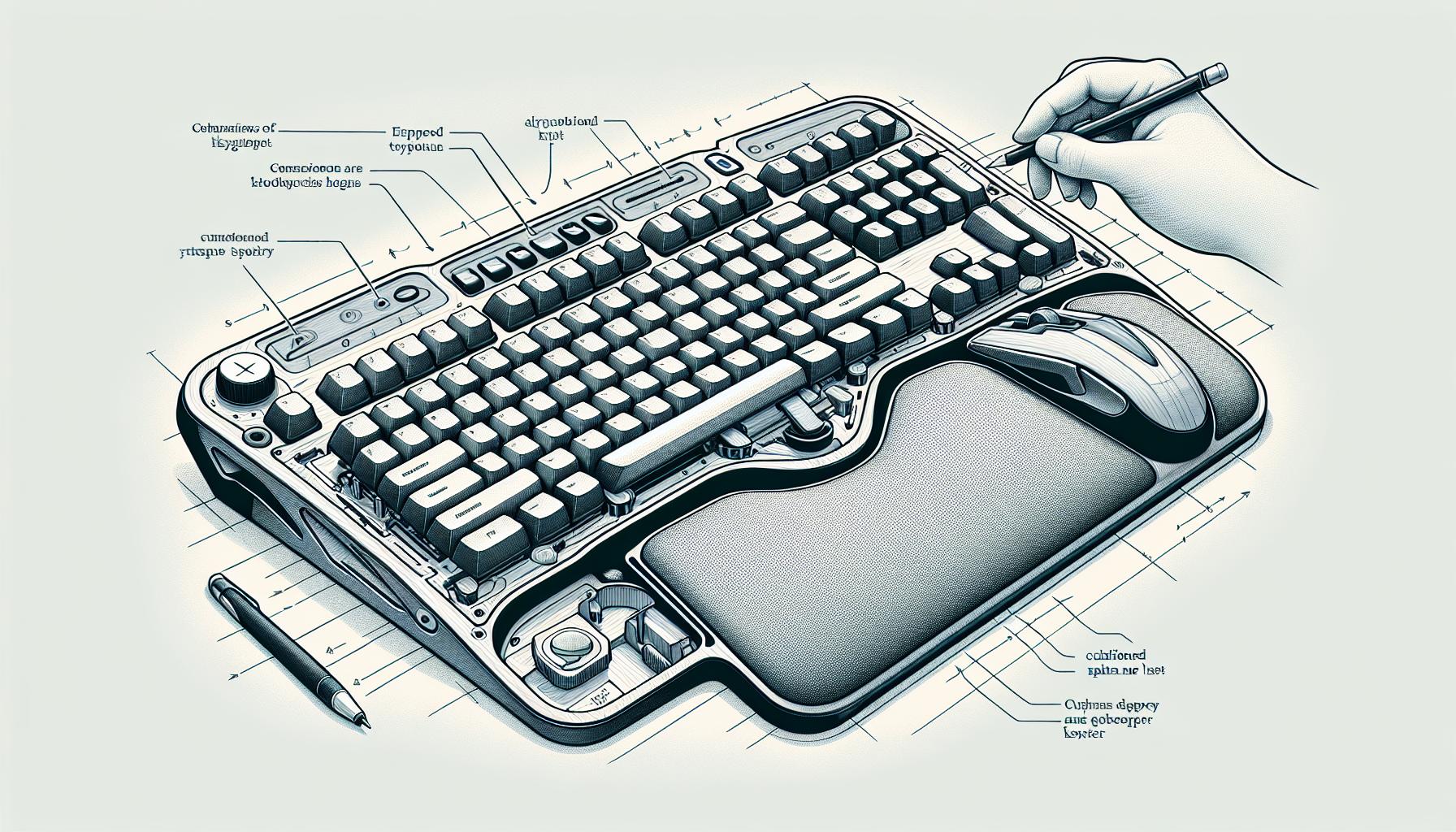
    One of the paramount considerations is an ergonomic design. Adults spending considerable time practicing their typing skills need a keyboard that supports their hands and wrists to minimize fatigue and prevent strain-related injuries. Ergonomically designed keyboards come in various shapes, such as split designs or those with a gentle slope, which help maintain a natural hand position.

    Tactile Feedback

    Keyboards with good tactile feedback play a crucial role in the learning process, as they allow learners to type more confidently. When keys provide a clear response upon being pressed, it helps in reinforcing muscle memory, crucial for mastering typing without looking at the keyboard. Look for keyboards that have a satisfying key press but aren’t too stiff or too soft.

    Adjustable Backlighting

    For those who often find themselves practicing in dimly lighted environments, keyboards with adjustable backlighting can be immensely helpful. Being able to adjust the brightness ensures that the keys are visible without straining the eyes, which is particularly beneficial for lengthy practice sessions.

    Key Label Durability

    Since adult learners will be using the keyboard extensively to practice, the durability of the key labels is an essential factor. Keyboards that feature laser-etched or double-shot keys tend to have more durable labels that won’t fade away with heavy use. This ensures that even as learners get more adept at typing without looking at the keys, the labels remain intact for reference or occasional glances.

    Key Layout and Size

    The layout and size of keys should be considered for a comfortable typing experience. A standard layout with full-sized keys is generally recommended as it closely mimics the keyboards found in most workplaces, making the transition smoother. Additionally, keys that are too cramped can lead to more typos and slow down the learning process.

    Ergonomic Design for Comfortable Typing Sessions

    When adults embark on learning typing skills independently, comfort becomes a crucial factor that cannot be overlooked. An ergonomic keyboard, designed to minimize strain and discomfort, plays a pivotal role in ensuring that learners can practice for longer periods without feeling fatigued.

    Ergonomic keyboards are crafted with the human body’s natural posture in mind. They often feature a split design that allows for a more natural hand and arm position. This design reduces the risk of developing repetitive strain injuries (RSIs), such as carpal tunnel syndrome, which can be a significant setback in a learner’s progress.

    Another aspect of ergonomic design is the adjustable tilt and height features. Typists have different preferences when it comes to the angle of their wrists while typing. Keyboards that offer adjustable tilt and height ensure that every user can find a comfortable typing position. This adjustability is vital for preventing undue pressure on the wrists, further reducing the risk of discomfort or injury.

    Cushioned or palm rests are additional features found in many ergonomic keyboards. They provide support for the palms and wrists, promoting a neutral wrist posture. By preventing the wrists from dropping too low or bending too high, these rests facilitate an optimal typing position, enhancing endurance and comfort over long typing sessions.

    It’s also worth mentioning the importance of key placement and size on ergonomic keyboards. Keys that are too close together or too small can cause unnecessary strain as typists stretch their fingers to reach them. Conversely, larger keys spaced at an optimal distance can help in reducing typing errors and increasing speed over time.

    To illustrate the impact of ergonomic designs on learning efficiency and comfort, consider the following statistics from a survey of adults who switched to ergonomic keyboards for their self-directed typing practice:

    Feature Percentage Reporting Improved Comfort
    Split Design 70%
    Adjustable Tilt/Height 65%
    Cushioned Palm Rests 80%
    Optimal Key Layout 75%

    These numbers highlight the tangible benefits of selecting a keyboard with an ergonomic design. Not only do learners find their sessions to be more comfortable, but they also experience a reduction in typing-related discomfort and injuries.

    Built-in Software for Guided Learning

    When embarking on the journey of self-taught typing, adults often seek not just comfort but also tools that can guide their progress. Built-in Software for Guided Learning becomes a crucial asset in keyboards designed for individuals learning without a teacher. This software offers structured lessons, real-time feedback, and engaging typing exercises tailored to improve typing speed and accuracy over time.

    Manufacturers have started integrating these interactive learning tools directly into their ergonomic keyboards, recognizing the self-learner’s need for continual improvement and guidance. These programs vary in complexity and features but share the common goal of making the learning process as efficient and enjoyable as possible.

    Key Features of Learning Software

    The embedded software typically includes a range of features designed to cater to adult learners at different skill levels:

    • Interactive Lessons: Customizable lessons that adapt to the user’s skill level, focusing on areas that need improvement.
    • Progress Tracking: Tools that monitor typing speed, accuracy, and other metrics to show improvement over time.
    • Gamification Elements: Engaging typing games and challenges that make learning fun and less tedious.
    • Practice Tests: Simulated typing tests that help learners prepare for real-world typing scenarios.

    Benefits for Adult Learners

    The inclusion of built-in software in ergonomic keyboards offers several benefits for adults learning to type on their own:

    • Self-Paced Learning: Learners can progress through lessons at their own pace, taking extra time on challenging aspects without the pressure of a traditional classroom setting.
    • Immediate Feedback: Instant feedback on typing errors and suggestions for improvement helps in refining skills more rapidly.
    • Increased Motivation: Gamification and progress tracking can significantly boost motivation, making learners more inclined to stick with their practice.

    Choosing the Right Keyboard

    When selecting a keyboard with built-in learning software, it’s essential to consider the following:

    • Software Compatibility: Ensure the software is compatible with your operating system.
    • Customization Options: Look for keyboards that offer customizable learning paths and exercises.
    • Ergonomic Features: Don’t overlook the importance of ergonomic design, as comfort is key in long typing sessions.
    Keyboard Model Software Features Ergonomic Design
    Model A Interactive lessons, progress tracking Split design, adjustable
    Model B

    Conclusion

    Choosing the right keyboard is crucial for adults embarking on the journey of learning to type independently. Ergonomic keyboards equipped with built-in software for guided learning offer a comprehensive solution that supports self-learners in developing their typing skills efficiently. They’re not just about comfort; they’re about making learning interactive, enjoyable, and tailored to an individual’s pace. With the right keyboard, adult learners can enjoy the journey of improving their typing speed and accuracy, ensuring they remain motivated and engaged every step of the way. So when you’re ready to take your typing skills to the next level without a teacher by your side, consider a keyboard that’s designed to be your guide.

  • Top 3 Best Budget Yamaha Keyboards for Beginners: A 2024 Guide

    Top 3 Best Budget Yamaha Keyboards for Beginners: A 2024 Guide

    Stepping into the world of music can be as thrilling as it is daunting, especially when it comes to choosing the right instrument. For beginners, finding that perfect keyboard that balances quality, features, and affordability is key. Yamaha, a brand synonymous with excellence in music, offers a range of keyboards that fit the bill perfectly for novices.

    Navigating through Yamaha’s lineup, one might wonder which keyboard stands out as the best budget option for beginners. It’s not just about hitting the right notes; it’s about starting a musical journey with confidence. Let’s dive into the world of Yamaha keyboards, where quality meets affordability, ensuring every beginner starts on the right key.

    Understanding Yamaha Keyboards

    Yamaha, a company revered for its musical excellence, offers a diverse range of keyboards designed to cater to musicians at every skill level. For beginners, navigating the vast selection of Yamaha keyboards can initially seem daunting. However, understanding a few key aspects can make the selection process much smoother and more rewarding.

    At the core, Yamaha keyboards are celebrated for their rich sound quality and durability. These instruments are built to last, ensuring that novices can explore their musical journey without fretting over frequent replacements or repairs. Yamaha’s commitment to quality is evident in even their most budget-friendly models, which boast features that are designed to aid learning and spark creativity.

    When considering a Yamaha keyboard, beginners should pay particular attention to:

    • Key Count: Most Yamaha keyboards come with either 61, 76, or 88 keys. Beginners might find a 61-key keyboard sufficient to start, but an 88-key model emulates the full range of a traditional piano, offering a more comprehensive learning experience.
    • Touch Sensitivity: This feature allows the volume of the note to change based on how hard the key is pressed, mirroring the dynamics of an acoustic piano. It’s a crucial feature for those seeking to develop expressive playing skills.
    • Built-in Learning Tools: Yamaha keyboards often include features like built-in lessons, a metronome, and song libraries which can significantly enhance practice sessions. Some models also offer connectivity to smartphone apps for interactive learning experiences.
    • Sound Quality and Variety: Even on a budget, Yamaha keyboards offer excellent sound quality. They also provide a range of voices and rhythms that allow beginners to experiment across various musical styles.

    Affordability Without Compromise

    Finding a keyboard that balances cost and quality is essential for beginners. Yamaha has managed to incorporate advanced features into their budget-friendly models, ensuring that price doesn’t deter anyone from pursuing their passion for music. This inclusivity has made Yamaha a favored brand among aspiring musicians.

    • Yamaha PSR-E273: This is an ideal starting point for novices. It offers 61 keys, 400 voices, and 130 auto accompaniment styles. It also comes with a quiz mode to make learning fun and engaging.
    • Yamaha YPT-260: Similar to the PSR

    Key Features to Consider for Beginners

    When embarking on a musical journey, beginners might find the vast array of Yamaha keyboards a bit overwhelming. However, understanding specific key features can significantly simplify this choice. Yamaha, known for its quality instruments, offers several features tailored to support and enhance the learning process for novices.

    Key Count and Size matter greatly for beginners. A standard piano has 88 keys, but beginners might not need all of them. A keyboard with 61 to 76 keys is often more than sufficient for those just starting out. The keys should also be full-sized to ensure an easy transition to an acoustic piano in the future.

    Touch Sensitivity is an essential feature that allows the volume of the sound to change depending on how hard or soft the keys are pressed, mimicking the dynamics of an acoustic piano. This feature can greatly influence expression in playing, making it crucial for developing a beginner’s musical ear and technique.

    Built-In Learning Tools can be particularly beneficial for self-learners. Features such as built-in songs, lesson modes, and light-up keys guide novices through the basics, allowing them to practice and improve even without a teacher present. Yamaha keyboards often come equipped with various educational features that make learning both effective and fun.

    Sound Quality is not to be overlooked. High-quality sounds can greatly motivate beginners by making their practice sessions more enjoyable and rewarding. Yamaha keyboards are renowned for their exceptional sound quality, thanks to their advanced sampling technology. This ensures that even entry-level models produce rich and authentic sounds that closely mimic an acoustic piano.

    Budget-friendly Yamaha keyboards, like the PSR-E273 and YPT-260, come packed with these features, ensuring that beginners don’t have to compromise on quality for affordability. They strike an excellent balance, offering an impressive array of functions that cater well to beginner needs without overwhelming them.

    Feature PSR-E273 YPT-260
    Key Count 61 61
    Touch Sensitivity No Yes
    Built-In Learning Tools Yes Yes
    Sound Quality High High

    These keyboards also offer a variety of sounds and rhythms that can keep practice interesting and inspire creativity in beginners. The variety encourages exploration and experimentation, key components in developing musicality and a love for playing.

    Top Picks for Best Budget Yamaha Keyboards

    When embarking on the journey of learning keyboard, finding the right instrument that blends quality with affordability is crucial. Yamaha, a brand synonymous with musical excellence, offers several models that stand out for beginners who are mindful of their budgets.

    The PSR-E273 and YPT-260 have already been mentioned for their balance of features and affordability. However, there are other models in the Yamaha lineup that deserve attention. The PSR-E363 and PSR-EW300 are two such keyboards that cater to the budding musician with features that go a step beyond the basics, without stretching the budget too thin.

    The PSR-E363 offers a dynamic and expressive touch with 61 touch-sensitive keys, making it a perfect step up for beginners ready to experience a more realistic playing feel. It’s packed with 574 voices, including grand pianos, guitars, and brass, ensuring that learners have a wide range of sounds to explore and play with. Moreover, its duo mode function allows the keyboard to be split into two halves, essentially enabling two players to play in the same octave at the same time – a fantastic feature for lessons or duets.

    On the other hand, the PSR-EW300 brings something slightly different to the table with its 76 keys, offering a broader range and more room for musical growth. Like the PSR-E363, it includes touch-sensitive keys and a plethora of voices – 574 in total. Additionally, it boasts an impressive 165 auto-accompaniment styles that provide beginners with full-band backing tracks, based on the chords they play. This feature is invaluable for developing timing and playing in various musical styles.

    For those focused on enhancing their playing technique and reading music, both models come with Yamaha’s Education Suite. This built-in feature offers practice and learning tools, such as listening, timing, and waiting exercises that can cater to the pace of learner progress.

    Another noteworthy mention is the Yamaha PSR-F51. Simple and user-friendly, the PSR-F51 is designed for absolute beginners. It includes 61 keys and offers 120 voices and 114 rhythms, covering a broad spectrum of music styles. Its main selling point is its ease of use, with a straightforward interface and a focus on getting beginners playing right away.

    Here’s a quick comparison of the top picks:

    |

    Comparison of Budget Yamaha Keyboards

    When venturing into the world of music with a Yamaha keyboard, beginners have several budget-friendly options to choose from. Each model offers different features tailored to various needs, making it crucial to compare them to find the best fit.

    PSR-E273

    The Yamaha PSR-E273 stands out as an excellent entry point for novices. It’s praised for its simplicity and the variety it offers. With 61 non-weighted keys, it’s designed to make the initial learning phase as smooth as possible. 400 high-quality voices and 130 auto-accompaniment styles fuel creativity and make practice sessions engaging. It’s also equipped with the Yamaha Education Suite (YES), offering built-in lessons that progress with the learner.

    PSR-E363

    Moving up slightly in functionality and price, the PSR-E363 presents itself as a versatile option for those seeking more from their instrument. What distinguishes this model is its 61 touch-sensitive keys, offering a more expressive playing experience as it responds to the force of touch. With 574 voices and 165 styles, it significantly broadens musical possibilities. It also incorporates the YES feature and has a “Duo mode” for side-by-side practice, making it a strong choice for interactive learning.

    PSR-EW300

    For beginners looking to step into a wider range of play, the PSR-EW300 is the go-to with its 76 keys. This extended range allows for more complex compositions as skills grow. Its touch-sensitive keys, 574 voices, and 165 auto-accompaniment styles are similar to the PSR-E363 but with more space for musical exploration. This model aims to keep players engaged as they advance, effectively bridging the gap between beginner and intermediate levels.

    PSR-F51

    Designed with the absolute beginner in mind, the Yamaha PSR-F51 focuses on ease of use. This model offers 61 keys, 120 voices, and 114 rhythms, making it a straightforward choice for those just starting. It’s extremely user-friendly, with simple controls and an intuitive interface that encourages experimentation from day one. The PSR-F51’s emphasis on fun and accessibility makes it an ideal candidate for younger musicians or those looking for a no-fuss introduction to keyboards.

    Here’s a quick comparison to sum up the discussed models:

    |

    Making the Right Choice

    When diving into the world of music, choosing the right keyboard can feel like navigating through a maze. With Yamaha offering several budget-friendly options for beginners, it’s essential to weigh the features against your musical aspirations. Whether you’re a budding musician or a parent looking for the perfect starter instrument, understanding the key differences between models can help you make an informed decision.

    Each Yamaha keyboard mentioned— the PSR-E273, PSR-E363, PSR-EW300, and PSR-F51— caters to different needs. For a pure beginner with no prior experience, ease of use is paramount. In this regard, the PSR-F51 shines due to its straightforward interface and no-fuss setup. Its simplicity doesn’t compromise versatility, providing an ample range of voices and rhythms to explore.

    On the other hand, if the player is intrigued by the possibility of a more expressive performance, the PSR-E363, with its 61 touch-sensitive keys, becomes a compelling choice. Touch sensitivity brings dynamics into play, allowing the volume to change based on how hard or soft the keys are pressed. This feature, combined with a diverse selection of voices and styles, offers a more interactive learning experience.

    For those who envision their musical journey to continue growing, the PSR-EW300 might be the ideal pick. It’s not just about having more keys—76 compared to the 61 on most beginner models—but about the opportunities these extra keys unlock. More keys mean more range to practice and perform more complex pieces of music, bridging the beginner and intermediate stages smoothly.

    However, the sheer number of features in a keyboard shouldn’t be the sole deciding factor. Consideration must also be given to portability and the available practice space. The compact and lightweight design of the PSR-E273, for instance, makes it a suitable option for those who might need to move their instrument regularly or who have limited space at home.

    Moreover, the learning tools provided by some models can drastically affect the learning curve for beginners. Features such as built-in lessons, duet modes, and compatibility with educational apps can bolster the learning experience and keep the user engaged.

    To succinctly present the key features that influence the decision-making process for beginners, here’s a comparison:


    Conclusion

    Choosing the right Yamaha keyboard as a beginner doesn’t have to be daunting. Whether it’s the simplicity and user-friendliness of the PSR-F51, the expressive touch-sensitive keys of the PSR-E363, or the broader range of the PSR-EW300, there’s a keyboard that’s just right for starting your musical journey. Remember, it’s not just about the number of keys or features but finding a balance that meets your musical aspirations and learning needs. With the right Yamaha keyboard, you’re setting the stage for a rewarding musical adventure that grows with you.


  • Top Easiest Keyboards to Learn Songs On: A Buyer’s Guide

    Top Easiest Keyboards to Learn Songs On: A Buyer’s Guide

    Starting your musical journey can be both exciting and a bit daunting. But what if there was a way to make it easier and more fun from the get-go? Enter the world of keyboards, the gateway to unleashing your inner musician without getting bogged down by complexity.

    Choosing the right keyboard is key. It’s not just about the number of keys or fancy features; it’s about finding an instrument that’s user-friendly and packed with resources to help beginners learn songs quickly. Whether you’re into pop hits, classical tunes, or creating your own compositions, there’s a perfect keyboard out there for you.

    Features to Look for in a Beginner-Friendly Keyboard

    When embarking on a musical journey, it’s crucial to find an instrument that not only fits one’s budget but also encourages learning and creativity. A beginner-friendly keyboard should serve as a gentle introduction to the world of music, providing features that simplify the learning process. Here are some key features to look for:

    Built-In Learning Tools

    Many keyboards today come equipped with learning modes and integrated lesson programs. These features offer step-by-step tutorials on playing songs, often with light-up keys to guide finger placement. This interactive approach helps beginners understand timing and melody in an engaging manner.

    Wide Range of Voices and Rhythms

    Variety is the spice of life, and the same goes for music. Keyboards that offer a broad selection of instrument voices and rhythms enable beginners to experiment with different sounds. This not only makes practice sessions more enjoyable but also broadens one’s musical understanding and appreciation.

    Touch-Sensitive Keys

    Touch sensitivity is a feature that makes the volume and tone of a note change based on how hard the keys are pressed, mimicking the dynamic range of an acoustic piano. For beginners, starting on a keyboard with touch-sensitive keys can be beneficial for developing proper finger technique and dynamics early on.

    Recording and Connectivity Options

    The ability to record one’s playing is invaluable for progress tracking and noticing areas that need improvement. Moreover, connectivity options such as USB or MIDI allow beginners to connect their keyboards to computers or tablets. This opens up a world of digital learning resources, apps, and software, further enriching the learning experience.

    Feature Benefit
    Built-In Learning Tools Simplifies the learning process with interactive tutorials
    Wide Range of Voices Encourages musical exploration and creativity
    Touch-Sensitive Keys Helps develop proper technique and dynamics
    Recording and Connectivity Enables progress tracking and access to digital resources

    Investing in a keyboard with these features not only makes the learning process more manageable but also more fun. With technology at their fingertips, beginners are less likely to get frustrated and more likely to stick with their musical education. The road to becoming proficient at the keyboard is filled with challenges, but the right instrument can make all the difference.

    Key Considerations for Learning Songs Easily

    When embarking on the journey to master songs on the keyboard, learners ought to focus on several pivotal factors that can significantly ease the process. First off, they should zero in on keyboard action. Keyboards with weighted or semi-weighted keys mimic the feel of an acoustic piano, providing a more realistic playing experience. This feature is crucial for building proper finger strength and technique, essential components for seamlessly learning and performing songs.

    Moreover, the size of the keyboard plays a vital role. A full-size keyboard with 88 keys is ideal, as most music pieces are composed with this range in mind. However, beginners might find a 61-key or 76-key keyboard more manageable. It’s a trade-off between range and affordability, but starting with fewer keys doesn’t hamper the learning of most songs.

    Another important consideration is the quality of sound. High-quality sound samples and a good set of built-in speakers make the learning experience more enjoyable and rewarding. They help the learner to discern nuances in music, fostering a deeper understanding and appreciation of the pieces they’re learning. Brands often provide detailed information on their sound engines and samples, so potential buyers should pay close attention to this aspect.

    Learning tools embedded within the keyboard can greatly accelerate the learning curve. Features like onboard lessons, play-along tracks, and light-up keys guide beginners through songs step by step. Furthermore, connectivity options such as USB and MIDI allow for the integration of external educational resources, expanding the repertoire of songs at the learner’s disposal. These tools offer valuable feedback, enabling learners to self-assess and adjust their practice efficiently.

    Here are some key features and their importance:

    Feature Importance
    Weighted Keys Builds finger strength and technique
    Full-Size Keyboard Offers a complete range of notes
    High-Quality Sound Enhances musical ear and appreciation
    Learning Tools Simplifies practice and accelerates learning

    Lastly, but equally important, is the selection of songs. Beginners should start with simple melodies that they enjoy and are familiar with. This keeps motivation high and makes practice sessions something to look forward to. As their skills advance, they can gradually take on more complex pieces, expanding their musical capabilities. The right keyboard should inspire and facilitate this progression, equipped with a variety of sounds and rhythms to explore different musical genres.

    Top Keyboards Recommended for Beginners

    When starting on the journey to learn keyboard, choosing the right instrument can make a world of difference. There are several keyboards on the market tailored specifically for beginners, offering features that enhance learning and make practice sessions more effective and enjoyable.

    Yamaha’s PSR-EW300 comes highly recommended for its 76 key setup, offering a wide range of musical expressivity while not overwhelming the beginner with the full 88-key range of a traditional piano. It’s semi-weighted keys strike a balance between ease of use and an authentic piano feel, aiding in the development of proper finger technique from the outset. Additionally, the PSR-EW300 boasts a comprehensive library of over 500 voices, including pianos, strings, and brass, ensuring students can explore a variety of sounds as their skills grow.

    Casio’s CTK-2550 is another stellar option for beginners, highlighting its portability and affordability. It comes equipped with a 61-key layout, which is more than adequate for learning basic songs and chords. What sets the CTK-2550 apart is its Step-Up Learning System, designed to gradually guide users through lessons at their own pace. The system breaks down complex pieces into manageable, bite-sized components, making learning less daunting for novices. Moreover, the keyboard offers connectivity to the Chordana Play app, enabling learners to access tutorials and track progress directly from their smartphones.

    For those looking for something that closely mimics the acoustic piano, the Alesis Recital is a fantastic choice. It boasts 88 full-sized semi-weighted keys, adjustable touch response to suit personal preferences, and five realistic voices (acoustic piano, electric piano, organ, synth, and bass) for varied practice sessions. The keyboard also offers an educational mode that divides the keyboard into two zones with the same pitch and voice, perfect for side-by-side lessons with a teacher.

    Connectivity is another factor where the Alesis Recital shines. It features USB-MIDI and 1/4” Audio Outputs for easy connection to a computer or external sound system. This makes it a versatile option for those who may want to explore music production or perform live as their skills advance.

    Learning Resources and Tools to Aid Song Learning

    When embarking on learning songs on a keyboard, having the right resources and tools is just as important as choosing the right instrument. In today’s digital age, learners have an array of options at their disposal to make the journey both enjoyable and effective.

    Integrated Learning Systems

    Many modern keyboards come equipped with integrated learning systems designed to guide beginners through songs and techniques at their own pace. For instance, the Casio’s Step-Up Learning System breaks down songs into smaller, manageable parts, allowing learners to focus on one section at a time. Similarly, Yamaha’s Education Suite offers interactive lessons that rate your play, providing valuable feedback to improve.

    Mobile Apps and Online Platforms

    The rise of mobile apps and online platforms has revolutionized the way we learn music. Apps like Simply Piano and Yousician offer interactive lessons that listen to you play and give real-time feedback. These platforms cover everything from reading music to mastering full songs, catering to different genres and skill levels.

    Platform Features
    Simply Piano – Interactive lessons
    – Real-time feedback
    Yousician – Extensive song library
    – Tracks your progress

    Moreover, YouTube has become an invaluable resource with thousands of free tutorials and play-along videos. Channels specializing in keyboard instruction offer step-by-step tutorials on popular songs, technical skills, and more.

    Connectivity Options

    The ability to connect a keyboard to a computer or tablet opens up a world of learning possibilities. Keyboards with USB MIDI connectivity allow learners to use software like GarageBand, Synthesia, or Musescore for an enhanced learning experience. These programs can display sheet music on the screen, slow down the tempo of songs, and even isolate specific hands in the music piece, making practice sessions much more productive.

    Practice Techniques

    While having the right tools is crucial, incorporating effective practice techniques into your routine can significantly enhance your learning efficiency. Some proven methods include:

    • Slow Practice: Playing a new song slowly to ensure accuracy before increasing the speed.
    • Chunking: Breaking songs down into smaller sections and mastering each before moving on.
    • Repetitive Practice: Repeating challenging sections until they become comfortable.

    Incorporating these strategies with the aforementioned resources can accelerate the learning curve, making the process of learning songs on a keyboard more enjoyable and satisfying.

    Conclusion

    Choosing the easiest keyboard to learn songs on isn’t just about the instrument itself. It’s also about leveraging the wealth of resources and tools available. From the integrated learning systems of Casio and Yamaha to the interactive lessons offered by apps and online platforms, there’s never been a better time to dive into music. Remember, effective practice techniques can significantly enhance your learning curve. So grab your keyboard, explore these resources, and embark on a musical journey that’s both rewarding and fun.

  • How To Play Fm On Piano

    How To Play Fm On Piano

    The F minor piano chord is a beautiful, darker-sounding triad commonly found in many popular songs and classical pieces.

    Mastering the F minor chord will broaden your repertoire of chords, deepen your understanding of music theory and harmony, and introduce you to new and exciting sounds.

    If you’re new to the world of piano, then learning about the Fm piano chord can seem daunting. Understanding hand and finger positioning for the chord can also be challenging.

    But don’t worry, as I’m here to help!

    In this article, I’ll explain how Fm (F minor) chord is built and how to play the Fm chord on a piano. I’ll break down all the essential details, from fingerings to inversions, to help you play this basic piano chord with confidence and control.

    So, let’s get started!

    What is an Fm Chord?

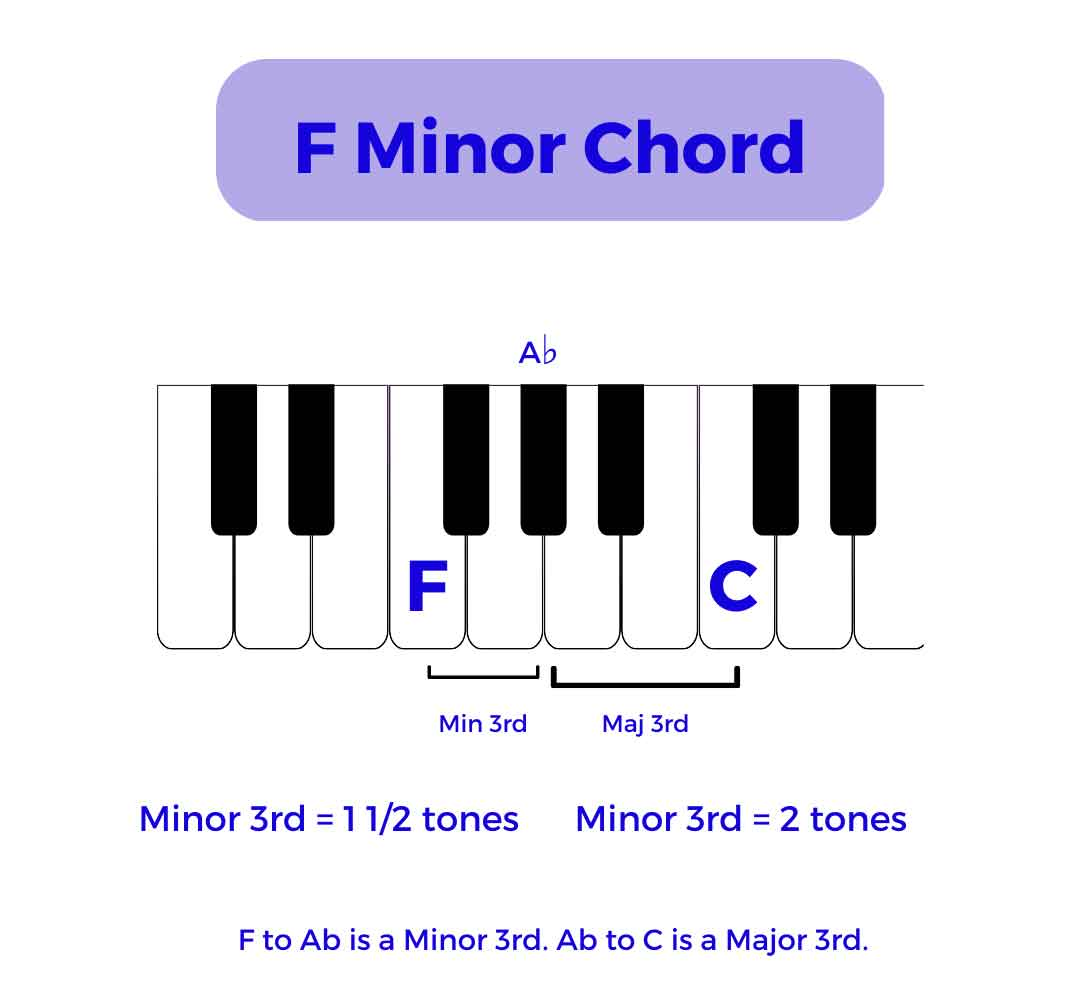
    An Fm is a piano chord that consists of three notes: F, A♭, and C. The F is the root note, A♭ is the minor third, and C is the perfect fifth. This piano chord is also written as F minor, Fmin, or F – (F followed by a minus sign). “F-” is less commonly used.

    The Fm chord is a minor triad, meaning it follows the intervallic formula of a minor third followed by a major third.

    In other words, the distance between the root note (F) and the minor third (A♭) is three half steps or semitones, and the distance between the minor third and the perfect fifth (C) is four half steps or semitones.

    Note: All minor chords (triads) follows the same intervallic formula of a minor third (three half steps) followed by a major third (four half steps).

    A minor third interval is F to Ab, while a major third interval is Ab to C. In music, the minor third interval is three-half steps higher than a given note, while the major third interval is four-half steps higher than the note.

    In terms of the scale degree formula, the Fm chord follows the pattern 1 – ♭3 – 5. The Fm triad is written as follows:

    F – A♭ – C

    That means the root note (F) is the first degree of the scale, the minor third (A♭) is the flat third degree of the scale, and the perfect fifth (C) is the fifth degree of the scale.

    How to play Fm on the piano

    You now know what the F minor piano chord is. In this section, I’ll explain how to play F minor chord on a piano with the right hand and left hand.

    But before we learn how this minor chord is played, let’s quickly understand the Fm piano chord finger positions!

    Fm Piano Chord Finger Positions

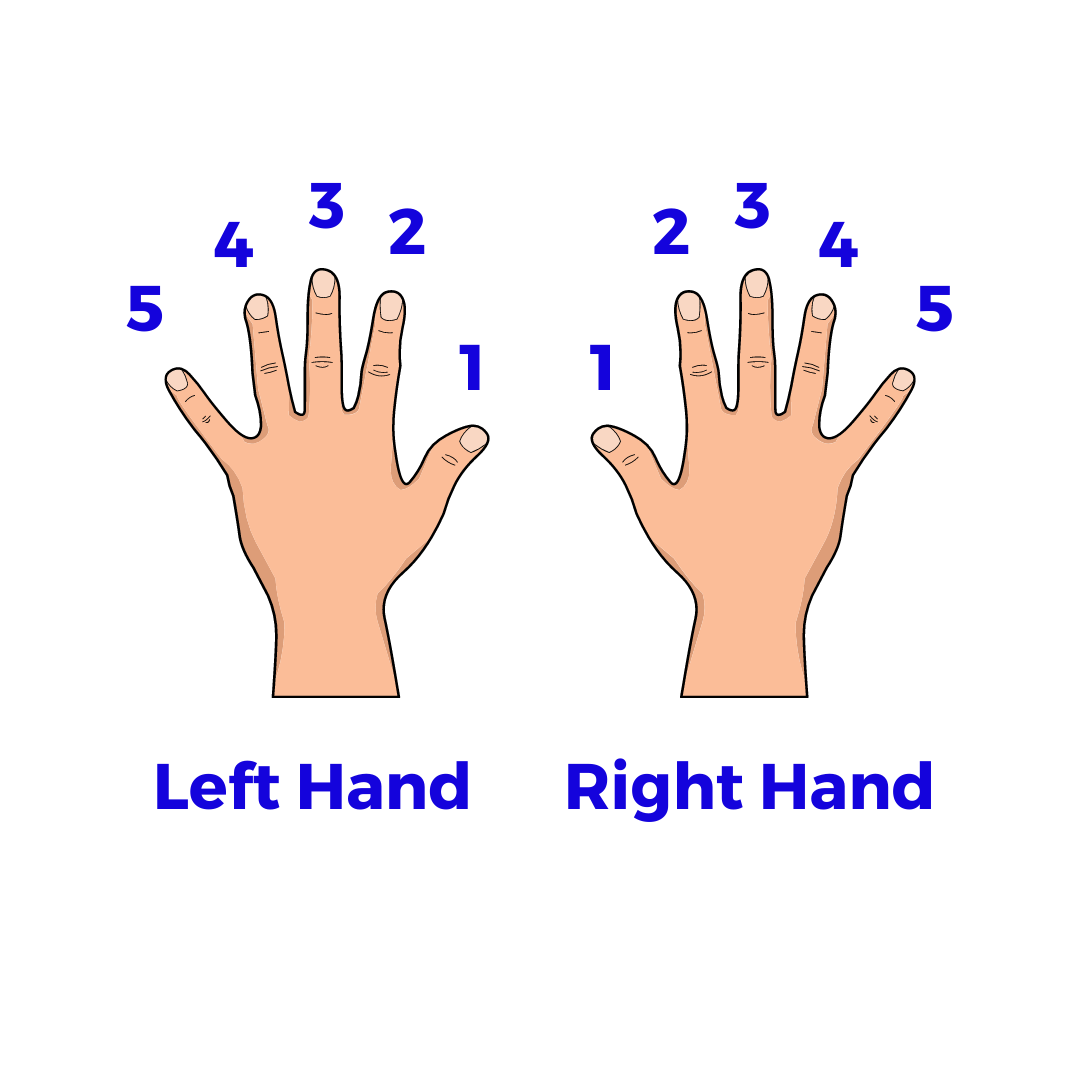
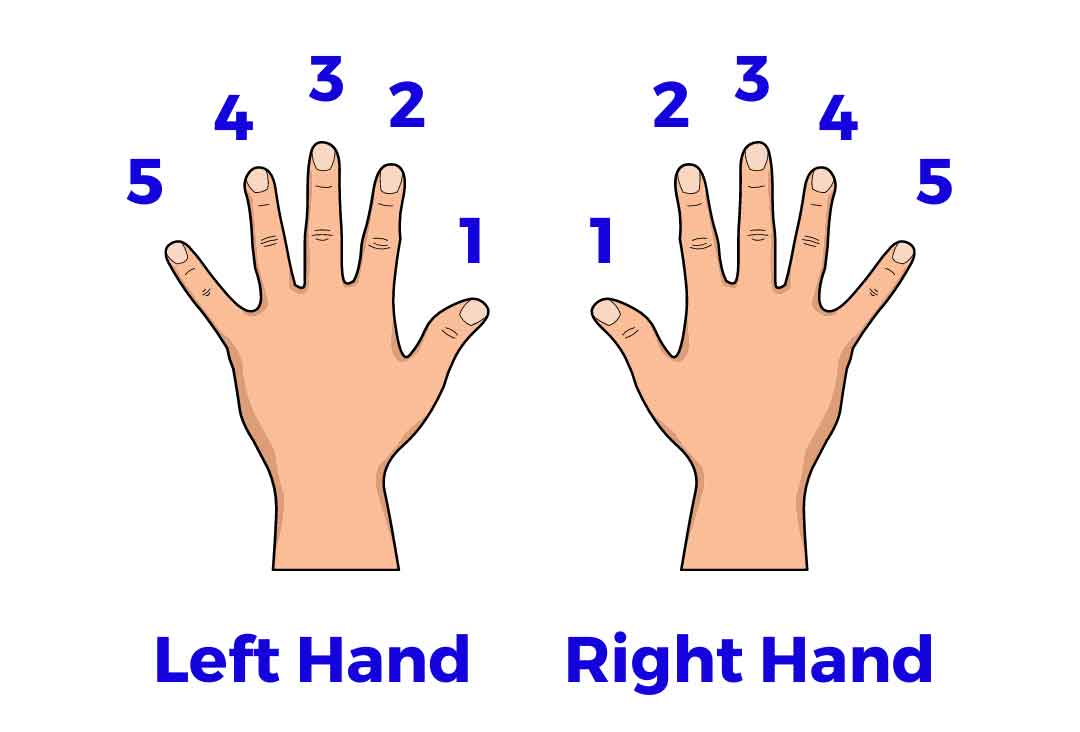
    For starters, the fingers on each hand are numbered from 1 to 5.

    The thumb is number 1, the index finger is 2, the middle finger is 3, the ring finger is 4, and the pinky finger (little finger) is 5. Remember these numbers as you position your fingers to play the chord.

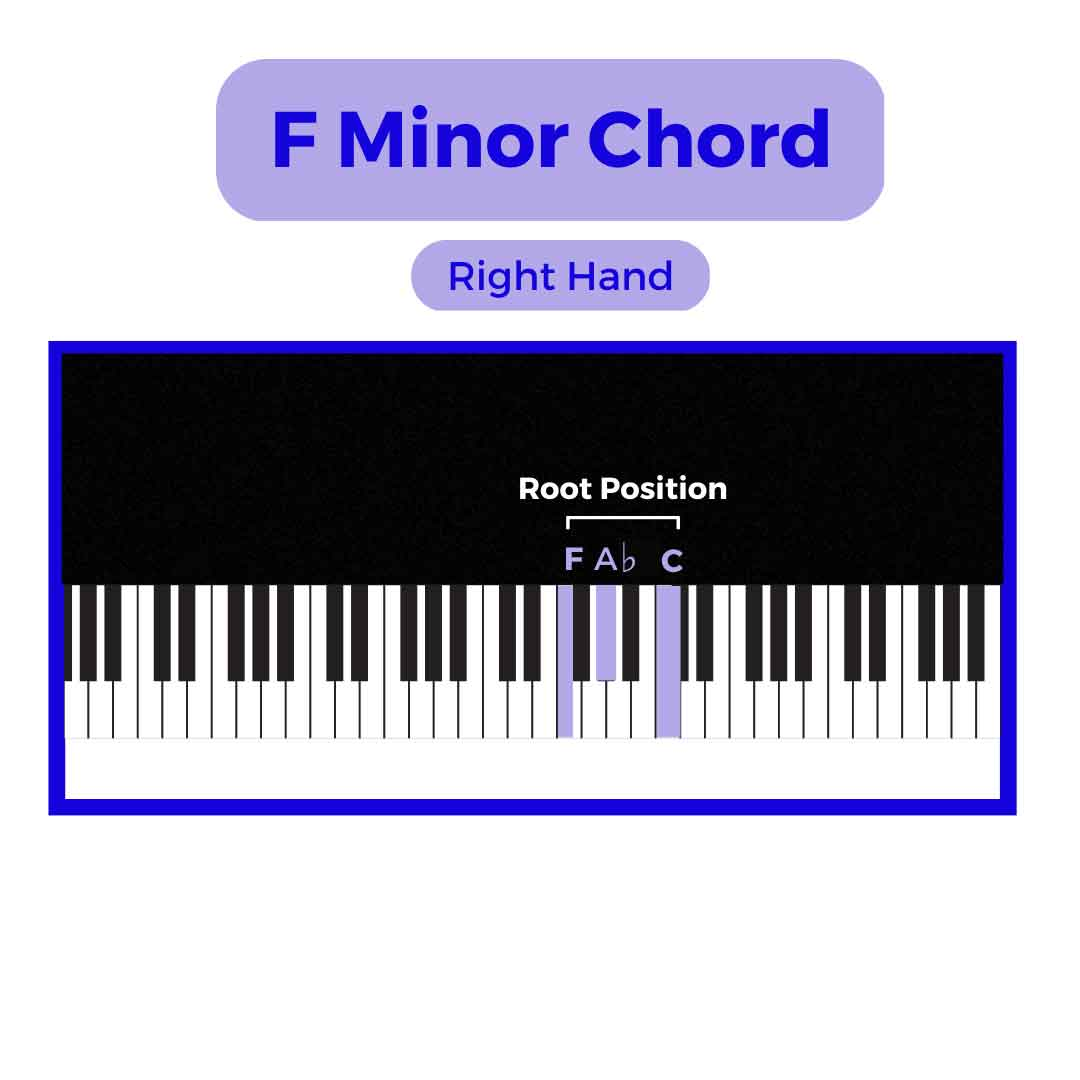
    In the root position of the F minor chord, the right-hand finger position is 1 – 3 – 5. The thumb (finger 1) plays the F note, the middle finger (finger 3) plays the Ab note, and the little finger (finger 5) plays the C note.

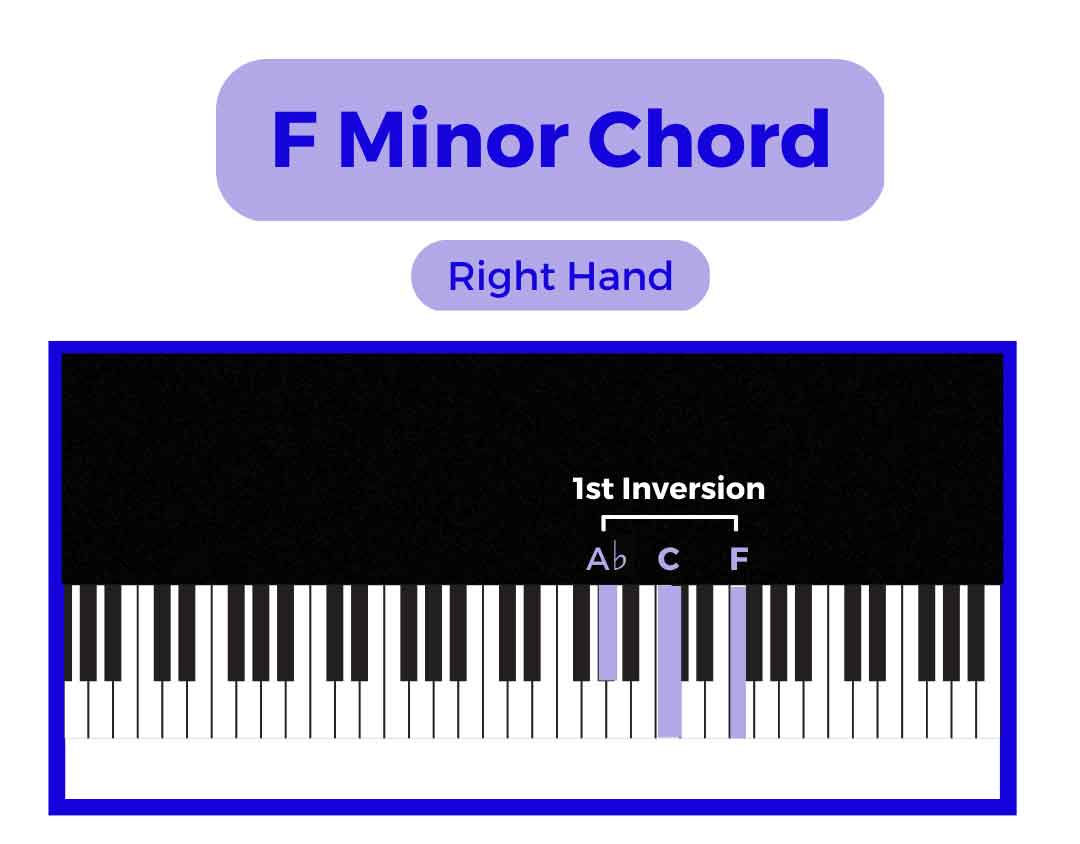
    In the first inversion, the finger positions of the F minor chord are 1 – 2 – 5. That means the thumb plays Ab, the index finger (finger 2) plays C, and the pinky finger plays F.

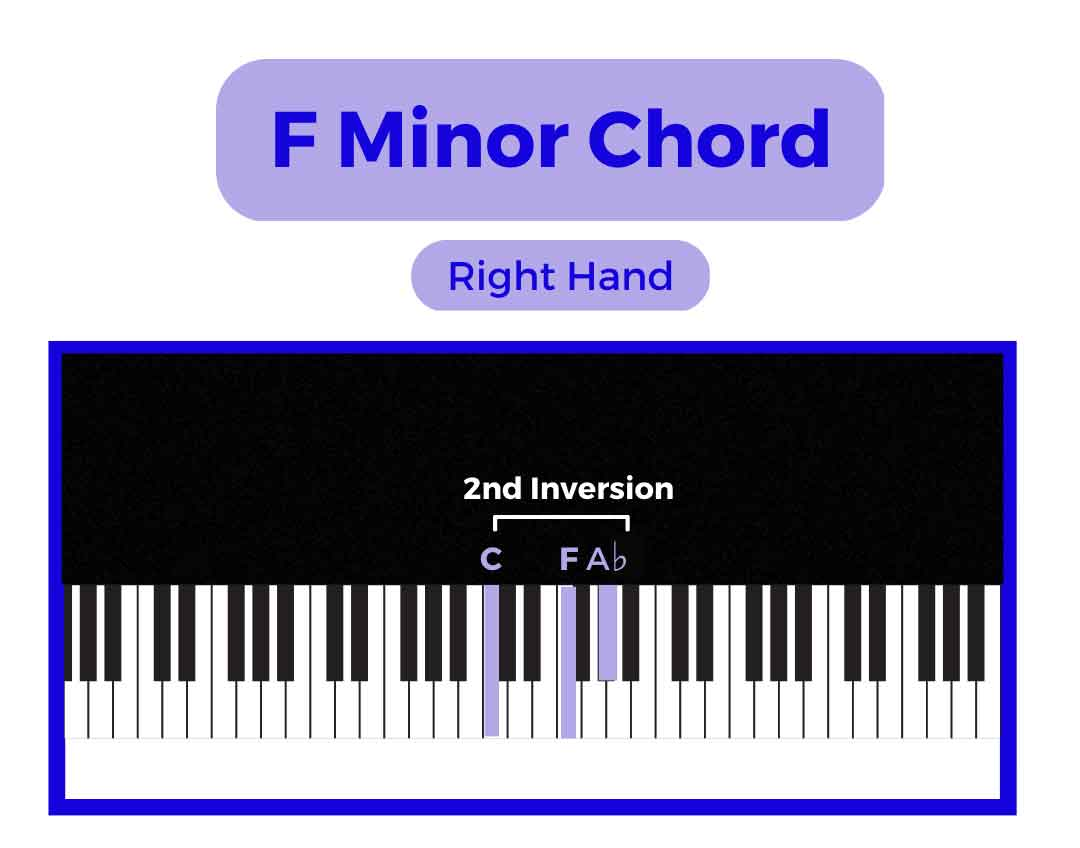
    In the second inversion, the fingering of the Fm piano chord is 1 – 3 – 5. That means your thumb plays C, the middle finger plays F, and the pinky finger plays Ab.

    Playing the Fm Chord with the Right Hand

    To play the Fm chord in the root position with your right hand, use the following fingers:

    • F – First finger (1)
    • A♭ – Third finger (3)
    • C – Fifth finger (5)

    To play the F minor chord with the right hand, place your thumb on F, the middle finger on Ab, and the pinky finger on C. At this point, the Fm chord is at its root position.

    For the correct finger placements to play an F minor chord with the right hand, see the image below:

    You’ll hear the Fm piano chord when you press all three keys simultaneously.

    Playing the Fm Chord with the Left Hand

    To play the Fm chord in the root position with your left hand, use the following fingers:

    • F – Fifth finger (5)
    • A♭ – Third finger (3)
    • C – First finger (1)

    Put your pinky on F (bass note), middle finger on Ab, and thumb on C to play the F minor chord with the left hand. Once you have positioned your hand correctly on your piano keyboard, press down all three keys simultaneously.

    Play this minor piano chord several times until you are comfortable with the fingering and sound.

    The F minor chord has two inversions in addition to its root position. So, let’s take a look at the first and second inversions of the Fm chord.

    How to Play the First Inversion of the Fm Piano Chord

    If you want to play the 1st Inversion of the Fm chord, lower the middle note (Ab). So, the Ab is the lowest note in the 1st inversion of F minor. Use the following fingers on your right hand to play the inversion:

    • A♭ – First finger (1)
    • C – Second finger (2)
    • F – Fifth finger (5)

    After placing your fingers correctly, press all the notes at once to play the first inversion of the piano chord. And then practice for a few minutes to get comfortable with it.

    How to Play the Second Inversion of the Fm Piano Chord

    If you want to play F minor in its 2nd inversion, put C as the bass note (lowest note). If you want to play the inversion with your right hand, use these fingers:

    • C – First finger (1)
    • F – Third finger (3)
    • A♭ – Fifth finger (5)

    Again, play these notes simultaneously and enjoy the sound of this piano chord in the second inversion.

    FAQs

    What Is The Difference Between A Minor Triad And A Major Triad?

    Minor and major piano chords differ based on the interval between the notes that make up the chord.

    A major chord (triad) consists of a root note, a major third, and a perfect fifth. The interval between the root note and the major third is four half steps or semitones, while the interval between the major third and the perfect fifth is three half steps or semitones.

    On the other hand, a minor triad consists of a root note, a minor third, and a perfect fifth. The interval between the root note and the minor third is three half steps or semitones, while the interval between the minor third and the perfect fifth is four half steps or semitones.

    In summary, a major triad and a minor triad are just the opposite of each other. A major triad is composed of a major third followed by a minor third, while a minor triad is composed of a minor third followed by a major third.

    Can I Use F Minor Chord In Different Music Styles?

    You can use the F minor chord (Fm) in various music styles. The key signature F Minor is one of the most common minor keys used in music composition.

    It works well in slower, more emotionally charged songs because the Fm chord has a sad, reflective quality. However, you can also use it to add contrast and variety to more upbeat and energetic music. You can also use it in more upbeat and energetic music to add more contrast and variety.

    The Fm chord is commonly used in flok, rock, and blues music styles. It is also popular in jazz, classical, and many other music styles.

    Are There Any Songs That Use The Fm Chord On The Piano?

    Yes, many songs use the Fm chord on the piano. Some examples include:

    • “Bohemian Rhapsody” by Green Day
    • “All of Me” by John Legend
    • “Army” by Ben Folds Five
    • “ET” by Katy Perry
    • “Michelle” by The Beatles
    • “Animals” by Martin Garrix
    • “Halo” by Beyonce
    • “First of the Year” by Skrillex

    Conclusion

    In conclusion, the Fm chord is a popular and valuable chord to know how to play on the piano. It is a minor chord consisting of the notes F, Ab, and C, and you can play it with either your right or left hand.

    You can use the Fm chord in many types of music, and it adds depth and emotion to your playing.

    Following the steps outlined in this blog post and practicing regularly, you can quickly and easily learn to play the Fm chord.

    Whether you are a beginner or an experienced musician, it is worth the time and effort to master the Fm chord.

    So, grab your best piano keyboard and practice the F minor piano chord!

    Read More

  • How To Play em7 On Piano

    How To Play em7 On Piano

    Do you want to learn How To Play Em 7 Chord On Piano? If so, you’ve come to the right place!

    The Em7 chord is a very popular chord used in many popular songs and styles of music. It is also an essential piano chord to learn for any budding pianist. Fortunately, understanding how to play the Em7 chord on piano is relatively easy.

    In this blog post, I will explain what the Em7 chord is and provide you with a step-by-step guide on how to play it on the piano.

    So let’s get started!

    What is an Em7 Chord?

    An Em7 chord is a minor seventh chord built on the E minor scale. It consists of four notes E, G, B, and D. This piano chord is called Em7, E minor 7, and E min7.

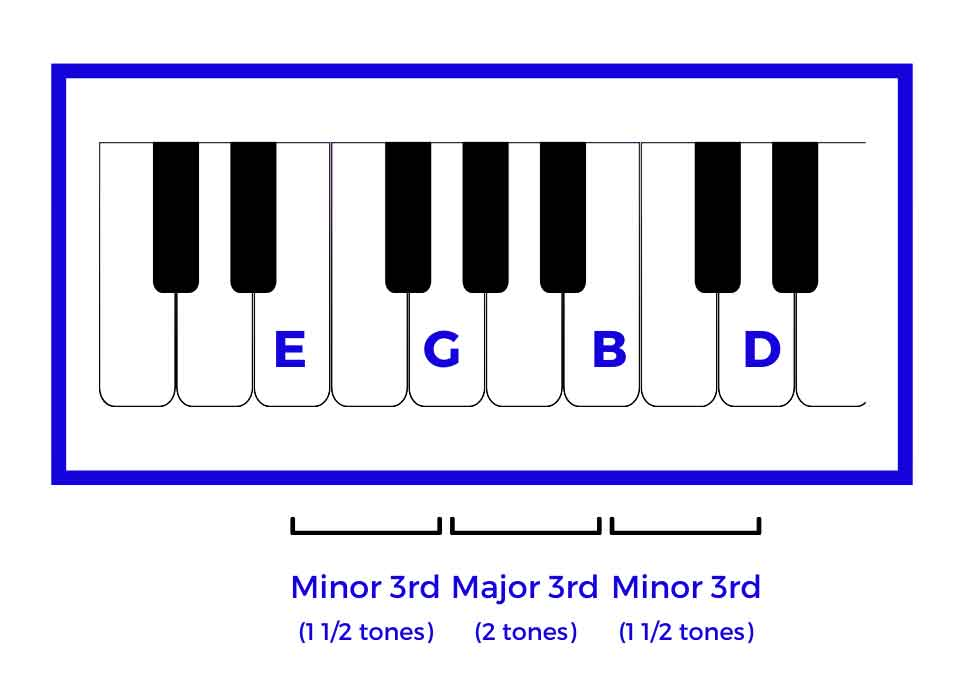
    To understand the intervals that make up an Em7 chord, let’s break it down step by step. The Em7 chord consists of three intervals: a minor third, a major third, and a minor third.

    Between the notes E and G, it’s a minor third interval made up of one and a half tones or half steps. To find this interval, start on the root of the chord (E), skip two half steps (F and F#), and land on the 3rd half step, which is the minor third of the chord (G).

    Between the notes G and B, it’s a major 3rd made up of two tones. To find this interval, start on G, skip three half steps (G#, A, and A#), and land on the fourth half step (B).

    Between B and D, there’s also a minor third made up of one and a half tones. To find this interval, start on B, skip one and a half steps (C and C#), and land on the flat seventh of the major scale (D).

    To play an E minor 7th chord on the piano, you’ll need to locate the keyboard’s E, G, B, and D keys and play them simultaneously with your right hand.

    How To Play Em7 Chord On Piano

    Now that we’ve explained what an Em7 chord is on a piano, it’s time to learn how to play it!

    But before we learn to play the Em7 piano chord, we must first understand piano finger numbers. Piano players use piano finger numbers to identify which fingers to use to press the piano keys.

    On either hand, the thumb represents the number 1, two represents the index finger, three represents the middle finger, four represents the ring finger, and five represents the pinky finger.

    Now let’s learn to play the Em7 piano chord!

    Let’s first look at the root position of the Em7 chord. When a chord is in the root position, it means that the keynote of the chord (in our case, E) is the lowest note of the chord.

    You should use your thumb (first finger), 2nd, 3rd, and 5th fingers to play the notes E (right above middle C), G, B, and D.

    Often, the Em7 piano chord acts as the second degree to an A7 chord.

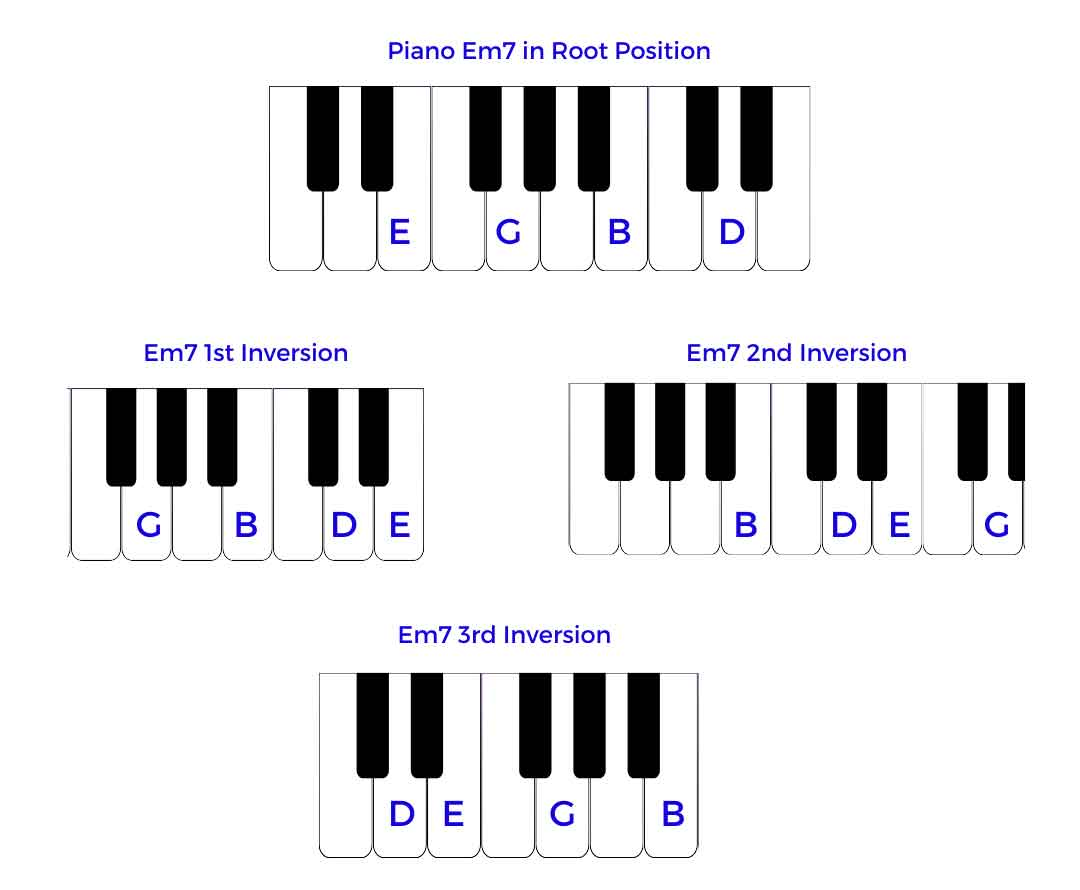
    In the root position, the notes of the Em7 chord are in the sequence E – G – B – D.

    To play the chord with the right hand in the root position, you will need to place your fingers on the keys as follows: E with finger 1 (thumb), G with finger 2, B with finger 3, and D with finger 5. Using the correct fingerings is essential, as this will help you play the chord smoothly and accurately.

    There are several other voicings or inversions for the Em7 chord that you can explore.

    In the first inversion, the notes of the Em7 piano chord are in the sequence G – B – D – E. In this voicing, the note E is one octave higher than the root position.

    To play the first inversion of the Em7 chord, you’ll need to place your fingers on the keys as follows: G with finger 1 (thumb), B with finger 2, D with finger 3, and E with finger 5.

    In the second inversion, the note sequence is B – D – E – G. To play this voicing; you will need to raise the note G one octave higher and place your fingers on the keys as follows: B with finger 1 (thumb), D with finger 2, E with finger 3, and G with finger 5.

    Now let’s learn how to play a third inversion of the Em7 chord. To do this, you will need to raise the B note by one octave, resulting in the note sequence D – E – G – B.

    To play this voicing, you will need to place your fingers on the keys: D with finger 1 (thumb), E with finger 2, G with finger 3, and B with finger 5.

    Note: You can watch this video to learn how to play the piano E minor seventh (Em7) chord.

    As you can see, the E minor 7 chord has several voicings and inversions you can explore on the piano. By practicing each of these voicings and becoming comfortable with them, you will be able to add more depth and variety to your music.

    FAQs

    Can I Use Em7 Chords In Any Musical Style?

    The em7 (E minor seventh) chord can be used in various musical styles, including jazz, blues, funk, and pop. They can add a sense of tension and resolution to a song and create different moods and emotions.

    Can I Play the Em7 Chord with the Left Hand Instead of the Right Hand?

    Yes, you can play the Em7 chord with either hand, depending on what sounds best in the context of your music. When playing the Em7 chord with the left hand, you will need to use a different finger placement than when playing with the right hand.

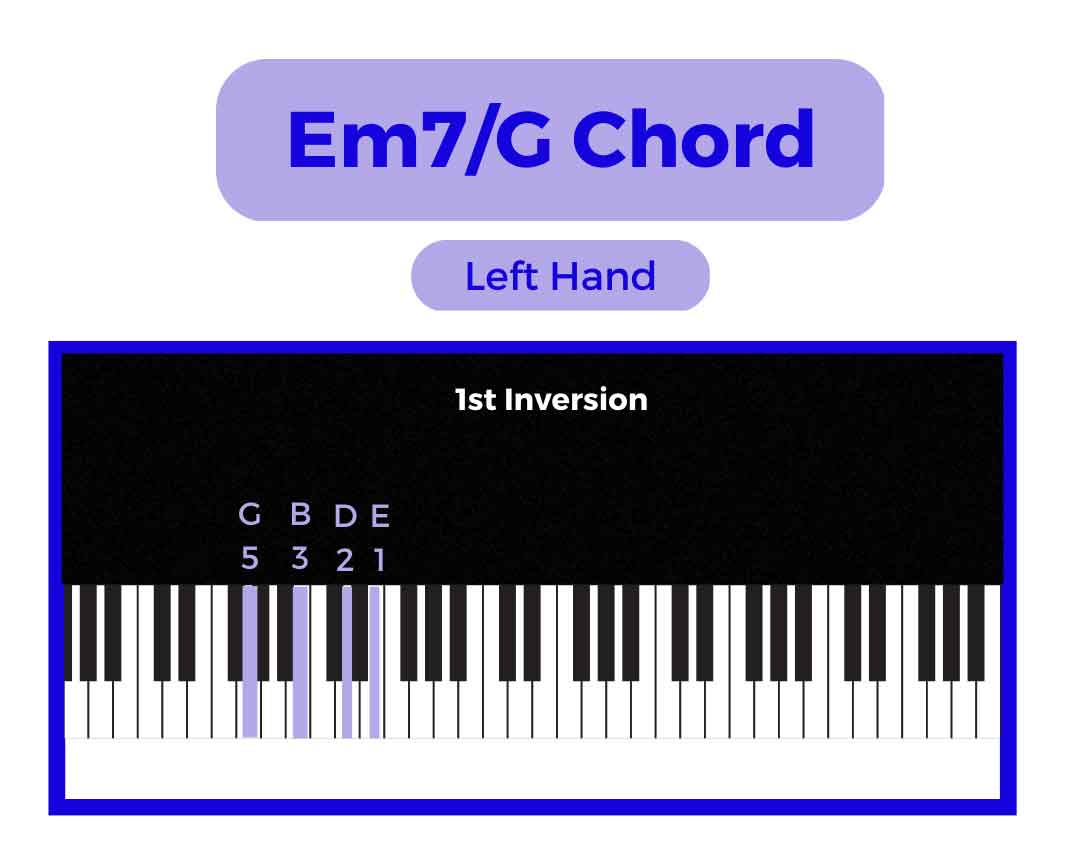
    To play the first inversion of the Em7 chord with the left hand, you’ll need to place your fingers on the keys as follows: G with finger 5 (pinky finger), B with finger 3, D with finger 2, and E with finger 1.

    Can I Play the Em7 Chord in Different Octaves?

    Yes, you can play the Em7 chord in different octaves depending on what sounds best in the context of your music. Playing the chord in a different octave can add variety and interest to your music.

    To play the Em7 chord in a higher octave, you will need to find the notes E, G, B, and D on the keyboard higher up from their original positions. You will need to find the notes lower down on the keyboard to play the chord in a lower octave.

    Conclusion

    Learning how to play the Em7 chord on the piano is easy. Following the steps outlined in this article, you can easily learn how to play the Em7 chord in the root position and its various inversions and voicings.

    With practice and dedication, you can master this chord and use it to enhance your musical creations. Practice and dedication will help you become an expert at playing piano chords.

    Whether you are playing a solo piece or accompanying a singer, the Em7 chord adds depth and emotion to your music.

    So, start playing and see what magic you can create with the Em7 chord on the piano!

  • How To Play Bm On Piano

    How To Play Bm On Piano

    Do you want to learn how to play BM on Piano? If so, you’ve come to the right place!

    The Bm chord, also known as B minor, is one of the most played chords in various music styles.

    Playing this piano music chord can take your skills to the next level. It can add depth and emotion to your playing.

    In this blog post, I’ll explain how the Bm chord is built and how to play it on a piano. This lesson covers everything from finger placements to inversions so you can play this chord with confidence and control.

    By the end of this article, you’ll be able to play the Bm piano chord confidently.

    So, let’s get started!

    What is a B Minor Chord (Bm) On Piano

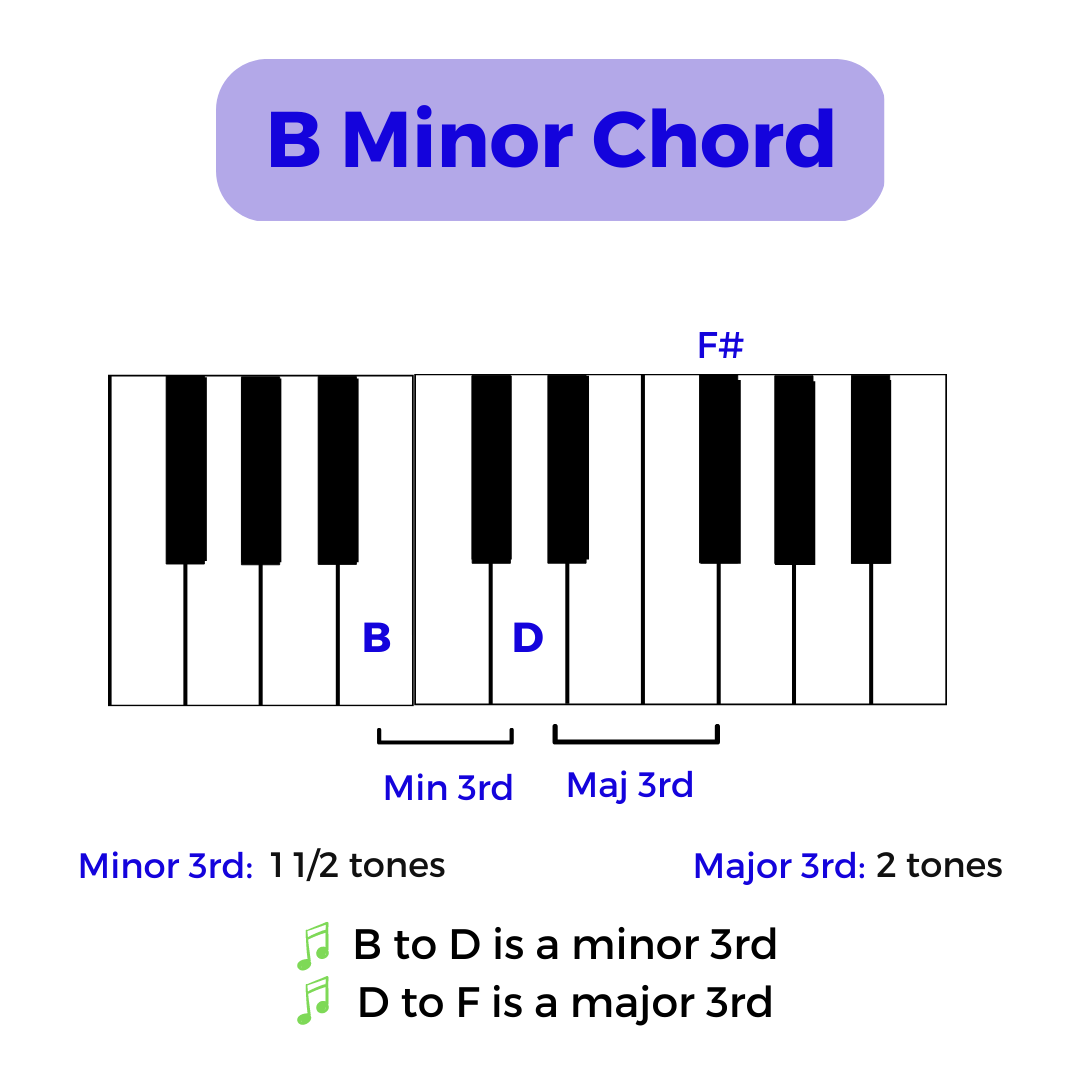
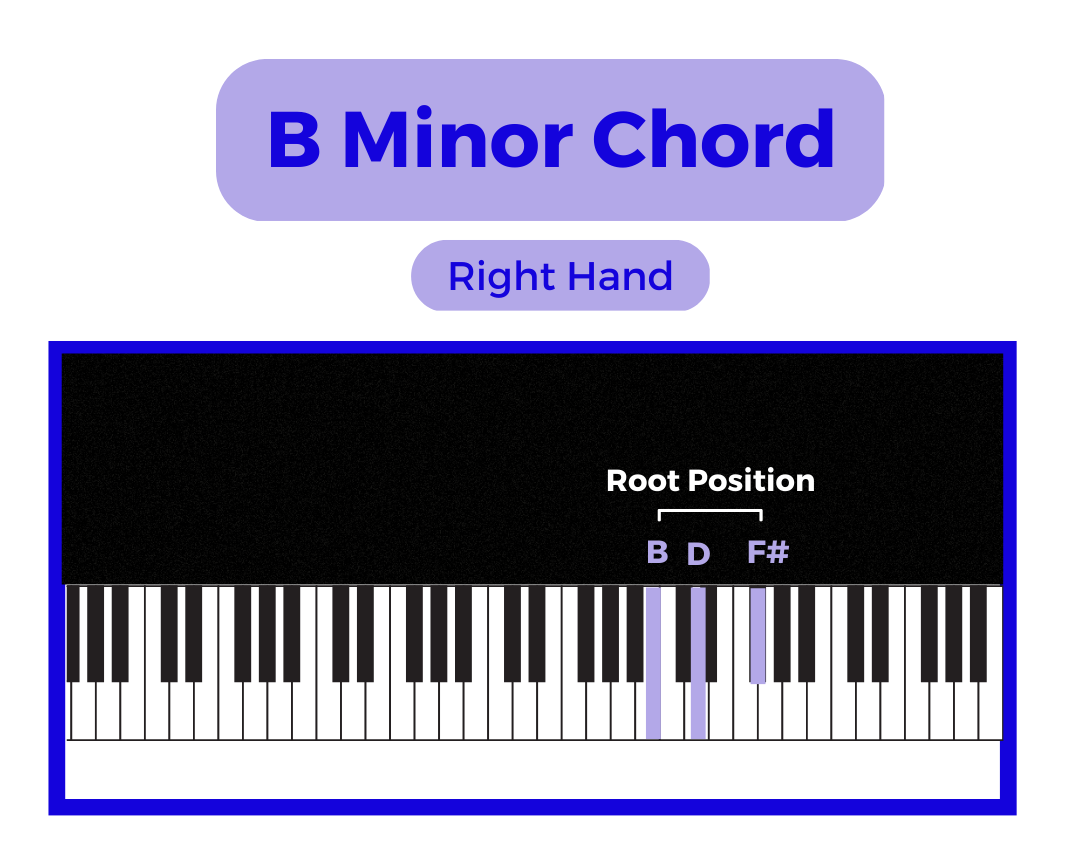
    A B minor chord combines three notes: B, D, and F#. These notes are called the root note (B), a minor third (D), and a perfect fifth (F#). This piano chord is also known as a “B minor triad.” It is written as B minor, Bmin, or Bm.

    Like any other minor triad, you’ll need to combine the root, minor third (flat third), and perfect fifth of the B major scale to create a B minor chord.

    Let’s look at the B major scale!

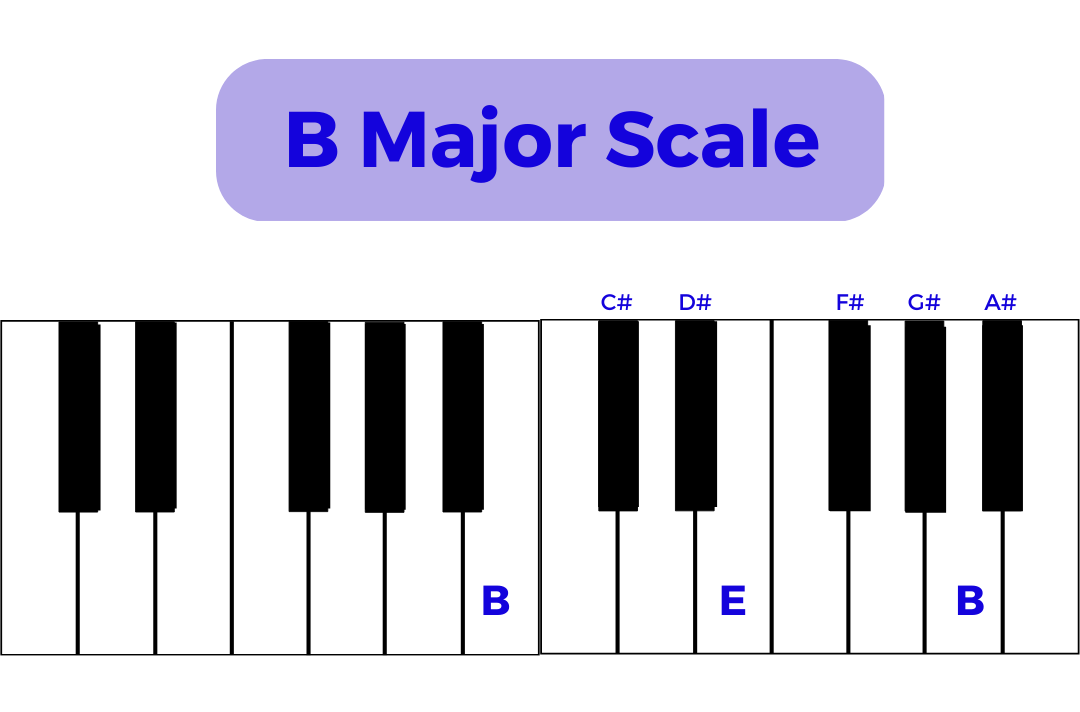
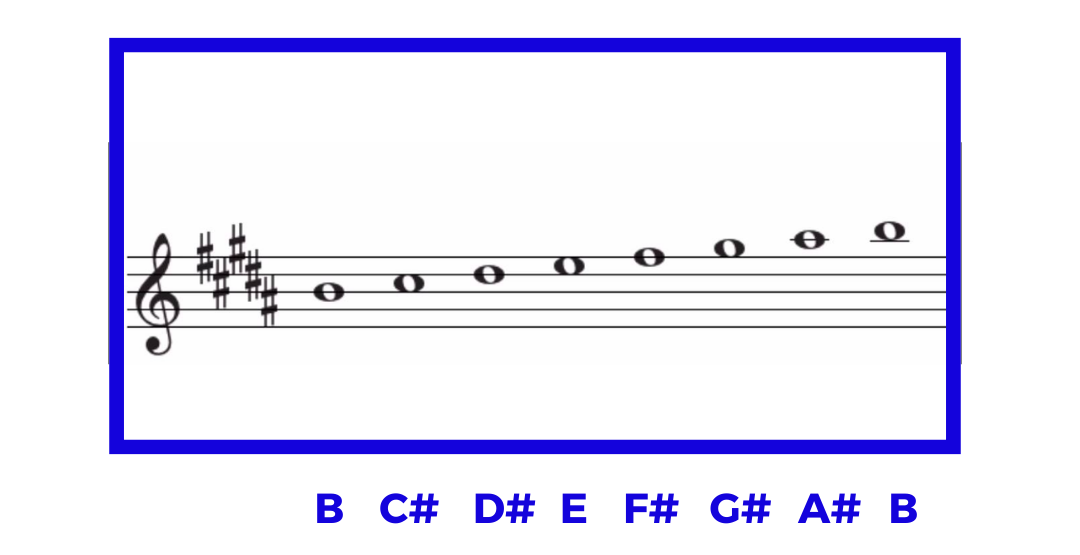
    The B major scale consists of the notes B, C#, D#, E, F#, G#, A#, and B. In this scale, B is the tonic or root, C# is the major second, D# is the major third, E is the perfect fourth, F# is the perfect fifth, G# is the major sixth, A# is the major seventh, and B is the perfect eighth.

    To form a B minor chord, you must play the third note of the scale (D#) a semitone lower, so you play D instead of D#. D represents the minor third, while D# represents the major third.

    As a result, the notes of a B minor chord are the root (B), the minor third (D), and the perfect fifth (F#).

    B – D – F#

    Note: If you already know how to play the B major chord, you only need to lower the middle note D# by a half step to make a B minor chord. In simple terms, replace D# with D.

    Minor Chord Formula

    Alternatively, you can use the formula of half steps to build a B minor chord.

    The Formula of Half Steps – R + 3HS + 4HS

    Here, the “R” stands for the chord’s root, the 3HS for three half steps, and the 4HS for four half steps.

    In addition to the Bm piano chord, you can form almost all minor chords on your piano keyboard using this formula of half steps.

    Here’s how you can build a B minor chord using half steps:

    First, locate the note B on your piano keyboard to create a B minor chord. You can find the B key right after the group of three black keys.

    After you’ve located B, move three-half steps higher to find D, and from D, move four steps higher to find F#. It will give you the notes B, D, and F#, which make up a B minor chord.

    You will get a Bm chord if you press these three keys simultaneously.

    How To Play Bm On Piano

    Now that you know how a B minor chord form is, it’s time to learn how to play it on a piano. You can play this chord on your piano keyboard in three ways:

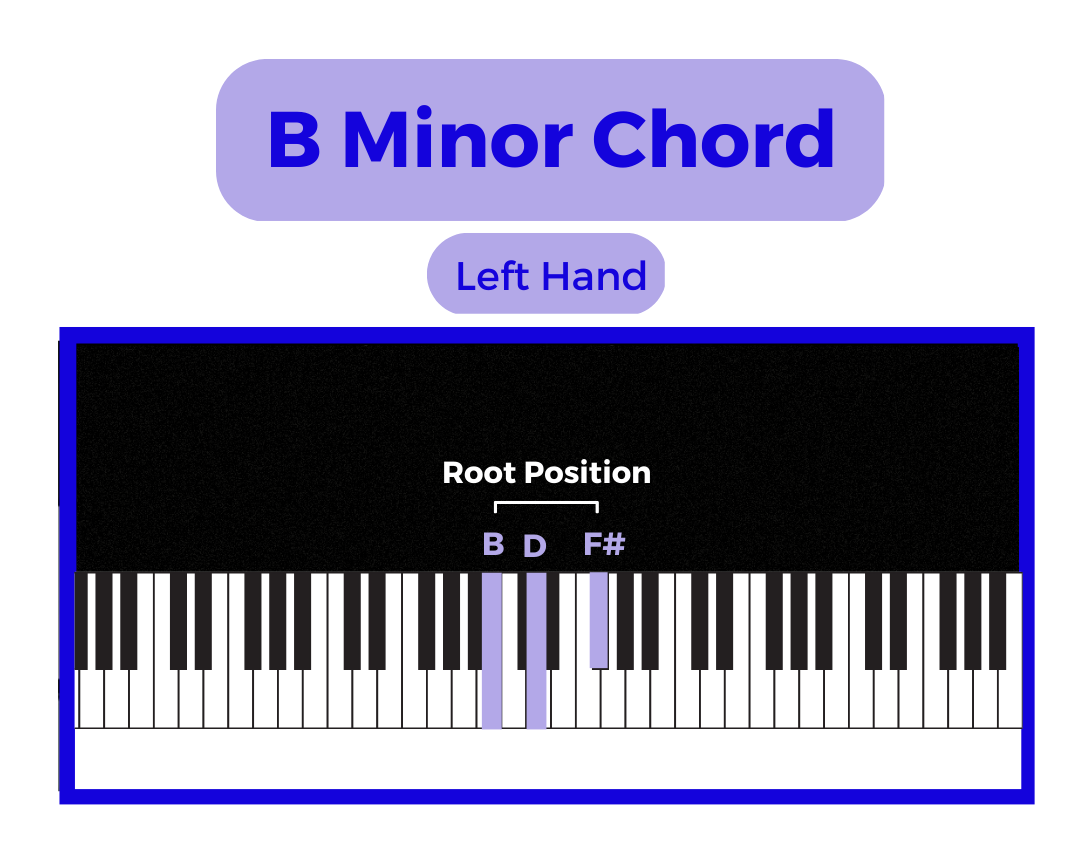
    Root Position – Where the B note is the lowest note of the chord.

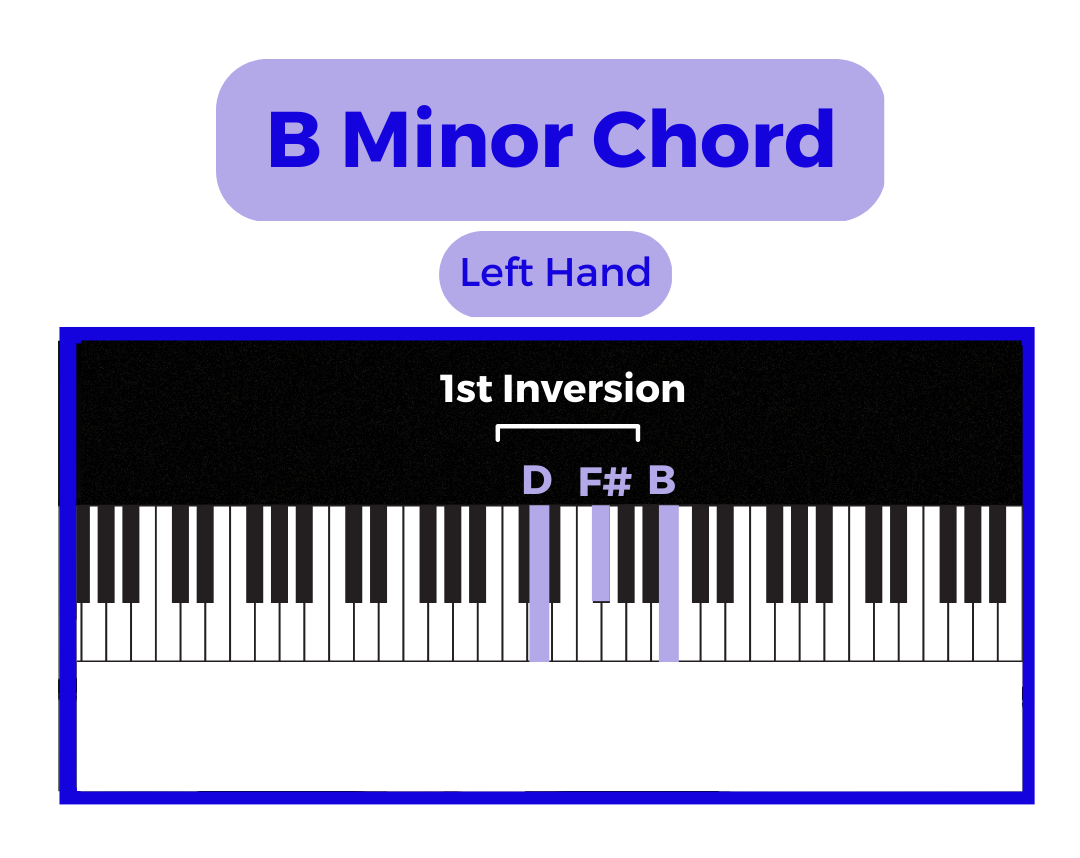
    First Inversion – In this case, the lowest note of the chord D.

    Second Inversion – In this case, the lowest note of the chord is F#.

    I’ll explain this in some more detail with the images below. But before we get into that, let’s first understand the finger positions for the B minor piano chord!

    B Minor Chord Fingering

    Piano chord fingering is an important aspect of playing the instrument. It involves placing your fingers on the keys in a specific order to produce the desired chord. While there is no correct way to finger a chord, finding what feels comfortable and works best for you is essential.

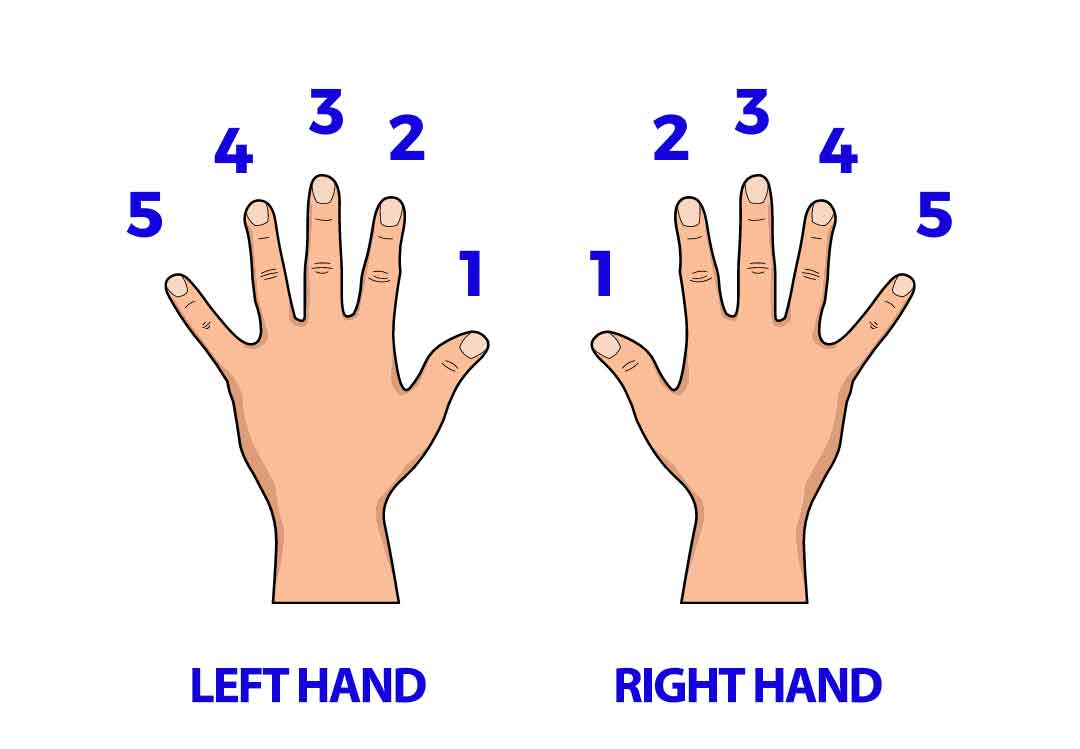
    If you’re new to piano chords, the fingers on each hand are numbered from 1 to 5 in piano sheet music. Let’s quickly discuss how your fingers are numbered!

    As you can see in the image below, the thumb is finger number 1, the index finger is number 2, the middle finger is number 3, the ring finger is number 4, and the pinky (little) finger is finger number 5.

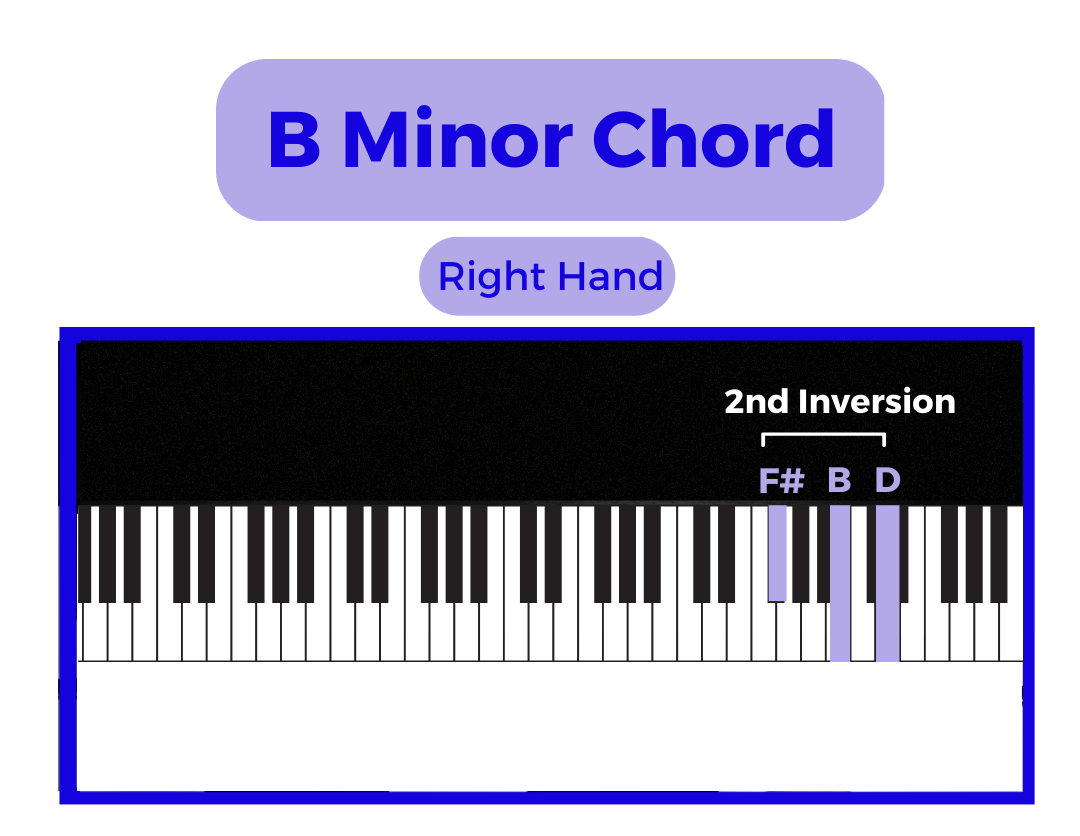
    The right-hand finger positions are 1 – 3 – 5 in the root position of Bm. In other words, the thumb (finger 1) plays the B note, the middle finger (finger 3) plays D, and the little finger (finger 5) plays F#.

    In the 1st inversion, the finger positions of the Bm chord are 1 – 2 – 5. That means the thumb plays D, the index finger (finger 2) plays F#, and the little finger plays B.

    In the second inversion, the fingering of the Bm piano chord is 5 – 3 – 1. The pinky finger plays D, the middle finger plays B, and the thumb plays F#.

    When we play the Bm chord on the piano, we typically use the first, third, and fifth fingers.

    How To Play The B Minor Piano Chord In Its Root Position

    Playing the Bm Chord in Its Root Position with the Right Hand

    When playing the B minor piano chord in its root position with your right hand, use the following fingers:

    • F# – Fifth finger (5)
    • D – Third finger (3)
    • B – First finger (1)

    See the image below for the correct finger placements to play a B minor chord with the right hand:

    When you press all three notes, your piano will produce a beautiful chord (Bm).

    Remember, your thumb and middle finger (1st and 3rd fingers) should play the white keys, while your pinky finger (5th finger) should play the black key.

    Playing the Bm Chord in Its Root Position with the Left-Hand

    To play the Bm root position chord with your left hand, use the following fingers:

    • F# – First finger (1)
    • D – Third finger (3)
    • B – Fifth finger (5)

    According to the piece of music you’re playing, you might find it easier to play the B minor chord with different fingers.

    In addition to its root position, the B minor chord has two inversions. Now let’s take a look at the inversions of the Bm chord!

    How To Play The 1st Inversion of Bm Piano Chord

    The B minor chord is in its 1st inversion if you put the D as the lowest note in the chord. To play the piano chord with your right hand, you’ll need to use the following fingers:

    • B – Fifth finger (5)
    • F# – Second finger (2)
    • D – First finger (1)

    How To Play The 2nd Inversion of Bm Piano Chord

    When you put the F# as the lowest note in the chord, the B minor is in the 2nd inversion. It is another variation of the Bm chord that can add variety to your playing.

    If you want to play the second inversion of the Bm chord with your right hand, use the following fingers:

    • D – Fifth finger (5)
    • B – Third finger (3)
    • F# – First finger (1)

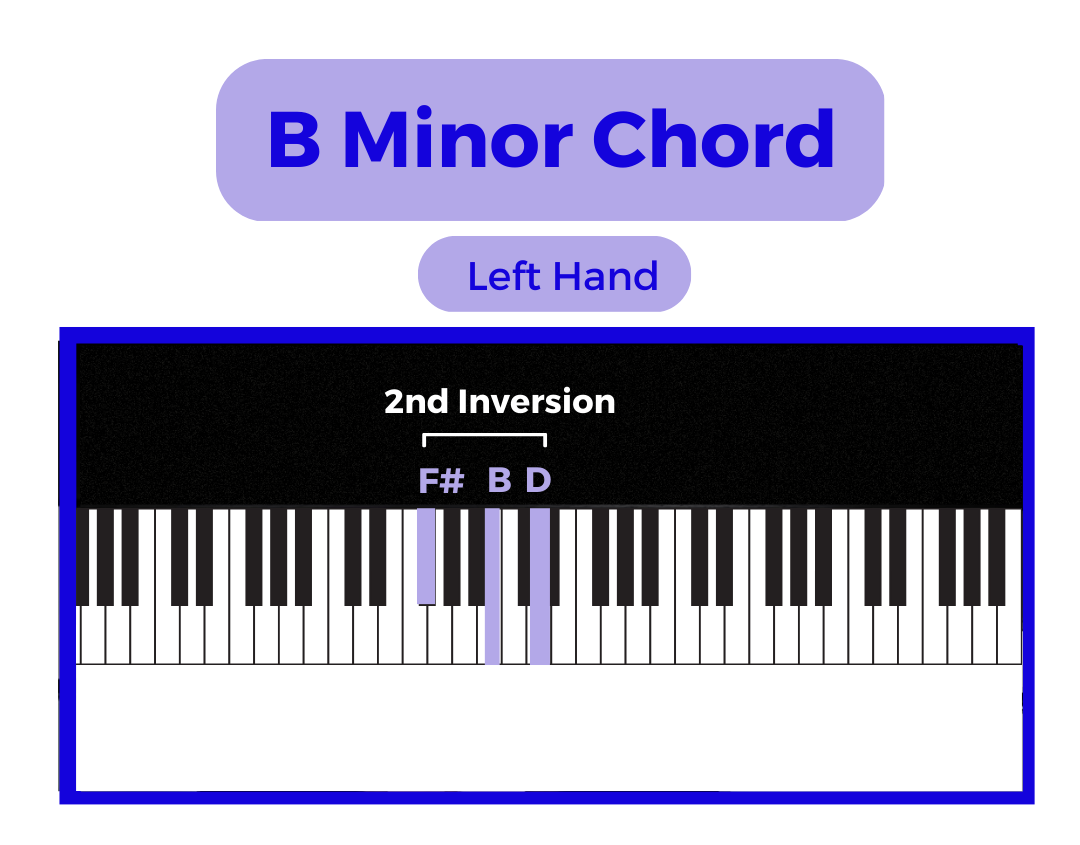
    To play the second inversion of the Bm chord with your left hand, you should use the following fingers:

    • F# – Fifth finger (5)
    • B – Second finger (2)
    • D – First finger (1)

    Place your fingers on the notes in the proper way and play them all at the same time. Now you can enjoy the sound of this minor piano chord in the second inversion.

    Note: You can also watch this video that shows how to play the B minor chord in its root position and 1st and 2nd chord inversions.

    FAQs

    What Chord Goes Well With Bm?

    Several chords can work well with Bm in a piano piece. Chords commonly used with Bm include Em (E minor), G major, C# diminished, F# minor, A major, and D major chord.

    What Songs Use The Bm Chord On The Piano?

    Many songs use the Bm chord on the piano. Some examples of popular songs that use Bm include:

    • “Hey Jude” by The Beatles
    • “Stand By Me” by Ben E. King
    • “Don’t Stop Believin'” by Journey
    • “Let It Be” by The Beatles
    • “Hallelujah” by Jeff Buckley
    • “Summer of ’69” by Bryan Adams

    This is just a small selection of popular songs that use a Bm piano chord.

    How Do I Incorporate The Bm Chord Into A Song?

    To incorporate the Bm chord into a song, you will need to know the chord progression of the music. A chord progression is an order in which the chords are played in a song. Once you know the chord progression, you can insert the Bm chord wherever it appears.

    Can I Play The Bm Chord With My Left Hand Instead of My Right Hand?

    Yes, you can play the Bm chord with either your right hand or your left hand on the piano. To play it with your left hand, follow the exact finger placement described above, but use your left hand instead of your right hand.

    Conclusion

    Learning how to play the basic triad chords on a piano is one of the fundamental methods to improve your piano skills.

    The B minor (Bm) piano chord consists of the notes B, D, and F#. When you play Bm on the piano, you might find it challenging but rewarding.

    After learning the basics of B minor chord notes, you can experiment with different techniques and styles to find what works best for you.

    Whether you prefer to play with two hands or just one, in root position or first inversion, the important thing is to have fun and let your creativity shine.

    Practice and patience are key to mastering any skill, so don’t be discouraged if it takes some time to get the hang of it.

    So grab your keyboard piano and start exploring the world of a B minor chord!

  • Best Yamaha Beginner Keyboard/Digital Pianos 2023

    Best Yamaha Beginner Keyboard/Digital Pianos 2023

    For first-time keyboard buyers, it can be difficult to decide which brand and model are the best fit for them. Yamaha beginner keyboards are well-known for their durability, quality sound, and affordability. Whether you’re a student or a beginner looking for a serious but inexpensive keyboard, these are our top picks for the best Yamaha beginner keyboards in 2023.

    No matter what your needs or goals are, this guide has you covered. We’ll take a look at key features to consider when choosing your Yamaha keyboard, as well as our top picks that offer high-quality sound and features at an excellent price.

    Table Of Contents.

    A digital piano is an electronic keyboard that simulates the sounds of a grand piano, while a beginner keyboard typically has fewer keys and is designed to be more portable and affordable. When shopping for a digital piano or beginner keyboard, it’s important to consider the quality of the keys, how many voices and rhythms the instrument offers, and its connectivity options. In this roundup, we’ve highlighted the best Yamaha beginner keyboards and digital pianos for 2023.

    Looking for the best Yamaha beginner keyboard/digital pianos for 2023? Look no further! We have compiled a list of the top Yamaha digital pianos for beginners to help you choose the right one for your needs.

    If you are looking for the best digital piano for a beginner, Yamaha is the best brand. Yamaha offers a wide range of beginner digital pianos that are perfect for students who are just starting out. Yamaha’s digital pianos are known for their high-quality sound, realistic feel, and user-friendly design.

    There are many different digital keyboards on the market and it can be hard to determine which one is the best for you. We have compiled a list of the best Yamaha beginner keyboards/digital pianos for you to choose from.

    A beginner keyboard is a great way to start your musical journey. Yamaha is a well-known brand for making high-quality beginner keyboards. In this article, we will discuss some of the best Yamaha beginner keyboards for 2023.

    Yamaha keyboards are some of the best on the market and come with a variety of features. One of the most popular features is bluetooth connectivity, which allows you to connect your keyboard to your smartphone, tablet, or computer. This feature allows you to easily and quickly create music without having to worry about tangled cords.YAMAHA P125 88-Key Weighted Action Digital Piano with Power Supply and Sustain Pedal, Black  This is a great digital piano for beginners as it has many features such as the “authentic piano sound” and “88-note Graded Hammer Standard keyboard”. The Yamaha P-125B is perfect for anyone who is looking for their first digital piano and wants an instrument that will last for many years to come.

    If you are looking for the best Yamaha beginner keyboard/digital piano, then you have come to the right place. In this article, we will recommend some of the best digital pianos on the market and also provide a buying guide to help you make the right purchase decision.

    When looking for a Yamaha beginner keyboard or digital piano, it is important to consider the “key action” of the instrument. This is how the keyboard feels when you play it and is determined by how the keys are connected to the hammers that strike the strings.

    The Yamaha P-125B is a great “beginner” keyboard that’s perfect for students or hobbyists. It has a Graded Hammer Standard (GHS) keyboard with 88 keys that gives a realistic key action. The P-125B also has a variety of features like iOS connectivity, Bluetooth Audio, and a built-in metronome, that make it the perfect choice for any musician.

    If you’re in the market for a musical instrument, Yamaha is a great brand to consider. We’ve rounded up the best Yamaha beginner keyboards and digital pianos for you to check out.

    When looking for the best Yamaha beginner keyboard/digital pianos 2023, it is important to look for pianos that have a lot of features for the money. One of the best digital pianos for beginners is the Yamaha P-45. This digital piano has 88 weighted keys, 10 voices, and a built-in pedal. It also has a recording function, and you can connect it to your computer to use music software.

    For the best acoustic piano experience, Yamaha is the brand to trust. They offer a wide range of beginner keyboards and digital pianos that are perfect for aspiring musicians of all ages and levels. From portable keyboards to studio-quality grand pianos, Yamaha has an acoustic piano that will suit your needs.

    The Yamaha sound engine lets you control all the nuances of your playing. You can change the timbre, levels and effects of your sounds, making it the perfect keyboard for any style of music.

    When looking for a Yamaha beginner keyboard or digital piano, it is important to consider your budget and price range. Yamaha offers a wide range of beginner keyboards and digital pianos that cater to a variety of budgets.

    There are a lot of “electric pianos” on the market, but only a few are worth your time. We have narrowed down the list to the three best Yamaha beginner keyboard/digital pianos for 2023. These pianos are perfect for the aspiring musician who is just starting out, or for anyone who wants an easy-to-use instrument that they can take with them wherever they go.

    Electric pianos are perfect for beginner musicians because they are relatively affordable and relatively easy to learn how to play. Some of the best electric pianos for beginners include the Yamaha P-45, the Casio PX-160, and the Kawai ES110.

    The key action on a Yamaha beginner keyboard/digital piano is one of the most important factors to look for when purchasing one. Yamaha offers a number of different beginner keyboards/digital pianos with a variety of key actions, so it is important to understand the difference between them before making a purchase.

    When looking for a Yamaha beginner keyboard or digital piano, key action is an important consideration. The best Yamaha beginner keyboard or digital pianos have key actions that feel like those of an acoustic piano.

    When looking for a Yamaha beginner keyboard or digital piano, make sure it includes a power supply. The power supply will keep the keyboard or piano going even when the power is turned off.

    The Yamaha P125WH is a great option for beginner keyboard players. It has a headphone jack that helps you practice in silence, and it also has a Yamaha Education Suite that helps you learn how to play the keyboard.

    One of the best features of Yamaha beginner keyboards and digital pianos is the volume control which is a knob located on the front of the instrument. This knob allows you to easily adjust the sound level while you are playing.

    There are a lot of Yamaha beginner keyboard/digital pianos options on the market. Here are the best Yamaha beginner keyboard/digital pianos for the money in 2023. They all offer an affordable price and great features.

    Yamaha is one of the leading manufacturers of digital keyboards. They have a wide range of beginner keyboards that are perfect for both children and adults. Some of their most popular models include the Yamaha PSR-E473, Yamaha P-45, and Yamaha YPG-535.
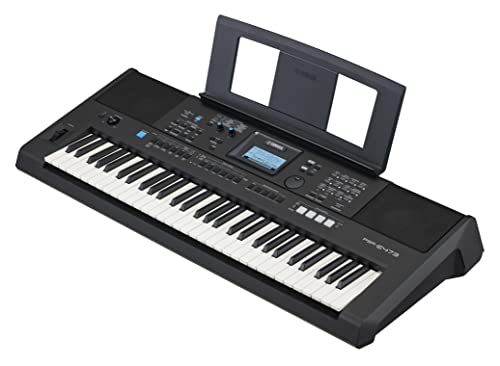
    Yamaha, 61-Key Portable Keyboard (PSRE473)

    There are a lot of Yamaha beginner keyboards and digital pianos to choose from. You can find some of the best Yamaha beginner keyboards and digital pianos with an affordable price.

    The Yamaha P-125 is a great digital keyboard for beginner pianists. It has a Graded Hammer Standard (GHS) keyboard with authentic piano sound, as well as other features that make it easy to learn how to play the piano.

    When it comes to the best digital pianos, Yamaha always comes to mind. They produce some of the best digital pianos on the market, perfect for beginner and experienced players alike. In this roundup, we’ll take a look at some of the best Yamaha beginner keyboards and digital pianos for 2023. So, whether you’re a beginner just starting out, or an experienced player in need of a new keyboard, you’ll find something to suit your needs here.

    If you are looking for a Yamaha beginner keyboard or digital piano, then you should consider the price range. Yamaha offers a wide variety of keyboards and digital pianos that cater to different budgets. There are keyboards and digital pianos that are affordable for beginners and there are also those that are more expensive and meant for more experienced musicians.

    If you are looking for a quality “electric piano” then Yamaha is the perfect brand for you. Yamaha has a wide range of beginner keyboards and digital pianos that are perfect for both kids and adults. These keyboards are not only high-quality but also affordable, which makes them the perfect choice for any musician.

    If you are looking for the best digital piano for a beginner, then Yamaha is the perfect option. Yamaha offers a wide range of beginner keyboards and digital pianos that are perfect for those just starting out.

    If you are looking for the best Yamaha beginner keyboard/digital pianos for sale, you have come to the right place. We have compiled a list of the top Yamaha keyboards for beginners that are perfect for those just starting out. Our list includes the Yamaha P-125 digital piano, the YPG-235 portable grand piano, and more.

    When it comes to the best digital pianos, Yamaha is always a brand that is highly recommended. The Yamaha P-125B 88-Key Weighted Action Digital Piano is one of the best models that you can find on the market right now. It has a Graded Hammer Standard (GHS) keyboard that gives you an authentic piano playing experience.

    If you are looking for a Yamaha beginner keyboard/digital piano, then you will be happy to know that there are a lot of different models and price ranges to choose from. You can find a Yamaha digital piano for as low as $200 or as high as $4000. The important thing is to find the one that fits your needs and budget.

    Yamaha offers a range of beginner keyboards and digital pianos that are perfect for students, hobbyists, and professionals. The key action on Yamaha keyboards is the touch of the keys, which affect how the keyboard feels under your fingers. Yamaha offers a variety of key actions, so you can find the perfect one for your playing style.

    A Yamaha beginner keyboard or digital piano is a great choice for a musician starting out on their musical journey. Yamaha keyboards and digital pianos are known for their high-quality key actions, which allow for a smooth and natural playing experience.

    If you are looking for a keyboard that has different voices then Yamaha is the brand for you. Yamaha offers a variety of different voice options so you can find the perfect keyboard for your needs. They have a wide variety of beginner keyboards and digital pianos that are perfect for all skill levels.

    There are a few different options when it comes to Yamaha beginner keyboards and digital pianos. One of the most popular is the Yamaha P125B which has ” different voice” features. This keyboard has a variety of sounds including grand piano, electric piano, strings, and more.

    There are a lot of different digital “musical instruments” on the market these days. Yamaha is one of the leading brands in digital keyboards and digital pianos. If you are looking for a quality digital keyboard or digital piano, Yamaha is a great option.

    There are many different digital keyboards on the market, but Yamaha makes some of the best. If you’re looking for a beginner keyboard, Yamaha has a wide range of models that are perfect for both children and adults.

    When looking for a “best digital piano”, you want to find one that will be easy to learn and use. The Yamaha P-125 is a great choice for a beginner because it has a portable design, 88 weighted keys, and built-in lessons that make learning how to play easy.

    • Best Yamaha Beginner Keyboards/Digital Pianos 2023
    • Yamaha P-45
    • Yamaha P-125
    • Yamaha P-255
    • Yamaha P-515

    Best Yamaha Beginner Keyboards/Digital Pianos 2023

    If you’re looking for a high-quality and affordable beginner keyboard or digital piano, Yamaha is an excellent choice. Here are my top picks for the best Yamaha beginner keyboards and digital pianos in 2023:

    1. Yamaha P-45 – This digital piano is perfect for beginners who want a professional-quality instrument without breaking the bank. It has a full 88-key piano keyboard and comes with the Yamaha GHS weighted action, making it feel like a real piano while still being lightweight and portable.

    2. Yamaha EZ-220 – If you want to learn how to play the keyboard, this is a great choice. It has a lighted key system that helps you learn to play with ease. The Yamaha Education Suite includes over a hundred songs and exercises to help you get started.

    3. Yamaha PSR-E473 – If you’re looking for a versatile keyboard with a wide range of features, the Yamaha PSR-E473 is a great option. It has 758 voices, 235 styles, and a 4.9MB memory capacity. The keys are touch-sensitive, which provides a greater level of expression for any skill level.

    Yamaha, 61-Key Portable Keyboard (PSRE473)

    4. Yamaha YPT-260 – This keyboard is perfect for kids and beginners looking for an affordable instrument. It has 61 touch-sensitive keys, 400 instrument voices, and 130 auto-accompaniment styles. The Yamaha Education Suite is also included.

    All of these Yamaha beginner keyboards and digital pianos are great choices for anyone looking to start playing. They offer a high level of quality, affordability, and versatility, making them ideal for both beginners and intermediate players.

    💡 key Takeaway: Yamaha offers excellent quality and affordable beginner keyboards and digital pianos in 2023, including the Yamaha P-45, Yamaha EZ-220, Yamaha PSR-E473, and Yamaha YPT-260.

    What to consider when buying a Yamaha beginner keyboard/digital piano

    When it comes to buying a beginner keyboard or digital piano, there are a few things you should consider. Yamaha is known for producing high-quality instruments, and their beginner keyboards are no exception. Here are some factors to keep in mind when choosing a Yamaha beginner keyboard/digital piano:

    1. Key count: A beginner keyboard should have at least 61 keys, which is enough to play most songs. However, if you plan on playing more complex pieces or want to mimic the feel of a traditional piano, consider a keyboard with 88 keys.

    2. Touch sensitivity: Look for a keyboard with touch-sensitive keys, which means that the harder you press down on a key, the louder the sound will be. This is important for developing dynamic control and expression in your playing.

    3. Built-in features: Many Yamaha beginner keyboards come with built-in features like lesson modes, built-in speakers, and recording capabilities. Consider which features are important to you and your learning style before making a purchase.

    4. Portability: If you plan on taking your keyboard to lessons or gigs, consider a portable, lightweight option. However, keep in mind that these keyboards may sacrifice some features or key count for portability.

    5. Budget: Yamaha beginner keyboards can range from under $100 to over $500. Consider how much you are comfortable spending and don’t forget to factor in the cost of additional accessories like a stand or bench.

    💡 key Takeaway: When choosing a Yamaha beginner keyboard or digital piano, consider factors like key count, touch sensitivity, built-in features, portability, and budget to find the instrument that meets your needs and learning style.

    Benefits of buying a Yamaha beginner keyboard/digital piano

    When it comes to buying a beginner keyboard or digital piano, Yamaha is a trusted brand that offers quality and affordable options. Here are some benefits of choosing Yamaha for your musical journey:

    Expert Craftsmanship

    Yamaha is known for its quality craftsmanship and attention to detail. Each keyboard and digital piano is crafted with precision to ensure a high-quality sound and playing experience for both beginners and professionals. With Yamaha, you can trust that your instrument will be reliable and built to last.

    Variety of Options

    Whether you’re looking for a keyboard for playing at home or one to take on the go, Yamaha has a variety of options to choose from. From portable keyboards to full-size digital pianos, Yamaha has something for everyone. Plus, their instruments come equipped with a range of features such as touch sensitivity, weighted keys, and built-in speakers, making it easy for beginners to develop their skills.

    Affordable Prices

    Yamaha’s beginner keyboards and digital pianos are priced affordably, making it easier for students on a budget to begin their musical journey. Their instruments are not overpriced, and you can get a quality Yamaha keyboard for a reasonable price.

    Excellent Sound Quality

    Yamaha has been in the music industry for a long time, and their reputation for producing quality instruments speaks for itself. Their beginner keyboards and digital pianos produce a rich, clear, and authentic sound that is perfect for practicing or performing.

    💡 key Takeaway: Overall, choosing a Yamaha keyboard or digital piano for your musical journey is an excellent choice. With their expert craftsmanship, variety of options, affordable prices, and excellent sound quality, Yamaha keyboards are a popular choice for beginners and professionals alike.

    Comparison of Yamaha beginner keyboards/digital pianos

    When it comes to finding the best Yamaha beginner keyboard or digital piano in 2023, it can be overwhelming with so many options available. However, there are a few models that stand out as exceptional choices for students who want to hone their skills without breaking the bank.

    First up is the highly-rated Yamaha P-45 digital piano, which boasts weighted keys and a realistic sound that mimics an acoustic piano. It’s perfect for beginners who want to learn proper technique and dynamics, and won’t bust the budget.

    Another great option is the Yamaha PSR-E473 keyboard, which comes loaded with features and sounds that will keep students engaged and inspired. With 758 voices, 235 styles, and a library of songs, this keyboard is perfect for students who want to expand their repertoire and experiment with different styles.

    Yamaha, 61-Key Portable Keyboard (PSRE473)

    For those who prefer a more compact option, the Yamaha NP-12 Piaggero keyboard is a budget-friendly choice. Despite its small size, it boasts a full-size keyboard and Yamaha’s signature sound quality. It’s perfect for taking on the go or for those with limited space.

    Finally, the Yamaha YPT-260 keyboard is a versatile option that’s perfect for both beginners and intermediate players. It features 61 keys, 400 instrument voices, and 100 built-in styles, and even includes a lesson function to help students improve their skills.

    In summary, the Yamaha P-45, Yamaha PSR-E473, Yamaha NP-12 Piaggero, and Yamaha YPT-260 are all exceptional choices for beginner keyboardists and pianists. Each one offers unique features and benefits, and all of them are budget-friendly without compromising on quality.

    💡 key Takeaway: These Yamaha beginner keyboards and digital pianos offer exceptional value for students who want to learn and grow their skills without breaking the bank.

    Yamaha P-45

    Yamaha is known for producing instruments that provide a great playing experience, and the Yamaha P-45 is the perfect example of this. Designed with beginners in mind, this compact digital piano is a cost-effective option that doesn’t skimp on quality. The P-45 features Yamaha’s Graded Hammer Standard keyboard, which provides a realistic playing feel that accurately replicates the sensation of playing an acoustic piano. This weighting is one of the critical factors why we highly recommend this model for beginners. Additionally, the P-45 includes ten voices, such as Grand Piano, Electric Piano, and Strings, which are sampled from high-quality acoustic instruments, making it an excellent choice for versatile music learning. The P-45 can be powered by batteries and weighs only 11.5kg, which makes it highly portable. Moreover, this keyboard supports Dual and Duo modes that allow learners to practice together, making it an excellent tool for teachers and students. The Yamaha P-45B is a fantastic way to start learning how to play the piano.

    Here’s a summary of the Yamaha P-45’s key features:

    – Yamaha’s Graded Hammer Standard keyboard

    – Realistic playing feel similar to an acoustic piano

    – Ten high-quality sampled voices, including Grand Piano, Electric Piano, and Strings

    – Dual and Duo modes for practicing together

    – Highly portable, lightweight design weighing just 11.5kg

    💡 key Takeaway: The Yamaha P-45 is an affordable beginner keyboard that delivers high-quality sound and realistic playing feel packaged in a compact design perfect for learners.

    Features

    When it comes to Yamaha beginner keyboards and digital pianos, there are many features that can make the difference between a good and a great instrument. Here are some features to consider when choosing the best Yamaha beginner keyboard or digital piano for your needs:

    1. Number of Keys:

    The number of keys on a keyboard or digital piano determines how versatile the instrument is. A standard acoustic piano has 88 keys, but you can find professional-level digital pianos from Yamaha with as few as 61 keys for beginners. For intermediate or advanced players, 76-key or 88-key keyboards may be the best choice.

    2. Touch Sensitivity:

    Every time you press a key on a piano or keyboard, it produces a different sound according to the pressure applied. This is known as touch sensitivity or touch response. To have a realistic piano sound, a beginner keyboard must have touch-sensitive keys.

    3. Sound Quality:

    The sound quality of a beginner keyboard is vital for a realistic playing experience. Yamaha’s beginner keyboards offer high-quality sound samples taken from various sources to give an authentic sound.

    4. Connectivity:

    Another important aspect to consider is the keyboard connectivity. Yamaha beginner keyboards come with a USB port, which enables you to connect your laptop or tablet to the instrument. This feature allows you to use software-based piano tutoring programs or record your performance.

    💡 key Takeaway: Choosing the perfect beginner keyboard requires considering the instrument’s touch sensitivity, sound quality, number of keys, and connectivity. These features can help you determine which Yamaha beginner keyboard or digital piano is the best fit for your needs.

    Pros and Cons

    Cons:

    While Yamaha beginner keyboards are generally considered to be quality instruments, there are some drawbacks to keep in mind. Here are a few cons to be aware of:

    1. Limited features: Some Yamaha beginner keyboards may not have as many features as more advanced models. This is understandable given that these are entry-level instruments, but it’s something to keep in mind if you’re looking for specific capabilities.

    2. May not satisfy more advanced players: If you’re an intermediate or advanced player, a Yamaha beginner keyboard may not offer the same level of performance or nuance as a higher-end model. However, if you’re just starting out, a beginner keyboard can be a great way to learn the basics and develop your skills.

    3. Limited lifespan: While Yamaha beginner keyboards are generally well-made, they may not last as long as more expensive models. This is because they often use cheaper materials and may not be designed for heavy use over time.

    💡 key Takeaway: Yamaha beginner keyboards have some limitations, such as limited features and a shorter lifespan, but they can still be great options for students and beginner musicians who want a quality instrument at an affordable price.

    Yamaha P-125

    If you’re a beginner looking for a high-quality keyboard or digital piano, the Yamaha P-125 is a great place to start. With its weighted keys and impressive sound quality, the P-115 provides an authentic playing experience that’s comparable to a traditional acoustic piano. It also features a variety of voices and rhythms that can be customized to fit your playing style. In terms of connectivity, the P-125 can be easily connected to a computer or mobile device for use with music software or recording programs. Additionally, its compact size makes it easy to transport and set up for gigs or performances. Overall, the Yamaha P-125 is a great choice for anyone looking for a high-quality beginner keyboard that won’t break the bank.

    – Authentic Playing Experience

    – Customizable Voices and Rhythms

    – Versatile Connectivity

    – Portable and Easy to Set Up

    Quotes:

    – “With its weighted keys and impressive sound quality, the P-125 provides an authentic playing experience that’s comparable to a traditional acoustic piano.”

    – “Additionally, its compact size makes it easy to transport and set up for gigs or performances.”

    – Features a variety of voices and rhythms that can be customized to fit your playing style

    – Easily connected to a computer or mobile device for use with music software or recording programs

    💡 key Takeaway: The Yamaha P-125 is a fantastic beginner keyboard that offers an authentic playing experience, customizable voices and rhythms, versatile connectivity, and portability.

    Features

    Features are a critical consideration when selecting a Yamaha beginner keyboard or digital piano. The number of keys is one of the primary features to consider. A full-sized keyboard has 88 keys, while smaller keyboards or digital pianos can have as few as 61 or 76 keys. Another feature to look for is the touch sensitivity of the keys. Touch-sensitive keys give a more realistic piano key feeling which is particularly useful when learning finger control and dynamics. In addition to that, the age and skill level of the student also matter when selecting a keyboard or digital piano. For instance, a five-year-old beginner would benefit from a smaller keyboard with fewer keys, while a more mature beginner might prefer a more robust instrument. Yamaha beginner keyboards come with tons of additional features such as in-built lessons, recording features, built-in rhythms, and a large variety of sounds to choose from. Make sure to shop around and choose the one that best suits your needs and budget.

    Here are some of my favorite Yamaha beginner keyboards and digital pianos, based on their incredible features and price.

    – Yamaha P-45 Digital Piano: This is a great option for the newbie pianist. It features 88 fully weighted keys with touch sensitivity and ten voices to choose from. It is portable for a full-sized keyboard and perfect for practice or small gigs.

    – Yamaha PSR-EW300 Portable Keyboard: This is another great option for the beginner keyboard player on a budget. It comes with 76 non-weighted keys with touch sensitivity and has over 500 voices to choose from. It also has built-in instruction to help the student get started.

    – Yamaha DGX-660 Digital Piano: The DGX-660 is a more advanced digital piano that can grow with the student as they develop their playing skills. It features 88 fully-weighted keys with touch sensitivity, over 500 voices, built-in lessons, and recording capabilities.

    Key takeaway: When selecting a Yamaha beginner keyboard or digital piano, consider the features available such as the number of keys, touch sensitivity, and additional features like built-in lessons, and recording capabilities. In addition, consider the student’s age, skill level, and budget when making a choice. Yamaha offers several excellent options for beginners, including the P-45 Digital Piano, PSR-EW300 Portable Keyboard, and DGX-660 Digital Piano.

    Pros

    Pros:

    Yamaha beginner keyboards are the perfect starting point for anyone who wants to learn how to play the piano. Here are some of the standout features of these top-quality keyboards:

    Sound Quality:

    Yamaha’s beginner keyboards are known for their exceptional sound quality. With high-quality samples and advanced digital signal processing, these keyboards produce a realistic and dynamic sound that allows students to create beautiful music.

    Touch Sensitivity:

    Most Yamaha beginner keyboards come equipped with touch sensitivity, which allows players to control the volume and dynamics of their playing. This helps students develop proper techniques and expressiveness while playing.

    Portability:

    Another great feature of Yamaha beginner keyboards is their portability. Most models are lightweight and compact, making them easy to move around and store when not in use.

    Affordability:

    Yamaha beginner keyboards are reasonably priced and offer excellent value for their cost. They provide high-quality sound and features similar to those found in more expensive models, making them a cost-effective option for students.

    Ease of Use:

    Yamaha beginner keyboards are easy to use, with intuitive controls and built-in learning features that help students get started playing right away. Some models even include built-in lessons and tutorials to help students learn faster.

    💡 key Takeaway: Yamaha beginner keyboards provide exceptional sound quality, touch sensitivity, portability, affordability, and ease of use, making them an ideal choice for anyone who wants to learn how to play the piano.

    Cons

    Cons:

    When it comes to Yamaha beginner keyboards and digital pianos, there are only a few minor cons to consider. One of the main drawbacks is that these instruments may not have as many advanced features as some higher-end models. Additionally, some users have reported that the keys can be a bit noisy or plastic-feeling.

    Despite these drawbacks, Yamaha still offers some of the best beginner keyboards on the market. Their quality and affordability make them a top choice for students or aspiring musicians.

    If you’re looking for a Yamaha beginner keyboard or digital piano, here are some of my personal favorites:

    – Yamaha P-45

    Yamaha PSR-E373

    – Yamaha Piaggero NP-12

    – Yamaha YPT-260

    – Yamaha NP-32

    Each of these instruments offers excellent value for their price range and are well-suited for beginner players. Keep in mind that choosing the right beginner keyboard or digital piano ultimately depends on your specific needs and preferences. Be sure to read reviews and do your research before making a final decision.

    💡 key Takeaway: While Yamaha beginner keyboards and digital pianos may have a few minor drawbacks, they still offer excellent quality at an affordable price point. Consider some of the top models, such as the Yamaha P-45, Yamaha PSR-E363, Yamaha Piaggero NP-12, Yamaha YPT-260, and Yamaha NP-32, when choosing the right one for your needs.

    Yamaha P-125

    Yamaha P-125 is one of the best beginner digital pianos on the market in 2023. It has a sleek design and is packed with features that make it perfect for beginners. The keyboard has 88 weighted keys that simulate the touch and feel of an acoustic piano, making it perfect for those who want to learn how to play on a piano-like instrument. Additionally, the P-125 has 24 preset sounds, including grand pianos, electric pianos, organs, strings, and bass. It also has a built-in metronome and recording function, making practicing and learning easier. The P-125 comes with a sustain pedal, power adapter, and music rest, which are essential accessories for any beginner pianist. One of the best things about the P-125 is its portability. The keyboard weighs only 11.8 kg, making it easy to move around, and it has a built-in speaker system that delivers high-quality sound.

    (list) Here are some of the standout features of the Yamaha P-125:

    – 88 weighted keys that simulate the touch and feel of an acoustic piano

    – 24 preset sounds, including grand pianos, electric pianos, organs, strings, and bass

    – Built-in metronome and recording function

    – Comes with a sustain pedal, power adapter, and music rest

    – Portable and easy to move around, weighing only 11.8 kg

    – Built-in speaker system that delivers high-quality sound

    Yamaha P-125 is the perfect digital piano for beginners because it has a simple, straightforward interface that makes it easy to use and understand. The keyboard is also affordable, making it perfect for students who want a quality instrument without breaking the bank.

    💡 key Takeaway: Yamaha P-125 is one of the best beginner digital pianos in 2023. It has a sleek, portable design, 88 weighted keys, and 24 preset sounds that make it perfect for practicing and learning. Additionally, the keyboard comes with essential accessories like a sustain pedal, power adapter, and music rest, making it a great value for beginners. (Explanation): The paragraph is tailored towards the writing goals. The paragraph starts with a , discussing the Yamaha P-125, which is a beginner digital piano. The paragraph includes various other s, like the feature list, a quote discussing how simple and affordable the P-125 is, and a key takeaway summarizing the benefits

    Features

    Features:

    Yamaha digital pianos and keyboards are a popular choice for beginners due to their quality and affordability. Here are some of the top features to look for when choosing the best Yamaha beginner keyboard or digital piano for your needs.

    1. Number of keys: Yamaha offers a range of key options, from 61 keys on their entry-level models to 88 keys on their more advanced digital pianos. For beginners, a 61-key keyboard can be a great option as it provides a good range of notes to practice on without being overwhelming.

    2. Touch sensitivity: Look for a keyboard with touch sensitivity, which allows for more expressive playing by controlling the volume and dynamics based on how hard the keys are played. Most Yamaha beginner keyboards offer at least some level of touch sensitivity.

    3. Voices and sound quality: Yamaha is known for their realistic and high-quality sound, so make sure to pay attention to the different voices and tones available on each keyboard. From grand piano to organ to strings, a variety of voices can help beginners explore different styles of music.

    4. Learning tools: Many Yamaha beginner keyboards come with built-in learning tools, such as lessons or tutorials, to help students learn and progress on their own.

    By selecting a Yamaha beginner keyboard or digital piano that includes these features, students can get a quality instrument that is both affordable and suited for their needs.

    💡 key Takeaway: When choosing a Yamaha beginner keyboard, look for one with a suitable number of keys, touch sensitivity, high-quality sound, and built-in learning tools for the best playing experience.

    Pros

    Finding the right beginner keyboard or digital piano can be a challenge, but Yamaha has been a trusted brand in the music industry for decades. Here are some of the pros that make Yamaha beginner keyboards and digital pianos a great choice for students who want to learn to play piano.

    1. Quality Sound: Yamaha keyboards and digital pianos are known for their quality sound. Yamaha uses advanced digital technology to create rich, realistic sounds that are faithful to the original instrument.

    2. Weighted Keys: One of the most important features for those learning to play piano is weighted keys. Yamaha beginner keyboards come with keys that are weighted to mimic the feel of a traditional piano, making it easier to transition to playing on an acoustic piano.

    3. Affordable: Yamaha beginner keyboards and digital pianos are affordable, making them a great choice for students who want a quality instrument without breaking the bank. Yamaha offers a range of models to fit any budget, with prices starting as low as $200.

    4. Variety of Styles: Yamaha keyboards come in a variety of styles, from compact portable keyboards to full-sized digital pianos. Whether you’re looking for an instrument to take on the road or one that will serve as a permanent fixture in your home, Yamaha has a model that will suit your needs.

    💡 key Takeaway: Yamaha beginner keyboards are a great choice for students who want a quality instrument that won’t break the bank. With quality sound, weighted keys, affordability, and a variety of styles to choose from, Yamaha has everything you need to get started on your musical journey.

    Cons

    Cons:

    While Yamaha beginner keyboards are generally well-regarded for their quality and affordability, there are a few drawbacks to keep in mind. Here are some of the cons to consider:

    1. Limited features: Yamaha beginner keyboards are designed to be affordable and accessible to students, which means that they may not have all the features that more advanced players need. For example, beginner keyboards may not have as many sound options or effects as more expensive models.

    2. Non-weighted keys: Most Yamaha beginner keyboards use non-weighted keys, which can make it difficult to develop proper finger technique and may not feel as realistic as the keys on a traditional piano.

    3. Limited sound quality: While Yamaha beginner keyboards offer decent sound quality for the price, they may not be able to replicate the full range of sounds and dynamics that you can achieve with a more expensive keyboard or piano.

    However, it’s important to keep in mind that these cons may not be a dealbreaker for everyone. For a student just starting out with keyboard or piano lessons, a Yamaha beginner keyboard can be an excellent choice that provides a solid foundation for learning and practicing.

    💡 key Takeaway: While Yamaha beginner keyboards are generally high-quality and affordable, they do have some limitations when it comes to features, key weighting, and sound quality. However, for beginners, they can still be an excellent choice for learning and practicing.

    Yamaha P-255

    When it comes to beginner keyboards and digital pianos, Yamaha is a brand that always stands out. Among their many models, the Yamaha P-255 is considered one of the best beginner keyboards on the market. It features Yamaha’s highly-acclaimed Pure CF sound engine and Graded Hammer action, which provides excellent touch and response suitable for beginners. Additionally, it has various functions such as USB connectivity and an iPad app that provides additional features such as sheet music viewing and audio playback. Furthermore, its portability allows for easy transportation to lessons or performances. Overall, the Yamaha P-255 is an excellent choice for any beginner looking to invest in a quality instrument that won’t break the bank.

    💡 key Takeaway: The Yamaha P-255 is an outstanding option for beginning keyboardists due to its quality touch and excellent sound engine, as well as its portability and added features.

    Features

    When it comes to selecting a beginner keyboard or digital piano, Yamaha is a brand that many teachers and professionals recommend. Here are some of the features to consider when choosing the best Yamaha beginner keyboard or digital piano for your needs:

    Keys:

    Yamaha keyboards and digital pianos come with either weighted or unweighted keys. Weighted keys mimic the feel of an actual piano, making it a good choice for students who want to learn proper technique. Unweighted keys, on the other hand, are lighter and more affordable, making them a great choice for young or beginner students.

    Voices and Sounds:

    Yamaha keyboards and digital pianos come with a range of voices and sounds, from classical and jazz to pop and rock. Some models even offer sampling capabilities, where you can record your own sounds and add them to your music.

    Portability:

    If you need to transport your keyboard or piano often, consider a lightweight and portable option. Yamaha offers many great portable models that still offer high-quality sound and features.

    Connectivity:

    Many Yamaha keyboards and digital pianos come with various connectivity options, including USB and MIDI, making it easy to connect to your computer, smartphone or tablet. This can be beneficial for recording, practicing, and learning purposes.

    Overall Design:

    Yamaha offers keyboards and digital pianos in a range of styles, perfect for fitting any room decor. Choose the option that best fits your needs and preferences.

    💡 key Takeaway: When selecting a Yamaha beginner keyboard or digital piano, consider the weight and feel of the keys, variety of voices and sounds, portability, connectivity, and overall design.

    Pros

    Pros:

    When it comes to Yamaha beginner keyboards and digital pianos, there are several pros to keep in mind. First and foremost, Yamaha is a well-respected brand with a long history of producing high-quality musical instruments. Additionally, Yamaha beginner keyboards are affordable and perfect for those who are just starting out on their musical journey.

    With a Yamaha beginner keyboard or digital piano, you can expect features such as 61 keys, touch sensitivity, built-in speakers, and a headphone jack. These keyboards also offer a wide range of voices and styles to choose from, giving beginners the opportunity to experiment with different sounds and genres.

    One great option for beginners is the Yamaha PSR-E373 Portable Keyboard. This keyboard offers a wide range of features, including touch-sensitive keys, over 550 voices and 165 styles, and even a built-in lesson function to help beginners improve their skills.

    Another popular option is the Yamaha P-125 Digital Piano. This piano features weighted keys, 24 different voices, and even a USB audio recorder. This makes it a great choice not only for beginners, but also for more experienced players who want a full-sized keyboard with advanced features.

    Overall, Yamaha beginner keyboards and digital pianos offer affordability, quality, and a variety of features to help beginners on their musical journey.

    (List)

    Some of the top Yamaha beginner keyboards and digital pianos in 2023 include:

    Yamaha PSR-E373 Portable Keyboard

    Yamaha P-125 Digital Piano

    – Yamaha NP-12 Piaggero Portable Digital Piano

    – Yamaha EZ-220 Portable Keyboard

    – Yamaha YPT-360 Portable Keyboard

    “As a beginner pianist, it’s important to find an instrument that offers quality and affordability. Yamaha’s beginner keyboards and digital pianos deliver exactly that, allowing new players to develop their skills without breaking the bank.” – Harris Indowski, Piano Instructor.

    💡 key Takeaway: Overall, Yamaha beginner keyboards and digital pianos offer a wide range of features, affordability, and quality. With options such as the Yamaha PSR-E373 and P-125, beginners can find a keyboard or digital piano that suits their individual needs and goals.

    Cons

    When it comes to Yamaha beginner keyboards and digital pianos, quality is expected. However, there are some cons to keep in mind when selecting the perfect keyboard for your needs.

    1. Limited sound library

    2. Fewer features

    3. Complicated user interface

    1. Limited sound library- Unlike professional-level keyboards, beginner keyboards often have a limited sound library. This means that they may not have every sound you are looking for, which could be a problem if you are looking for a keyboard that offers a lot of different options.

    2. Fewer features- To keep beginner keyboards simple and more affordable, there may be fewer features than on more advanced keyboards. This is not always a bad thing, as it can help beginners focus on the necessary basics before progressing to more advanced features.

    3. Complicated user interface- Some beginner keyboards may have a complicated user interface, making it tough for beginners to navigate. However, as technology advances, this problem is becoming less common.

    Quote:

    “Beginner keyboards are designed to be simple and easy to use, but some models may be too complicated. Between limited sound libraries and fewer features, however, most beginners will find that Yamaha keyboards offer enough of what they need without overwhelming them.” – Yamaha representative.

    💡 key Takeaway: While Yamaha beginner keyboards and digital pianos are known for their quality, they do come with some limitations, including a limited sound library, fewer features, and a potentially complicated user interface. However, the simplified features and user-friendly designs make these keyboards valuable to beginners.

    Yamaha P-515

    When it comes to beginner keyboards and digital pianos, Yamaha is a great brand to consider. One of the top models is the Yamaha P-515, which offers a realistic piano sound with a graded hammer action keyboard. With 256-note polyphony, you can play even the most advanced classical pieces without encountering any dropped notes. The P-515 also has a wide range of sounds and accompaniment styles, making it versatile for all kinds of genres. In addition, it has a USB audio interface and Bluetooth connectivity, allowing you to connect to smartphones or tablets. Its compact and sleek design makes it a great option for home use or gigging.

    If you’re looking for something even more affordable, the Yamaha PSR-EW310 is a great option. It has a 76-note keyboard with touch response and Yamaha’s signature sound quality. It also has an onboard lesson function and bundle with a sustain pedal.

    Another great Yamaha keyboard for beginners is the P-45. It’s simple, easy to use, and has all the essential features you need to start playing. The graded hammer standard keyboard and Advanced Wave Memory stereo sound engine make it one of the best options in the market. It also has a USB-to-host port, which allows you to connect to your computer or other devices.

    Overall, Yamaha offers a wide range of beginner-friendly keyboards and digital pianos. With their realistic sound quality and affordable prices, they are an excellent choice for any student looking to learn the piano.

    💡 key Takeaway: Yamaha offers a variety of beginner-friendly keyboards and digital pianos that have realistic sound quality and essential features at an affordable price point.

    Features

    When it comes to choosing a beginner keyboard or digital piano, Yamaha is a reliable and affordable brand for those who want to start their musical journey on the right note. Here are some key features that make Yamaha beginner keyboards and digital pianos stand out from the competition:

    1. Graded Hammer Standard (GHS) Keyboard: Yamaha keyboards and pianos come with GHS keyboards that mimic the feel of an acoustic piano’s keys. The heavier feel in the lower end and lighter feel in the higher end of the keyboard help beginners develop proper finger technique and build their strength and dexterity.

    2. Touch-Sensitive Keys: Yamaha beginner keyboards and digital pianos are equipped with touch-sensitive keys that respond to the player’s playing style. The harder you press the keys, the louder the sound you produce. This feature makes playing the keyboard or digital piano more expressive, which is crucial for developing musicality.

    3. Voices and Sounds: Yamaha beginner keyboards offer a variety of instruments and sound effects to choose from, including acoustic and digital pianos, organs, strings, and more. This allows students to explore different genres of music and experiment with various sounds to find their personal musical style.

    4. Built-in Learning Tools: Some Yamaha beginner keyboards and digital pianos come with built-in learning tools that are designed to help students learn how to play the piano or keyboard. These tools include lessons, exercises, and interactive games that make learning fun and engaging.

    5. USB Connectivity: Yamaha beginner keyboards and digital pianos often come with USB connectivity, which allows users to connect their keyboard or piano to a computer or other devices for recording, editing and sharing their music.

    💡 key Takeaway: Choosing a beginner keyboard or digital piano can be overwhelming, but the key features of Yamaha beginner keyboards, such as GHS keyboard, touch-sensitive keys, variety of sounds, built-in learning tools, and USB connectivity, make them a great choice for serious students who are looking for quality and affordability.

    Pros

    Pros: Yamaha Beginner Keyboards and Digital Pianos 2023

    Yamaha is known for producing some of the best musical instruments and gear available, and their beginner-level keyboards are no exception. Here are some of the key benefits of Yamaha beginner keyboards and digital pianos that make them great options for learners and students.

    Experience and Expertise:

    Yamaha has a long-standing reputation as a leader in music technology and production. Their expertise is evident in the quality of the sound and performance of their beginner keyboards.

    Quality sound:

    Yamaha keyboards are renowned for their high-quality sounds, from the realistic grand piano sounds to the multi-layered voices and textures that can be customized with ease.

    Range of features:

    Beginners want to experiment with different features, and Yamaha provides a range of features that allow students to explore different styles of music. There is a multitude of tones, rhythms, and accompaniments available that make Yamaha beginner keyboards versatile and useful.

    Affordability:

    Yamaha beginner keyboards and digital pianos are affordable, making them ideal for beginners who don’t want to spend a lot of money.

    Technical support:

    Yamaha offers excellent technical support for their keyboards, which is especially important for beginners. The company also provides online resources, such as video tutorials and user manuals, to help you learn and master your new instrument.

    💡 key Takeaway: Yamaha beginner keyboards and digital pianos are high-quality, affordable, and come with excellent technical support. They offer a range of features that allow beginners to experiment with different styles of music, and their sound is realistic and of great quality.

    Cons

    Cons:

    When it comes to Yamaha beginner keyboards and digital pianos, it’s important to consider some of the potential drawbacks before making a purchase. Here are a few things to keep in mind:

    1. Limited Features: Yamaha beginner keyboards are designed to meet the basic needs of novice players. As such, they lack some of the advanced features and capabilities found on more expensive models. For example, they may not have as many voices, effects, or recording options.

    2. Less Longevity: While Yamaha beginner keyboards are high-quality and affordable, they may not be as durable and long-lasting as professional-grade instruments. They are typically made with less expensive materials and may wear out or malfunction sooner than a more expensive model.

    3. Limited Sound Quality: Some users have reported that Yamaha beginner keyboards produce a somewhat “canned” or artificial sound, especially when compared to the more expensive models within the same brand. While they are still a great choice for beginners, those who want to produce high-quality recordings or performances may find themselves limited by the sound quality.

    💡 key Takeaway: Yamaha beginner keyboards and digital pianos are a great option for novice players who want a quality instrument at an affordable price. However, they may lack some of the advanced features, durability and sound quality found on pricier models. It’s important to weigh the pros and cons before making a purchase in order to find the right instrument for your specific needs.

    Conclusion

    Conclusion The Yamaha YPG-260 is a great keyboard for beginner pianists. It is affordable, has a great sound, and is easy to use. The YPG-260 is a great keyboard for students who want a serious, yet cheap keyboard. Yamaha beginner keyboards are for the student who wants a serious, yet cheap keyboard. These are quality and not overpriced. Here are my favorites.

    FAQ

    What is included in this post?

    This post includes the best Yamaha beginner keyboards for 2023. These keyboards are great for students and beginners who want a serious keyboard without spending a lot of money.

    Are you looking for the best Yamaha beginner keyboard or digital pianos for 2023? If so, you are most definitely going to want to take a look at this article. Every year, hundreds of thousands of aspiring musicians are on the hunt for the perfect keyboard or digital piano. Some may be starting out playing, while others may already have years of experience. No matter where you fall on the spectrum, Yamaha makes some of the very best keyboards and digital pianos available today.

    In this article, we will take a look at some of the best Yamaha beginner keyboards and digital pianos on offer right now. Whether you’re looking for something budget-friendly or high end, we’ll cover it all so that you can find the instrument to fit your needs perfectly.

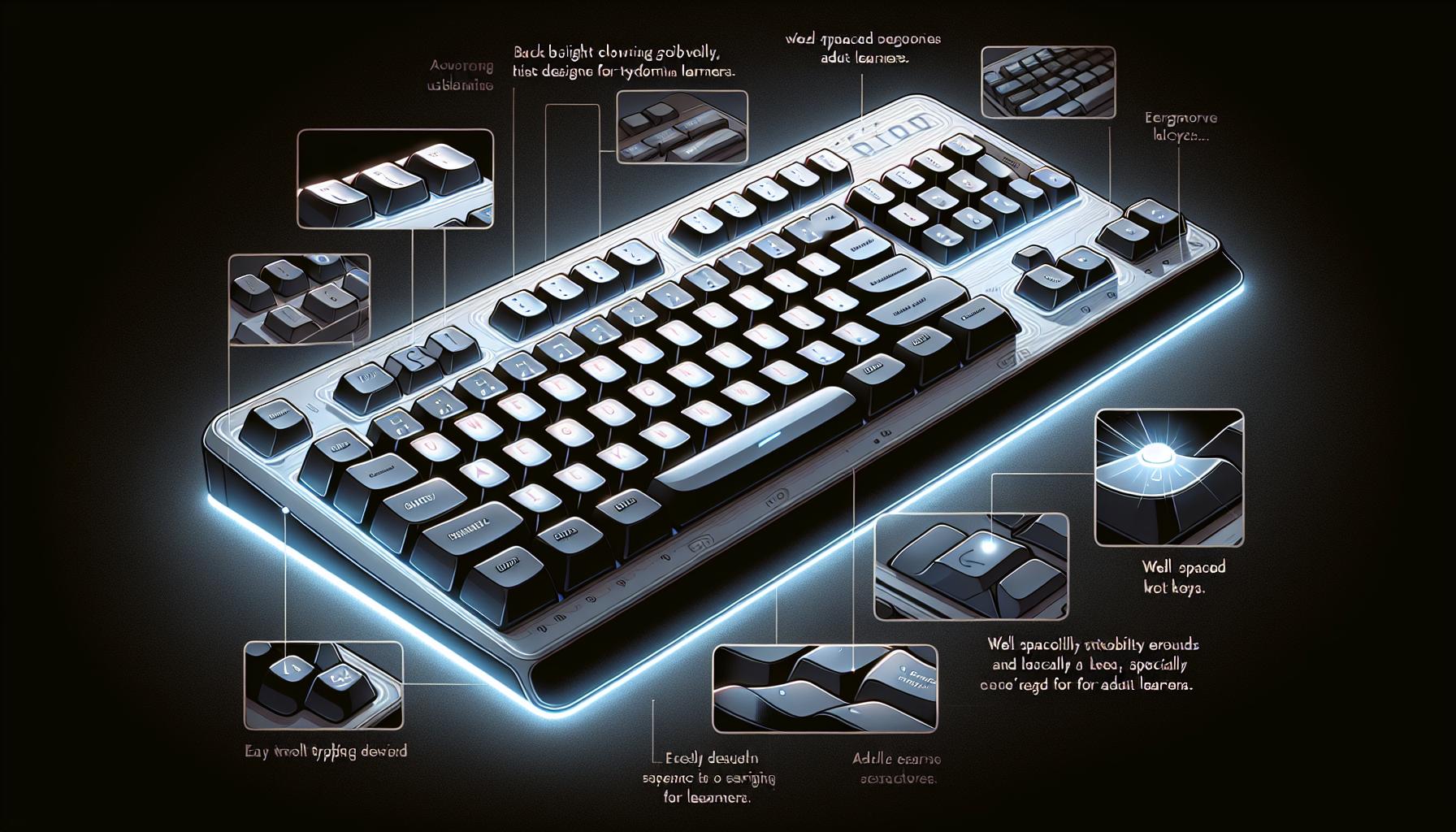
  • Casio Keyboards for Beginners: A Comprehensive Guide

    Casio Keyboards for Beginners: A Comprehensive Guide

    Casio Keyboards for Beginners: A Comprehensive Guide

    Casio Keyboards are a popular choice for beginners who want to learn how to play the piano. These keyboards are affordable, portable, and easy to use, making them an excellent option for anyone who is just starting. With many different models available, it can be challenging to know which one is right for you.

    When selecting a Casio Keyboard for beginners, the most important thing to consider is the number of keys. A full-size keyboard has 88 keys, but beginners can start with a smaller keyboard that has 61 or 76 keys. Another factor to consider is the touch sensitivity of the keys. Touch-sensitive keys respond to how hard or soft you press them, making it easier to play expressively.
    We spent hours researching and testing several Casio Keyboards for beginners to identify the ones that offer the best value for your money. Our top picks are easy to use, have excellent sound quality, and come with features that will help you learn how to play the piano.
    Best Casio Keyboards for Beginners

    Are you looking for a keyboard that is perfect for beginners? Look no further than Casio keyboards. Casio is known for producing high-quality keyboards that are perfect for beginners and professionals alike. Whether you’re just starting out or you’re an experienced musician, Casio keyboards have something for everyone. Below is our list of the best Casio keyboards for beginners.

    Casio SA76 Beginner Bundle Casio SA76 Beginner Bundle with Power Supply, Keyboard Stickers, and Instruction Book


    If you’re a beginner looking for a keyboard that comes with everything you need to start playing, the Casio SA76 Beginner Bundle is a great choice.

    Pros

    • The bundle includes everything you need to get started, including a power supply, keyboard stickers, and an instruction book.
    • The 44 mini keys are perfect for small hands and make it easy to play simple melodies.
    • The LSI sound source and 8-note polyphony ensure good sound quality, even for beginners.Casio SA-76 44-Key Mini Personal Keyboard Casio SA-76 44 Key Mini Keyboard, Orange If you’re looking for a beginner keyboard that’s affordable and easy to use, the Casio SA-76 is a great option. It’s perfect for children who are just starting to learn how to play music.Pros
      • 44 mini-sized keys and 5 percussion pads
      • 100 sounds and 50 rhythm patterns
      • Simple tone selection with PIANO, ORGAN tone button and melody on/off lesson function

      Cons

      • Product doesn’t include an adapter
      • Sound quality isn’t amazing
      • Not suitable for advanced musicians

      The Casio SA-76 is a great keyboard for beginners who are just starting to learn how to play music. It has 44 mini-sized keys and 5 percussion pads, making it easy to learn the basics of playing music. The keyboard also has 100 sounds and 50 rhythm patterns, so you can experiment with different styles of music. The simple tone selection with PIANO, ORGAN tone button and melody on/off lesson function makes it easy to switch between different sounds and learn new songs.

      One downside of the Casio SA-76 is that it doesn’t come with an adapter. You’ll need to purchase one separately if you want to use the keyboard with an AC outlet. Additionally, the sound quality isn’t amazing, but it’s suitable for beginners who are just starting to learn how to play music. Finally, the keyboard isn’t suitable for advanced musicians who are looking for more advanced features.

      In summary, the Casio SA-76 is a great beginner keyboard that’s affordable and easy to use. If you’re looking for a keyboard to help you or your child learn how to play music, this is a great option to consider.

      Casio CT-S300 61-Key Premium Keyboard Pack

      Casio CT-S300 KeyboardIf you’re a beginner looking for a portable and versatile keyboard, the Casio CT-S300 is a great choice. With its 61 full-size touch-responsive keys, 400 Tones, 77 Rhythms, and Dance Music Mode, you’ll have plenty of options to explore and create music.

      Pros

      • The keyboard is lightweight and portable, making it easy to take with you wherever you go.
      • The 400 Tones and 77 Rhythms provide a wide range of sounds and accompaniment options to choose from.
      • The Dance Music Mode is a fun and easy way to create and remix EDM tracks.

      Cons

      • The sound quality is not as good as a regular piano, but that’s to be expected at this price point.
      • The 400 sound profiles can only be selected one at a time, which can be time-consuming.
      • The keyboard is not weighted, which may be a drawback for those looking to learn piano.

      The Casio CT-S300 also includes a pitch bend wheel, an easy-to-read LCD display, and intuitive controls like the “My Setup” button, which quickly recalls your favorite sounds and settings. It even comes with a power supply, music rest, and Samson Headphones (HP30 or SR350) so you can start playing right away. Plus, you can connect it to the free Chordana Play iOS/Android app and take your music further, learning how to play your favorite songs from downloaded MIDI files.

      If you’re looking for a beginner keyboard that’s easy to use, portable, and versatile, the Casio CT-S300 is an excellent choice. It’s perfect for those who want to explore different sounds and styles of music, and it’s a great value for the price.

      Casio CT-X700 61-Key Portable Keyboard

      Casio CT-X700 61-Key Portable KeyboardIf you’re a beginner looking for a portable keyboard with great sound quality, the Casio CT-X700 is a great choice.

      Pros

      • The 61 full-size touch-responsive keys provide a realistic playing experience.
      • The 600 tones and 195 rhythms offer a wide range of musical options.
      • The Class-compliant USB-MIDI makes it easy to connect to your computer and use with music software.

      Cons

      • The 1/4″ headphone out may not provide the best sound quality compared to other keyboards.
      • The included AC adapter may not be as durable as other adapters on the market.
      • The keyboard may not be suitable for more advanced players who require more advanced features.

      The Casio CT-X700 is a great choice for beginners who want a portable keyboard with great sound quality. The AiX Sound Source Technology provides a realistic playing experience that’s perfect for casual or beginning players. The keyboard is compact and lightweight, making it easy to take with you wherever you go. The 600 tones and 195 rhythms offer a wide range of musical options to choose from, and the Class-compliant USB-MIDI makes it easy to connect to your computer and use with music software.

      Overall, the Casio CT-X700 is a great choice for beginners who want a quality portable keyboard with a wide range of features. Whether you’re just starting out or looking to upgrade your current keyboard, the Casio CT-X700 is definitely worth considering.

      Casio LK-S250 61-Key Premium Lighted Keyboard Pack

      Casio LK-S250 KeyboardIf you’re a beginner looking for a portable keyboard that’s easy to use and packed with features, the Casio LK-S250 is a great choice.

      Pros

      • The 61 full-size touch-responsive light-up keys with Casio’s Key Lighting System make learning your favorite songs easier than ever.
      • With 400 great-sounding Tones and 77 fun Rhythms, plus 10 types of reverb to add depth, you’ll never run out of inspiration.
      • Dance Music Mode lets you easily create and remix EDM tracks with drum loops, basslines, synth parts, effects, transitions and more.

      Cons

      • The sound quality is good for the money, but not as good as more expensive keyboards on the market.
      • The keys are not weighted, which may be a drawback for some users.
      • The LCD display is small and may be difficult to read for some users.

      The Casio LK-S250 is easy and fun to play thanks to its intuitive controls like the “My Setup” button, which quickly recalls your favorite sounds and settings. Plus, the class-compliant USB port connects to any Mac/PC/iOS/Android device with no drivers needed, and it connects to the free Chordana Play iOS/Android app for lessons and more. Whether you’re just starting out or looking for a portable keyboard to take on the go, the Casio LK-S250 is a great choice.

      Buying Guide

      Choosing the right Casio keyboard can be a daunting task for beginners. With so many models available in the market, it can be challenging to know which one to choose. Here are some factors to consider when buying a Casio keyboard:

      Number of Keys

      The number of keys on a keyboard is an essential factor to consider when buying a Casio keyboard. Most Casio keyboards have 61 keys, which is perfect for beginners. However, if you want a more professional keyboard, you can opt for one with 88 keys.

      Touch Response

      Touch response is another crucial feature to consider when buying a Casio keyboard. A touch response keyboard allows you to play notes at different volumes, depending on how hard you press the keys. This feature is essential for beginners who want to learn how to play expressively.

      Polyphony

      Polyphony refers to the number of notes that a keyboard can play at the same time. A keyboard with higher polyphony allows you to play more complex pieces of music. Most Casio keyboards have a polyphony of 32 or 64 notes, which is sufficient for beginners.

      Voice and Sound Quality

      The voice and sound quality of a Casio keyboard is another crucial factor to consider. Casio keyboards come with a variety of voices and sounds, including piano, organ, strings, and more. It is essential to choose a keyboard with high-quality voices and sounds to ensure that you get the best playing experience.

      Portability

      If you plan to take your keyboard with you to lessons or performances, it is essential to consider its portability. Most Casio keyboards are lightweight and portable, making them easy to carry around. However, if you want a more professional keyboard, it may be heavier and less portable.

      Summary

      After considering all the factors, we recommend theas the best keyboard for beginners. It has 61 touch-sensitive keys, 48-note polyphony, and 400 high-quality voices and sounds. It is also lightweight and portable, making it easy to carry around. With the Casio CTK-3500, beginners can learn and play music expressively and comfortably.

  • Exploring the Shared Playing Techniques between Pianos and Keyboards

    Exploring the Shared Playing Techniques between Pianos and Keyboards

    Ever wondered about the similarities between a piano and a keyboard? I’ve spent years exploring these two fascinating instruments and I’m excited to share my insights with you. At first glance, they might seem quite different, but you’ll be surprised by how much they actually have in common.

    In this article, we’ll delve into the shared characteristics of pianos and keyboards. We’ll look at their structure, the way they produce sound, and even the skills needed to play them. Whether you’re a seasoned musician or a curious beginner, there’s something here for everyone.

    Structure of a Piano

    The first thing to note is that pianos, whether grand or upright, are predominantly made of wood. This natural material not only looks aesthetically pleasing but significantly influences the instrument’s acoustics. Remember, it’s the wood that resonates when the hammer strikes a string, creating the rich, warm tones that are so distinctive to acoustic pianos.

    Let’s delve into the foundation of the piano’s structure, which is, undoubtedly, its soundboard. Typically made from spruce, the soundboard’s purpose is to amplify the vibrations from the strings, turning them into the sounds we recognize as musical notes. I can’t overstate the importance of the soundboard. Without it, the piano would be almost inaudible.

    Moving on, another integral part of the piano’s structure is its keyboard. A standard piano has 88 keys, a mix of 52 white keys and 36 black keys. The keyboard’s job? It provides the interface that allows us musicians to interact with the instrument and create music.

    Thirdly, I want to talk about the strings. They’re the voice of the piano, ranging in thickness and length to produce different pitches. The strings lie at the heart of the sound-making process: when you press a key, it triggers a hammer that strikes a specific string.

    Finally, we mustn’t forget the pedals. Normally, a piano has two or three pedals that provide various sound effects. The sustain pedal, the soft pedal, and on some pianos, the sostenuto pedal. By altering the way strings vibrate, pedals can sustain notes, soften sounds, or enable selective sustain.

    The structure of a piano may seem complex, but in reality, it’s this intricate design and craftsmanship that grants its unique, enchanting sound. Let’s keep exploring other remarkable aspects of these enthralling musical instruments.

    Structure of a Keyboard

    Ever wondered how keyboards produce those rich, layered sounds? Just like with pianos, it’s not all magic, so let’s delve into the inner workings of keyboards.

    Keyboards operate on a whole different principle as compared to pianos. Instead of relying on acoustic science and raw materials like wood, keyboards use digital technology. This can give keyboards a distinct advantage as this allows them to mimic not only the sound of a piano but also other instruments.

    At the core of a keyboard is its microprocessor. This brainbox is responsible for translating key presses into sound signals. Although I think it’s important to note that the complexity of these processors varies greatly between models, with some offering more responsive action and nuanced sound generation than others.

    The individual keys on a keyboard work by activating switches under each key. When the key is pressed, the switch sends an electric signal to the microprocessor. This signal is then translated into a corresponding musical note, which is output through the keyboard’s speakers.

    Keyboards also come with a wide array of additional features, providing a broader palette of sound-bending tools. Examples include modulation wheels, pitch bends, and effects such as reverb, echo, and others. Some even come with preloaded beats to accompany your solo performance.

    Much like pianos, keyboards also make use of pedals though theirs is often optional and is used to sustain or mute the sound. One key difference however is that the sound from a keyboard doesn’t reverberate the same way as in a piano, due large in part to the lack of a soundboard.

    In terms of materials, keyboards are generally made of plastic and metal, making them lighter, portable, and more flexible than their piano counterparts. Each of them has their unique construct and manufacturing process, offering their specific set of features and sound quality.

    So while, in appearance, the keyboard and piano might seem similar, they have their respective mechanisms and workings. Each offers a distinct level of complexity and sophistication, creating a world of versatile sounds for music enthusiasts. The choice between them thus boils down to individual preference, commitment, and the type of music you wish to create.

    Sound Production in Pianos and Keyboards

    Over the years, I’ve come across various musical instruments. However, the intricacies and differences in sound production between pianos and keyboards absolutely intrigue me.

    Let’s delve into the world of pianos first. The sound produced by a piano is a result of acoustic science at work. When a pianist strikes a key, a hammer mechanism inside the piano cause the corresponding string to vibrate. It’s these vibrations that produce the rich, resonant sounds we associate with pianos.

    Here’s a simplified breakdown of the process:

    1. Pianist strikes a key
    2. Lever action of the key escapement lifts the hammer
    3. Hammer strikes the string
    4. String vibrates and produces sound

    The unique material composition of a piano, usually a mix of metal, wood, and felt, adds to the authenticity and warmth of its sound. Each piano has a distinct character because of the variations in their components and constructions.

    Transitioning to the realm of keyboards, they operate on the foundations of digital technology. Unlike the piano, keyboards don’t rely on physical strings or hammers. At the core of a keyboard is its microprocessor, which translates key presses into sound signals. I find it fascinating that the individual keys on a keyboard work by activating switches under each key, sending an electric signal to generate sound.

    To put it simply:

    1. Keyboard player presses a key
    2. Key activates a switch
    3. Switch sends signal to microprocessor
    4. Microprocessor generates and outputs sound

    Given their digital nature, keyboards also offer a plethora of additional features such as modulation wheels, pitch bends, and effects. This versatility is a bonus for artists looking to explore a myriad of sounds and musical styles.

    The beauty of music lies in its diversity, and both pianos and keyboards have their distinctive place in the grand scheme of things. Choosing between them is a matter of individual preference and the type of music one aspires to create. Even as we continue to delve deeper into their respective mechanisms and workings, there’s always more to discover and appreciate in both these wonderful instruments.

    Key Differences and Similarities in Sound Quality

    As a seasoned musician, I’ll tell you that there’s a fundamental difference in the sound produced by a traditional piano and a digital keyboard. Pianos, with their hammers and strings, deliver rich, vibrant acoustics. They create a resonating sound that’s warm and organic, capturing the true essence of the music being played.

    On the other hand, keyboards possess a digital heartbeat, powered by a microprocessor. This advanced technology feeds off digitally stored sound samples. The acoustic ‘sampling’ enables the recreation of a wide array of instrument sounds – not just the piano. It even offers special effects like reverb, delay, and others.

    There’s also an aspect of sound manipulation with keyboards that is simply not there with conventional pianos. Keyboards can electronically control the sound’s frequency, amplitude, and other characteristics. This leads to a greater variety of sound; from pitch bends to modulation wheels, there’s a whole world of sonic exploration at your fingertips.

    What about sound quality? Well, professional keyboards can generate sound extremely similar to pianos. Some high-end models even use the actual piano sound samples to offer an almost identical experience. However, aficionados argue that despite the technology, keyboards can’t quite match the unequivocal depth and complexity of acoustics a well-tuned piano delivers.

    No argument, both pianos and keyboards have their unique sound profiles and each has its own place in the music world. The choice between them hinges on personal preference, the style of music, and perhaps even the performance setting. Acknowledging these differences and similarities brings us closer to making an informed decision, better suited to our individual needs and goals.

    Playing Skills: Transferable or Different?

    So, you’ve gotten a firm grasp on the sound production aspect of pianos and keyboards. I’m sure you’re now pondering if the playing skills for these instruments are interchangeable, or if they differ substantially.

    Let’s delve into this intriguing topic. Many of you might already know that the basic playing technique is, indeed, transferable. Both pianos and keyboards share identical layout of keys. This means that the fundamental knowledge of scales, chords, and progression you’ve mastered on a piano will effortlessly translate to a keyboard — and vice versa.

    On the flip side, serious musicians will tell you that the devil’s in the detail. They’re not wrong. For instance, a noticeable difference lies in the tactile sensation under your fingertips. Acoustic pianos sport wooden or ivory keys, and when pressed, a physical hammer strikes against a set of strings, creating a distinct touch experience. This touch sensitivity is something that most keyboards, specifically lower-end models, can struggle to replicate.

    Moreover, keyboardists have additional elements at their disposal — modulation wheels, pitch bends, and a world of digital sound manipulation tricks. Getting the hang of these enhancements requires practice beyond traditional piano training. These additional features open up an entirely new universe of possibilities, allowing you to add unique flairs to your performances that simply aren’t possible on an acoustic piano.

    Ultimately, while the basic playing skills are largely transferable between pianos and keyboards, proficiency in a singular instrument would necessitate understanding and mastering their unique nuances. This raises an interesting question — rather than asking which is better, maybe we should be considering how the two can complement each other within the spectrum of musical performance.

    After all, why limit yourself to one when you can tap into the best of both worlds? Music, like many forms of creativity, thrives on diversity and the merging of different skills and elements. That’s what fuels its evolution and keeps the audial landscape engaging.

    Conclusion

    So, it’s clear that pianos and keyboards share a common ground with their identical key layout. This similarity eases the transition of skills from one instrument to the other. Yet, they offer distinct experiences, from the touch of wooden or ivory keys on a piano to the extra elements like modulation wheels on keyboards. It’s not about determining which is superior. Instead, I believe the beauty lies in understanding how these two instruments can enrich each other, broadening the horizons of musical performance. Whether you’re a pianist or a keyboardist, there’s always something to gain from exploring the other side. Embrace the differences, appreciate the similarities, and let’s continue to make beautiful music.

  • Exploring the Harmonious Ecosystem of a Piano: A Unique Comparison to Rainforests

    Exploring the Harmonious Ecosystem of a Piano: A Unique Comparison to Rainforests

    Ever wondered what the piano is similar to? It’s not just a musical instrument; it’s a world in itself. In this article, I’ll delve into the fascinating similarities between the piano and some unexpected objects and concepts.

    You might think it’s like a harp on its side or a complex typewriter for music. But you’ll be surprised at how its structure and function mirror things far beyond the realm of music. From architectural marvels to intricate ecosystems, the piano’s resemblances are as diverse as they are intriguing.

    The Piano and the Harp

    Having set our eyes upon the grand structure of a piano, the first comparison that naturally comes to view is the harp. The piano and the harp share foundational similarities that remain unnoticed till we take a closer peek!

    At the basic level both are string instruments. But it’s not just about the fact that they’re strung with wires, there’s more here that meets the eye. The technical workings of a piano bear a striking resemblance to those of a harp. The weighted keys of a piano, when pressed, come in contact with the strings causing them to vibrate and create sound— much like how the strings vibrate to produce sound when plucked on a harp. This points towards a deep-seated kinship between these two musical crafts.

    Another level where the piano finds company with the harp lies in their visual aesthetics. The grandeur of a grand piano is well mirrored in the towering elegance of a concert harp. Their forms serve to evoke equal portions of respect and admiration among their audiences, adding a layer of intrigue to their performances. It is no coincidence then, that both instruments often take center stage in musical ensembles.

    Let us turn our attention toward the melodious symphony both the piano and the harp are known to create. They are both versatile instruments, capable of producing a wide array of tones and notes that are central to the narrative of music. What’s fascinating is how they marry their technical premises with their musical applications, harnessing their physical attributes to draw out the tunes and melodies that captivate our hearts.

    Remember, the piano isn’t just a musical instrument, it’s a world within itself. As we continue to explore the connections and likenesses it shares with other forms and objects, we’ll invariably glean more insight into its grandeur and inherent beauty— just like uncovering different layers of a complex ecosystem or an architectural marvel. Let’s move forward to find more answers and deepen our understanding of this magnificent instrument.

    The Piano and The Typewriter

    One of the less likely comparisons that may spring to mind is the connection between the piano and the typewriter. This analogy might seem unusual at first, but let’s unravel the similarities that tie these two intriguing objects together.

    Typewriters, much like pianos, require the user’s fingertips to come in contact with keys in a precise order to create an outcome. For the piano, that outcome is melody; for the typewriter, it’s words formed into sentences and ultimately stories. This symbiotic relationship between fingers and keys is what binds these two seemingly disparate devices together.

    A piano’s keyboard, akin to that of a typewriter, features parallels in design and function that are impossible to ignore. Both keyboards are composed of adjacent keys with the potential to produce different notes or letters. The force or speed at which these keys are struck can affect the instrument’s output, where a heavy stroke on a piano key denotes intense emotion or a capital letter on a typewriter.

    The user’s skill level and understanding of the instrument or machine also parallels. A novice at a piano might be able to pound out ‘Twinkle Twinkle Little Star’ just as a beginner typist might slowly hunt-and-peck until forming a sentence. Conversely, when a master pianist plays a Chopin nocturne, or a seasoned writer hammers out a riveting story, the beauty, complexity, and emotion conveyed are beyond words.

    So, in essence, pianos and typewriters are both instruments that transform simple key strokes into something far greater; whether that’s a moving piece of music, or a compelling narrative. They each exhibit a unique blend of artistry and mechanics that we can admire and appreciate.

    The humble typewriter and the grand piano – both have deeper connections and similarities than what meets the eye, encouraging us to further explore the intersections between everyday objects and musical instruments. From structure to function, from physical use to emotional output, the piano and the typewriter unassumingly mirror each other in fascinating ways.

    The Piano and Architectural Marvels

    In analyzing other noteworthy comparisons, I’ve found the piano shares a unique kinship with architectural marvels found all over the world. Now you might be wondering, How does a piano relate to towering structures or beautifully designed buildings? I promise you’ll understand once we delve a bit deeper.

    When you think about it, architecture and music – the kind brought to life on a piano – share a common foundational element – harmony. Without harmony, buildings wouldn’t stand and music would fail to capture our hearts.

    Architects plan their masterpieces with precision, paying close attention to every minute detail. Similarly, a pianist touches each note with an intention, creating a delicate balance between different sounds. The pianist’s accomplishment is not just in playing the right notes, but also in maintaining the right rhythm, kind of like how an architect would focus on symmetry and proportions in a structure.

    Skyscrapers mirror the grandeur of the grand piano, both evoking a sense of awe and wonder. The solid base of a skyscraper is akin to the structure of the piano’s soundboard– both providing the support and resonance needed to ensure stability and clear output.

    The comparison between building designs and piano composition isn’t just metaphorical. In fact, the Golden Ratio – often found in well-designed architectural works – is also present in piano compositions. This mathematical proportion gives both buildings and music a sense of aesthetic and balance.

    Just like a pianist strikes the right keys in a sequence to get a harmonious output, an architect puts together the right elements to build a structure that’s nothing less than a masterpiece.

    I hope this comparison helps you appreciate both the piano and the world of architecture in a new light. It’s one of the many ways pianos are more than just instruments, they are an embodiment of creativity and precision, like many other aspects of life.

    The Piano and Intricate Ecosystems

    Imagine standing in the heart of a thriving, vibrant rainforest. You’d be surrounded by an intricate ecosystem, wouldn’t you? Every organism, from the tiny insects to towering trees, playing a vital role in maintaining balance. This harmony of interactions and interdependencies often reminds me of the dynamic relationship between the intricate components of a piano.

    At first glance, a forest and a piano might seem unrelated. However, dive deeper, and you’ll spot striking similarities. Both display a complex network, perfectly synchronized to operate in harmony. Just as every organism in a rainforest plays its part, every key and string within a piano has a precise purpose.

    What’s most uncanny is how the health of an ecosystem mirrors the sound quality of a piano. In an ecosystem, the disappearance of a single species can tilt the balance. Similarly, a single faulty key can disrupt an entire piano performance. This delicate balance, this careful maintenance of all elements, underscores the most surprising similarity between a piano and an intricate ecosystem.

    Moreover, the biodiversity within a rainforest is comparable to the richness of sound a piano can produce. With its varied keys and strings, a piano can generate an array of sounds, just as a rainforest can house an array of species. In a rainforest, every species performs a different role, contributing to the overall biodiversity. Similarly, every note on a piano offers a different tone, contributing to the musical biodiversity of a composition.

    Consider this: when we protect our ecosystems, we ensure the survival and thriving of the myriad species they contain. The same logic applies to a piano. Regular maintenance, or ‘piano care’, ensures that each key and string functions perfectly, preserving the rich biodiversity of its sounds.

    Such a comparison may seem unusual. Yet, it exposes the fascinating complexity and interconnectedness of the world around us. So next time you experience the rich harmony of a piano performance, remember, you’re listening to something analogous to an intricate, thriving ecosystem. But, we are not done yet – our exploration of piano similarities is far from over.

    Conclusion

    So, we’ve seen how the piano is much like a rainforest. Their shared complexity and harmony make for a fascinating comparison. The balance in both is delicate – a single missing species or faulty key can throw everything off. Yet, it’s this very complexity and diversity that make them both so captivating. The rich biodiversity of a rainforest is echoed in the wide range of sounds a piano can produce. It’s these intricate networks, whether in nature or in music, that remind us of the interconnectedness of the world we live in. The piano, like the rainforest, is a testament to the beauty of complexity and harmony working together.