Blog

  • Top Easy Pop Keyboard Songs for Beginners: Learn & Play with Joy

    Top Easy Pop Keyboard Songs for Beginners: Learn & Play with Joy

    Starting to learn the keyboard can feel like a daunting task, especially if you’re eager to play your favorite pop songs. But guess what? There’s a whole world of catchy, easy-to-learn tunes that are perfect for beginners. These songs not only sound great but also provide a solid foundation in keyboard basics, from chord progressions to melody lines.

    Diving into pop songs is a fantastic way to stay motivated and enjoy your musical journey from the get-go. They’re familiar, fun, and often come with simple structures that make them ideal for those just starting out. So, if you’re ready to start tickling those ivories with some pop flair, you’re in for a treat.

    Understanding Chord Basics

    Embarking on a musical journey, especially with the keyboard, involves a fundamental appreciation of chords and their role in creating harmony and melody. For beginners, grasping chord basics is not just about learning how to play; it’s about unlocking the simplicity behind popular music.

    Chords are essentially a group of notes played together to create a harmonious sound. What makes pop songs ideal for beginners is that they often rely on a limited set of simple chords, making them easier to learn and master. These chords—major, minor, and seventh chords—are the building blocks of countless songs and are your first step towards playing catchy tunes.

    Major Chords: The Happy Sounds

    Major chords are known for their bright and cheerful sound, fitting perfectly with the upbeat sections of pop songs. They’re formed by combining the root note, the major third, and the perfect fifth of the major scale. For instance, a C major chord involves playing C, E, and G. These chords are often used in the chorus to lift the mood and create a memorable melody.

    Minor Chords: The Soulful Echoes

    In contrast, minor chords carry a more somber tone, adding depth and emotion to a song. They consist of the root note, the minor third, and the perfect fifth. Switching from an A major chord (A, C♯, and E) to an A minor chord (A, C, and E) lowers the third by a half step, drastically changing the vibe of the music. This tonal shift is essential in adding complexity and variety to the tunes.

    Seventh Chords: A Touch of Jazz

    Seventh chords add an extra layer of sophistication and are frequently found in pop music bridges or as part of a song’s hook. They’re built by adding a fourth note, the seventh, to the basic triad, creating an even richer sound. For example, a G seventh chord (G7) will include G, B, D, and F. These chords often introduce a sense of anticipation or a lead-in to a powerful section of the song.

    • Learn the basic chord shapes for major, minor, and seventh chords on the keyboard.
    • Practice transitioning between these chords smoothly, as pop songs often involve quick changes.
    • Select easy pop songs that utilize a few simple chords and play along with the track

    Simple Melodies to Practice
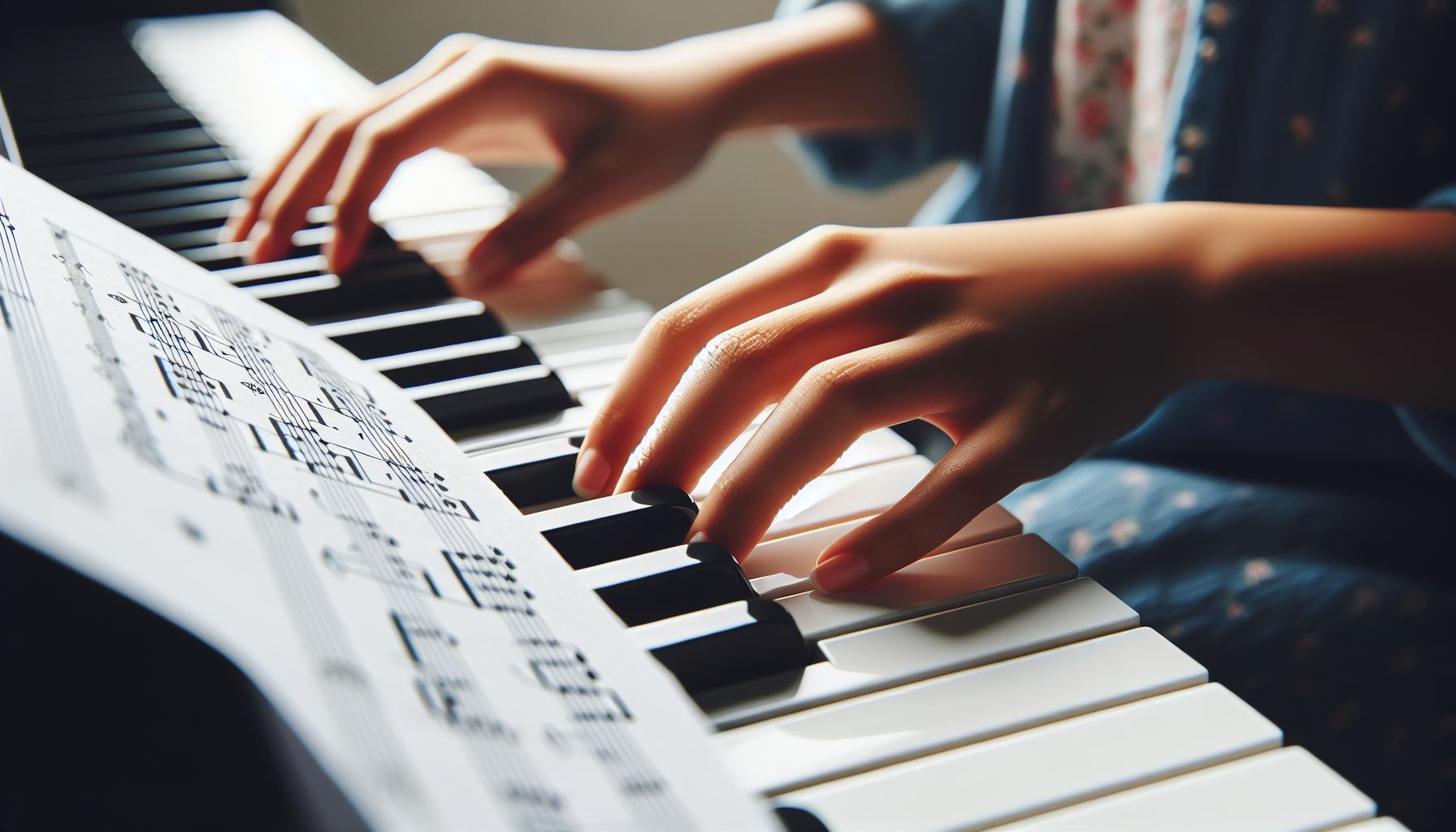
    As beginners find their footing in the realm of keyboard playing, transitioning from mastering chords to incorporating melodies presents a thrilling next step. Simple melodies, often found in pop songs, offer an avenue through which novices can explore various aspects of music theory in practice. These tunes aren’t just catchy; they’re also considerably easy to pick up, even for someone just starting out.

    One of the charms of pop music lies in its straightforward structure—usually a verse followed by a chorus that repeats. This repetition aids beginners in recognizing patterns and understanding song construction. Moreover, many pop songs utilize a limited range of notes, making them less daunting for those who are still familiarizing themselves with the keyboard layout.

    Pop songs from the 80s and 90s, in particular, are known for their melodious and straightforward keyboard parts. Songs like “Every Breath You Take” by The Police or “Don’t Stop Believin'” by Journey feature memorable keyboard riffs that are not overly complex. These classics provide an excellent starting point for beginners eager to combine chord progressions with melodic playing.

    In addition to these older hits, contemporary tracks also serve as great learning material. Artists like Adele and Ed Sheeran often use simple but effective piano parts in their music, making their songs accessible for keyboard learners. Adele’s “Someone Like You” and Sheeran’s “Perfect” are prime examples of modern pop songs that combine simplicity with emotional depth, making them enjoyable yet straightforward pieces to learn.

    To assist beginners in navigating their learning journey, here’s a list of pop songs, categorized by their difficulty level, to practice:

    • Easy

    • “Let It Be” by The Beatles
    • “Clocks” by Coldplay
    • “All of Me” by John Legend
    • “Lean on Me” by Bill Withers
    • “Imagine” by John Lennon
    • “I’m Yours” by Jason Mraz

    This approach of starting with simpler songs and gradually moving to more challenging pieces allows beginners to build confidence and skill incrementally. Furthermore, practicing these songs not only enhances technical ability but also helps in developing a keen ear for melody and harmony.

    Building Finger Dexterity
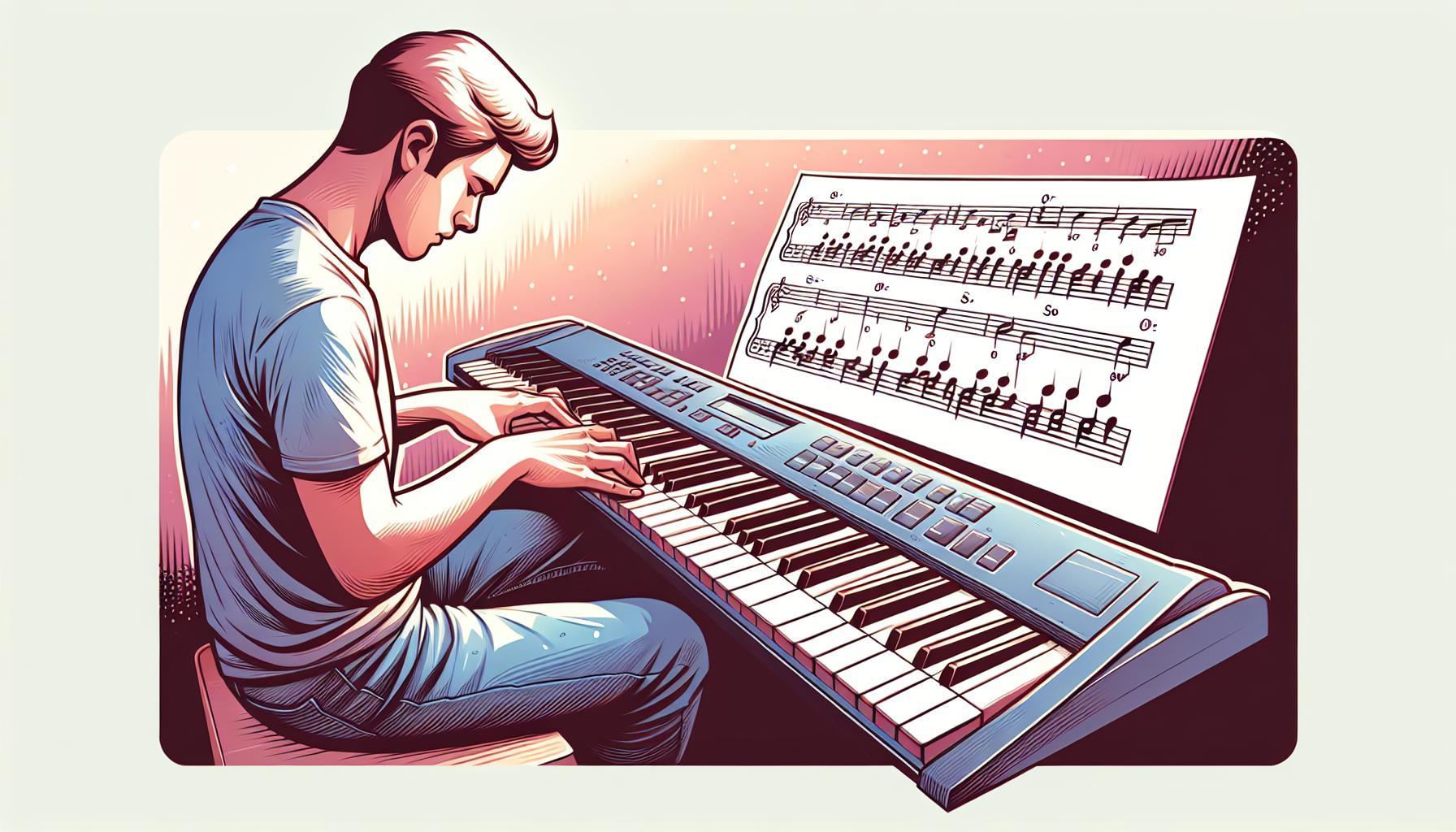
    As beginners dive into the world of pop keyboard songs, building finger dexterity becomes a crucial step in their musical journey. This progression from mastering chords to playing melodies isn’t just about learning notes—it’s about making those notes fluid, expressive, and ultimately, effortless. Finger strength and agility play a significant role in this process, enabling new players to transition smoothly between chords and melodies.

    Practicing scales is an invaluable method for improving finger dexterity. Though it might seem monotonous, engaging in daily scale practice can significantly enhance one’s ability to maneuver across the keyboard with precision and speed. C Major, being a scale without sharps or flats, is an excellent starting point for beginners. As confidence and skill level increase, incorporating minor scales and those with sharps and flats adds complexity and further challenges finger coordination.

    Hand independence is another critical area to focus on. Often, beginners find their hands want to mirror each other’s movements. To combat this, exercises specifically designed to promote hand independence should be integrated into practice routines. Playing different rhythms or notes with each hand can initially be frustrating but becomes easier with perseverance. This skill not only boosts dexterity but also prepares players for the intricate melodies and harmonies found in many pop songs.

    To put these skills into a practical context, beginners should start with simple pop songs that allow them to apply what they’ve learned. Songs with repetitive chord progressions or melodies are particularly useful. For instance, Adele’s “Someone Like You” offers a repetitive, yet soulful, piano riff that’s perfect for practicing chord transitions and finger pacing. Similarly, Ed Sheeran’s “Perfect” stands as another example of a song with a gentle melody line that’s great for beginners to learn fluid hand movements.

    Engaging in Effective Practice Techniques

    To maximize the benefits of practice, beginners should adopt effective techniques that encourage progression. Setting small, achievable goals for each practice session can help maintain focus and motivation. Whether it’s mastering a new scale, perfecting a section of a song, or improving hand coordination, having specific objectives can make practice sessions more productive.

    Tips for Playing with Rhythm
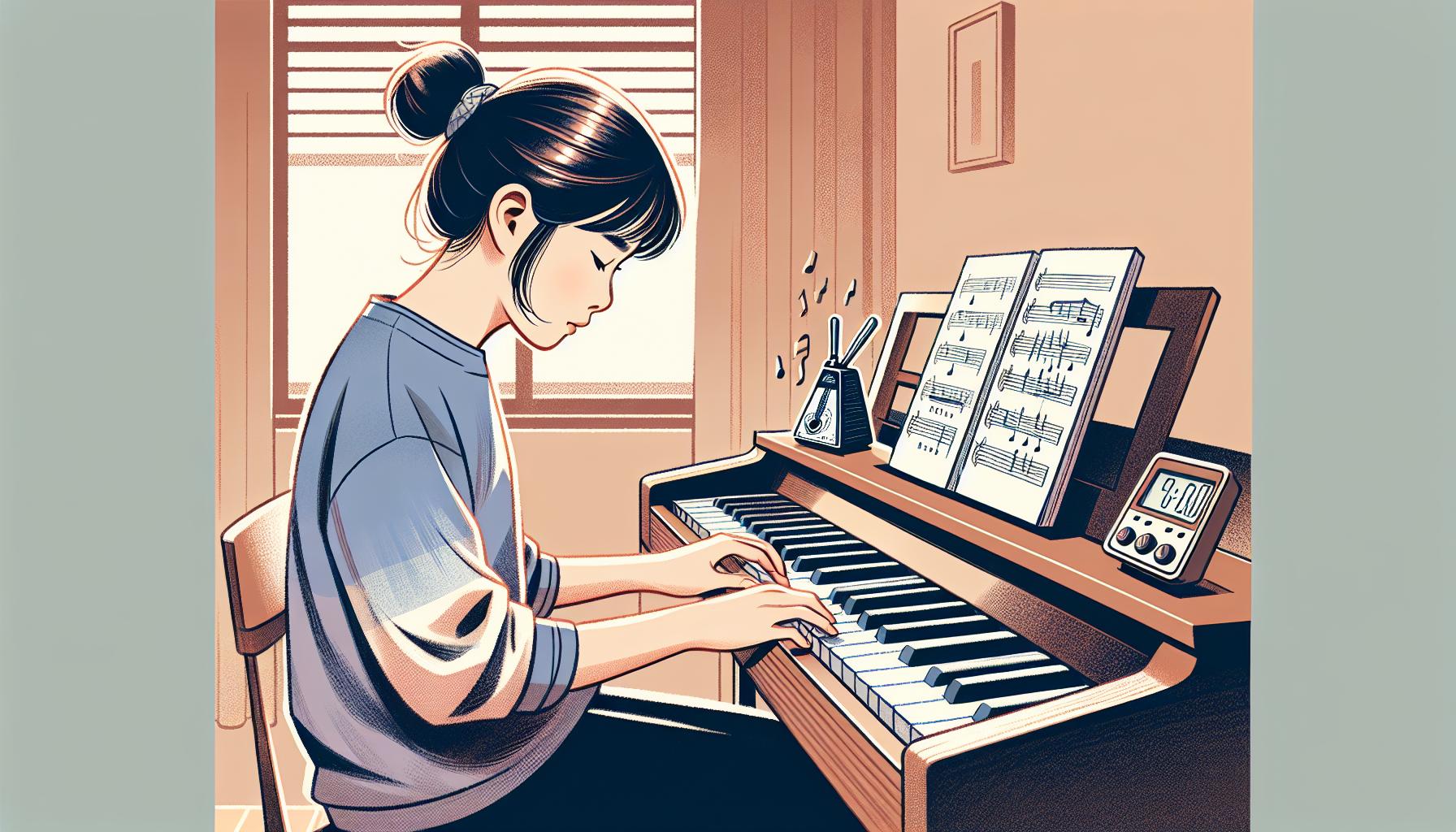
    When beginners venture into playing pop songs on the keyboard, mastering the rhythm is just as crucial as getting the notes right. Rhythm acts as the heartbeat of any song, setting the pace and bringing the music to life. For newcomers, grasping the rhythm might initially seem daunting, but with some focused strategies, it becomes an integral part of their musical journey.

    First and foremost, listening is key. Before even attempting to play a song, beginners should immerse themselves in its rhythm by listening to it multiple times. This practice helps internalize the beat, making it easier to replicate when playing. Creating a mental map of the song’s structure can significantly improve one’s ability to play with the correct rhythm.

    Metronomes are invaluable tools for learners. These devices keep a consistent beat, aiding players in maintaining a steady tempo. Beginners should start practicing with a metronome at a slow pace, gradually increasing the speed as they become more comfortable with the song. Here’s a simple progression strategy:

    Starting Tempo (BPM) Increase After Mastery
    60 5-10 BPM
    70 5-10 BPM
    80 When ready

    Tapping the rhythm with hands or feet before playing can also bridge the gap between understanding the rhythm and executing it on the keyboard. This physical manifestation of the beat helps solidify the timing and flow of the music.

    Another tip is to break down the rhythm into smaller, more manageable components. Focusing on mastering the rhythm of one section at a time allows for a deeper understanding and more precise execution when combining them later.

    Practicing hand coordination exercises separately can further enhance rhythmic accuracy. Since many pop songs require simultaneous melody and rhythm, developing independence between the hands ensures that the rhythm remains steady even as the melody varies. Simple exercises, such as playing different rhythms with each hand or alternating between them, can make a substantial difference.

    Incorporating rhythm-centric exercises into practice routines is beneficial. Clapping rhythms, using rhythm flashcards, or even playing along with drum beats can heighten one’s rhythmic awareness and agility.

    Lastly, patience and persistence are vital. Rhythm skills, like any aspect of musicianship, require time to develop. Celebrating small victories and incremental progress keeps motivation high and makes the learning process enjoyable.

    Fun Pop Songs to Get Started
    When embarking on the journey of learning pop songs on the keyboard, it’s crucial for beginners to choose pieces that are not only popular but also straightforward and enjoyable to play. These songs often have simple chords and rhythms, making them perfect for new players. Here’s a list of fun pop songs that are excellent for beginners to get started with.

    • “Let It Be” by The Beatles: This classic song has a slow, clear melody and simple chord progressions.
    • “All of Me” by John Legend: With its emotional depth and repetitive structure, it’s great for practicing chord transitions.
    • “Clocks” by Coldplay: Featuring a distinctive piano riff, this song is fantastic for learning rhythmic patterns.
    • “Lean on Me” by Bill Withers: This song offers a great lesson in playing chords and melody together.

    These songs not only help in honing keyboard skills but also keep the learning process engaging and fun. Practicing them can boost confidence as beginners start to play recognizable tunes right from the start.

    Advancing from mastering rhythm, incorporating these pop songs into practice sessions can provide a more comprehensive learning experience. They encourage students to apply their rhythmic skills in playing real music, bridging the gap between exercises and performance. Moreover, playing enjoyable and familiar tunes can significantly enhance motivation. It gives immediate feedback on progress, as improvements can be heard and felt directly through the music they’re playing.

    To effectively learn these songs, beginners should focus on breaking them down into smaller sections. It’s often helpful to start with the chord progressions before adding the melody. Listening to the original track can serve as a great reference and inspiration. Many of these songs also have tutorials and sheet music available online, which can be invaluable resources for self-learners.

    Incorporating technology into practice can also enhance the learning experience. Using apps and websites that offer interactive piano lessons and games can make practice sessions more engaging. These tools often have features that allow learners to play along with the song at a slower tempo, gradually increasing speed as they become more comfortable.

    Practicing these pop songs can go beyond merely playing the right notes. Beginners should pay attention to the dynamics and expression of the music. Adding personal touches to their rendition of the song can make the performance unique and more enjoyable for both the player and the audience.

    Conclusion

    Diving into the world of pop songs on the keyboard opens a door to not only mastering a new instrument but also enjoying every step of the journey. By starting with catchy, easy-to-learn tunes, beginners can quickly feel a sense of accomplishment. It’s about making practice sessions as enjoyable as they are educational. With the right approach, breaking songs down, and embracing technology, anyone can turn their practice into a captivating musical adventure. Remember, it’s not just about hitting the right notes; it’s about expressing yourself through music. So grab your keyboard, pick a song, and let your musical journey begin.
  • Mastering Adaptation: Classical Music for Keyboard Explained

    Mastering Adaptation: Classical Music for Keyboard Explained

    Adapting classical music for keyboard is like giving old masterpieces a new lease on life. It’s not just about playing notes; it’s about weaving a new story with threads of the past. Imagine the lush harmonies of a full orchestra distilled into the intimacy of a single instrument. That’s the magic waiting to unfold.

    For many musicians, the challenge of bringing orchestral depth to the keyboard is a thrilling journey. It’s a blend of respect for the original compositions and the creativity to reimagine them. Whether you’re a seasoned pianist or a curious beginner, the world of classical adaptations offers a unique way to connect with music’s timeless beauty.

    Exploring the Art of Classical Music Adaptations

    Adapting classical music for the keyboard is like walking through a bridge spanning centuries, connecting the rich tapestries of musical history to the present day. The art of adaptation is not just about transferring notes from one score to another; it’s an intricate process requiring creativity, a deep understanding of the original piece, and a respectful approach to its reinterpretation.

    One of the foremost challenges faced during this adaptation process is capturing the essence and depth of orchestral compositions within the confines of a piano’s 88 keys. A piano, despite its range, is a singular instrument compared to an orchestra’s multitude of voices and timbres. Therefore, pianists and arrangers must make thoughtful decisions about which elements to highlight and which to simplify, always aiming to preserve the emotional core of the original composition.

    Essential Elements of Successful Adaptations

    • Fidelity vs Innovation: Balancing respect for the original work with the personal touch of the pianist is crucial. Successful adaptations often strike a perfect balance, offering listeners a new perspective on familiar tunes without distorting their inherent beauty.
    • Technical Mastery: The pianist must possess not only proficiency but also a deep understanding of both the keyboard and the original score. This mastery allows for the seamless integration of complex orchestral parts into a coherent and expressive piano performance.
    • Emotional Insight: Great adaptations resonate emotionally with the audience. They capture the mood and spirit of the piece, transforming mere notes into a compelling musical narrative that speaks across time.

    In the process of adaptation, certain technical choices become pivotal. Transcribers often face decisions about octave placement, harmonization, and dynamics that can drastically alter the listener’s experience. For instance, a powerful brass section theme might be transformed through the use of the piano’s lower octaves, coupled with skillful pedaling for resonance. Similarly, fast string sections may be adapted using intricate arpeggios or skillfully crafted runs that mimic the lightness and agility of bows on strings.

    The journey of adapting classical music for the keyboard is also a deeply personal one. Each pianist brings their unique interpretation and emotional connection to the piece, infusing it with individuality and fresh insights. Through this process, timeless compositions are reimagined, making them accessible to new audiences and ensuring their place in the ever-evolving landscape of classical music.

    Understanding the Essence of Keyboard Adaptations

    When it comes to adapting classical music for the keyboard, it’s not just about transferring notes from one score to another. The essence of keyboard adaptations lies in recreating the emotional and auditory experiences of the original compositions within a new medium. This section explores the nuance and depth required to achieve such transformative reinterpretations.

    One of the primary challenges in keyboard adaptations is maintaining the integrity of the original piece while navigating the physical limitations of the piano. Unlike an orchestra with its diverse range of instruments, the piano must singularly encapsulate a broad spectrum of tones, dynamics, and textures. Adaptation, therefore, becomes an art form in itself, demanding both technical mastery and a deep emotional understanding of the work being translated.

    Key aspects that adaptors must consider include:

    • Fidelity vs. Innovation: Striking the right balance between staying true to the original score and introducing novel interpretations to suit the keyboard.
    • Technical Adjustments: Adjusting octave placement, chord voicings, and harmonization to replicate the complexity and depth of orchestral sounds.
    • Emotional Resonance: Ensuring the adapted piece continues to evoke the intended emotions and narratives of the original composition.

    Successful adaptations often hinge on the adaptors’ ability to make thoughtful decisions in these areas, always with an eye towards honoring the spirit of the original work.

    In addition to these considerations, the unique characteristics of the piano as an instrument play a pivotal role in shaping adaptations. The piano’s ability to produce both percussive and sustained sounds offers unique opportunities to mimic a wide array of orchestral effects. Adaptors might use the sostenuto pedal to imitate sustained wind instrument notes or employ rapid arpeggios to simulate the shimmer of string sections. These technical choices require not just an understanding of the piano’s capabilities but also of how different instruments interact within an orchestral setting.

    Moreover, the pianist’s interpretative skills become crucial. Each pianist brings their personal touch to the adaptation, influenced by their technical skillset, emotional insights, and overall musicality. This individuality adds another layer of depth to adaptations, ensuring that each version offers a new and distinct listening experience.

    Techniques for Transforming Orchestral Music for Keyboard

    When adapting orchestral music for the keyboard, a thorough understanding of the original score and its emotional landscape is paramount. The journey of transformation involves not just a literal translation of notes but a deep dive into the essence of the piece. Here, the adaptors use a variety of techniques to preserve the integrity of the original while making it playable and expressive on a single instrument.

    Transcription Versus Arrangement

    Firstly, it’s important to differentiate between transcription and arrangement. Transcription involves transferring music note-for-note from the original score to the keyboard. This approach seeks to stay as true to the original composition as possible. On the other hand, arrangement offers more freedom, allowing the adaptor to modify, add, or omit elements to fit the keyboard’s capabilities and to highlight certain features of the music.

    Technical Adjustments

    Key technical adjustments are often necessary for a successful adaptation:

    • Octave Placement: To mimic the vast range of an orchestra, adaptors may shift melodies and harmonies across different octaves. This technique helps in recreating the depth and texture of orchestral sounds.
    • Harmonization: Since a single keyboard can’t replicate the multitude of voices in an orchestra, adaptors cleverly use harmonization to fill in the tonal richness. Chord voicings and counterpoint play critical roles here.
    • Pedal Usage: The sustain and sostenuto pedals become powerful tools in emulating the sustain of strings or the resonance of brass instruments, adding a layer of expressiveness.

    Mimicking Orchestral Effects

    The keyboard’s unique characteristics allow adaptors to creatively mimic various orchestral effects. Techniques such as rapid arpeggios or trills can simulate the fluttering of woodwinds, while heavy chordal passages might represent the power of brass sections. Adaptors often leverage the dynamic range of the keyboard to mirror the intensity levels of different orchestral sections.

    Emotional Resonance

    Beyond technical aspects, ensuring the adaptation carries the emotional weight of the original piece is crucial. This involves interpretative decisions by pianists, such as:

    • Adjusting tempo and dynamics to evoke the intended emotional responses.
    • Emphasizing certain melodies or harmonies to highlight the piece’s emotional peaks and valleys.
    • Utilizing articulation and phrasing to breathe life into the music, making the keyboard speak with the same emotional depth as an orchestra.

    Navigating the Challenges of Adapting Classical Pieces

    When adapting classical music for the keyboard, musicians often confront a series of unique challenges, each demanding a thoughtful approach to ensure that the essence of the original piece is not lost in translation. At the heart of these challenges is the need to maintain the intricate balance between technical fidelity and emotional expressiveness, a task easier said than done.

    One of the primary obstacles is the sheer complexity of orchestral scores. These compositions were crafted with a full range of instruments in mind, each contributing to the overall texture and timbre of the piece. Adaptors must make difficult decisions about which lines to prioritize and which to modify or omit entirely. This process involves a deep understanding of the composition’s structure and an ability to distill its essence into a form that a single instrument can convey.

    Furthermore, dynamical range and color present significant hurdles. Orchestras can produce a wide array of sounds, from the softest whisper of a string section to the powerful blasts of brass instruments. The keyboard, although versatile, has limitations in reproducing this spectrum of dynamical expressions. Adaptation therefore often entails creative use of dynamics and articulation to mimic the diverse colors of an orchestra. Pedal techniques become invaluable here, enabling the pianist to sustain or blur sounds in a manner that evokes the original orchestral texture.

    Technical limitations of the keyboard also play a role. Certain passages that are easily executed by a string ensemble or a woodwind section can prove to be incredibly challenging or even unplayable on a piano. This requires adaptors to not only have a high level of technical proficiency but also an inventive mind that can find plausible workarounds. Sometimes this involves reimagining a passage altogether, ensuring that the adapted piece remains playable without sacrificing its musical integrity.

    To illustrate the variance in adaptational approaches and their impacts, let’s consider the following examples:

    Original Piece Adaptor Adaptational Approach Impact on Performance
    Beethoven’s 9th Symphony Franz Liszt Transcribed for solo piano, emphasizing harmonic richness and textural depth Allows pianists to capture the symphony’s grandeur with technical virtuosity
    Stravinsky’s The Rite of Spring Igor Stravinsky (himself)

    Embracing the Creative Freedom in Keyboard Adaptations

    Adapting classical music for the keyboard opens up a realm of creative freedom that can both challenge and reward the musician. While the essence of the original work must remain intact, the process of transcribing orchestral pieces for a single instrument allows for personal expression and interpretation. This journey starts with a deep understanding of the original composition, but it quickly moves into the territory of inventiveness and innovation.

    Musicians often find themselves making difficult decisions about which elements of the score to foreground. Should the melody always take precedence, or can harmonic progressions and inner voices provide a new perspective on well-known works? These questions do not have straightforward answers, but they stimulate artistic exploration and personal growth. The adaptors’ choices can reveal new insights into the composition, highlighting overlooked motifs or bringing a fresh emotional depth to the music.

    Technical adaptations also play a significant role in this process. The piano’s range and capabilities differ vastly from an orchestra’s, which means that certain passages might need reimagining to fit the constraints of the keyboard. For example, a rapid sequence of notes intended for the violin might need redistribution across the hands or even reconfiguration to maintain its fluidity on the piano. Similarly, the depth and color of a full orchestral chord might be suggested through the use of strategic pedaling or dynamic variation. Such technical considerations not only require a profound knowledge of piano technique but also a willingness to experiment with sound and texture.

    Moreover, the adaptation process allows musicians to explore the boundaries of the keyboard’s expressive capabilities. They may employ inventive pedal techniques to mimic the sustain of a string section or explore the instrument’s upper and lower registers to replicate the contrast between the brightness of brass and the depth of woodwinds. Through creative dynamics and articulation, adaptors can evoke the wide range of colors and textures found in an orchestra, all from the keyboard.

    Successful adaptations often result from a balance between technical virtuosity and expressive insight. Musicians like Franz Liszt demonstrated this balance by transcribing orchestral works in such a way that they not only remained faithful to the original compositions but also showcased the piano’s unique expressive possibilities. Liszt’s adaptations are celebrated not just for their technical brilliance but also for their ability to capture the emotional essence of the orchestral works, demonstrating the profound creative freedom that comes with keyboard adaptations.

    As the world of classical music continues to evolve, so too does the approach to adaptations.

    Conclusion

    Adapting classical music for the keyboard is a journey of artistic discovery and technical prowess. It offers musicians a unique opportunity to explore their creative boundaries while paying homage to the masterpieces of orchestral music. Through careful consideration of the original work’s spirit and the inventive use of keyboard techniques, adaptors can breathe new life into timeless compositions. This process not only enriches the repertoire available for keyboard players but also deepens the musical conversation between the past and present. As artists continue to navigate these waters with curiosity and respect, the tradition of adaptation will undoubtedly foster a deeper appreciation for both the complexities of orchestral works and the expressive potential of the keyboard.

  • Revamp Popular Pop Songs on Keyboard: Unique Cover Tips

    Revamp Popular Pop Songs on Keyboard: Unique Cover Tips

    Playing popular pop songs on the keyboard has become a delightful way for musicians of all levels to connect with their favorite tunes. From catchy melodies to unforgettable hooks, these songs bring joy and a sense of accomplishment when mastered. Whether you’re a beginner eager to play your first song or an experienced player looking to add some pop flair to your repertoire, there’s something incredibly satisfying about hitting those keys and recreating the hits we all love.

    The beauty of pop music lies in its diversity and the way it evolves with time, making the keyboard an ideal instrument to explore its vast landscape. It’s no wonder that keyboard covers of chart-topping hits often go viral, showcasing the universal appeal of playing pop songs on this versatile instrument. Let’s dive into the world of popular pop songs on the keyboard, where melodies come to life and the rhythm gets everyone moving.

    Top 10 Popular Pop Songs to Play on Keyboard

    Delving deeper into the realm of pop tunes adaptable for keyboard rendition uncovers a treasure trove of melodies that resonate with players and audiences alike. The following compilation of top 10 pop songs combines timeless classics and modern hits, ensuring there’s something for every keyboard enthusiast to enjoy and aspire to learn.

    1. “Let It Be” by The Beatles: A timeless classic that offers both simplicity and depth, making it an excellent choice for beginners and seasoned players. The song’s melodic piano line is iconic, providing a solid foundation in chord progression and rhythm.

    2. “Someone Like You” by Adele: Known for its heartfelt lyrics and stunning piano accompaniment, this song allows keyboardists to explore emotional expression through music. Its chord progressions are both accessible and deeply moving.

    3. “Clocks” by Coldplay: With its repetitive and hypnotic piano riff, “Clocks” is a masterclass in building atmosphere with a few well-chosen notes. This song is perfect for those looking to practice timing and rhythm.

    4. “All of Me” by John Legend: A modern classic that has quickly become a favorite for piano players of all levels. Its beautiful melody and rich chords offer a rewarding challenge.

    5. “Bohemian Rhapsody” by Queen: A more complex piece, this song allows keyboardists to delve into various musical styles within one composition. It’s an ambitious choice that rewards dedication with its dynamic range and intricate parts.

    6. “Fur Elise” by Beethoven: While not a “pop song” in the traditional sense, this piece is immensely popular and frequently played by keyboardists looking to bridge classical technique with popular music sensibilities.

    7. “Shape of You” by Ed Sheeran: A contemporary hit that translates well to the keyboard, offering an upbeat rhythm and catchy melody that is sure to captivate listeners and players alike.

    8. “Imagine” by John Lennon: This simple yet profound song is beloved by many. Its straightforward chords are perfect for beginners, while its message continues to inspire players towards expressive performance.

    9. “Hallelujah” by Leonard Cohen: A song that has been covered by countless artists, “Hallelujah” possesses a hauntingly beautiful melody that fits the keyboard’s expressive potential perfectly.

    Tips for Mastering Pop Songs on the Keyboard

    Mastering pop songs on the keyboard is a journey that’s both exciting and challenging. It requires patience, practice, and a bit of strategy. Whether you’re a beginner looking to learn your first song or an experienced player aiming to add more songs to your repertoire, these tips will help elevate your keyboard playing skills.

    Start with the Basics. Before diving into complex songs, ensuring a solid understanding of the keyboard fundamentals is crucial. Learn to read sheet music if you haven’t already as it’s an invaluable skill for any musician. Familiarize yourself with major and minor scales, chords, and basic music theory. These elements form the foundation of most pop songs and will significantly aid in your learning process.

    Choose the Right Songs. Start with simpler songs and gradually move to more complex ones. This approach helps build confidence and skill. Songs with fewer chords or repetitive chord progressions are excellent for beginners. For instance, many pop songs use the famous four-chord progression which is easier to master and can be a good starting point.

    Practice Regularly but Smartly. Consistent practice cannot be overstated but it’s also important to practice smartly. Break down songs into smaller sections, focusing on mastering each part before moving on. Use a metronome to improve your timing, starting slow and gradually increasing the speed as you become more comfortable.

    Utilize Technology and Resources

    In today’s digital age, a wealth of resources is available at your fingertips. Use online tutorials, sheet music, and keyboard apps to aid your learning. Many tutorials break down popular pop songs into manageable lessons that cater to various skill levels. Additionally, some apps listen to you play and provide instant feedback, which can accelerate your learning curve.

    Play Along with the Track. Playing along with the original track can boost your rhythm and timing. It also makes practice sessions more enjoyable and gives you a sense of how the song should sound. Start by playing along at a reduced speed, then gradually increase to the original tempo as you gain confidence.

    Focus on Expression. Pop music often conveys emotion through dynamics and tempo changes. Once you’ve got the notes and rhythms down, focus on playing expressively. Experiment with different dynamics and articulations to find what best suits the song and your personal style. It’s these nuances that transform a good performance into a great one.

    Learning Techniques for Beginners

    When embarking on the journey of learning popular pop songs on the keyboard, beginners often face a maze of techniques and advice. Filtering through this abundance of information can be daunting, but there are several proven strategies that can pave the way to mastery.

    Firstly, mastering the basics cannot be overstated. Before diving into complex songs and melodies, a solid foundation in keyboard fundamentals – such as understanding scales, chords, and hand positioning – is crucial. This groundwork not only makes learning songs easier but also enhances musicality and expression.

    Selecting the right songs to start with plays a pivotal role in maintaining motivation and interest. Beginners should choose pop songs that are not overly complex. Starting with simpler melodies allows learners to experience success early in their journey, which can significantly boost their confidence and enthusiasm for more challenging pieces.

    Effective practice routines are the backbone of any musical learning process. Beginners should aim for regular, focused practice sessions rather than sporadic, lengthy ones. Consistency is key, as it helps build muscle memory and familiarity with the keyboard. Setting small, achievable goals for each practice session can make the process feel more manageable and rewarding.

    Leveraging technology and resources can significantly accelerate learning. Numerous online tutorials, apps, and interactive software are designed specifically for keyboard learners. These tools often provide visual and auditory aids that can help clarify complex concepts and offer interactive exercises for practice.

    Playing along with the original track of the pop song being learned is another effective technique. This not only helps with rhythm and timing but also allows learners to gauge their progress by comparing their playing to the actual song. Listening to and playing along with the music can also improve one’s ability to capture the nuances and dynamics that define pop music.

    Focusing on expression is essential for bringing any pop song to life on the keyboard. Dynamics, tempo, and emotional delivery all contribute to the overall impact of a performance. Beginners should experiment with these elements, even in their early stages of learning, to develop a more expressive and impactful playing style.

    Engaging with a community of fellow learners can provide additional motivation and insight. Joining online forums, social media groups, or local music clubs can offer valuable support, tips, and inspiration from others who are on the same learning journey. Sharing progress and challenges with a community can also make the learning process more enjoyable and less isolating.

    Advanced Keyboard Techniques for Playing Pop Songs

    Once a keyboard player has a solid foundation in the basics and can confidently navigate through simpler songs, advancing their skills to tackle more complex pop songs is an exciting next step. Advanced techniques not only add depth and richness to the music but can also distinguish an intermediate player from someone truly adept at their craft.

    Mastering Syncopation and Complex Rhythms

    A key element in many pop songs is syncopation, where emphasis is placed on off-beats or weaker beats in a measure. Mastering this technique requires:

    • Focused listening to the rhythm of pop songs to internalize their groove.
    • Practicing with a metronome to maintain timing while playing syncopated rhythms.

    Complex rhythms often involve irregular patterns that can challenge even experienced players. Incorporating these into practice sessions gradually can help build proficiency.

    Utilizing Proper Voicing

    Voicing refers to how chords are spread out across the keyboard and which notes are highlighted. Effective voicing can transform the sound of a song by:

    • Bringing out the melody more clearly while playing chords.
    • Creating a fuller sound by distributing notes across the keyboard.

    Players should experiment with different voicings to discover what best suits the song they’re learning.

    Implementing Advanced Chord Progressions

    Pop music often features advanced chord progressions that go beyond basic major and minor triads. Understanding and implementing these can add a new layer of complexity and emotion to performances. Advanced chords include:

    • Seventh chords — add a depth and jazz-like quality to pop songs.
    • Suspended chords — create a sense of anticipation and resolve in the music.

    Learning these chords and how to transition smoothly between them is crucial for playing advanced pop arrangements.

    Enhancing Expression with Dynamic and Tempo Changes

    Expression is what makes a performance compelling. Advanced keyboard players know how to use dynamics (how loudly or softly they play) and tempo changes to make their performance stand out. Techniques include:

    • Gradually increasing volume (crescendo) or decreasing it (decrescendo) to build intensity or convey emotion.
    • Making slight adjustments to tempo (rubato) to add expressiveness without losing the overall pace of the song.

    How to Add Your Unique Style to Pop Song Covers

    Mastering popular pop songs on a keyboard can often feel like a journey that merely scratches the surface of musical expression. While technical proficiency is crucial, the true challenge lies in making a piece truly one’s own. To add a unique style to pop song covers, keyboard players need to explore beyond the written notes and basic chord structures.

    One effective way to start is by experimenting with chord voicings. Most pop songs rely on a relatively simple progression of chords. By altering the voicing, or the way in which these chords are played, musicians can inject their own personality into a piece. For example, playing a chord in a higher register can give a song a lighter, more ethereal feel, while lower voicings can add depth and gravity.

    Incorporating improvisation is another powerful tool for personalization. This doesn’t mean keyboardists have to embark on long, complex solos—though they certainly can. Instead, adding small improvised flourishes to the melody or creating a unique intro or outro can significantly distinguish one’s cover from the original. To get started, they could try embellishing the melody with additional notes or playing around with rhythm within the structure of the song.

    Playing with dynamics also dramatically affects how a pop song feels. Many artists have made their covers stand out simply by changing the song’s intensity. For instance, playing a typically upbeat song with a softer, more introspective approach can reveal an entirely new emotional layer. Dynamic contrast, such as gradually building intensity or suddenly dropping to a whisper, can captivate listeners and keep them engaged throughout the performance.

    In addition to these techniques, incorporating different musical genres into pop covers can add a fresh twist. A keyboard player might take a pop song and infuse it with jazz chords, a classical arrangement, or even electronic elements, depending on their skills and technology available. This cross-genre exploration not only showcases the musician’s versatility but also breathes new life into well-known tunes.

    Lastly, the choice of instrument sounds and effects available on electronic keyboards can greatly alter the character of a song. Using a vintage electric piano sound instead of a standard grand piano tone, adding delay or reverb effects, or even layering synth textures, can turn a conventional pop song into something unexpected and delightful.

    Conclusion

    Mastering pop songs on the keyboard is just the beginning. The real magic happens when players inject their unique flair into each piece. By experimenting with chord voicings, embracing improvisation, and playing with dynamics, keyboardists can elevate their covers from good to unforgettable. Blending genres and using the vast array of sounds and effects available on electronic keyboards allows for creative freedom that can transform any pop song into a personal masterpiece. So, let’s keep pushing the boundaries of what’s possible and make every performance uniquely ours.

  • Master Classical Keyboard Notation: Your Ultimate Guide

    Master Classical Keyboard Notation: Your Ultimate Guide

    Diving into the world of classical keyboard music can feel like stepping into a maze with its complex notations and symbols. But don’t let that intimidate you! Understanding classical keyboard notation is like learning a new language, one that opens up a universe of musical expression and creativity.

    Imagine sitting at the piano, sheets of music in front of you, and being able to decipher the mysterious symbols as easily as reading your favorite book. It’s not just about hitting the right notes; it’s about bringing the composer’s vision to life. With a bit of guidance and practice, anyone can master this art. Let’s embark on this musical journey together, unlocking the secrets of classical keyboard notation step by step.

    Overview of Classical Keyboard Notation

    Classical keyboard notation is a system of symbols and markings that acts as a map, guiding musicians through the landscape of compositions spanning centuries. At its core, this notation comprises staffs, clefs, notes, rhythms, and dynamics, each element playing a pivotal role in conveying the composer’s intentions. For anyone new to classical music, this system might look complex, but it’s designed with precision to make interpreting pieces as clear as possible.

    Staffs and clefs lay the foundation of classical keyboard notation. A staff consists of five lines and four spaces where notes are placed, and its counterpart, the clef, indicates the pitch of notes on the staff. For keyboard players, the treble clef represents higher pitches played with the right hand, while the bass clef marks lower pitches for the left hand. Understanding this dual system is crucial for keyboard musicians, since much of classical music involves simultaneous reading of both clefs.

    When it comes to notes and rhythms, the variety and combinations can seem endless. Notes signify not just the pitch but also the duration a sound should be held. Rhythms, created through a sequence of notes and rests, bring the melody and harmony to life. They’re the heartbeat of a piece, dictating its pace and energy. Notations such as quarter notes, half notes, and whole notes dominate the scores, each representing different time values. Recognizing these symbols and interpreting their rhythmic patterns is key to mastering classical keyboard pieces.

    Dynamics and articulations add color and emotion to the music. Dynamics, indicated by symbols like piano (p) for soft and forte (f) for loud, instruct players on the intensity of a note or passage. Articulations, including staccatos (short and detached) and legatos (smooth and connected), further refine how a note should be played to express a certain mood or character. These markings are essential for bringing depth and feeling to the performance, allowing musicians to connect more deeply with the music and, ultimately, with their audience.

    Understanding Key Signatures

    Key signatures are an essential aspect of classical keyboard notation, acting as a map that guides musicians through the tonal landscape of a piece. At the beginning of each staff, right after the clef, the composer places a series of sharp (#) or flat (b) symbols which indicate the key of the music. This system allows the performer to know which notes will be consistently altered throughout the piece without having to notate every single alteration next to the notes themselves.

    For keyboard players, understanding key signatures is crucial because it affects how they approach the keys and interpret the music. A piece in C Major, with no sharps or flats, will have a different tonal quality compared to a piece in E Major, which contains four sharps. Similarly, a piece in F Major, with one flat, offers a distinctive mood that differs from that of B Flat Major, which has two flats. The key signature directly influences the overall color and emotional expression of the piece.

    Key Sharps or Flats
    C Major None
    E Major 4 Sharps
    F Major 1 Flat
    B Flat Major 2 Flats

    Musicians often rely on mnemonic devices to remember the order of sharps and flats in key signatures. For sharps, the phrase “Father Charles Goes Down And Ends Battle” helps recall that the order is F#, C#, G#, D#, A#, E#, and B#. Conversely, for flats, the phrase “Battle Ends And Down Goes Charles’ Father” serves to remember that the order is Bb, Eb, Ab, Db, Gb, Cb, and Fb. These aids are not just memory tricks but tools that significantly enhance a musician’s ability to quickly adapt to different keys.

    Interpreting Time Signatures

    In the realm of classical keyboard notation, time signatures play a pivotal role, acting as a conductor that guides the rhythm and pace of a piece. Positioned right after the key signature at the beginning of a music staff, time signatures are composed of two numbers stacked one on top of the other. Understanding these notational symbols is essential for keyboard players as it directly influences their performance tempo and rhythmic precision.

    The top number in a time signature indicates how many beats are contained in each measure, whereas the bottom number reveals what note value is assigned to each beat. This system allows musicians to grasp the piece’s rhythmic structure quickly.

    For example, a 4/4 time signature, often referred to as “common time,” signifies that there are four beats in each measure and the quarter note receives one beat. This time signature is prevalent in many classical compositions due to its straightforward nature and balance. On the other hand, a 3/4 time signature creates a waltz rhythm, with each measure holding three beats and the quarter note still representing one beat.

    Keyboard players must be adept at interpreting various time signatures to accurately convey the composer’s intended rhythmic flow. Here are a few key points:

    • Beat Groupings: Understanding how beats are grouped within a measure is crucial. In a 6/8 time signature, for example, beats are typically divided into two groups of three eighth notes, creating a lilting rhythm characteristic of many dances and marches.
    • Changes in Time Signature: It’s not uncommon for classical compositions to feature changes in time signature throughout the piece. These changes require the performer to adapt quickly to maintain the piece’s rhythmic integrity.
    • Dotted Rhythms and Syncopation: Beyond simple time signatures, keyboard players often encounter dotted rhythms and syncopation, which challenge their rhythmic precision and interpretative skills. Mastery over these complex rhythms enhances a musician’s ability to perform a wide range of classical repertoires with proper emotional expression.
    • Slow Practice: Beginning with a slow tempo allows for a deeper understanding of the rhythmic structure and aids in internalizing the beat.
    • Metronome Use: Practicing with a metronome helps in maintaining a consistent tempo and understanding the division of beats within a measure.
    • Counting Aloud: Vocalizing the count can reinforce the mental processing of rhythmic patterns and ensure

    Exploring Musical Expressions and Dynamics

    Beyond the notes and rhythms scored on a piece of music, classical keyboard notation is rich with instructions for the performer on how to infuse the composition with emotion and dynamics. These markings, often in Italian, guide musicians through the intended loudness or softness and the emotional expression of a piece. Understanding these expressions and dynamic markings is essential for delivering a performance that’s both technically accurate and emotionally resonant.

    Musical expressions cover a wide range of instructions. From legato (smoothly) to staccato (short and detached), these indications help define the character of a piece. Another common marking, crescendo, signals a gradual increase in volume, adding to the intensity of the music. Similarly, a decrescendo or diminuendo instructs the player to gradually decrease the volume, often leading to moments of calm or introspection.

    Dynamics are notated from ppp (pianississimo, or very very soft) to fff (fortississimo, or very very loud), with several gradations in between. Understanding these dynamics and how they interact with the tempo and rhythm of a piece can profoundly affect its overall mood and impact. For example, a sudden shift from piano (p) to forte (f) can be startling and is often used to convey a change in emotion or to highlight a particular section of the music.

    Incorporating these elements into one’s playing involves a mix of technical skill and emotional sensitivity. Keyboard players must develop a keen sense of touch to execute these dynamics effectively, which can take years of practice. They also need to cultivate an emotional connection to the music, allowing them to interpret the composer’s intentions and bring the piece to life in a way that resonates with the audience.

    One practical way to enhance understanding and execution of musical expressions and dynamics is through active listening. By studying recordings of esteemed musicians performing the same piece, keyboard players can gain insight into various interpretive choices. Noticing how different artists handle the transitions between dynamics or how they apply expressions to convey emotion can be incredibly educational.

    Additionally, experimenting with the weight and speed of key strikes during practice can help musicians find the right touch for each dynamic marking. Coupled with regular feedback from instructors and peers, this exploration can lead to a deeper understanding and more nuanced performances.

    Practice Tips for Mastering Classical Keyboard Notation

    Mastering classical keyboard notation is akin to learning a new language. It requires patience, persistence, and a lot of practice. Here are some invaluable tips to help musicians of all levels interpret, understand, and execute classical compositions with ease and accuracy.

    Start with The Basics

    Before diving into complex compositions, it’s crucial to have a solid understanding of the basics of classical notation. This includes recognizing the different types of notes and rests, being familiar with the staff, and understanding clefs and key signatures. Musicians should practice reading and playing simple pieces to reinforce their knowledge of these fundamental elements.

    Break It Down

    When faced with a challenging piece, breaking it into smaller, manageable sections can be highly effective. Focus on one measure or phrase at a time, mastering each before moving on to the next. This approach not only makes the learning process more manageable but also ensures thorough understanding and memorization.

    Slow Practice

    Slow practice is key. Playing a piece slowly allows musicians to pay close attention to every detail in the notation, from dynamics to articulations. This methodical approach helps in internalizing the nuances of the composition and builds a solid foundation for gradually increasing the speed without compromising accuracy or expression.

    Technique Benefit
    Slow Practice Enhances accuracy and expression
    Hands-Separate Practice Improves coordination
    Metronome Use Ensures rhythmic consistency

    Use a Metronome

    Rhythm plays a vital role in classical music. Using a metronome during practice can help musicians maintain a consistent pace and improve their sense of timing. Start by setting the metronome to a slow tempo that allows for accurate note execution, then gradually increase the speed as proficiency develops.

    Hands-Separate Practice

    Many classical pieces involve intricate hand coordination. Practicing each hand separately before trying both hands together can make it easier to focus on the specific challenges of each part. Once comfortable with each hand’s part, slowly combine them, paying close attention to the interplay between the hands.

    Understand the Historical Context

    Understanding the historical background of a piece or composer can provide valuable insights into the intended emotion and character of the music. Researching the period in which a piece was written, along with the composer’s stylistic tendencies, can inform interpretive decisions and deepen the musician’s connection to the piece.

    Conclusion

    Mastering classical keyboard notation is a journey that unfolds with each note and every piece. It’s about embracing the process, from the foundational principles to the intricate details that bring music to life. By breaking down pieces into manageable sections and practicing slowly, musicians can cultivate a deeper understanding and a more expressive performance. Remember, it’s not just about hitting the right notes; it’s about connecting with the music’s soul, informed by its historical roots and your personal touch. So keep at it, let patience be your guide, and watch as the language of classical keyboard notation reveals its secrets to you, one beautiful melody at a time.

  • Mastering Keyboard Soloing Techniques for Rock: Become a Sonic Architect

    Mastering Keyboard Soloing Techniques for Rock: Become a Sonic Architect

    Diving into the world of rock music, there’s a thrilling element that often steals the show: keyboard solos. These electrifying moments can elevate a song from great to unforgettable, showcasing the keyboardist’s skill and creativity.

    Keyboard solos in rock aren’t just about playing fast or loud; they’re an art form that requires a blend of technique, emotion, and a touch of wild energy. Whether you’re a seasoned player looking to spice up your solos or a newbie eager to dive into the world of rock keyboards, understanding the foundation of soloing is key.

    From the classic Hammond organ swells to the futuristic sounds of synthesizers, the keyboard’s versatility has made it a staple in rock music. Let’s explore some essential techniques that can help you master the art of keyboard soloing in rock, turning your performances into moments that leave the audience begging for more.

    Understanding Keyboard Soloing in Rock Music

    In the heart of rock music, keyboard soloing isn’t just an afterthought—it’s a powerhouse display of musicality and emotion. The keys offer a palette so broad that it can paint soundscapes ranging from the haunting echoes of a Mellotron to the gritty bite of a clavinet. This versatility is what makes keyboard solos stand out. They can be as iconic and memorable as any guitar riff or vocal melody in rock history.

    To truly understand keyboard soloing in the realm of rock, one has to appreciate the dual role it plays. On one hand, it serves as a bridge, connecting different sections of a song, melding verses and choruses with a ribbon of harmonies and melodies. On the other, it’s a spotlight moment where the keyboardist can unleash their creativity, showcasing not just technical prowess but also a deep emotional connection to the music.

    Techniques for keyboard soloing in rock vary widely and incorporate elements from classical training as well as jazz improv skills. The effective use of scales, chord progressions, and arpeggios forms the foundation. However, it’s the player’s ability to inject a dose of personal style and flair that truly makes a solo memorable. Let’s break down a few essential techniques that stand out in rock keyboard soloing:

    • Hammond Organ Swells: These create a full, rich backdrop, perfect for leading into or out of a solo section.
    • Synthesizer Lead Lines: Often used for their ability to cut through a mix, these can be punchy or ethereal, depending on the chosen sound.
    • Piano Arpeggios: When played with rhythm and emotion, they add a sophisticated undertone to rock tracks.

    The importance of rhythm can’t be overstated. In many cases, the compelling nature of a keyboard solo lies not just in the notes played but in the rhythm and pacing of those notes. A solo can either drive the song forward with relentless energy or pull it back for a moment of introspection.

    Dynmics play a crucial role as well. Knowing when to surge forward and when to pull back allows the solo to breathe, giving it a life of its own within the constraints of the song. The dynamic range of the keyboard is a tool just as important as the notes themselves.

    Essential Techniques for Expressive Solos

    In the realm of rock music, keyboard solos stand out for their expressive capacity, often serving as the emotional center of a composition. To achieve this level of expression, several key techniques are crucial for any keyboardist aiming to elevate their solos from good to unforgettable.

    One foundational technique is the use of dynamic contrasts. Just like the ebb and flow of a story, a solo that weaves through soft, introspective passages and powerful, exuberant outbursts captures listeners’ attention. Dynamic contrasts not only add emotional depth to a piece but also highlight the musicianship of the keyboardist.

    Another vital technique involves articulation and phrasing. The way notes are connected or separated can drastically change the feel of a solo. Staccato notes can inject a feeling of urgency or excitement, while legato phrasing may convey a sense of fluidity and emotion. Successful keyboardists often experiment with different articulations to find the perfect expression for each segment of their solo.

    Improvisation also plays a key role in crafting expressive solos. While some keyboard solos are meticulously composed, others are born from the spontaneous creativity of the musician during a performance. This unpredictability can lead to truly unique and memorable moments within a song. Improvisation requires not only a deep understanding of music theory and scales but also a willingness to take risks and explore uncharted musical territories.

    One cannot discuss keyboard solo techniques without mentioning the use of synthesizers. Synthesizers allow keyboardists to experiment with a vast array of sounds, from classic analog tones to futuristic digital effects. Playing with different textures and timbres can bring a new dimension to solos, making them even more compelling.

    Let’s not forget the importance of rhythm in a solo. Even in the absence of other instruments, a keyboard solo should maintain a strong sense of rhythm. Experimenting with syncopation or incorporating unusual time signatures can add an exciting twist to a performance. Keyboardists often use rhythmic variations to build tension and release within their solos, keeping the audience on the edge of their seats.

    To provide a clearer understanding of how these techniques come together, here’s a brief summary:

    Technique Description
    Dynamic Contrasts Varying volume to add emotional depth
    Articulation Changing how notes connect to affect the solo’s feel

    Mastering Classic Hammond Organ Swells

    The Hammond organ, since its inception, has been synonymous with the sound of rock music, imbuing tracks with its distinctive warmth and character. One of the most expressive techniques on this classic keyboard is the organ swell, a dynamic method that can elevate a rock keyboard solo from good to unforgettable. Mastering this technique not only requires a keen sense of timing but also a deep understanding of the instrument’s unique features.

    At the heart of executing captivating Hammond organ swells is the player’s ability to manipulate the drawbars and the expression pedal skilfully. The drawbars control the organ’s timbre, allowing performers to mix fundamental tones and harmonics, thereby sculpting the sound. Starting a swell with a darker, muted setting and gradually opening up the drawbars adds color and intensity to the solo. This, combined with the nuanced use of the expression pedal to control volume, enables musicians to create swells that breathe with emotion and dynamics.

    Timing is crucial when performing organ swells. They’re often used to build anticipation in a piece, leading up to a climactic moment or to subtly introduce a change in the musical landscape. Skilled keyboardists will pay close attention to the rhythm and flow of the track, using swells to complement the overall feel of the music.

    Incorporating Leslie speaker effects can further accentuate organ swells, adding a rotating doppler effect that brings a unique spatial quality to the sound. This classic combination of Hammond organ and Leslie speaker has become a staple in rock music, providing a sonic experience that’s both lush and immersive.

    Here’s a simplified overview of steps to master Hammond organ swells:

    • Start with Drawbars:
    • Begin with a conservative drawbar setting for a soft sound.
    • Slowly increase the harmonics for richness.
    • Expression Pedal Dynamics:
    • Gradually press down the expression pedal to increase volume.
    • Use subtle foot movements for smooth dynamics.
    • Timing and Rhythm:
    • Synchronize swells with the song’s tempo and mood.
    • Use swells as emotional peaks or transitional elements.
    • Incorporate Leslie Speaker:
    • Activate the Leslie for swirling, spatial effects.
    • Adjust the speed for different textures.

    Experimenting with Synthesizer Sounds

    As rock music has evolved, so too have the tools and techniques used by keyboard artists. One of the most significant advances in keyboard soloing comes from experimenting with synthesizer sounds. The endless possibilities offered by these electronic instruments allow musicians to explore new sonic territories that were unimaginable in the past.

    Synthesizers, with their vast array of sounds and textures, offer a playground for creativity. They can emulate traditional instruments like pianos and strings, generate ambient landscapes, or create entire new voices that defy traditional classification. This versatility makes them an invaluable tool for keyboardists looking to expand their sonic palette.

    When incorporating synthesizers into rock keyboard solos, understanding the instrument’s architecture is key. Synthesizers typically offer a variety of oscillators, filters, modulators, and effects that can be combined in countless ways to create unique sounds. Experimentation is crucial as each setting and adjustment can lead to a new discovery.

    Creating Signature Sounds

    One of the joys of synthesizers is the ability to create signature sounds. These are unique tones and textures that become as identifiable with the musician as their playing style. Think of the iconic synth sounds used by bands like Pink Floyd, Yes, or Muse; these sounds become almost another member of the band.

    To develop these signature sounds, keyboardists often start with a basic patch and tweak parameters such as oscillation type, filter cutoff, resonance, and modulation depth. Layering different patches can also produce complex sounds that have depth and movement.

    Technological Advancements

    The advent of digital synthesizers and software-based virtual instruments has further expanded the possibilities. With these tools, keyboardists can access an almost limitless array of sounds without the need for multiple physical instruments. Modern MIDI controllers also allow for expressive performance techniques, such as aftertouch and pitch bending, which can add emotion and dynamism to a solo.

    Practice and Exploration

    Despite the vast capabilities of synthesizers, mastery comes down to the musician’s willingness to explore and practice. Experimenting with different configurations, learning the nuances of synthesis, and understanding how different sounds fit within a rock mix are all critical. Recording and analyzing playback can also be a helpful tool for refining synthesizer solos, offering insights into how different textures and dynamics contribute to the overall impact of the performance.

    Key Takeaways for Synthesizer Exploration
    Understanding the synthesizer’s architecture
    Creating signature sounds

    Elevating Your Keyboard Solos to Rock Star Level

    Developing standout keyboard solos isn’t just about mastering the instrument; it’s about embracing the role of a sonic architect in a rock setting. When keyboardists consider their solos, they often focus on technique and speed. However, harnessing the full potential of synthesizers and digital keyboards requires a blend of musicianship and creativity that goes beyond traditional playing.

    Exploring the Boundaries of Sound

    The first step in elevating keyboard solos is to push the boundaries of sound. Synthesizers provide an expansive array of tones and textures, from analog warmth to digital crispness. By diving deep into the synthesizer’s architecture—manipulating oscillators, filters, and envelopes—keyboardists can craft a signature sound that complements the band’s vibe yet stands out during a solo.

    • Experiment with modulation to add movement to your sound.
    • Layer different synth patches to create a fuller, more complex tone.
    • Use pitch bend and modulation wheels to inject expressiveness into your solos.

    Dynamic Performance Techniques

    Performance techniques also play a crucial role. Playing with dynamics—varying the volume and intensity of your playing—can breathe life into your solos, making them more emotionally resonant. Similarly, incorporating techniques like arpeggiation, legato slides, and rhythmic variances adds texture and interest, encouraging listeners to engage more deeply with your performance.

    • Practice switching between soft, melodic passages and powerful, aggressive sections.
    • Explore the use of effects pedals and external processors to expand your sound palette.

    Integration of Technology

    Leveraging technology is another key aspect. Modern keyboardists have access to a variety of tools that can significantly enhance their solos. MIDI controllers and software synthesizers offer endless possibilities for sound creation and manipulation. Mapping various parameters to your controller can facilitate real-time sound sculpting during a solo, making each performance unique.

    • Utilize MIDI mapping to control multiple parameters simultaneously.
    • Incorporate looping and sequencing for creating intricate layers on the fly.

    Collaboration and Improvisation

    Finally, the magic of a memorable keyboard solo often emerges from the synergy between band members. Engaging in improvisational exchanges with other instruments not only showcases individual virtuosity but also elevates the collective energy of the performance. It’s this spontaneous creation and the interplay of ideas that often lead to the most electrifying moments in rock music.

    • Record jam sessions and listen back to

    Conclusion

    Mastering keyboard solos in rock goes beyond just hitting the right notes. It’s about diving deep into the world of sound and emerging as a true innovator. By embracing synthesizers’ vast capabilities and integrating cutting-edge technology, keyboardists can push the boundaries of what’s possible. Remember, the journey doesn’t end at technical proficiency. It’s the collaboration and moments of improvisation with fellow band members that truly ignite the stage. So, keep exploring, experimenting, and connecting with your music and your audience. The path to unforgettable keyboard solos in rock is an exhilarating one, filled with endless possibilities and discoveries.

  • Top VST Plugins for Authentic Rock Keyboard Sounds

    Top VST Plugins for Authentic Rock Keyboard Sounds

    Rock music and keyboards go together like peanut butter and jelly. They create a blend that’s both unique and electrifying. But in the digital age, finding the right sound can be like searching for a needle in a haystack. That’s where VST plugins come in, offering a world of sounds at your fingertips.

    Whether you’re laying down a gritty Hammond organ track or looking for that perfect electric piano riff, there’s a VST out there for you. The challenge isn’t just in finding good plugins; it’s about finding the best ones that truly capture the essence of rock. And that’s exactly what we’re diving into today.

    Why VST Plugins are Essential for Rock Keyboard Sounds

    In today’s fast-evolving music scene, VST (Virtual Studio Technology) plugins have become indispensable tools for musicians and producers alike. This rings especially true for the realm of rock music, where the keyboard plays a pivotal role in defining the genre’s distinctive sound. VST plugins offer an expansive palette of sounds that can mimic classic instruments with astonishing accuracy or produce entirely new, cutting-edge tones.

    Firstly, VST plugins address a critical need for versatility. Rock music, known for its rich textures and intricate layers, demands a wide array of sounds—from the raw, overdriven organ riffs reminiscent of the ’60s and ’70s to the sleek, digital synthesizer lines that define ’80s and ’90s rock. With the right VST plugins, keyboardists can effortlessly switch between diverse sounds during live performances or studio recordings, thus significantly expanding their creative possibilities.

    Another compelling reason why VST plugins are essential lies in their cost-effectiveness and space efficiency. Traditional keyboard setups can quickly become prohibitively expensive, not to mention the logistical nightmare of transporting bulky equipment for gigs. In contrast, a laptop loaded with the right VST plugins can offer the same, if not greater, breadth of sounds without draining one’s bank account or straining one’s back. This democratization of music production tools has enabled more budding rock artists to pursue their passions without financial burden.

    Moreover, VST plugins shine in their ability to replicate the nuances of vintage keyboard instruments. Classic gear like the Hammond organ, Fender Rhodes, and Moog synthesizers are prized for their unique warmth and character. However, these instruments are often rare, delicate, and require extensive maintenance. Through meticulous sampling and advanced synthesis techniques, VST plugins can capture the soulful expressiveness of these legendary instruments, providing musicians with an authentic sound that’s both convenient and reliable.

    Beyond emulation, VST plugins also push the boundaries of sound design, offering features that go beyond what’s possible with traditional hardware. Effects processing, dynamic modulation, and extensive customization options allow musicians to craft sounds that are entirely unique to their vision. This capacity for innovation is crucial in rock music, where evolving one’s sound can distinguish an artist from the masses.

    Top Features to Look for in VST Plugins for Rock Keyboards

    When venturing into the vast world of VST plugins for rock keyboards, it’s essential to know what features will truly elevate your music. This will ensure you’re investing in tools that not only enhance your sound but also fuel your creative process. Here are some crucial attributes to consider.

    Authentic Sound Emulation stands out as a pivotal aspect. The rock genre prides itself on its rich history, often invoking classic tones from legendary keyboard instruments. Look for VST plugins that faithfully reproduce the characteristics of vintage equipment like the Hammond organ, Fender Rhodes, and Moog synthesizers. This authenticity in sound allows musicians to infuse their tracks with the quintessential vibes of rock music, without the hassle of acquiring and maintaining old, cumbersome gear.

    Another significant feature is Intuitive Interface and Usability. Regardless of its sound quality, a VST plugin that’s complex and cumbersome can hinder your creative flow. A user-friendly interface with intuitive controls not only makes it easier for musicians to explore various sounds and effects but also facilitates a faster, more efficient workflow. The ability to quickly adjust parameters and tweak sounds to your liking is invaluable in a fast-paced recording environment.

    Extensive Sound Library and Presets offer a treasure trove of options for artists looking to push the boundaries of their sound. A comprehensive collection of sounds and presets ensures that musicians can experiment with a wide array of tones, from gritty electric piano riffs to soaring synthesizer leads. This versatility is crucial for artists seeking to create a unique sound that stands out in the competitive landscape of rock music.

    Effects Processing Capabilities should not be overlooked. The ability to add and manipulate effects within the VST plugin itself can dramatically transform the character of the keyboard sounds. From lush reverbs and delays to gritty distortion and modulations, the right effects can add depth and texture, empowering musicians to craft their signature sound.

    Lastly, Low CPU Usage is a practical consideration that can significantly impact your music production workflow. VST plugins that are CPU-intensive may limit how many instances you can run simultaneously, affecting your creative process and project complexity. Opting for plugins optimized for performance will allow for a smoother experience, especially when layering multiple sounds and effects.

    Best VST Plugins for Gritty Hammond Organ Sounds

    Rock music’s soul often pulsates from the rich, gritty tones of a Hammond organ. Capturing this essence in digital format isn’t simple, but several VST plugins rise to the occasion, bringing the warmth and depth of the Hammond organ to the digital age. Let’s dive into some of the best VST plugins that faithfully recreate these iconic sounds.

    First on the list is VB3-II by GSi. This plugin stands out with its detailed simulation of the classic Hammond B3 organ. It’s not just about the sound; the VB3-II pays homage to the playability and feel of the instrument, complete with a rotary speaker emulation that adds that vital swirling effect. Musicians find its interface intuitive, allowing them to tailor sounds from soft and mellow to gritty and overdriven, reminiscent of rock legends who made the Hammond sound their trademark.

    Another notable mention is B-5 V2 by AcousticSamples. What sets B-5 V2 apart is its meticulous attention to the characteristics of the organ’s sound generation. It employs advanced modeling techniques to recreate the complex interactions between each component, delivering an authentic auditory experience. The plugin offers a vast library of presets, enabling users to explore various tones and settings that defined different eras of rock music.

    For those who require deep customization, Blue3 by GG Audio might hit the right note. Blue3 offers extensive tweaking options, from modifying drawbar settings to adjusting the age model, which simulates the wear and tear on an organ over decades. This plugin shines in delivering a range of tones from soft purrs to the full-blown gritty roars that can fill any mix with energy and emotion.

    Each of these plugins provides unique features and capabilities:

    Plugin Key Features
    VB3-II Rotary speaker emulation, intuitive interface
    B-5 V2 Advanced modeling, vast preset library
    Blue3 Comprehensive customization, age model simulation

    Top VST Plugins for Electric Piano Riffs

    When delving into the world of rock keyboard sounds, the electric piano stands out as a staple in creating those iconic, soulful tracks that resonate with audiences. Achieving that perfect electric piano tone can significantly elevate a song’s feel, making the choice of VST plugins an essential consideration for musicians and producers alike.

    Among the plethora of options, Scarbee Vintage Keys emerges as a frontrunner. This plugin is known for its authentic replication of classic electric pianos. Developed by Native Instruments, Scarbee Vintage Keys is based on meticulous sampling of the Fender Rhodes and Wurlitzer pianos, providing users with an array of sounds that defined the rock and soul music of the 70s and 80s. The level of detail in the sound, combined with an intuitive interface, allows musicians to explore a wide range of tones, from smooth and mellow to gritty and aggressive.

    Following closely is Lounge Lizard EP-4 by Applied Acoustics Systems, renowned for its physical modeling approach. Instead of relying on samples, Lounge Lizard EP-4 synthesizes electric piano sounds, offering an unparalleled level of customization. Users can tweak virtual hammers, tines, and other components to craft unique sounds that can blend perfectly into a rock mix or stand out as a leading instrument. Its presets span the gamut of electric piano sounds, making it a versatile tool for producers looking to recreate a specific era’s vibe or forge a new sonic path.

    Another noteworthy mention is Keyscape by Spectrasonics. While it encompasses a broader range of keyboard instruments, Keyscape’s inclusion of sought-after electric pianos makes it a powerhouse for any keyboardist’s arsenal. The attention to detail in the sampling process, along with the advanced modeling of mechanical noises and pedal sounds, ensures that each performance is imbued with life and authenticity. Keyscape offers a massive library of presets, including rare and unique electric pianos, making it ideal for those seeking to push the boundaries of their rock compositions.

    Conclusion

    Exploring the best VST plugins for rock keyboard sounds reveals a world of sonic possibilities. From the authentic replication of classic electric pianos in Scarbee Vintage Keys to the customizable sounds of Lounge Lizard EP-4 and the extensive library in Keyscape, musicians have a wealth of tools at their disposal. Each plugin offers its unique features, enabling artists to craft the perfect sound for their rock compositions. Whether it’s smooth tones or gritty riffs, these plugins ensure that keyboardists can bring their musical visions to life with authenticity and flair.

  • Master Blues Scales on Keyboard: Techniques & Tips for Every Genre

    Master Blues Scales on Keyboard: Techniques & Tips for Every Genre

    Diving into the world of blues music can be a thrilling adventure, especially when you’re doing it from the comfort of your keyboard. The blues scale, with its soulful bends and heartfelt expressions, is a cornerstone of this genre’s unmistakable sound. It’s not just a scale; it’s a doorway into an expressive world where every note tells a story.

    For many, the thought of playing blues scales on a keyboard seems daunting, but it’s actually more accessible than one might think. Whether you’re a seasoned pianist looking to explore new genres or a complete novice eager to start your musical journey, mastering the blues scale can add a rich layer of emotion to your playing. Let’s embark on this musical journey together, discovering the magic of blues scales and how they can transform your keyboard playing.

    Understanding the Blues Scale

    The essence of blues music comes alive through its signature scale. The blues scale, a pentatonic scale with an added flattened fifth, is pivotal in creating that soul-stirring and foot-tapping rhythm synonymous with blues music. This scale, unlike others, carries a unique blend of notes that evoke a wide range of emotions, from melancholy to joy.

    For those venturing into the world of keyboard blues, understanding the structure of the blues scale is the first step toward mastery. The scale essentially consists of six notes: the root, flat third, fourth, flat fifth, fifth, and flat seventh. This combination is what gives the blues scale its characteristic sound, differentiating it from the standard major and minor scales primarily used in Western music.

    Let’s break down the scale in the key of C, as it’s one of the easiest scales to learn for beginners:

    Note C Eb F Gb G Bb
    Interval 1 b3 4 b5 5 b7

    Practicing the scale in C is a great starting point because it allows learners to get comfortable with the intervals without worrying about sharp or flat notes, other than those within the scale itself. Once the scale is comfortably mastered in C, branching out to other keys becomes significantly easier.

    To truly get the feel of the blues, it’s essential not only to play the scale up and down but to experiment with it. The beauty of blues lies in its expressiveness and the personal touch one can add. Playing with dynamics, bending notes, and experimenting with rhythms are all ways to bring the blues scale to life on the keyboard. These techniques allow musicians to convey the depth of emotion that blues music embodies.

    One common approach to learning the blues scale on the keyboard is to start with the right hand, focusing on getting the notes under the fingers. Once comfortable, the left hand can then be introduced, starting with simple bass lines or chords that complement the scale. This method facilitates an understanding of how the blues scale interacts with other elements of music, providing a foundation for improvisation and composition.

    Mapping Out the Blues Scale on the Keyboard

    Once a beginner gets acquainted with the essence of the blues scale and its emotional depth, the next step is mapping it out on the keyboard, a process that’s vital for both understanding and performance. The keyboard, with its visually linear layout, serves as the perfect instrument for beginners to easily grasp the structure of the blues scale.

    The blues scale, especially in the key of C, offers a tangible starting point for novices. This scale consists of the notes C, Eb, F, F#, G, and Bb. Visually, on a keyboard, this selection combines both white and black keys, providing a straightforward pattern that can be memorized and executed even by someone just starting their musical journey.

    When embarking on this learning path, it’s advisable to start with the right hand. The thumb (finger 1) should be positioned on C, the index finger (finger 2) on Eb, the middle finger (finger 3) on F, the ring finger (finger 4) on F#, and the little finger (finger 5) on G. This fingering pattern helps in creating a fluid motion through the scale, and with practice, it becomes second nature. The Bb is easily reached by extending the little finger or by shifting the hand position slightly, ensuring the entire scale is accessible without discomfort.

    For the left hand, the fingering mirrors the right but in reverse order, encouraging ambidextrous skill development which is crucial for more advanced pieces where the hands play distinct, interweaving parts. Initially, focusing on mastering the scale with the right hand before moving to the left hand simplifies the learning process. However, integrating both hands early on is beneficial for developing coordination and a deeper understanding of the scale’s structure in relation to keyboard harmony and melody.

    An effective way to practice is by using a metronome, starting at a slow tempo to ensure accuracy in finger placement and timing. Gradually increasing the speed as proficiency develops not only enhances agility but also instills a sense of rhythm and groove, essential components in blues music.

    Furthermore, experimenting with different dynamics (playing loud vs. soft) and incorporating various rhythms (straight vs. swung feel) within the scale practice brings the blues to life on the keyboard. It’s in these variations that players find their unique voice, making the blues a personal and expressive journey.

    Practicing Techniques for Blues Scale Mastery

    Once musicians have mapped the blues scale on the keyboard and grasped the fingering for both hands, the next step is to dive into practicing techniques that pave the way for mastery. It’s essential to approach this phase with patience and persistence as these skills contribute to a musician’s ability to inject soul and emotion into their performance.

    One effective method for mastering the blues scale is slow, focused practice. Start by playing the scale slowly, ensuring each note sounds clean and precise. This method not only reinforces muscle memory but also allows musicians to listen closely to the tones and intervals of the blues scale, deepening their understanding of its structure.

    Incorporating repetition is crucial for solidifying knowledge of the blues scale. Musicians should practice the scale in various keys, not just the key of C, to become versatile in their playing. Shifting between keys helps build agility and adaptability on the keyboard. Here’s a simple plan musicians can follow to add variety to their practice sessions:

    • Day 1: Practice the blues scale in C and G.
    • Day 2: Practice in D and A.
    • Day 3: Practice in E and B.

    This sequence encourages comprehensive familiarity with the keyboard layout across different scales, promoting a rounded skill set.

    Another technique to consider is the use of backing tracks. Playing along with blues backing tracks can significantly enhance one’s timing and rhythm. It simulates a real-life jamming session, offering an immersive experience that challenges musicians to keep up with the pace while staying in key. This practice is both enjoyable and highly educational, as it trains the ear and improves improvisational skills.

    Call and response exercises are also highly beneficial. They involve listening to a musical phrase and then responding to it with an improvisation or repetition of the phrase. This technique hones a musician’s listening skills, improvisation, and ability to interact musically, which is paramount in blues music.

    Finally, incorporating dynamics and articulation into the practice of the blues scale cannot be overstated. Playing with variations in volume and attack brings expressiveness to the music, making the notes sing. Techniques such as bends, slides, and vibrato add a vocal quality to keyboard playing, further enhancing the bluesy feel.

    Incorporating Blues Scales into Your Playing

    Once keyboard players have a grasp of the blues scale, the next step is to seamlessly incorporate it into their playing. This isn’t just about playing the scale up and down. It’s about making the scale work in the context of music, breathing life into performances. One of the first strategies is playing over blues progressions. Taking a simple 12-bar blues progression and adding in blues scale runs, licks, and motifs can elevate the overall feel and introduce players to the foundational structure of blues music.

    Improvisation plays a significant role in blues music, and the blues scale is a powerful tool for improvisation. Players should start with slow, simple improvisation exercises, focusing on a few notes at a time. They can gradually expand to more complex improvisations as they become more comfortable. It’s important to listen to a lot of blues music to understand how experienced musicians use the scale effectively in their improvisations.

    Another effective method for incorporating the blues scale into keyboard playing is through call and response exercises. This age-old practice, traditionally used in blues and gospel music, involves playing a phrase (call) and responding to it with another phrase (response) using the blues scale. This not only helps in developing musical ideas but also in improving listening and improvisation skills.

    To further enhance the ability to incorporate the blues scale, keyboard players should practice in different rhythm and timing contexts. Experimenting with swing rhythms, shuffle beats, and straight eighth or sixteenth notes can add variety and authenticity to blues scale applications. It’s also beneficial to play along with recordings from different blues artists to grasp the diverse ways the blues scale can be articulated and expressed.

    1. Use Backing Tracks: Playing along with blues backing tracks can provide a solid rhythmic and harmonic foundation, making it easier to experiment with the blues scale.
    2. Transpose the Scale: Learning to play the blues scale in all twelve keys increases versatility and deepens the understanding of the keyboard layout.
    3. Incorporate Dynamics: Adding dynamics and articulation marks, like crescendos, decrescendos, and accents, can make the use of the blues scale more expressive.
    4. Limitation Exercises: Limiting improvisation to certain notes of the blues scale or certain fingers can push creativity and skill development.

    Advancing Your Blues Scale Skills

    Once keyboard players have a firm grasp on the basics of playing blues scales, it’s time to elevate their music. Advancing blues scale skills involves not just repeating patterns, but also integrating them into more complex musical contexts. Here are several strategies that can help musicians deepen their understanding and utilization of blues scales on the keyboard.

    Incorporating Blues Scales into Different Genres

    Blues scales aren’t confined to blues music; they can add a soulful touch to a variety of genres. By blending blues scales into jazz, rock, and even pop, players can create unexpected and fresh sounds. Experimentation is key. Trying blues scales over different chord progressions and in songs outside the traditional blues genre can broaden a musician’s creative horizon.

    • Experiment with genres: Jazz, Rock, Pop
    • Try different chord progressions

    Mastering Techniques for Expressiveness

    To truly capture the essence of blues, keyboard players must master techniques that add expressiveness to their playing. Techniques such as bends (simulated by pitch wheels on electronic keyboards), vibrato, and slurs can mimic the vocal-like qualities that are so prominent in blues music. Emphasizing the blue note within the scale can also add a distinctive, soulful quality that resonates with listeners.

    • Use pitch wheels for bends
    • Practice vibrato and slurs
    • Emphasize the blue note

    Playing with Others

    One of the most effective ways to advance blues scale skills is by playing with other musicians. Jamming with a band or even a duo can expose keyboard players to new ideas and ways of thinking about blues scales. This experience can be invaluable for learning how to adapt and respond musically in real-time.

    • Join jam sessions
    • Collaborate with musicians

    Improvisation and Solos

    Improvisation is at the heart of blues music. Keyboard players should allocate time to focus solely on improvisation, using blues scales as their foundation. This can be structured as dedicated improv sessions or as part of regular practice. Creating solos over blues progressions not only builds technical proficiency but also enhances a musician’s ability to express emotions and tell a story through their music.

    • Dedicate time to improvisation
    • Create solos over blues progressions

    Conclusion

    Mastering the blues scale on the keyboard opens up a world of musical expression and creativity. By diving into different genres, adopting essential techniques, and engaging with other musicians, players can truly capture the soulful essence of blues music. The journey doesn’t stop at learning the scales; it’s about making them your own through improvisation and emotional storytelling. So, grab your keyboard, find your groove, and let the blues take you where words cannot. Remember, practice, patience, and passion are your best friends on this musical adventure. Happy playing!

  • Master Easy Funk Keyboard Grooves: Tips & Techniques

    Master Easy Funk Keyboard Grooves: Tips & Techniques

    Diving into the world of funk music, one can’t help but be drawn to the infectious rhythms and soulful grooves that define this genre. At the heart of that irresistible vibe are the funk keyboard grooves, a blend of rhythm and melody that sets your feet tapping and your soul alight. Even for beginners, mastering some easy funk keyboard patterns can open up a new realm of musical expression.

    For those eager to channel their inner funk maestro, starting with a few simple grooves can make all the difference. These patterns not only lay the foundation for more complex compositions but also instill a sense of rhythm and timing essential for any budding keyboardist. Let’s dive into the world of easy funk keyboard grooves and get those fingers flying across the keys with soul and style.

    Exploring Funk Music

    The essence of funk music lies in its rhythmic complexity and its ability to make listeners move. This genre, evolving from the late 1960s and early 1970s, brought with it a new era of musical expression, heavily influenced by jazz, soul, and R&B. Central to funk’s distinctive sound are the keyboard grooves that lock in with the bass and drums to create an unstoppable force of rhythm.

    Funk music is characterized by its emphasis on the downbeat. With a syncopated bassline that often utilizes the “one” (the first beat of each measure), musicians craft grooves that differ markedly from the consistent backbeats of rock and pop. This focus on the downbeat, coupled with intricate rhythms, results in a powerful and dance-inviting sound.

    Keyboards, particularly electric pianos and clavinets, play a crucial role in funk compositions. They provide not just melody and harmony but also rhythmic patterns that can make or break a song. A classic example of this is Herbie Hancock’s “Chameleon,” where the keyboard part is as integral to the groove as the bass and drums.

    The Influence of Funk Music

    Funk has left an indelible mark on many genres of music. From hip-hop to electronic dance music, elements of funk can be heard far and wide. It’s this cross-genre influence that has kept funk alive and well, inspiring a new generation of musicians and music lovers.

    • Hip-hop producers have long sampled the breaks from funk records, using these grooves as the backbone for rap tracks.
    • In pop music, funky basslines and rhythms can turn a simple song into a hit that’s impossible to sit still to.
    • Electronic music often borrows the syncopated rhythms and bass-heavy sounds of funk to create danceable tracks.

    Starting with Simple Grooves

    For those looking to explore funk keyboard playing, starting simple is key. Mastering a few basic grooves can provide a solid foundation on which to build more complex rhythms. Patterns based on the pentatonic scale or the blues scale are especially user-friendly for beginners.

    • Focus on keeping the rhythm steady. Even the simplest groove can sound impressive with consistent timing.
    • Experiment with different sounds on your keyboard. The clavinet and electric piano presets can instantly give your playing a more authentic funk

    The Essence of Funk Keyboard Grooves

    Stepping into the world of funk music, one quickly realizes the undeniable sway of keyboard grooves that make your feet move and your heart groove. The essence of funk lies not just in the notes played but in the soulful syncopation and rhythmic interplay between instruments. Funk keyboard grooves, in particular, are a vital element that adds flavor and depth to the music. They bridge the gap between melody and rhythm, creating a seamless flow that is both intoxicating and invigorating.

    At the heart of every memorable funk tune is a keyboard groove that stands out for its catchy melody, rhythmic precision, and the ability to make listeners feel every beat. Keyboardists in funk bands often draw inspiration from jazz, soul, and R&B, incorporating elements like swing notes and syncopation to create grooves that are complex yet accessible. This incorporation of diverse influences ensures that funk keyboard grooves have a unique sound that’s both versatile and unmistakably funky.

    Crafting the Perfect Groove involves a deep understanding of rhythm and timing. The groove must lock in perfectly with the bass and drums, forming a unified front that lays down the foundation of the song. It’s about playing with the rhythm, sometimes pushing against it, other times laying back to create tension and release. This push and pull are what gives funk its distinctive bounce, inviting the listener to dance along.

    Keyboard players often experiment with different sounds to find the perfect tone that complements the groove. Classic funk recordings feature an array of keyboard sounds, from the punchy strikes of a Clavinet to the smooth swirls of an electric piano. Each sound brings a different color to the groove, allowing for a rich tapestry of musical expression. Players might start with a simple riff or chord progression, then layer on effects like wah-wah or phaser to add texture and movement to the sound.

    In practice, Funk Keyboard Grooves are about more than just the notes. It’s the attitude, the feel, and the groove that count. Keyboardists looking to master this art should pay close attention to the groove’s dynamics, experimenting with volume, articulation, and spacing to see how they affect the overall feel. It’s also important to listen to lots of funk music, absorbing the nuances of iconic tracks and understanding what makes each one tick.

    To develop a solid foundation in funk, beginners are encouraged to start with basic rhythms and gradually introduce complexities.

    Benefits of Mastering Easy Funk Keyboard Patterns

    Mastering easy funk keyboard patterns offers a wealth of benefits for musicians. It not only lays a solid foundation for understanding the funk genre but also immensely improves a player’s versatility across multiple musical styles. By focusing on these simpler grooves, musicians can rapidly build their confidence, honing their timing and rhythm in a fun and engaging way.

    One of the primary advantages is the development of musical ear and improvisation skills. As players become comfortable with basic patterns, they’re better equipped to anticipate changes in the music and react creatively. This spontaneity is a hallmark of funk music, where a sudden shift in groove or an unexpected fill can electrify the atmosphere.

    Skill Benefit
    Timing and Rhythm Improved synchronization with other musicians
    Musical Ear Enhanced ability to understand and anticipate musical changes
    Improvisation Skills Increased creativity in performances

    Furthermore, mastering these patterns encourages exploration of the keyboard’s sonic possibilities. Funk music is known for its innovative use of keyboard sounds, and beginning with easy patterns allows players to experiment with different textures and effects without being overwhelmed. This experimentation is crucial for developing a unique sound that can set a musician apart.

    Focusing on easy grooves also fosters musical discipline and work ethics. The repetitive nature of funk patterns, even the simpler ones, requires consistent practice and attention to detail. Musicians learn the value of patience and persistence, qualities that are beneficial in all areas of life.

    Playing funk keyboard grooves, especially in a group setting, also enhances collaboration skills. Funk music is inherently communal, relying on the tight interplay between instruments to create its signature sound. Musicians adept at easy funk patterns contribute more effectively to a group, listening closely to their bandmates, and responding dynamically to the music around them.

    Additionally, as musicians gain proficiency in these patterns, they naturally find their practice sessions more enjoyable. The playful and rhythmic nature of funk music turns practice into an exciting exploration rather than a chore. This joy in practice promotes a lifelong love for playing music, encouraging continuous learning and growth.

    Getting Started with Simple Grooves

    When first venturing into the vibrant world of funk keyboard playing, starting with basic grooves is the key to rapidly building confidence and skill. These simple patterns are the backbone of funk music, creating a solid foundation upon which budding musicians can expand their repertoire. To kick off this journey, focusing on rhythms and the unique syncopation that defines funk is a great starting point.

    A good rule of thumb for beginners is to keep it simple. Starting with one or two chord grooves allows for practicing the rhythmic complexity of funk without being overwhelmed by complicated chord progressions. This approach makes it easier to feel the groove and focus on the timing, which is crucial in funk music.

    Incorporating Octaves and Basic Chords

    The use of octaves is a common feature in funk keyboard patterns. Playing the same note in different octaves can add depth and excitement to a groove. Beginners should practice shifting octaves while maintaining rhythm to add a dynamic layer to their sound. Basic chords, such as sevenths and ninths, also play a significant role in funk music. These chords add a distinct color and mood to the music, characteristic of the funk genre.

    Practice Techniques

    To truly master simple grooves, integrating specific practice techniques is beneficial:

    • Metronome Use: Practicing with a metronome improves timing, a critical component in funk music. It helps musicians lock in the groove and stay on beat.
    • Listening and Imitation: Listening to classic funk tracks and attempting to play along can accelerate learning. This technique helps in understanding groove placement and the genre’s stylistic nuances.
    • Slow Practice: Playing patterns slowly at first, then gradually increasing the speed, ensures accuracy and a deeper musical understanding.
    • Recording and Critique: Recording practice sessions and critically listening back can uncover areas for improvement that might not be obvious in the moment.

    By incorporating these techniques, beginners can make significant progress in their ability to play funk keyboard grooves.

    Exploring Keyboard Sounds

    Funk music is known for its rich palette of sounds, from the classic clavinet to electric pianos and synthesizers. Experimenting with different keyboard sounds can greatly enhance the funk experience, bringing grooves to life in unique ways. Beginners should take time to explore and understand the settings on their keyboards or software that emulate these iconic sounds.

    Elevating Your Funk Keyboard Game

    Once you’ve dipped your toes into the funk keyboard waters by mastering simple grooves, it’s time to take things up a notch. Elevating your funk keyboard game involves adding complexity and flair to your playing style. Here’s how you can begin to expand your skills and make those grooves even funkier.

    Experiment With Advanced Chords

    To truly capture the essence of funk, you’ll need to go beyond basic seventh and ninth chords. Funk music often utilizes extended and altered chords to achieve its characteristic sound. Start experimenting with eleventh and thirteenth chords, as well as altered dominants like sharp nines or flat fives. These chords can add a new layer of richness and color to your playing.

    Chord Type Characteristic
    Seventh Basic funk staple
    Ninth Adds depth
    Eleventh Introduces complexity
    Thirteenth Adds richness
    Altered Dominants Creates tension

    Master the Art of Syncopation and Timing

    Rhythm plays a pivotal role in funk music; it’s what gives it that distinctive “groove.” As you progress, focus on mastering more complex rhythms and syncopations. Playing off the beat, or adding unexpected accents, can significantly enhance the feel of your grooves. Use a metronome to practice these rhythms slowly, gradually increasing the tempo as you become more comfortable.

    Incorporate Slides and Grace Notes

    To add expressiveness to your playing, start incorporating slides and grace notes into your grooves. These techniques can make your playing sound more fluid and natural. A slide, or glissando, involves moving from one note to another smoothly, which can be particularly effective in funk music for transition between chords or embellishing a groove. Grace notes, on the other hand, are quick, almost percussive notes played just before a main note, adding texture and rhythm to your playing.

    Explore the World of Riffs and Hooks

    Riffs and hooks are memorable phrases of music that can really make a funk groove stand out. They are often what people will remember most about a piece. Start creating your own riffs and hooks by playing around with short phrases and motifs. Mixing these into your grooves can add an element of surprise and keep listeners engaged.

    Conclusion

    Diving into the world of funk keyboard grooves opens up a playground of musical expression. By adding advanced chords, mastering syncopation, and experimenting with slides and grace notes, players can truly bring their music to life. Remember, it’s not just about the notes you play but how you play them. Exploring riffs and hooks further enriches your sound, making each performance uniquely yours. So keep pushing the boundaries and let your funk keyboard journey continue to evolve. Your audience is ready to groove along with you.

  • Iconic Pop Keyboard Riffs That Shaped Music and Culture

    Iconic Pop Keyboard Riffs That Shaped Music and Culture

    When you think of iconic pop music moments, it’s the catchy keyboard riffs that often jump to mind first. They’re the hooks that get stuck in your head, the melodies that define a generation. From the electrifying runs of the 80s to today’s chart-toppers, keyboard riffs have been the backbone of many unforgettable tunes.

    These riffs do more than just sound good; they capture the essence of their time, making the songs they’re part of timeless classics. Whether it’s the funky grooves that make you want to dance or the soul-stirring melodies that tug at your heartstrings, there’s no denying the power of a great keyboard riff in pop music. Let’s dive into some of the most memorable ones that have left their mark on the music world.

    The Significance of Keyboard Riffs in Pop Music

    Keyboard riffs in pop music have become more than just a part of the background; they’re often the soul of the song, anchoring it in the hearts of listeners. These melodies are not mere embellishments but central pillars that define the track’s identity. It’s these catchy sequences that fans hum and remember, long after the song has ended.

    In the realm of pop music, a great keyboard riff has the power to catapult a song from being merely good to becoming iconic. This transformation is not solely due to the melody but also how it interacts with the song’s rhythm, lyrics, and overall production. A perfect example is the opening riff of “Just the Way You Are” by Billy Joel. Its simplicity and elegance immediately draw the listener in, setting the tone for the entire piece.

    Historical Impact

    Keyboard riffs have not only shaped single tracks but have also left a lasting impact on entire generations. They reflect the musical and cultural zeitgeist of their times. From the psychedelic 60s to the synth-heavy 80s and beyond, keyboard riffs have mirrored the evolving trends in music technology and production techniques.

    • 60s and 70s: The era of experimental sounds and the rise of electronic keyboards.
    • 80s: Synthesizers dominate, creating unforgettable electronic riffs.
    • 90s to Present: Digital advancements lead to new sounds and the resurgence of classic vibes.

    Emotional Connection

    It’s fascinating how a series of notes can evoke such strong emotions. A well-crafted keyboard riff can take you back in time, remind you of a special moment, or even make you feel emotions tied to a memory you didn’t know you had. The opening keys of “Clocks” by Coldplay, for example, instantly conjure a sense of urgency and nostalgia, a testament to the emotional power embedded in these melodies.

    Global Influence

    The influence of iconic keyboard riffs transcends geographical boundaries, making them truly global phenomena. They’re a universal language that speaks to the shared emotions and experiences of humanity. This worldwide resonance is clear when observing the global charts; no matter the country, these riffs find their way into the hearts of listeners far and wide.

    • “Superstition” by Stevie Wonder
    • “Jump” by Van

    Evolution of Keyboard Riffs Over the Decades

    Keyboard riffs have traversed a fascinating journey, evolving dramatically across the decades. From the groovy 60s to the digital era of today, they’ve continued to captivate audiences worldwide, leaving an indelible mark on the fabric of pop music.

    In the 1960s, keyboards began to distinguish themselves in pop music, exploring new sonic territories. Classics like The Doors’ “Light My Fire” introduced listeners to the potential of the keyboard as a lead instrument in a rock context. This period was dominated by the Hammond organ and the Mellotron, instruments that added depth and character to the music of the era.

    The 1970s saw a surge in experimentation with electronic keyboard sounds. Progressive rock bands like Pink Floyd and Yes incorporated elaborate synthesizer solos, pushing the boundaries of what could be achieved musically. The decade also welcomed the iconic Moog synthesizer, which played a pivotal role in the development of keyboard riffing, offering a more diverse palette of sounds for artists to explore.

    Entering the 1980s, the advent of digital synthesizers and MIDI technology revolutionized the music scene. This era embraced a cleaner, more polished sound, with bands like Van Halen (“Jump”) and a-ha (“Take On Me”) crafting some of the most memorable keyboard riffs of all time. These riffs were not just hooks but the backbone of pop anthems, driving their success across the globe.

    The 1990s introduced a wave of electronic and dance music, elevating keyboard riffs to new heights. The era’s technology facilitated more complex production techniques, enabling artists to layer sounds and create rich, textured compositions. Dance classics from this decade often featured catchy, repetitive keyboard sequences that became the hallmark of ’90s dance music.

    As the 2000s unfolded, pop music saw a resurgence of bands incorporating keyboards in innovative ways, blending electronic elements with traditional pop-rock arrangements. Coldplay’s “Clocks” and Keane’s “Somewhere Only We Know” are splendid examples of how keyboard riffs continued to evolve, retaining their emotive power and appeal.

    Iconic 80s Keyboard Riffs that Defined an Era

    The 1980s was a transformative decade for music, with the advent of digital synthesizers and keyboards shaping the soundscape of pop culture. This era saw the creation of some of the most unforgettable keyboard riffs, which not only defined the sound of the 80s but also left a lasting impact on music as a whole.

    Van Halen’s “Jump” is perhaps one of the most recognizable keyboard riffs of all time. The song’s opening synthesizer riff, played by Eddie Van Halen, captures the energetic and optimistic spirit of the 80s. It’s a synthesis of rock and pop, with the keyboard taking center stage in a way that was somewhat unprecedented for rock bands at the time.

    Another hallmark of the decade was a-ha’s “Take On Me.” The track features a distinctive keyboard riff that complements its unique narrative and groundbreaking music video. The riff, playful yet melancholic, helped solidify the song’s place in pop culture history.

    The era also saw bands like Duran Duran and Depeche Mode experimenting with synthesizers to create new sounds. Duran Duran’s “Hungry Like the Wolf” with its infectious synths, and Depeche Mode’s “Just Can’t Get Enough” with its upbeat keyboard lines, became anthems of the 80s. These bands used keyboards to craft a sound that was not only distinctive but also emblematic of the decade’s flair for innovation and experimentation.

    The Pet Shop Boys added to the decade’s memorable riffs with their song “West End Girls.” The track’s introduction, a combination of low-toned keyboard riffs and spoken-word verses, set a moody, atmospheric tone that captured the essence of urban storytelling.

    Here’s a summary of iconic 80s keyboard riffs:

    Song Artist Keyboard Feature
    Jump Van Halen Energetic opening riff
    Take On Me a-ha Playful yet melancholic riff
    Hungry Like the Wolf Duran Duran Infectious synth lines
    Just Can’t Get Enough Depeche Mode Upbeat keyboard lines
    West End Girls Pet Shop Boys

    Unforgettable Modern Pop Keyboard Riffs

    While the 1980s are often hailed for their iconic keyboard riffs, the musical baton was carried into the modern era, with contemporary artists continuing to produce catchy and compelling keyboard melodies. This era’s music has seen a harmonious blend of digital innovation and nostalgic influences, leading to the creation of unforgettable keyboard riffs that have quickly become the hallmark of modern pop anthems.

    Artists like Coldplay and Lady Gaga have masterfully incorporated keyboard riffs into their music, creating songs that are not only chart-toppers but also musical landmarks of their time. Coldplay’s “Clocks,” for example, features a piano riff that is both simple and hypnotic, propelling the song into the realm of anthemic pop. Lady Gaga’s “Just Dance” uses synthesizer riffs to create a dynamic and electrifying track that has become a dance floor staple worldwide.

    In addition to these household names, newer artists have emerged, showcasing their ability to craft compelling keyboard-driven hits. Here are a few standout examples:

    • Halsey’s “Without Me” features a finely crafted synth line that underscores the song’s emotional depth, making it a powerful anthem of vulnerability and resilience.
    • The Chainsmokers’ “Closer” leverages a catchy synth riff that not only captures the essence of the song but also contributes to its massive commercial success, clearly demonstrating the power of a great keyboard riff in the modern music industry.

    Below is an overview of the impact these modern keyboard riffs have had on the charts:

    Song Artist Year Released Billboard Hot 100 Peak Position
    Clocks Coldplay 2002 29
    Just Dance Lady Gaga 2008 1
    Without Me Halsey 2018 1
    Closer The Chainsmokers 2016 1

    These songs not only achieved commercial success but also influenced the sound of pop music, encouraging other artists to explore the potential of keyboard riffs in their compositions. The versatility and expressiveness of keyboard instruments allow for a wide range of textures and tones, making them an ideal choice for artists looking to add a distinct sound to their tracks.

    Influence of Keyboard Riffs on Popular Culture

    The magnetic pull of keyboard riffs in popular culture can’t be overstated. They’ve not only cemented songs into the annals of music history but also permeated various aspects of popular culture, influencing everything from film soundtracks to personal ringtones. Artists like Van Halen with “Jump” and Europe’s “The Final Countdown” have left indelible marks, their keyboard intros instantly recognizable and often used to evoke nostalgia or excitement.

    A significant impact is how these catchy melodies have become intertwined with identity and emotions. For instance, the haunting keys in Gary Jules’ cover of “Mad World” have made their way into countless movies and TV shows, evoking a sense of melancholy and introspection. This demonstrates the power of keyboard riffs not just as elements of songs but as cultural touchstones that can convey complex emotions and themes.

    Moreover, the visual aspect of keyboard performances in music videos and live shows has contributed to their influence on popular culture. Artists like Lady Gaga and Halsey, known for their theatricality, often incorporate elaborate keyboard setups into their performances, blending visual art with music. This not only elevates the live music experience but also sets a stylistic trend that fans and aspiring musicians look up to.

    Social media and the internet play a pivotal role in the viral spread of keyboard riffs. Memes, TikTok challenges, and YouTube tutorials have introduced iconic keyboard melodies to new generations. Clips of catchy riffs are shared and reposted across platforms, sometimes even leading to a resurgence in popularity of the original songs. This digital word-of-mouth has a profound effect on how keyboard-driven songs are consumed and celebrated globally.

    Lastly, the adaptability of keyboard riffs across different genres underscores their universal appeal. From rock to pop and even hip hop, a compelling keyboard riff transcends genre boundaries. The Chainsmokers’ “Closer”, featuring Halsey, melds electronic beats with a memorable keyboard riff, illustrating how modern pop music continues to innovate while retaining the infectious charm of classic keyboard melodies.

    The influence of keyboard riffs extends far beyond the notes themselves. They shape how songs are remembered, generate new trends in music and visual performance, ignite global conversations through digital platforms, and bridge the gap between diverse musical genres. The keyboard has proven itself to be an instrument of both nostalgia and innovation, capable of continuing to push the boundaries of popular culture.

    Conclusion

    The power of keyboard riffs in shaping popular culture is undeniable. They’re not just catchy melodies; they’re the heartbeat of iconic songs that transcend time and genre. From evoking deep nostalgia to inspiring the latest internet craze, these riffs prove that the keyboard is a versatile and vital instrument in the music world. As we’ve seen, its influence stretches far beyond the notes themselves, touching everything from visual artistry in performances to sparking global conversations. Keyboard riffs have a unique way of bringing people together, reminding us of music’s universal language and its ability to innovate while paying homage to its roots. Whether it’s through a meme or a melody that moves us, the keyboard continues to play a central role in defining the soundtrack of our lives.

  • Top Famous Rock Keyboard Players Who Shaped Music History

    Top Famous Rock Keyboard Players Who Shaped Music History

    When you think of rock ‘n’ roll, electric guitars and thunderous drums might jump to mind first. But let’s not overlook the wizards of the ivories who’ve added layers of complexity and emotion to some of the most iconic tracks in rock history. Keyboard players in rock bands have often been the unsung heroes, weaving together melodies that elevate the music to new heights.

    From the psychedelic swirls of the ’60s to the synth-heavy sounds of the ’80s, keyboardists have played pivotal roles in shaping the soundscapes of rock music. They’ve pounded out stadium-shaking organ solos, crafted haunting synthesizer lines, and everything in between. Let’s dive into the stories of these famous rock keyboard players, celebrating their contributions to the music that’s defined generations.

    The Pioneers of Rock Keyboard

    The history of rock music is rich with the sounds of pioneering keyboard players who pushed the boundaries of what was possible, both musically and technically. These musicians weren’t just background accompaniments to the guitars and drums; they were integral to the development and evolution of the genre.

    One of the first names that come to mind is Ray Manzarek of The Doors. His innovative use of the electric organ drove the band’s biggest hits and added a new layer to rock music that had been unheard of before. Tracks like “Light My Fire” and “Riders on the Storm” would lose their haunting depth without Manzarek’s keys, proving how essential keyboards were to their iconic sound.

    Then there’s Rick Wakeman, whose work with Yes and as a solo artist showcased his virtuosic talent and expansive creative vision. Wakeman wasn’t afraid to blend rock with classical music, incorporating elaborate keyboard solos that brought a symphonic richness to progressive rock.

    Jon Lord, the keyboardist for Deep Purple, brought the Hammond organ to the forefront of rock. With his aggressive, yet melodic playing style, Lord’s keyboards were not just complementary but central to the band’s sound, helping to carve out the heavy rock genre in the 70s.

    Keith Emerson of Emerson, Lake & Palmer took keyboard playing to an entirely new level. His classical training, combined with a progressive rock sensibility, allowed him to produce some of the most complex and technically challenging music in rock history. Emerson’s performances were legendary, often involving elaborate setups with multiple keyboards and synthesizers, showcasing what could be achieved through both talent and technology.

    Beyond these legends, many other keyboardists have left their mark on rock music:

    • Richard Wright of Pink Floyd, whose atmospheric sounds and innovative use of synthesizers and piano helped define the band’s psychedelic sound.
    • Tony Banks of Genesis, whose keyboard work added both grandiose and delicate textures to the band’s music.
    • Jordan Rudess of Dream Theater, who brought a new level of technical proficiency and electronic experimentation to progressive metal.

    Innovations in Keyboard Technology

    The landscape of rock music has been significantly shaped by technological advancements in keyboard instruments. These innovations not only expanded the sonic possibilities but also allowed musicians to push the boundaries of their creativity. From the mellotron’s haunting tape loops to the Moog synthesizer’s thick, analog tones, each development brought a new layer of depth to rock compositions.

    In the late 1960s, the Mellotron became one of the first keyboards to leave a lasting impact on rock music. This instrument played back pre-recorded tapes of actual instruments, allowing keyboardists to mimic strings, choirs, or any other sound recorded onto the tapes. The Beatles’ “Strawberry Fields Forever” and the Moody Blues’ “Nights in White Satin” showcased the Mellotron’s ethereal qualities, bewitching listeners with its orchestral sounds that could be produced by a single musician.

    The early 1970s witnessed the rise of the Moog Synthesizer, an innovation that drastically altered the musical landscape. Bob Moog’s creation was one of the first portable and affordable synthesizers available, making it a staple in rock bands. Its unique sound came from analog circuits that generated and manipulated electric signals, offering an array of previously unheard sounds. Keith Emerson and Rick Wakeman were among the pioneers who explored its full potential, integrating its futuristic whirs and hums into their compositions and performances.

    Another game-changer was the Yamaha DX7, introduced in the early 1980s. This digital synthesizer utilized frequency modulation synthesis, a method that allowed for a wider range of sounds, from realistic instruments to unique electronic tones. The DX7’s affordability and versatility made it a favorite among professionals and hobbyists, marking it as one of the bestselling synthesizers of all time. Its crystal-clear digital sounds and electric pianos became defining features of the decade’s pop and rock hits.

    The advent of Music Workstations in the late 1980s and early 1990s further revolutionized the role of keyboards in music production. Instruments like the Korg M1 combined synthesizers, samplers, and sequencers, enabling musicians to compose entire tracks using a single piece of gear. These workstations facilitated a more integrated approach to music-making, where keyboardists could not only play live but also produce and arrange music, crafting layers of sound that were previously impossible to achieve alone.

    | Year |

    Iconic Keyboard Riffs in Rock Music

    The evolution of rock music has been significantly enriched by the contribution of keyboard riffs that have left an indelible mark on listeners worldwide. These riffs, often memorable and instantly recognizable, serve as the backbone of many classic rock tracks. They have not only defined the sound of their respective songs but have also elevated the role of keyboardists in rock bands, showcasing their creativity and technical prowess.

    One of the most celebrated keyboard riffs can be found in “Light My Fire” by The Doors. Ray Manzarek’s intricate playing on a Vox Continental organ created a mesmerizing introduction that has become synonymous with the psychedelic rock era. This riff exemplifies how keyboards can lead a song, setting a tone that is both haunting and captivating.

    Another iconic piece is the intro of “Jump” by Van Halen, where Eddie Van Halen, predominantly known for his guitar skills, showcased his versatility by crafting one of rock’s most unforgettable keyboard riffs using an Oberheim OB-Xa. The punchy and vibrant riff perfectly captured the energy of the 80s rock scene, demonstrating the keyboard’s ability to stand out in a genre often dominated by guitars.

    In the realm of progressive rock, the keyboard riff in “Roundabout” by Yes stands out for its complexity and brilliance. Rick Wakeman’s use of the Hammond organ combined with a Minimoog synthesizer creates a soundscape that is both intricate and beautiful, further cementing his status as a keyboard virtuoso. This riff is not just a part of the song; it is a pivotal moment that captures the essence of progressive rock’s experimental nature.

    The introduction to “Baba O’Riley” by The Who, created by Pete Townshend on a Lowrey organ, offers a distinctive blend of electronic and rock elements. Often mistaken for a synthesizer, the organ riff is cyclic and hypnotic, laying the groundwork for one of the most innovative tracks in rock history. The usage of a repeating marimba-like effect demonstrates the keyboard’s versatility and its capacity to produce unique sounds that guitar or drums cannot replicate.

    Song Artist Keyboardist Instrument Used
    Light My Fire The Doors Ray Manzarek Vox Continental
    Jump Van Halen

    Rock Keyboardists Who Influenced Other Genres

    The world of rock music has been teeming with prodigious keyboard players, but the influence of some has transcended the boundaries of rock, seeping into other genres and shaping sounds in unexpected ways. These artists have demonstrated that a mastery of the keyboard can push musical innovation far beyond the conventional limits.

    Ray Manzarek, famed for his work with The Doors, is a prime example. His iconic keyboard lines didn’t just define the sound of The Doors; they left an indelible mark on the world of jazz and blues. Manzarek’s ability to blend rock with these genres showed many musicians the potential for cross-genre innovation. His improvisational style, particularly on tracks like “Riders on the Storm,” showcased a jazz influence that would inspire keyboardists in various genres to experiment more freely with their compositions.

    Another luminary is Jon Lord of Deep Purple, whose pioneering work on the Hammond organ was not confined to the realm of hard rock. Through his classical compositions and the fusion of rock, classical music, and blues in his keyboard playing, Lord influenced not just rock musicians but also those in the classical and blues genres. His blend of baroque and classical motifs with rock music in tracks like “Highway Star” and “Lazy” demonstrated how the keyboard could serve as a bridge between vastly different musical worlds.

    Herbie Hancock, though primarily known as a jazz musician, had a profound impact on rock and funk with his innovative use of synthesizers. His album “Head Hunters,” featuring the track “Chameleon,” is a testament to his influence, showing how keyboards could drive a song’s rhythm as well as its melody. Hancock’s forays into electro-funk and his willingness to embrace the possibilities of electronic instruments encouraged rock keyboardists to explore new sounds and textures, expanding the sonic palette of rock music.

    The influence of these keyboardists on other genres underscores the versatility and transformative power of the keyboard in popular music. The following are some pivotal moments that highlight how each artist contributed to their respective fields:

    Artist Genre Influenced Key Contribution
    Ray Manzarek Jazz & Blues Blending improvisational styles
    Jon Lord Classical & Blues Fusing classical motifs with rock
    Herbie Hancock Funk Pioneering use of synthesizers

    Remembering the Legends: Legacy of Rock Keyboard Players

    The legacy of rock keyboard players stretches far and wide, impacting not just the realm of rock music but also seeping into the veins of various musical styles. Pioneers like Rick Wakeman of Yes and Keith Emerson of Emerson, Lake & Palmer didn’t just play music; they transformed the rock landscape with every note. Wakeman, with his capes and extravagant performances, and Emerson, with his flamboyant keyboard theatrics, showed that the keyboard was not just an accompaniment—it was a centerpiece capable of astounding feats of musical gymnastics.

    These legends were instrumental in showcasing the keyboard’s versatility, blending it seamlessly with electric guitars and drums to create a cohesive sound that was unmistakably rock n’ roll yet distinct in its richness. For instance, Rick Wakeman’s contributions to the concept albums of Yes added layers of narrative depth, transforming the music into an auditory journey. Meanwhile, Keith Emerson’s pioneering work with the Moog synthesizer brought a new sonic palette to rock music, highlighting the synth’s potential as a lead instrument in a genre dominated by guitars.

    Beyond their musical contributions, these keyboardists inspired a generation of musicians across various genres, proving the keyboard’s place as a vital and dynamic instrument in the world of music. The influence of these rock legends can be seen in the works of contemporary artists in pop, hip-hop, and electronic music, where the keyboard continues to play a crucial role in composition and performance.

    The impact of rock keyboardists of the 1970s and 1980s on today’s music scene is undeniable. Innovators like Tony Banks of Genesis, with his intricate compositions, helped to lay the groundwork for progressive rock and pop music, influencing not only rock bands but also composers and producers in other genres. The melding of classical training with rock and roll energy by these artists created a new template for what was possible musically, pushing the boundaries of creativity and innovation.

    Moreover, the advent of digital technology and synthesizers, embraced wholeheartedly by these rock keyboardists, paved the way for the electronic and digital sounds that dominate contemporary music. The legacy of rock keyboard players is not confined to their era but continues to resonate, with modern artists frequently citing them as major influences on their work.

    Conclusion

    The legacy of rock’s keyboard maestros is a testament to their groundbreaking work. They didn’t just play music; they created worlds within melodies, blending classical influences with rock’s raw energy. It’s clear that their innovative use of keyboards and synthesizers did more than shape the sound of their own bands. They laid down a musical foundation that continues to influence a wide array of genres today. Their passion and creativity remind us that at the heart of great music is the courage to experiment and the talent to transform notes into emotions. As we look back at their contributions, it’s evident that the spirit of rock lives on, not just in guitars and drums, but in the keys that danced under the fingers of these legendary artists.