Category: Learning Methods

  • Best Roland Keyboards for Beginners: Top Picks for Easy Learning

    Best Roland Keyboards for Beginners: Top Picks for Easy Learning

    When it comes to learning a new instrument, having the right gear can make all the difference. For beginners interested in learning the keyboard, Roland offers a range of options to suit different needs and budgets. In this article, we’ll be focusing on the best Roland keyboards for beginners.

    Roland is a well-known brand in the music industry, with a reputation for producing high-quality instruments. Their keyboards are no exception, and they offer a range of features to help beginners get started on their musical journey. Some of these features include built-in lessons, touch-sensitive keys, and a variety of sounds and effects to experiment with.

    When choosing a keyboard, one of the most critical things to consider is the number of keys. While a full-sized keyboard has 88 keys, beginners may benefit from a smaller keyboard with fewer keys to start with. Another important factor is the touch sensitivity of the keys, which can affect how the keyboard responds to the player’s touch.

    After researching and testing different models, we’ve identified the best Roland keyboards for beginners. These keyboards offer a range of features to help beginners learn and grow as musicians, from built-in lessons to a variety of sounds and effects. Whether you’re just starting or looking to upgrade, these keyboards are sure to inspire you on your musical journey.

    Best Roland Keyboards For Beginners

    We know how daunting it can be when you’re just starting out on your musical journey. That’s why we’ve put together a list of the best Roland keyboards for beginners. Whether you’re looking to learn the basics or hone your skills, these keyboards offer a range of features and functions to help you on your way. From compact and portable options to full-sized models with weighted keys, we’ve got you covered. Check out our top picks below and get ready to make beautiful music!

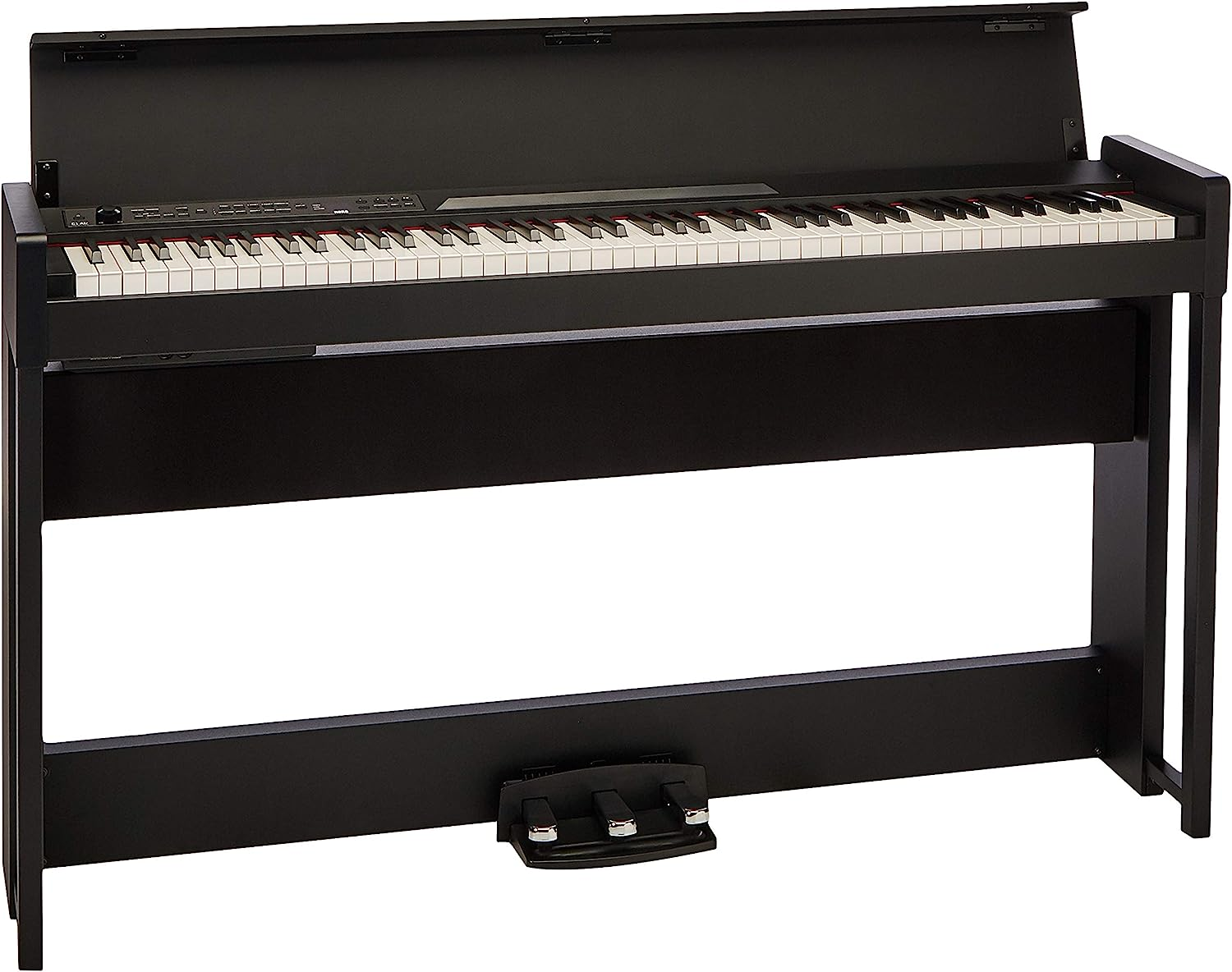
    Roland F107 Digital Piano

    Roland F107 Digital Piano

    If you’re looking for a beginner-friendly digital piano with an attractive modern design, the Roland F107 is a great option.

    Pros

    • The slim and stylish design looks great in modern living spaces.
    • The 88-note PHA-4 Standard keyboard offers authentic acoustic grand piano touch and response.
    • With 256 notes of polyphony, you can play complex pieces with no compromise.

    Cons

    • The piano is quite heavy, weighing in at 119 pounds.
    • The F107 is only available in black, so it may not match all decor styles.
    • The piano may be too basic for advanced players looking for more features.

    We recently had the chance to try out the Roland F107 digital piano and were impressed with its performance. The streamlined design is based on the award-winning F701 and blends perfectly with contemporary furnishings. The piano’s sound engine and keyboard action are found in higher-end Roland pianos, so you get best-in-class tone and touch.

    We were particularly impressed with the deep expression from Roland’s acclaimed SuperNATURAL Piano technology. The 88-note PHA-4 Standard keyboard offers authentic acoustic grand piano touch and response, making it a joy to play. The 256 notes of polyphony ensure that you can play complex pieces with no compromise.

    The F107 also features onboard Bluetooth, allowing you to connect a smartphone or tablet to play along with favorite songs and work with MIDI music apps. You can also control F107 features, explore lessons, and more with the companion Roland Piano App. The piano also has dual headphones jacks and Twin Piano mode for playing along with a friend or teacher.

    Overall, we think the Roland F107 digital piano is a great option for beginners looking for an affordable and attractive modern piano. Its best-in-class tone and touch make it a joy to play, and the onboard Bluetooth and companion app offer a range of features to enhance your musical enjoyment.

    Roland GO 61-key Music Creation Piano Keyboard with Integrated Bluetooth Speakers

    Roland GO 61-key Music Creation Piano Keyboard with Integrated Bluetooth Speakers

    We highly recommend the Roland GO 61-key Music Creation Piano Keyboard with Integrated Bluetooth Speakers for beginners who want to start playing music in a fun and inspiring way.

    Pros

    • The Loop Mix function allows you to build songs by simply playing notes on the keyboard, making it easy for beginners to create fully produced songs.
    • With over 500 pro-quality sounds, including pianos, synths, strings, bass, brass, and more, there’s a diverse range of pro sounds to explore.
    • The keyboard has Bluetooth audio/MIDI support for connecting with your smartphone or tablet, allowing you to jam along with music from your favorite apps.

    Cons

    • The keyboard is not as sturdy as some other models, so it may not hold up as well over time with heavy use.
    • The keys are not weighted, so the keyboard may not feel as realistic as some other models.
    • The keyboard does not come with a sustain pedal, so you may need to purchase one separately if you want to use one.

    We were impressed with the Roland GO 61-key Music Creation Piano Keyboard with Integrated Bluetooth Speakers. The Loop Mix function was especially fun to use, and we were able to create fully produced songs right away, even with no previous music experience. The range of pro sounds was also impressive, and we were able to explore a wide variety of different sounds and styles. The Bluetooth connectivity was also a nice touch, allowing us to jam along with music from our smartphones and tablets.

    Overall, we think the Roland GO 61-key Music Creation Piano Keyboard with Integrated Bluetooth Speakers is an excellent choice for beginners who want to start playing music in a fun and inspiring way. If you’re looking for a keyboard that’s easy to use, has a wide range of pro sounds, and allows you to create fully produced songs right away, this is definitely a keyboard worth considering.

    Roland FP-30X Digital Piano

    Roland FP-30X Digital Piano

    We highly recommend the Roland FP-30X Digital Piano for beginners who want to balance affordability with superior performance.

    Pros

    • Authentic acoustic-style piano touch with PHA-4 Standard keyboard
    • Wide variety of onboard sounds for every musical genre
    • Three months of free piano lessons from Pianote

    Cons

    • Sustain pedal needs to be upgraded or eliminated
    • Sound can be odd and less like a piano than expected
    • Bluetooth capabilities can disconnect at times

    The Roland FP-30X Digital Piano is a slim and stylish portable piano that builds on the entry-level FP-10 with an enhanced sound engine, more powerful onboard speakers, and increased polyphony. The SuperNATURAL Piano sound engine provides rich expression, from pianissimo to fortissimo, and the powerful 22-watt stereo speaker system offers room-filling sound. The dedicated setting for optimizing the sound when placed on a desktop is a nice touch.

    The optional KSC-70 stand and KPD-70 three-pedal unit allow for upright performance and traditional playing styles. The dual headphones outputs and quiet keyboard action let you play when it suits you, without disturbing others.

    The Roland FP-30X Digital Piano includes a wide variety of onboard sounds for every musical genre, including electric pianos, organs, strings, and synthesizers. The PHA-4 Standard keyboard provides authentic acoustic-style piano touch, and the piano comes in a home-friendly compact footprint with easy-to-transport weight.

    Turn your piano goals into a reality with three months of free piano lessons, compliments of our partner Pianote, the ultimate online piano lessons experience. If you own a Roland piano, you’ll get unlimited access to everything inside Pianote—from step-by-step lessons, to detailed song tutorials, and even access to live lessons and support from real piano teachers. Learn to play your Roland piano from the comfort of your own home, anytime you like. Plus, access your lessons from any internet-ready computer, tablet, or phone.

    In conclusion, the Roland FP-30X Digital Piano is an excellent choice for beginners who want to balance affordability with superior performance. The piano provides rich expression, a wide variety of onboard sounds, and authentic acoustic-style piano touch.

    Roland RP107 Digital Compact and Affordable Home Piano

    Roland RP107 Digital Compact and Affordable Home Piano

    We highly recommend the Roland RP107 Digital Compact and Affordable Home Piano for beginners looking for an affordable yet authentic piano experience.

    Pros

    • The RP107 delivers authentic tone and playability thanks to the acclaimed sound engine and keyboard action found in higher-end Roland pianos.
    • The smart design combines traditional styling with a compact footprint that fits in any space.
    • The onboard Bluetooth feature allows you to enhance your musical enjoyment and accelerate learning with mobile devices and the companion Roland Piano App.

    Cons

    • The RP107 is relatively heavy, weighing in at 132 pounds.
    • The piano does not come with a bench, so you will need to purchase one separately.
    • The RP107 is only available in black.

    The Roland RP107 Digital Compact and Affordable Home Piano is perfect for those on a budget and looking for their family’s first piano. The RP107 delivers authentic tone and playability thanks to the acclaimed sound engine and keyboard action found in higher-end Roland pianos. The piano also has an attractive design that combines traditional styling with a compact footprint that fits in any space.

    The RP107 also features Roland’s acclaimed SuperNATURAL Piano technology, which provides deep expression and authentic acoustic grand piano touch and response with the 88-note PHA-4 Standard keyboard. The piano has a simple and direct user interface for easy operation and an onboard stereo speaker system with rich, full sound.

    The RP107 also has 256 notes of polyphony, which supports playing complex pieces with no compromise. You can also connect a smartphone or tablet via Bluetooth to play along with favorite songs and work with MIDI music apps. The piano also has dual headphone jacks and Twin Piano mode for playing along with a friend or teacher.

    In conclusion, the Roland RP107 Digital Compact and Affordable Home Piano is an excellent choice for beginners looking for an affordable yet authentic piano experience. The piano has a smart design, authentic tone and playability, and onboard Bluetooth feature for mobile devices and the companion Roland Piano App.

    Roland FP-10 88-key Entry Level Digital Keyboard with Bluetooth

    Roland FP-10

    We highly recommend the Roland FP-10 88-key Entry Level Digital Keyboard with Bluetooth to anyone looking for an affordable digital piano that delivers an authentic feel and rich sound.

    Pros

    • The PHA-4 Standard keyboard offers a progressively weighted piano touch for maximum expression.
    • The Bluetooth MIDI feature allows for wireless connection to popular apps for education, creativity, and enjoyment on your mobile device.
    • The Twin Piano Mode is ideal for lessons, letting student and teacher play side-by-side in the same octave ranges.

    Cons

    • The onboard speakers might not be loud enough for larger rooms or performances.
    • The included sustain pedal might not be of the highest quality.
    • The USB cable for connecting to a computer or mobile device is not included.

    The Roland FP-10 is a great instrument for beginners and experienced players alike. The keyboard feels like a real piano and the sound is rich and expressive. The Bluetooth MIDI feature makes it easy to connect to mobile devices and explore a wide range of apps. The Twin Piano Mode is also a nice touch, allowing for side-by-side playing during lessons.

    The onboard speakers are decent, but might not be loud enough for larger rooms or performances. If you plan on playing for larger audiences, it might be worth investing in external speakers. Additionally, the included sustain pedal might not be of the highest quality, but it gets the job done.

    Overall, the Roland FP-10 is a great choice for anyone looking for an affordable digital piano that delivers an authentic feel and rich sound. It’s portable and space-saving design makes it ideal for home use, whether you’re practicing techniques in the spare room or giving performances in the living room.

    Buying Guide

    When it comes to choosing the best Roland keyboard for beginners, there are a few factors to consider. We understand that it can be overwhelming to navigate the various features and options available, so we’ve put together this buying guide to help you make an informed decision.

    First and foremost, it’s important to think about your needs and goals as a beginner keyboard player. Are you looking to learn basic chords and melodies, or do you have more specific musical aspirations in mind? This will help you narrow down the type of keyboard and features you should be looking for.

    One key feature to consider is the number of keys on the keyboard. While a full-sized keyboard typically has 88 keys, beginners may find it more manageable to start with a smaller keyboard with 61 or 76 keys. This can also make the keyboard more portable and easier to store.

    Another important factor to consider is the keyboard’s touch sensitivity. Some keyboards have weighted keys that mimic the feel of a traditional piano, while others have lighter, more responsive keys that are better suited for playing fast-paced electronic music.

    Other features to consider include:

    • Polyphony: The number of notes that can be played simultaneously
    • Sound quality: The quality and variety of built-in sounds and effects
    • Connectivity: The ability to connect the keyboard to a computer or other devices for recording and playback
    • Learning tools: Built-in lessons and tutorials to help beginners learn the basics of keyboard playing

    To help you compare and contrast different Roland keyboards, we’ve included a table below with some of the key features to look for. Keep in mind that every keyboard is unique, so be sure to do your research and read reviews before making a purchase.

    Feature Description
    Number of keys The number of keys on the keyboard
    Touch sensitivity The weight and responsiveness of the keys
    Polyphony The number of notes that can be played simultaneously
    Sound quality The quality and variety of built-in sounds and effects
    Connectivity The ability to connect the keyboard to other devices
    Learning tools Built-in lessons and tutorials for beginners

    Overall, choosing the best Roland keyboard for beginners comes down to finding the right combination of features that meet your needs and goals. We hope this buying guide has been helpful in pointing you in the right direction.
  • Which Yamaha Keyboard Should I Choose For A Beginner?

    Which Yamaha Keyboard Should I Choose For A Beginner?

    Which Yamaha Keyboard Should I Choose For a Beginner

    Types of Yamaha Keyboards for Beginners

    For those just starting their musical journey, finding the right keyboard is essential. Yamaha has a wide range of options perfect for beginners.

    Here is a breakdown of the types of Yamaha keyboards for beginners and their features:

    Keyboard Type Description
    Portable Lightweight and easily transportable with 61-76 keys. Great for practicing or performing on the go. Comes with built-in speakers and headphone jacks.
    Arranger A more advanced option with features like accompaniment styles, MIDI connectivity, and sampling options. Perfect for those who want to compose or produce music. Comes with 61-76 keys and built-in speakers/headphone jacks.
    Digital Pianos Designed to mimic the sound and feel of an acoustic piano, digital pianos have weighted keys, graded action technology, and authentic piano sound samples. They come in various sizes from compact to full-size 88 key versions. Great for those who want to learn piano basics at home.

    In addition, some Yamaha keyboards have educational functions like built-in lessons and chord recognition software.

    It’s worth noting that while beginner keyboards may lack certain advanced features, they are designed to instill basic skills that can be carried over into playing more advanced instruments later on.

    According to a study by the Music Industries Association, Yamaha is one of the most popular brands among first-time keyboard buyers.

    Choose your keyboard carefully based on your needs as a beginner musician.

    Finding the right Yamaha keyboard for beginners is like looking for a needle in a haystack, except the needle is actually a keyboard and the haystack is a sea of buttons, knobs, and confusing features.

    Features to Look For in a Yamaha Keyboard for Beginners

    To choose the perfect Yamaha keyboard as a beginner, you need to look for certain features that align with your learning preferences and style. With “Features to Look For in a Yamaha Keyboard for Beginners” section with sub-sections like “Number of Keys,Touch Response,Voices and Sounds,Polyphony,Learning Features,” we’ll help you discover the most important features to consider when selecting a Yamaha keyboard.

    Number of Keys

    Yamaha keyboards come in different models and sizes suitable for beginners. The number of keys can be a crucial feature to consider when selecting a Yamaha keyboard that meets your needs. A standard full-size keyboard has 88 keys, while compact models have fewer keys.

    Furthermore, a higher number of keys does not necessarily mean better performance or quality sounds. A beginner may find 61-key models more than enough to play songs and practice exercises without limiting their creativity or music learning journey.

    When choosing a Yamaha keyboard as a beginner, other essential factors include touch response, built-in lessons, portability, connectivity options, and sound quality.

    A true fact is that Yamaha has been providing innovative musical instruments for various genres and skill levels for over 130 years.

    Perfect for those who like to play with feeling, the touch response on a Yamaha keyboard will have you tickling the ivories like a pro (or at least sounding like one).

    Touch Response

    For beginners, understanding the intricacies of a Yamaha keyboard can be daunting. One such aspect is the way it responds to touch. This feature determines how sensitive the keys are, and how easily they respond to varying degrees of pressure.

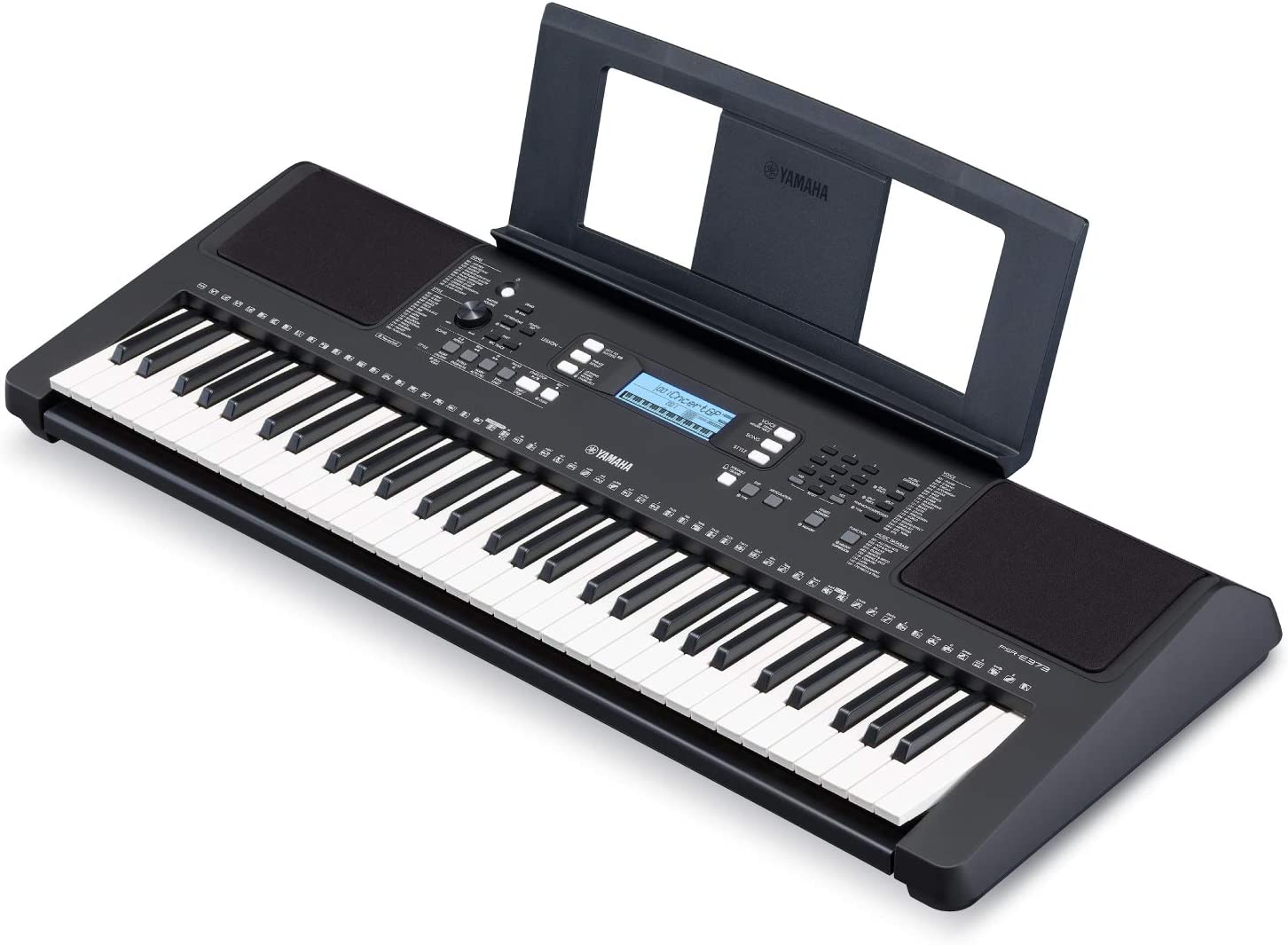
    A table showcasing different levels of Touch Response can be helpful in making an informed decision. For instance, higher-end models like Yamaha PSR-E373 boasts 61 key touch-responsive keyboard while its lower model PSR-E263 features a non-touch responsive keyboard.

    Apart from this basic difference in sensitivity, other details are essential to consider before buying a Yamaha Keyboard. These include user-friendliness, available sounds, and styles with preset songs Moreover, entry-level models may not always have these features.

    It is worth noting that Yamaha keyboards often feature prominently in both beginner and professional circles. They have consistently upgraded their products to meet changing needs by conducting extensive research and assessing customer feedback.

    This brand’s reputation as a top-quality and professional-industry standard speaks for itself – one need only look at their presence in various genres from classical music performance to pop recordings. Aspiring pianists who understand these crucial aspects should be able to make a well-informed decision when choosing a Yamaha keyboard that best suits their needs.

    Get ready to rock out like a beginner pro with the array of voices and sounds offered by Yamaha’s keyboards. Or just annoy your neighbors, either way.

    Voices and Sounds

    When selecting a Yamaha keyboard for beginners, it is important to consider the range and diversity of available voices and sounds. The wider the selection, the more versatile and appealing your compositions can become. Variety in tone, pitch, and texture can help bring a unique dimension to your music.

    In addition to the number of voices and sounds offered by the keyboard, consider the quality of each sound. Higher-end Yamaha keyboards typically feature advanced sampling technology that offers authentic replication of various instruments’ nuances. Pay attention to the volume levels of each voice, too – some keyboards offer greater dynamic range than others.

    To enhance your playing experience even further, look for a keyboard with onboard effects such as reverb or chorus. These features can help you shape your sound in real-time and add extra character to your performances.

    Don’t miss out on creating professional-level arrangements because you chose a limited instrument! Make sure you choose a Yamaha keyboard with plenty of rich, high-quality voices and sounds that fit your style and musical goals.

    Polyphony is like having multiple imaginary friends who can all play different instruments at the same time.

    Polyphony

    The number of notes a Yamaha keyboard can play at the same time is an essential feature to consider for beginners. A Yamaha keyboard with a high polyphony count will enable the player to layer multiple sounds and experiment with different styles seamlessly. The table below summarizes some popular Yamaha keyboards with their corresponding polyphony count:

    Keyboard Model Polyphony Count
    PSR-E363 48
    PSR-E463 48
    PSR-S670 128
    YPT-260 32

    In addition, certain models like the PSR-S670 offer voice doubling or layering features to enhance their polyphony capabilities for even more versatility.

    Pro Tip: Although an adjustable touch response feature may seem insignificant, it significantly affects how dynamic and expressive a player’s performance can be. Consider investing in a Yamaha keyboard model with adjustable touch sensitivity.

    A Yamaha keyboard with good learning features is like having a cruel but fair piano teacher in a single piece of equipment.

    Learning Features

    Yamaha keyboards are an excellent choice for beginners who are looking to learn and improve their music skills. These keyboards come with a range of learning features that make the process easier and more enjoyable.

    Here are 6 Learning Features available in a Yamaha keyboard:

    • Lesson Modes – This feature provides interactive lessons that allow users to practice and learn at their own pace
    • Metronome – A metronome allows users to keep track of the tempo, which is essential when learning new songs or genres
    • Recording Function – Recording function allows learners to listen back to their performance and identify errors or areas for improvement
    • Voice Guidance – Voice guidance gives step-by-step instructions on how to play various melodies and chords, making learning much more accessible
    • Song Library – The extensive song library contains thousands of songs that learners can play along to, making practice sessions more fun and enjoyable.
    • Connectivity Options – Bluetooth connectivity options enhance the user experience by connecting them to compatible devices such as smartphones, tablets, or laptops.

    Apart from these features, Yamaha keyboards offer additional benefits like user-friendly interface, built-in effects, and styles among other things.

    Pro Tip: Invest in a good quality input device like headphones or speakers as this will provide better audio feedback during recording and playback.

    Get the perfect keyboard to start your musical journey with these top-rated Yamaha keyboards for beginners.

    Recommended Yamaha Keyboards for Beginners

    To make your journey as a beginner keyboardist stress-free, we’ve recommended some fantastic Yamaha keyboards for you to choose from. These keyboards are not only affordable but also user-friendly. You can go for Yamaha PSR-E263, Yamaha EZ-220, Yamaha YPT-260, Yamaha PSR-E363, or Yamaha NP-12, depending on your preferences.

    Yamaha PSR-E263

    The Yamaha PSR-E263 is an ideal keyboard for beginners. It is a versatile piece of equipment that can be used for various purposes. Below are four points that make the Yamaha PSR-E263 an excellent choice for anyone starting on their musical journey:

    • It has 400 high-quality instrument voices
    • It features a built-in lesson function, making learning easier and more accessible
    • The keyboard’s compact design makes it easy to use and transport
    • With touch-sensitive keys, this keyboard produces realistic tones that mimic those of real instruments

    This keyboard’s USB connectivity enables data transfer to computers or mobile devices such as smartphones or tablets.

    Regarding unique details, the Yamaha PSR-E263 is an affordable solution with sophisticated options built into it. Its uses span beyond beginner level playing; advanced players can appreciate its numerous functions as well.

    A young artist, Carmen, shared her experience using the Yamaha PSR-E263 in her first live performance at a school event. She mentioned being nervous and unsure about how she would sound live; however, the quality of the music was exceptional using this keyboard. The support reinforced her confidence while performing in front of a live audience. This story shows that people at all stages in their musical career benefit from owning a reliable keyboard like the Yamaha PSR-E263.

    Even if you have two left hands, the Yamaha EZ-220 will have you sounding like a pro in no time.

    Yamaha EZ-220

    For beginner musicians, the Yamaha EZ-220 is an ideal choice.

    • It has 61 touch-sensitive keys that make playing songs easy and enjoyable.
    • The backlit LCD screen displays sheet music clearly, so even beginners can read and play along with ease.
    • The built-in Yamaha Education Suite provides interactive lessons to help new players hone their skills.

    One unique feature of the Yamaha EZ-220 is its wireless connectivity to both iOS and Android devices, allowing access to a variety of apps that enhance music-making experiences. Create your own beautiful music by getting the Yamaha EZ-220 today! Don’t miss out on this great opportunity to start your musical journey on the right foot.

    Get ready to tickle those ivories with the Yamaha YPT-260, the perfect keyboard for beginners and aspiring piano pun-dits.

    Yamaha YPT-260

    The Yamaha YPT-260 keyboard is a recommended option for beginners who are looking for an affordable and user-friendly keyboard.

    • It has 61 touch-sensitive keys with innovative features
    • The model comes with 400 high-quality voices and 130 auto-accompaniment styles
    • With the built-in Yamaha Education Suite, it offers a perfect learning opportunity to beginners and students
    • The Portable Grand button enables users to instantly access a grand piano voice, which is perfect for playing classical music
    • The keyboard also includes auxiliary input, onboard speakers, and headphone jack, making practicing convenient and comfortable for all environments.

    Additionally, the YPT-260 is lightweight so that users can take it anywhere. It includes battery backup operation and adapter to ensure seamless practice time.

    A close friend of mine had recently purchased the Yamaha YPT-260 keyboard. Being new to the instrument, my friend found the built-in tutorials extremely helpful in kick-starting their musical journey from scratch. The high-quality vocal selection helped ease them into exploring various genres of music while experimenting with different effects using the Pitch Bend Wheel. Playing became part of daily routine!

    If you’re a beginner looking for a keyboard with plenty of features, the Yamaha PSR-E363 is like the Swiss Army Knife of musical instruments – but without the knife part, of course.

    Yamaha PSR-E363

    For beginners seeking an accessible and versatile keyboard from a prominent brand, the Yamaha PSR-E363 presents a suitable option. This intermediate model offers high-quality sound, numerous features and functionality to create original music.

    Weight 4.6 kg
    No. of Keys 61 Full Size Touch Sensitive Keys
    Sounds & Accompaniments 574 (197) instrument sounds, 165 auto accompaniment styles with backing tracks, and access to downloadable content via the internet.
    Connectivity Aux-in for external music devices, headphone jack for silent practice, USB-To-Host port enabling connection to computers & iOS/Android portable devices for making & recording music with software such as Garageband.

    Moreover, the Yamaha PSR-E363 also features touch sensitivity keys that allow players to adjust the volume based on how hard they strike them. Additionally, the keyboard has Duo mode that allows two players to play side by side in the same octave range.

    For beginners looking to improve their musical talent on this Yamaha model, a good suggestion is to experiment with different instrument sounds while using the built-in accompaniment styles. By doing so steadily without any rush can increase creativity as well as loosen up rigid fingers. Also, playing songs you know incorporate practices like rhythm matching and chord progression work surprisingly well with this model.

    Who needs to learn how to play actual piano keys when you can just press buttons on the sleek and stylish Yamaha NP-12?

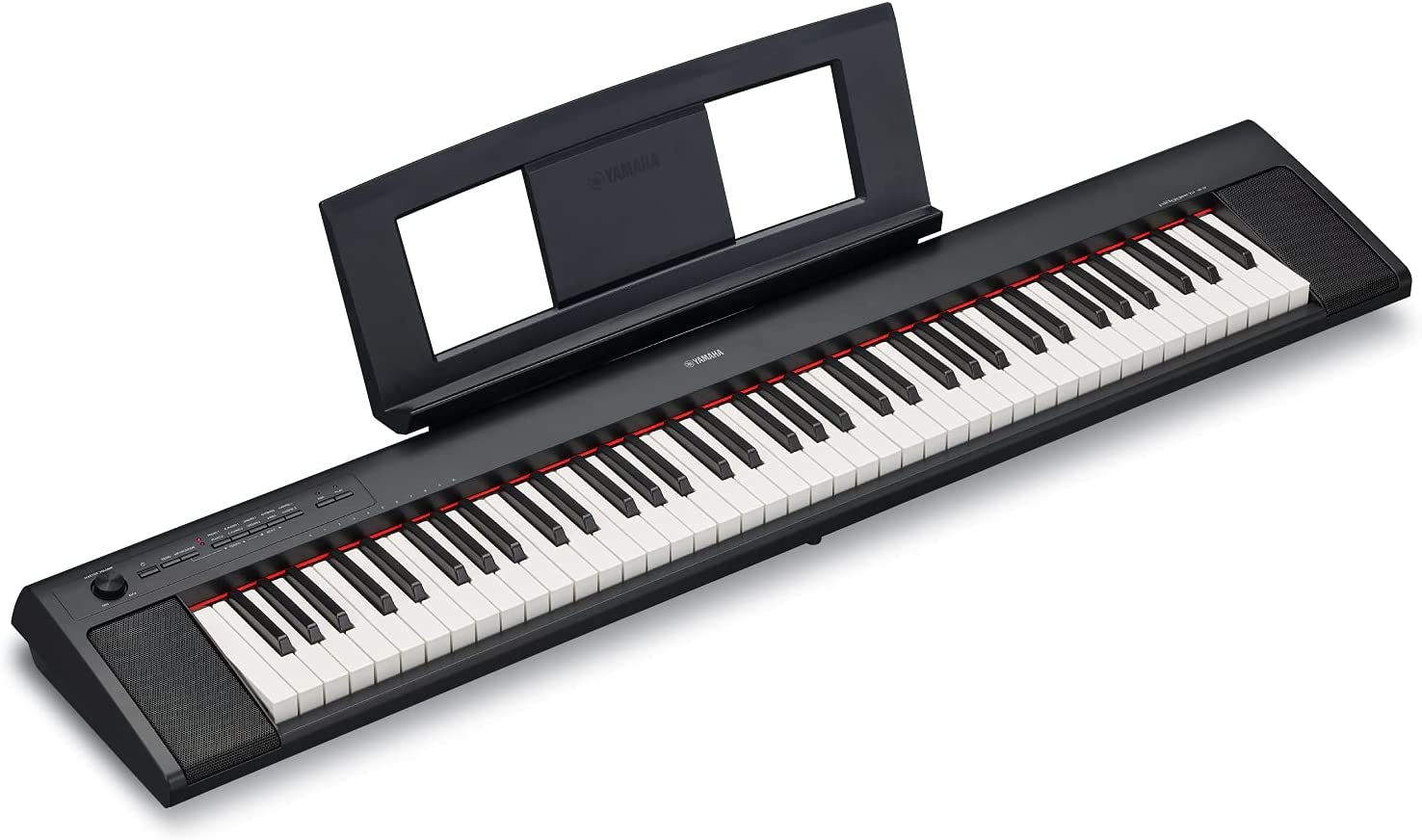
    Yamaha NP-12

    The Yamaha NP-12: A Professional Overview

    Yamaha NP-12 is perfect for beginners who want to learn and develop their skills. Here’s what you need to know about the keyboard.

    • The Yamaha NP-12 is lightweight and portable, making it easy to move around.
    • It has a 61-key touch-sensitive keyboard that enhances the sound experience.
    • The keyboard has ten voices and ten demo songs that beginners can use to practice.
    • With its built-in speakers, the device gives off a rich sound quality even without headphones.

    One of the unique features of this keyboard is how it uses Yamaha’s “Graded Soft Touch” technology, which creates a sensation similar to playing a grand piano.

    Pro Tip: Remember to purchase a stand for your Yamaha NP-12 for easy adjustment of height and support. Choose wisely or you’ll end up feeling like a broke Mozart with a fancy toy keyboard.

    Budget Considerations when Choosing a Yamaha Keyboard for Beginners

    When selecting a Yamaha keyboard for beginners, it’s crucial to consider budget. Here is some useful information to help in the selection process.

    Considerations when Choosing a Yamaha Keyboard for Beginners – Budget Table:

    Keyboard Model Price Range (USD) Number of Keys Weight (lbs) Type of Action
    PSR-E263 100-150 61 keys 8.6 lbs Non-weighted
    EZ-220 200-250 61 keys with light-up feature 10.6 lbs Touch-sensitive and non-weighted
    YPT-260 120-170 61 keys 9 lbs Non-weighted

    While all three keyboard models above are affordable, keep in mind the features that matter most to you when making your final decision.

    In addition to price and features, also think about what accessories you may need to accompany your Yamaha keyboard. For example, a sustain pedal can add expressive capabilities while playing, learning materials may be beneficial for those who are taking their first steps with music theory.

    Ultimately, it boils down to personal taste when choosing a beginner-level Yamaha electronic piano or keyboard. By going through product specs promptly, testing instruments locally, and finding valuable advice from trusted sources before buying will come in handy!

    Whether you’re a beginner or a pro, Yamaha keyboards have got your back…and your fingers.

    Conclusion

    Discussing the Perfect Yamaha Keyboard for a Beginner

    When choosing a suitable Yamaha keyboard, beginners often get overwhelmed with the wide array of options available. To ensure that you make an informed decision based on your needs, skills and budget, consider key factors such as portability, number of keys, sound quality and additional features.

    To start with, selecting a portable Yamaha keyboard with 61 to 76 keys is ideal for novice players who are still developing their skills. These models offer compactness, variety of sounds and style options while being affordable compared to larger models such as 88-key keyboards.

    Moreover, you should invest in a dynamic sound engine that captures the nuances of music styles through sampled sounds from different instruments such as pianos, strings or drums. This helps beginners develop their playing ability by providing accurate sound reproduction and versatility when practicing or performing different genres.

    Additionally, select a Yamaha keyboard that offers extra perks such as interactive teaching aids like tutorials for beginners or play-along tracks to hone your skills further. These features can also enhance your playing experience and make it more enjoyable.

    Yamaha keyboards have been recognized for their great functionality and easy-to-use interface; however, finding the right beginner model can be challenging. Ensure that you analyze your needs before selecting a model since features may vary considerably based on usage requirements and personal preferences.

    Fun fact: “The name “Yamaha” was taken from its founder’s name – Torakusu Yamaha – who started his company by manufacturing reed organs in Japan over a century ago.” (source: https://usa.yamaha.com/about_yamaha/corporate/history/index.html)

  • Top 5 Best Yamaha Keyboards Under $500 in 2023

    If you’re a musician looking for an affordable keyboard, Yamaha has some great options for you. Yamaha keyboards are known for their high-quality sound, durability, and versatility. In this article, we’ll be focusing on the best Yamaha keyboards under $500.

    When choosing a keyboard, there are a few things you should consider. First, you’ll want to think about the number of keys you need. Yamaha offers keyboards with 61, 76, and 88 keys. You’ll also want to consider whether you need weighted keys for a more realistic piano feel, or if you’re looking for something lighter and more portable.

    Another important factor to consider is the type of music you’ll be playing. Do you need a keyboard with a lot of different sounds and rhythms, or are you looking for something more basic? Yamaha keyboards come with a variety of features, including built-in speakers, USB connectivity, and the ability to record and playback your performances.

    After researching and testing several Yamaha keyboards under $500, we’ve narrowed down the top options for you. Whether you’re a beginner or a more experienced musician, there’s a Yamaha keyboard on this list that will meet your needs.

    Best Yamaha Keyboards under $500

    We know that finding the right keyboard can be tough, especially if you’re on a budget. That’s why we’ve put together a list of the best Yamaha keyboards under $500. Whether you’re a beginner or a seasoned player, these keyboards offer a range of features and capabilities to suit your needs. So, without further ado, let’s dive into our top picks!

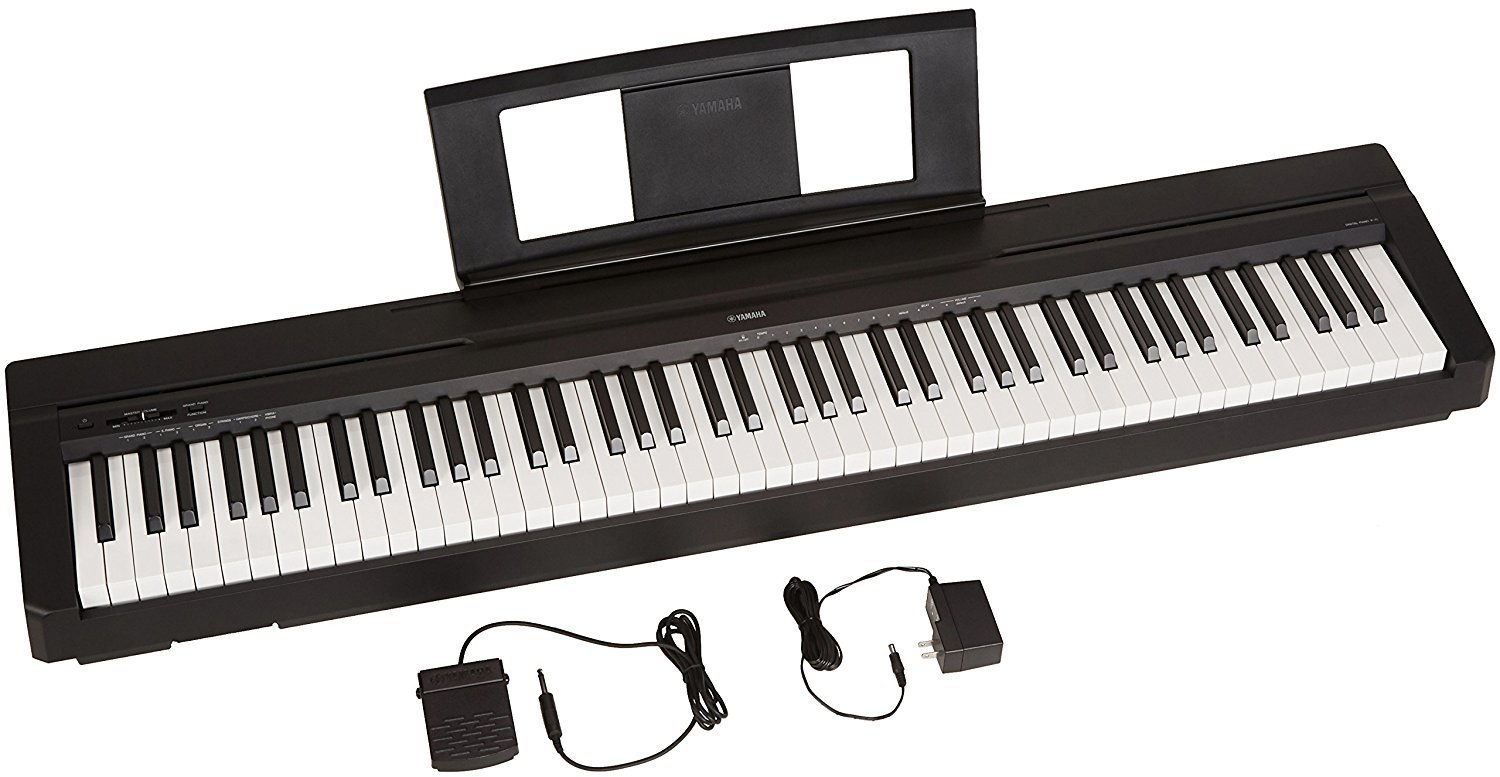
    Yamaha P45 88-Key Weighted Digital Piano Black

    Yamaha P45 88-Key Weighted Digital Piano Black

    If you’re looking for an affordable digital piano that simulates the feel of an acoustic piano, the Yamaha P45 is a great option.

    Pros

    • The weighted keys provide a quality playing experience that simulates an acoustic piano.
    • The dual mode lets you combine 2 voices together for an inspiring new playing experience.
    • The piano comes with 10 different voices, including digitally sampled tones from real Yamaha acoustic grand pianos.

    Cons

    • The onboard speakers are OK, but not great.
    • The piano doesn’t come with a stand, so you’ll need to purchase one separately.
    • The piano doesn’t have a lot of sound choices.

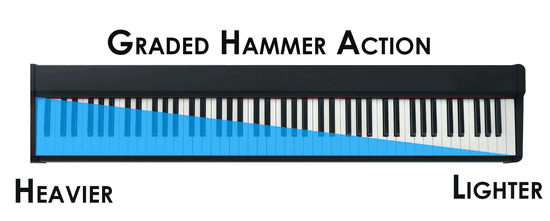
    We recently purchased the Yamaha P45 and have been impressed with its performance. The 88 fully weighted piano style keys simulate the feel of an acoustic piano and provide a quality playing experience. The GHS weighted action is heavier in the low end and lighter in the high end, just like an acoustic piano.

    One of the best features of the Yamaha P45 is the dual mode, which lets you combine 2 voices together, like piano and strings, for an inspiring new playing experience. The piano comes with 10 different voices, including digitally sampled tones from real Yamaha acoustic grand pianos.

    While the onboard speakers are OK, they’re not great. If you’re looking for better sound quality, we recommend connecting the piano to external speakers. Additionally, the piano doesn’t come with a stand, so you’ll need to purchase one separately.

    Overall, we’re happy with our purchase of the Yamaha P45. It’s a great option for anyone looking for an affordable digital piano that simulates the feel of an acoustic piano.

    Yamaha P71 88-Key Weighted Action Digital Piano

    Yamaha P71

    We highly recommend the Yamaha P71 88-Key Weighted Action Digital Piano for those looking for a quality digital piano under $500.

    Pros

    • The fully weighted piano style keys simulate the feel of an acoustic piano, providing a quality playing experience.
    • The dual mode lets you combine 2 voices together, like piano and strings, for an inspiring new playing experience.
    • The slim and stylish design with a depth of less than 12 inches requires little space and weighs only 25 pounds, making it easy to move around.

    Cons

    • The built-in speakers don’t put out as much sound as expected, so external speakers may be needed.
    • The sustain pedal can be a bit noisy.
    • The selection of voices is limited to 10.

    We have had the pleasure of using the Yamaha P71 and have found it to be an excellent digital piano for the price. The fully weighted keys provide an authentic playing experience and the dual mode allows for creative exploration. The slim design makes it easy to store in small spaces and the included power adapter and sustain pedal are a nice touch. However, the built-in speakers could be better and the selection of voices is limited. Overall, the Yamaha P71 is a great option for those looking for a quality digital piano under $500.

    Yamaha 61-Key Portable Keyboard

    Yamaha 61-Key Portable Keyboard

    If you’re looking for a versatile keyboard that won’t break the bank, the Yamaha 61-Key Portable Keyboard is a great choice.

    Pros

    • The assignable knobs allow for real-time manipulation of effects and parameters on voices, styles, and more.
    • The motion effect button modifies voices with filter, pitch, and modulation effects.
    • Quick sampling to USB or internal memory allows for instant recall at the right time.

    Cons

    • The surface of the keys feels a bit plastic-like.
    • The manual is limited in explaining how to use all the buttons.
    • The built-in speakers could be louder.

    We’ve been using this keyboard for a few weeks now, and we’re impressed with its range of features. The assignable knobs are a standout feature, allowing for quick and easy manipulation of effects and parameters. The motion effect button is also a lot of fun to play around with, and we’ve found ourselves using it more than we expected.

    One downside is that the surface of the keys feels a bit plastic-like, which may bother some users. Additionally, the built-in speakers could be louder, but this is a common issue with portable keyboards.

    Overall, the Yamaha 61-Key Portable Keyboard is a great choice for anyone looking for a versatile keyboard under $500. Its range of features and affordable price make it a solid choice for both beginners and more experienced players.

    Yamaha YPT270 Keyboard

    Yamaha YPT270 Keyboard

    If you’re searching for a beginner keyboard that is both affordable and feature-packed, the Yamaha YPT270 Keyboard is an excellent option.

    Pros

    • The Yamaha YPT270 Keyboard has hundreds of high-quality voices, drum kits, and special effects kits that bring variety and authenticity to your music.
    • The keyboard’s styles bring your music to life by adding natural feeling accompaniment instruments to your playing, whether you’re playing country, rock and roll, or a samba.
    • Smart Chord allows you to play great-sounding chords from simple Pop triads to complex jazz 7th chords with only a single finger.

    Cons

    • The Yamaha YPT270 Keyboard has only 61 full-sized keys, which may not be enough for more advanced players.
    • The keyboard’s sound quality is not as good as some higher-end models.
    • The keyboard’s build quality is not as durable as some more expensive models.

    We recently got our hands on the Yamaha YPT270 Keyboard and were impressed by its features and affordability. The keyboard’s hundreds of high-quality voices, drum kits, and special effects kits bring a wide range of sounds to your fingertips, making it easy to experiment with different genres and styles.

    One of our favorite features of the Yamaha YPT270 Keyboard is its styles. The keyboard’s styles bring your music to life by adding natural feeling accompaniment instruments to your playing, whether you’re playing country, rock and roll, or a samba. This makes it easy to create full-sounding arrangements without the need for a full band.

    Another feature we love is Smart Chord. Smart Chord allows you to play great-sounding chords from simple Pop triads to complex jazz 7th chords with only a single finger. This makes it easy to play complex chord progressions without having to learn each chord individually.

    However, the Yamaha YPT270 Keyboard does have some drawbacks. The keyboard’s 61 full-sized keys may not be enough for more advanced players, and the sound quality is not as good as some higher-end models. Additionally, the keyboard’s build quality is not as durable as some more expensive models, which may be a concern for players who plan to use it frequently.

    Overall, we think the Yamaha YPT270 Keyboard is an excellent option for beginner players who are looking for an affordable and feature-packed keyboard. Its styles and Smart Chord features make it easy to create full-sounding arrangements, and its hundreds of voices and effects kits provide a wide range of sounds to experiment with.

    Yamaha PSR-E273 PKY Premium Keyboard Pack

    Yamaha PSR-E273 PKY Premium Keyboard Pack

    If you are looking for an entry-level keyboard that combines Yamaha quality voices and styles with practical learning functions, then the Yamaha PSR-E273 PKY Premium Keyboard Pack is definitely worth considering.

    Pros

    • The Portable Grand button allows you to easily select and play various instrument voices, including a piano sound.
    • With a wide variety of sound effects, such as animal, weather, vehicle, and bell sounds, you can have hours of fun exploring different sounds.
    • The quiz mode is a fun and educational feature that helps develop your musical ear by playing sound effects and notes and letting you choose the corresponding key to play.

    Cons

    • The built-in speakers are not very powerful, so you may need to use headphones or external speakers for better sound quality.
    • The keyboard stand that comes with the pack is not very sturdy, so you may need to purchase a separate stand if you want more stability.
    • The keys are not weighted, so it may take some time to get used to the feel of the keyboard if you are used to playing on a piano.

    We were impressed with the Yamaha PSR-E273 PKY Premium Keyboard Pack’s various fun and educational features that ensure speedy progress, making the whole learning experience fun. The three built-in lesson modes (Listen & Learn, Timing, and Waiting) are great for beginners who want to learn how to play songs. The on-board song recorder is also a useful feature that allows you to capture performances and play them back to help you improve.
    Overall, we think the Yamaha PSR-E273 PKY Premium Keyboard Pack is a great choice for aspiring musicians who are just starting out. It is portable, easy to use, and offers a wide variety of sounds and functions to help you realize your potential and develop enthusiasm for learning and playing music.

    Buying Guide

    When it comes to buying a Yamaha keyboard under $500, there are a few things to consider to ensure that you get the best product for your needs. In this section, we’ll discuss the most important features to look for when choosing a keyboard.

    Types of Keys

    The first thing to consider is the type of keys the keyboard has. There are two main types of keys: weighted and unweighted. Weighted keys are designed to mimic the feel of a traditional piano, while unweighted keys are lighter and easier to play. If you’re a beginner or plan to use the keyboard for casual playing, unweighted keys may be the best option. However, if you’re an experienced pianist or plan to use the keyboard for serious practice, weighted keys are a must-have.

    Number of Keys

    The number of keys on a keyboard is another important consideration. Most Yamaha keyboards have either 61 or 88 keys. If you’re a beginner or plan to use the keyboard for casual playing, 61 keys may be sufficient. However, if you’re an experienced pianist or plan to use the keyboard for serious practice, 88 keys are a must-have.

    Polyphony

    Polyphony refers to the number of notes a keyboard can play at once. The higher the polyphony, the more notes you can play at the same time. If you plan to use the keyboard for complex pieces of music, look for a keyboard with a higher polyphony.

    Voices and Sounds

    Yamaha keyboards come with a variety of voices and sounds, including piano, organ, strings, and more. Look for a keyboard with a wide range of voices and sounds to ensure that you can play a variety of music styles.

    Connectivity

    Finally, consider the connectivity options of the keyboard. Look for a keyboard with USB connectivity, MIDI connectivity, and headphone jacks. USB and MIDI connectivity allow you to connect the keyboard to a computer or other devices, while headphone jacks allow you to practice without disturbing others.

    By considering these features, you can find the best Yamaha keyboard under $500 for your needs.

  • Learn Piano Easily: Top Billy Joel Songs for Beginners

    Billy Joel is a legendary musician known for his catchy pop hits and impressive piano skills. Many aspiring pianists are drawn to his music and want to learn how to play his songs on the piano. However, some of his songs can be challenging to learn for beginners or those with limited experience playing the piano.

    Fortunately, there are some Billy Joel songs that are relatively easy to learn on the piano, making them great options for those who want to start playing his music. Whether you’re a fan of “Piano Man” or want to learn some of his other popular hits, there are several songs that you can master with some practice and dedication.

    With the help of modern technology, aspiring pianists can also use apps and online resources to learn how to play Billy Joel songs on the piano. These tools can be especially helpful for those who don’t have access to a piano teacher or want to learn at their own pace.

    Background on Billy Joel

    Billy Joel is an American singer-songwriter and pianist who was born on May 9, 1949, in The Bronx, New York City. He is one of the best-selling music artists of all time, having sold over 150 million records worldwide. Joel began playing the piano at a young age, and his father was a classical pianist who encouraged his son’s musical interests.

    Joel’s music career took off in the 1970s with hits such as “Piano Man” and “New York State of Mind.” He is known for his ability to blend different genres of music, including rock, pop, and classical, into his songs. Joel’s music often tells stories and is known for its emotional depth and honesty.

    Many of Joel’s songs are love songs and ballads that have become iconic. His music has been featured in movies, TV shows, and commercials, making it a part of popular culture.

    Billy Joel’s influence on music is undeniable, and his legacy continues to inspire musicians and fans today.

    Easiest Billy Joel Songs to Learn on the Piano

    Beginner Level

    For those just starting out on the piano, there are a few Billy Joel songs that are relatively easy to learn:

    • “Piano Man” – This classic tune features a simple melody and chord progression that is easy to follow. For an absolute beginner I suggest start where the lyrics start and not the opening.
    • “Uptown Girl” – Another popular hit, “Uptown Girl” has a catchy melody that is easy to pick up.
    • “The Entertainer” – This upbeat tune features a repetitive melody that is easy to memorize. However, when Billy plays this song live, it’s incredible fast. Don’t expect to play it as fast as Billy when you get started.

    Intermediate Level

    If you have some experience playing the piano, you may want to try these slightly more challenging Billy Joel songs:

    • “Just the Way You Are” – This romantic ballad features a beautiful melody and some slightly more complex chord progressions.
    • “She’s Always a Woman” – Another popular love song, “She’s Always a Woman” has a simple melody but some more intricate piano accompaniment.
    • “Vienna” – This lesser-known Billy Joel song has a hauntingly beautiful melody and some interesting chord changes.

    Advanced Level

    For more experienced piano players, these Billy Joel songs will provide a challenge:

    • “Scenes from an Italian Restaurant” – This epic song is over seven minutes long and features multiple sections with varying tempos and chord progressions.
    • “The Stranger” – The title track from Billy Joel’s fifth studio album, “The Stranger” has a complex piano accompaniment and some challenging key changes.
    • “Angry Young Man” – This fast-paced song features a difficult piano intro and some intricate finger work.

    Regardless of your skill level, there is a Billy Joel song out there for you to learn on the piano. With sheet music and online tutorials readily available, aspiring piano players can easily pick up one of these classic tunes and start playing.
    This book below was recently published by Billy with his keyboard player David Rosengarten. I recommend all the books in the series.

    Billy Joel - Greatest Hits, Volume I & II - Piano/Vocal/Guitar Songbook
     

    Tips for Learning Billy Joel Songs on Piano

    Learning to play Billy Joel songs on the piano can be a fun and rewarding experience. Here are some tips to help make the process easier:

    • Find a good teacher: A good teacher can help you learn the basics of playing the piano and guide you through the process of learning a new song.
    • Use tutorials: There are many online tutorials available that can help you learn how to play a Billy Joel song on the piano. These tutorials can be a great resource for beginners.
    • Download sheet music: Sheet music can be a helpful tool for learning a new song. There are many websites where you can download sheet music for Billy Joel songs.
    • Listen to other piano players: Listening to other piano players can be a great way to learn new techniques and get inspiration for your own playing.

    By following these tips, you can make the process of learning a Billy Joel song on the piano easier and more enjoyable.

    Conclusion

    Learning to play the piano can be a challenging, yet rewarding experience. For those who are fans of Billy Joel, there are many songs to choose from that are both enjoyable to play and relatively easy to learn.

    Through this article, readers have been introduced to five of the easiest Billy Joel songs to learn on the piano, including “Piano Man,” “Just the Way You Are,” “Vienna,” “New York State of Mind,” and “She’s Always a Woman.” Each of these songs has its own unique style and melody, making them a great starting point for anyone looking to expand their piano-playing skills.

    While it may take some time and practice to master these songs, the end result is sure to be worth the effort. By starting with these easier songs, players can gradually build their skills and move on to more challenging pieces in the future.

  • When Were Electric Keyboards Invented? A Brief History of Keyboard Instruments

    When Were Electric Keyboards Invented? A Brief History of Keyboard Instruments

    Electric keyboards have been an integral part of music for decades, and their invention has revolutionized the way we create and perform music. The history of electric keyboards dates back to the early 20th century, and over the years, they have undergone significant changes and improvements.

    The first electric keyboard was invented in the 1920s by Laurens Hammond, an American engineer. His invention was called the Hammond Organ, and it used a series of tone wheels to produce sound. The Hammond Organ was a significant improvement over traditional organs, as it was more compact, portable, and versatile.

    Since the invention of the Hammond Organ, electric keyboards have continued to evolve, and today, they are used in a wide range of musical genres, from classical to pop. The history of electric keyboards is a fascinating one, and it is a testament to human ingenuity and creativity.

    Early History of Keyboards

    The history of keyboards dates back to the 3rd century BC, where the first keyboard instrument was invented in ancient Greece. This instrument was called the hydraulis, and it was a type of pipe organ powered by water. The hydraulis was used in theaters and temples, and it was the largest and most complex musical instrument of its time.

    Pre-Electric Keyboards

    Over the centuries, various types of keyboard instruments were invented, including the clavichord, harpsichord, and piano. These instruments were all acoustic, meaning they didn’t require electricity to produce sound. The piano, invented in the early 18th century, became the most popular keyboard instrument and is still widely used today.

    During the 19th century, inventors began experimenting with ways to use electricity to power musical instruments. In 1876, Elisha Gray invented the musical telegraph, which used a keyboard to send electrical signals over a wire to a receiver that produced sound. The musical telegraph was not a commercial success, but it paved the way for future inventions.

    In 1902, Thaddeus Cahill invented the Telharmonium, which was the first electric keyboard instrument. The Telharmonium used rotating disks to produce sound, and it was capable of producing a wide range of tones. However, the Telharmonium was very large and expensive, and it was not widely adopted.

    It wasn’t until the 1930s that electric keyboards began to gain popularity. In 1935, Laurens Hammond invented the Hammond organ, which used a series of tone wheels to produce sound. The Hammond organ became a popular instrument in jazz and rock music, and it was used by many famous musicians, including Jimmy Smith and Keith Emerson.

    The Invention of Electric Keyboards

    Electric keyboards have come a long way since their invention. The first electric keyboard was invented in the early 20th century, and it was a significant milestone in the history of music. This section will explore the history of electric keyboards, including the pioneers who made it possible.

    Christopher Latham Sholes and the Typewriter

    Christopher Latham Sholes is credited with inventing the first practical typewriter in 1867. His invention revolutionized the way we write and communicate. Sholes used a keyboard to input characters onto a sheet of paper, and this technology was later adapted to create electric keyboards. Sholes’ typewriter was the precursor to the modern computer keyboard.

    Elisha Gray and the Audion

    Elisha Gray was a prominent inventor and scientist who made significant contributions to the development of the telephone and the telegraph. He is also credited with inventing the Audion, an electronic device that could amplify electrical signals. The Audion was a crucial component in the development of electric keyboards, as it allowed for the creation of electronic sounds. Gray’s invention paved the way for the development of modern electronic keyboards.

    The invention of electric keyboards was a significant milestone in the history of music. It allowed musicians to create new sounds and experiment with different styles of music. The use of electricity and technology in music opened up new possibilities for musicians, and it continues to influence the way we create and perform music today.

    The Rise of the Electronic Keyboard

    The electronic keyboard has come a long way since its inception in the early 1900s. The first electric keyboard was invented in 1902 by Thaddeus Cahill, who created the Telharmonium, an instrument that used dynamos and telephone lines to produce sounds. However, it wasn’t until the mid-20th century that electronic keyboards became widely available and popular.

    The Trautonium and the Synthesizer

    One of the earliest electronic instruments was the Trautonium, invented by Friedrich Trautwein in 1929. It used oscillators to produce sounds and had a unique user interface that allowed for expressive playing. In the 1950s, the first synthesizers were developed, including the RCA Mark II and the Buchla Series 100. These instruments used various modules to generate and shape sounds, and they were often controlled by complex patch cables.

    The ARP and the Rhodes

    In the 1970s, electronic keyboards became more accessible and user-friendly. The ARP Odyssey and the Fender Rhodes were two of the most popular instruments of the time. The ARP Odyssey was a compact synthesizer that had a built-in sequencer and a modulation wheel for adding effects. The Fender Rhodes was an electric piano that used hammers to strike metal tines, creating a unique sound that became popular in jazz and rock music.

    The Polymoog and the Odyssey

    In the late 1970s, the Polymoog and the Yamaha CS-80 were introduced. The Polymoog was a polyphonic synthesizer that had a unique sound engine and a built-in power amplifier. The Yamaha CS-80 was a massive instrument that had a rich, complex sound and a unique user interface that included a ribbon controller and aftertouch.

    The Yamaha CS-80

    The Yamaha CS-80 was one of the most advanced and expensive instruments of its time. It had two sound generators, each with its own set of filters and envelopes. It also had a built-in effects processor that included chorus, phaser, and delay. The CS-80 was used by many famous musicians, including Vangelis and Stevie Wonder.

    The Evolution of Keyboards in Entertainment and Pop Culture

    The Hammond Organ

    The Hammond Organ was invented in 1934 by Laurens Hammond. It was initially marketed as a cheaper alternative to the pipe organ. However, it quickly gained popularity in the entertainment industry due to its versatility and portability. The Hammond Organ was used in various genres of music, including jazz, blues, and rock and roll. It was also used in churches and other religious institutions.

    The Loudspeaker

    The Hammond Organ was initially designed to be used with a large speaker system, which was necessary to amplify its sound. However, in the 1940s, the invention of the loudspeaker made it possible for the Hammond Organ to be used in smaller venues. This made it even more popular in the entertainment industry.

    The Hammond Organ and the loudspeaker paved the way for the development of electronic organs, which were more compact and easier to transport. Yamaha was one of the first companies to introduce electronic organs in the 1950s. These organs were more affordable than traditional pipe organs and were used in various genres of music.

    In the 1960s, synthesizers were invented. These electronic keyboards could produce a wide range of sounds and were used in various genres of music, including pop, rock, and electronic music. The development of synthesizers revolutionized the music industry and led to the creation of new genres of music.

    In the 1970s, electronic keyboards became more popular in pop culture. They were used in television shows, movies, and commercials. The introduction of MIDI technology in the 1980s made it possible for electronic keyboards to be connected to computers, which opened up new possibilities for music production.

    Overall, the evolution of keyboards in entertainment and pop culture has been a fascinating journey. From the Hammond Organ to the synthesizer, these instruments have played a significant role in shaping the music industry.

    Conclusion

    Electric keyboards have come a long way since their invention in the 1920s. From the first electric piano, the Neo-Bechstein, to the modern-day digital keyboards, these instruments have revolutionized the music industry.

    Through the years, electric keyboards have been used in various genres of music, from classical to rock and pop. They have become an essential tool for musicians and composers, providing them with a range of sounds and effects that were previously not possible.

    While the exact date of the invention of the electric keyboard is still up for debate, it is clear that the development of this instrument has had a significant impact on the world of music. The continued evolution of electric keyboards will undoubtedly bring new innovations and advancements in the years to come.

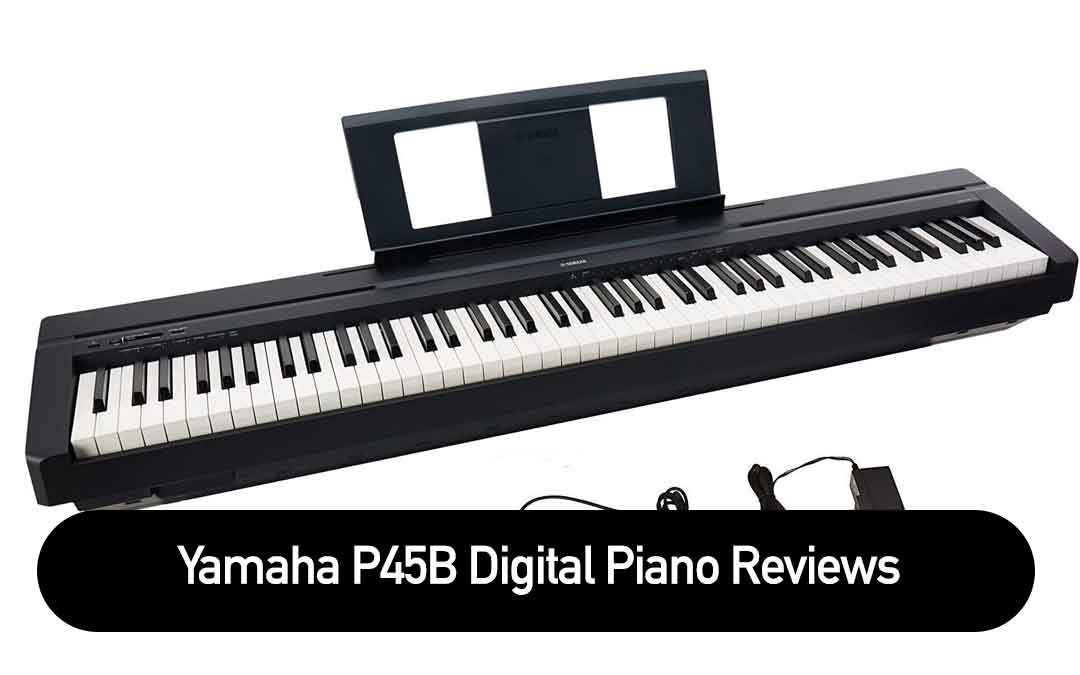
  • Yamaha P45B Digital Piano Reviews – 2023

    Yamaha P45B Digital Piano Reviews – 2023

    Yamaha P45 is one of the best-selling digital pianos from the brand, and that’s no surprise.

    Many piano teachers worldwide recommend the P45 to their beginner students because it is Yamaha’s cheapest 88-key weighted keyboard piano.

    But before you invest in the Yamaha P45 digital piano, you must know what you’re getting. So you won’t get any nasty surprises when you first start playing this instrument.

    In this blog post, we’ll review the Yamaha P45B digital piano in more in-depth and give our honest opinions on the following areas:

    • Key Specifications
    • Design
    • Keyboard
    • Sound Quality
    • Features
    • Connectivity
    • Accessories
    • Price

    By the end of this post, you’ll have all the information you need to decide whether the Yamaha P45 88-key digital piano is right for you.

    So, read on to learn everything you need about the Yamaha P45!

    Yamaha P45 Digital Piano: An In-Depth Review

    Quick Overview

    The Yamaha P-45 is the simplest yet most popular model in Yamaha’s P (Portable) digital piano series. Also, it’s the only digital piano in Yamaha’s arsenal that costs less than $600. This makes the P-45 one of the best in its class.
    Check On Amazon

    The Yamaha P45 is a fantastic entry-level digital piano for beginners who want to learn how to play the piano without breaking the bank.

    It’s a compact and lightweight instrument. And you can easily move around, making it perfect for those who want to practice on the go.

    The P45 keyboard features 88 fully weighted keys that simulate the feel of an acoustic piano, providing a satisfying playing experience for beginners as well as professional pianists.

    Similarly to a traditional piano, the GHS-weighted action is heavier at the low end and lighter at the high end. The keys have a matte finish, which is great for sweaty hands during extended rehearsals.

    The Yamaha P45 uses AWM Sampling technology which is excellent and does a good job reproducing the in-built sounds. The P45 contains ten voices, including digitally sampled tones from real Yamaha acoustic grand pianos.

    And with the dual mode, you can combine two voices, like piano and strings, for a new and inspiring playing experience. The controls on the P45 are simple and easy to navigate.

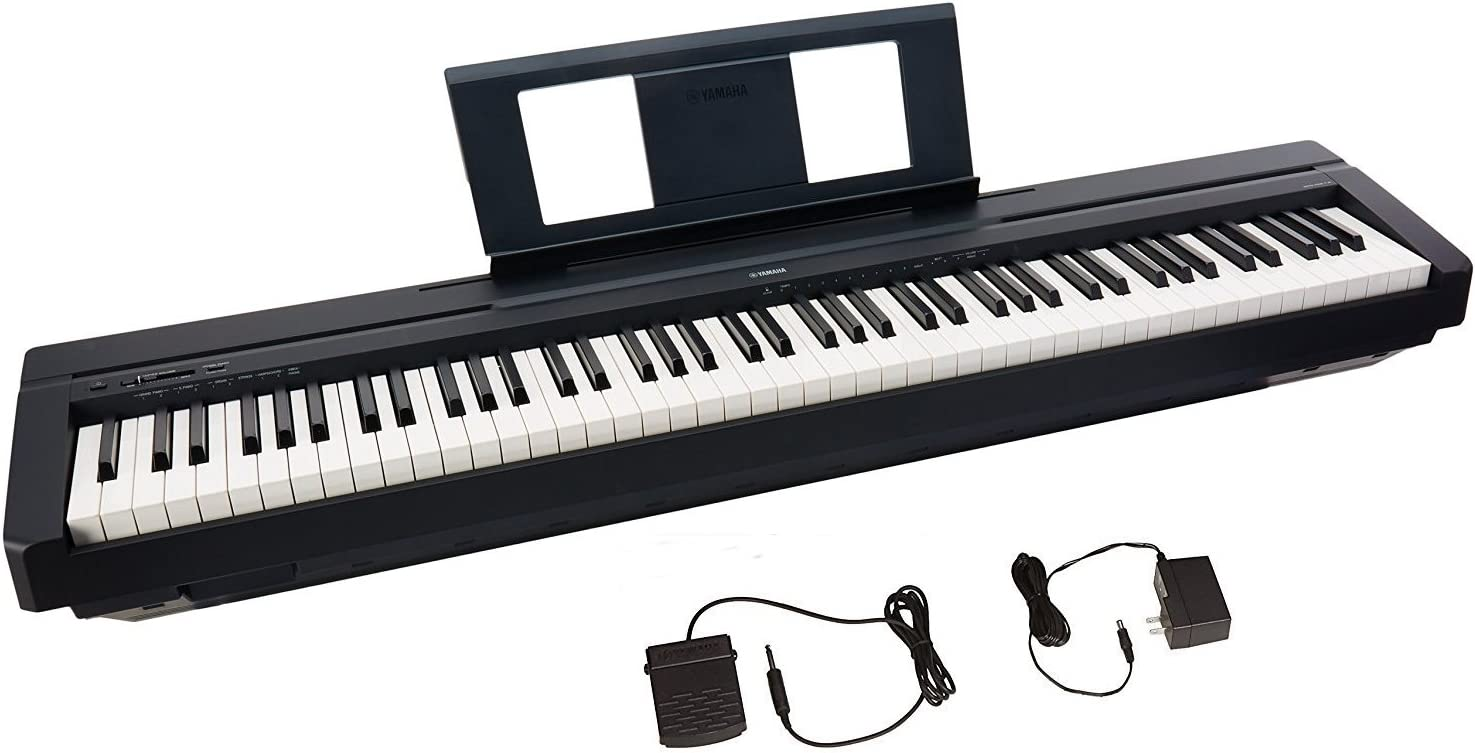
    Besides that, the package includes a P45 digital piano, power adapter, sustain pedal, and music rest.

    Overall, the Yamaha P45 digital piano is a solid choice for beginners looking for an affordable, easy-to-use instrument that provides a quality playing experience. However, it’s not the instrument you’re looking for if you need many sounds and effects.

    Key Specifications

    Here are the main specifications of the Yamaha P45 88-Key Weighted Digital Piano:

    • Dimensions: 52.2 x 11.6 x 6.0 inches
    • Keyboard Type: Graded hammer standard (GHS) keyboard
    • No. of Keys: 88
    • Touch Sensitivity: Yes (Hard, Medium, Soft, Fixed)
    • Piano Sound: AMW Stereo Sampling
    • Voices: 10
    • Polyphony (Max.): 64
    • Demo Songs: 10
    • Display: No
    • Speakers: 6W + 6W (12cm x 2)
    • Effects: Yes
    • Metronome: Yes
    • Transpose: Yes
    • Pedals: 1 (sustain pedal)
    • Recorder: N/A
    • Modes: Duo & Dual
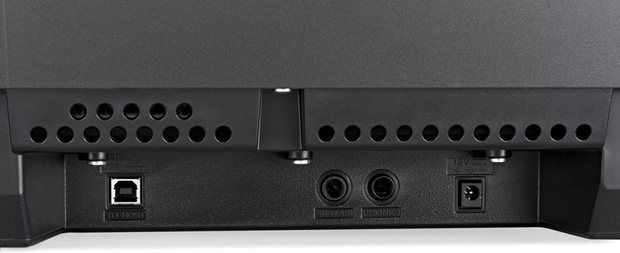
    • Connectivity: USB to Host, Sustain Pedal jack, Headphone jack,
    • Power Supply: AC Power Adapter
    • Color: Black
    • Weight: 11.5kg (25lbs. 4oz)

    Design

    The Yamaha P45 digital piano has a compact and lightweight design, making it an ideal option for musicians on the go.

    Being a portable stage piano, the P45 measures 52 inches in length, 12 inches in depth, and 6 inches in height. The unit weighs 11.5 kg (24 lbs. ), so it is light enough for one person to carry.

    If you are traveling or playing gigs, you can conveniently take this keyboard, as it fits in most cars.

    In terms of color, it’s classic black and white. This model is only available in one color, so you have no choice. The minimalist interface design adds to its aesthetic appeal.

    Now let’s talk about the controls!

    The control panel of the Yamaha P45 is simple and user-friendly. It consists of a power button, volume slide, and function button.

    With the function button, you can change the sound, turn on the metronome, and fine-tune the instrument by combining it with one of the 88 piano keys.

    However, not all functions are labeled, and you may need to refer to the user manual to adjust some settings like reverb.

    The P45 piano doesn’t have an LCD screen, so you won’t be able to see which instrument sound you choose and other settings you may change, such as reverb, transposition, velocity curve, or the metronome tempo.

    However, if you’re starting out playing the piano, you probably won’t be using these advanced functions yet. So, not having an LCD screen won’t be a deal-breaker for beginners.

    Overall, the Yamaha P45 portable stage piano is minimalist and easy to use, making it a popular choice for children and adult beginners.

    Keyboard

    The Yamaha P45 piano keyboard features 88 fully weighted keys with Yamaha’s Graded Hammer Standard (GHS) technology. It’s the company’s most affordable hammer action. You can typically find this hammer action in most entry-level digital pianos.

    The keyboard gives the keys a similar feel and action to an acoustic piano, using little hammers inside the keyboard instead of springs (semi-weighted actions).

    Like an acoustic piano, the GHS action is heavier at the bottom and lighter at the top.

    Unlike some high-end models, the P-45 keyboard piano does not have moisture-absorbing keytops that mimic the feel of ivory and ebony.

    However, the black keys have a matte finish, which helps prevent fingers from slipping off when moist. The white keys are glossy, which is common in many acoustic pianos.

    Note: It’s worth mentioning that Yamaha’s GHS action tends to be less noisy (noticeable when playing at a low volume or while wearing headphones) than Casio’s Tri-sensor hammer action. But in terms of realism, Casio’s action is superior.

    The keyboard is also touch-sensitive. This means the volume/timbre changes based on how hard or soft you play the piano keys, simulating a grand piano’s rich, dynamic range.

    You can choose from four different touch-sensitivity levels to suit your playing style: Fixed, Soft, Medium (which is the default), and Hard.

    If you select the “Fixed” setting, the keyboard won’t change volume based on how hard or soft you play the keys. It will always produce the same amount of sound, no matter how you play.

    But if you choose the “Hard” setting, you’ll have to hit the keys really hard to get the loudest sound. This gives you the broadest range of sound dynamics.

    One downside of the P-45 key action is that it only has two sensors. That makes it harder to play fast repeated notes and control the sound. This is because the key needs to travel a longer distance before making a sound when repeating.

    Sound

    When it comes to digital pianos, sound quality plays a crucial role. Luckily, the Yamaha P45B digital piano does a great job in this area.

    It uses the latest AWM (Advanced Wave Memory) digital technology to capture the authentic sound of a real acoustic piano.

    This technology combines pairs of waveforms (L and R) to create a deeper, richer, and more spacious sound. As a result, the P45B piano uses this recorded sound to play at varying volume and timbre levels, making it a versatile instrument.

    Additionally, the P-45B offers ten instrument sounds, including:

    • Two grand pianos
    • Two electric pianos
    • Two pipe organs
    • Two harpsichords
    • A strings section
    • And a vibraphone patch.

    Beginner and intermediate piano players will find these piano sounds useful for practice and casual playing. You can even layer two voices together to create your own unique sound if you wish.

    In addition, the piano has four different reverb effects that you can use to make the sound even better.

    The only drawback is that you can’t save your customized settings for quick recall.

    Other than that, the Yamaha P45B digital piano produces a beautiful piano sound. This instrument is an excellent choice for those looking for an acoustic piano sound in a digital format.

    Polyphony

    When playing a digital piano, “polyphony” refers to how many notes you can play simultaneously. The more polyphony a piano has, the better it can handle complex music with many notes.

    The Yamaha digital piano has 64-note polyphony, which is enough for beginners. This means you can play up to 64 notes simultaneously without any issues. However, 64 notes may not be enough for a professional classical pianist who plays complex pieces. This could lead to notes dropping off and ruining your performance.

    So, while the Yamaha digital piano is an excellent option for beginners, it’s not the best option for advanced pianists who need more polyphony.

    It’s worth noting that similarly priced digital pianos from other brands now offer 128 and even 256-note polyphony. You may consider another brand or model if you’re an advanced player.

    Speakers

    The P45 has two built-in speakers that measure 2 x 12 cm and have a 6W + 6W amp. They produce loud enough sound to practice or perform in a small room or in front of a few people.

    However, you will need an external amplifier for a live performance with several instruments, as the onboard sound is weak for such occasions.

    Considering the size of the P45, the sound quality through its onboard speakers is decent. Even at max volume, the sound remains clear and doesn’t distort.

    For an even better sound experience, you can plug in a good pair of headphones. It will provide a more precise, detailed sound and immersive listening experience.

    Features

    The P45B keyboard piano comes with some helpful features that are suitable for beginners as well as intermediate players. Here are some of these features:

    Modes

    This keyboard piano has two modes:

    Dual Mode: This mode lets you layer two instrument sounds so they play together across the entire keyboard range. You can combine different voices (like strings and piano) to create something unique and exciting. Additionally, you can adjust the volume balance between the two sounds to make one louder than the other.

    Duo Mode: This mode splits the keyboard into two equal sections with the same pitch range. The instrument allows two people to play at the same time while sitting side by side.

    Piano teachers often use this mode to teach their students. The piano teacher can sit next to the student during piano lessons and play some tunes while the student follows along and plays the same notes on the other part of the keyboard. This is a great way to learn together and improve your skills.

    Metronome

    The P-45 has a built-in metronome that ticks consistently to help you keep a steady tempo. Practicing with a metronome will help you develop time-keeping and rhythmic skills.

    You can also adjust the beat, tempo, and volume of the metronome on the P-45 to suit your preferences.

    Auto Power Off

    The auto-off function saves power by automatically turning off the instrument after 30 minutes of no use. If necessary, you can disable this feature.

    Fine-tuning

    Even though the P45B doesn’t need tuning, it comes with a fine-tuning function. This feature lets you adjust the pitch of the keyboard in small increments (0.2 Hz) to match the pitch of other instruments or singers.

    Transpose

    The digital piano also has a transpose function that you can use to change the pitch of the keyboard in semitone steps. This makes it easier to play songs in different keys without changing hand placements.

    The feature comes in handy if you’re playing a song written in a hard key with a lot of black keys. Simply shift the pitch of the keyboard and play the song in an easier key.

    All in all, the Yamaha P45B digital piano offers several educational features helpful for piano students looking to start playing piano or improve their skills.

    Connectivity

    When it comes to connectivity, the Yamaha P45 digital piano offers all the necessary ports and jacks for connecting external devices, such as external amplifiers, headphones, sustain pedals, etc.

    You’ll find all the connectors on the back of the device.

    USB (type B) port

    The keyboard includes a USB to Host port instead of a Midi In/Out port, which is more convenient in most cases. It allows you to transmit MIDI data to external devices like computers, tablets, etc. You’ll need an adapter, though.

    To connect the P45 piano to your computer, you’ll need an A to B USB cable, which is relatively inexpensive.

    Once connected to a computer, you can use the piano keyboard as a MIDI controller with various music software.

    Headphone jack

    If you want to practice privately or want accurate sound, plug in headphones using the 1/4″ stereo jack on the back. Also, this jack lets you connect an external speaker or amplifier to the piano.

    Sustain pedal jack

    The sustain pedal jack is where you plug in the included footswitch. The jack also works with third-party sustain footswitches/pedals with a 1/4″ plug.

    Accessories

    The Yamaha P-45 digital piano comes with a few useful accessories to get you started with your playing:

    • Music Rest
    • Basic Sustain Pedal
    • AC Power Adapter (with cord)
    • Owner’s manual

    Music Rest

    The music rest is designed for portability and is easy to attach and detach from the piano.

    Although it doesn’t have clips to hold your sheet music, it’s big enough to display two and a half A4-sized pages side by side.

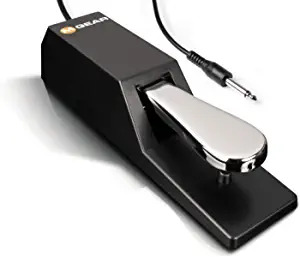
    Sustain Pedal

    The included Yamaha FC5 sustain footswitch works well, but it looks a bit flimsy and not as elegant as a real piano pedal.

    If you want a more realistic experience, consider upgrading to the M-Audio SP-2 piano-style pedal. It is affordable, durable, and feels like a grand piano pedal.

    Besides that, you can buy an optional piano-style stand (L-85) to complete the elegant look.

    AC Power Adapter

    The AC power adapter is included with the piano and comes with a cord. This ensures you can play your piano without worrying about running out of battery.

    Owner’s manual

    The owner’s manual is included and will help you get started with your new piano. It covers everything from setting up the piano to troubleshooting common problems.

    Price

    As we always say, price is one of the most factors when purchasing a product.

    Fortunately, the P45B digital piano is an affordable instrument. You can get it on Amazon for about $549, which is reasonable for its quality.

    Despite its price tag, this piano is impressive in terms of quality and sound. It has many useful features, especially for beginners learning to play piano.

    So, if you’re wondering if it’s worth the money, the answer is yes. It’s worth every penny.

    Pros and Cons of The Yamaha P45B Digital Piano

    We have discussed the Yamaha P45 digital piano in detail. Now let’s summarize its pros and cons:

    Pros

    Portable design: The P45B piano is lightweight and compact, making it easy to move and store when not in use.

    Easy to use: It’s simple and easy to use, ideal for beginners who don’t want to get bogged down in complex settings.

    Good Key Action: Even though the key action is not perfect for professional musicians, it is pretty decent for beginners.

    Excellent piano sound: The P45B simulates the sound of an acoustic piano beautifully. It also comes with ten high-quality instrument sounds.

    Various connectivity options: This piano has multiple connectivity options, allowing you to connect it to external devices like headphones, amplifiers, and computers. This expands the piano’s versatility.

    Inexpensive: It is an affordable digital piano that anyone can afford.

    Cons

    No built-in recording function: The Yamaha P45B doesn’t have a built-in recording function, so you’ll need to use external devices to record your performances.

    Flimsy sustain footswitch: The included sustain pedal is slightly flimsy and doesn’t look very nice.

    Doesn’t include a stand and bench: It doesn’t include a keyboard stand and a piano bench, so you’ll need to purchase those separately.

    Who Should Buy Yamaha P45 Digital Piano?

    If you’re a beginner piano player looking for your first digital piano at an affordable price to start your musical journey, the Yamaha P45B is your best bet.

    It’s designed to cater to beginners who want to learn the piano without breaking the bank. It has all the necessary features and a good key action to help you develop your skills during the early stages of learning.

    It is also a good choice for those who want to try piano playing but are unsure if it is for them. Since it has an affordable price point, you won’t lose much if you decide to give up later.

    However, if you’re an intermediate or advanced-level player, we cannot recommend the Yamaha P45. Two primary reasons account for this:

    Firstly, the limited polyphony of the P45 can make it challenging to play more complex classical pieces. That’s because any sound older than the last 64 will be cut off, which can be frustrating for more experienced players.

    Secondly, the duo sensor used in the key action of the P45 can make it challenging to play repeated notes quickly and with control, which can also be a significant drawback for intermediate or advanced pianists.

    These downsides won’t affect beginners. They may become frustrating as you progress and improve your skills. Therefore, it’s essential to consider your level and musical goals before purchasing a digital piano, including the Yamaha P45.

    Conclusion

    I hope this article has helped you determine whether you should get the Yamaha P45B digital piano in 2023.

    The P45 model is ideal for beginners since it has all the features a beginner needs without adding unnecessary frills. It’s affordable and offers fantastic sound and touch for the price.

    But if you’re an intermediate player or professional musician, the P45 is not your thing. Instead, I’d suggest looking for other digital pianos, such as the Yamaha P-125, the Casio PX-160, Alesis Recital Pro, and the Korg B1 digital keyboards.

    Overall, I strongly recommend the Yamaha P45 to beginners on a budget looking for a quality digital piano for under $600.

    Related Topics


  • Best Casio Keyboards For Beginners in 2023

    Best Casio Keyboards For Beginners in 2023

    Since 1980, Casio has been producing many affordable musical keyboards that are accessible to those who are more budget-conscious.

    Casio has a good selection of affordable keyboards in their lineup. And someone without enough knowledge of these keyboards will get lost in their marketing hype and technical specifications.

    But don’t worry if you’ve never touched a musical keyboard before, I’m here to help!

    In this article, I’m going to review the eight best Casio keyboards for beginners, and I’ll tell you which one is the best for beginners in early 2023.

    So, read on to find out what I recommend!

    8 Best Casio Keyboards For Beginners (2023)

    Here’s the list of my eight best Casio portable musical keyboards for beginners and children:

    Casio CT-X700 Portable Keyboard

    Key Specifications

    • Dimensions: 37.32 x 13.78 x 4.29 inches
    • Number of Keys: 61
    • Touch Sensitivity: Yes
    • Polyphony (Max.): 48
    • Sounds: 600
    • Rhythms: 195
    • Effects: Yes
    • Speakers: Yes
    • Weight: 4.3 kg
    • Price: $199

    My top pick for the Best Casio Keyboard for beginners is the Casio CT-X700 portable keyboard. It’s designed for beginner students, but it produces impressive sounds.

    Also, it has a compact and lightweight design that makes it easy to carry around wherever you go, perfect for practicing on the go.

    The keyboard features 61 piano-style keys with a touch response on/off button, giving it a realistic feel.

    The sound quality of the CT-X700 is truly impressive. This keyboard produces 600 high tones and 195 rhythms with high computing power. You’ll find old favorite tunes and chart-topping hits played with incredibly realistic instruments that sound better than ever.

    In addition, its large, clear LCD and intuitive user interface make it incredibly easy to use. You can also record your musical performance with the six-track recorder.

    One of the standout features of the CT-X700 is the Step-Up Lesson System. This system can help beginners learn to play the keyboard or be used alongside regular piano lessons.

    Also, this keyboard includes an AC power supply and optional battery power, making it a perfect go-anywhere musical partner.

    Overall, the Casio CT-X700 is one of the best entry-level arranger keyboards. It is ideal for people looking for an affordable, versatile keyboard with realistic piano sounds, high-quality voices, and accompaniment styles.

    Check On Amazon

    Casio CT-S300

    Key Specifications

    • Dimensions: 36.61 x 10.07 x 2.87 inches
    • Number of Keys: 61
    • Touch Sensitivity: Yes
    • Polyphony (Max.): 48
    • Sounds: 400
    • Rhythms: 77
    • Effects: Yes
    • Speakers: Yes
    • Weight: 3.3 kg
    • Price: $189.95

    The CT-S300 model is one of the best portable Casio piano keyboards for under $200.

    It features 61 touch-sensitive keys. That means how hard you press a key affects the volume of the pressed key sound. The keyboard is a step towards a real piano keyboard, but still far from it.

    Despite only weighing 3.4 kg, it features a sustain pedal that keeps notes in time even after keys are released.

    In terms of sound quality, it’s pretty decent for the price.

    The keyboard has 48 notes of polyphony, which is quite good for its price and one of the most important aspects of piano sound. It includes 400 impressive quality sounds, 77 fun rhythms, and some piano sound effects.

    It also features a pitch bend wheel. You can easily create and remix EDM tracks using its Dance Music Mode.

    Furthermore, this Casio keyboard includes a micro USB port, so you can connect it to any digital device if you want to access a music media program or app.

    As a side note, the CT-S300 can be powered by six AA batteries and lasts up to 20 hours. You can also use the provided AC adapter.

    In summary, if you’re looking for a good, cheap piano keyboard that plays well and sounds alright, the CT-S300 is a good option.

    Check On Amazon

    Casio SA-76 44-Key Mini Personal Keyboard

    Key Specifications

    • Dimensions: 23.78 x 2.25 x 8.3 inches
    • Number of Keys: 44
    • Touch Sensitivity: N/A
    • Polyphony (Max.): 8
    • Sounds: 100
    • Rhythms: 50
    • Effects: Yes
    • Speakers: Yes
    • Weight: 1.4 kg
    • Price: $59

    The SA-76 is the cheapest Casio Keyboard for beginners available in the Casio SA series mini keyboards. It costs around $60.

    It weighs only 1.4kg, making it the most lightweight and compact keyboard on this list.

    It has a touch-sensitive keyboard with 44 mini-sized keys, ideal for young musicians. Remember that the keys are not weighted, so it does not feel like a real piano.

    However, that’s not a deal-breaker at this level – it’s a fun way for kids to learn how to play simple melodies over fun backing tracks.

    The SA-76 features built-in speakers, 100 built-in sounds, and 50 exciting rhythms. It also has ten basic songs, five drum pads, and, perhaps most importantly, a headphone jack.

    Designed for beginners, this keyboard is easy to use and fun to play. You can operate all the buttons quickly, and they’re clearly labeled. You can pick the Grand Piano or Reed Organ sound with the big orange button.

    Additionally, it has an LCD screen that lets you see the notes you play on screen, which helps you learn music notation.

    In summary, the Casio SA-76 is an excellent practice keyboard and perfect for kids or newbies trying to play piano to see if it is for them. Since the keys aren’t velocity-sensitive, it is not suitable for serious beginners.

    Check On Amazon

    Casio LK-S250 61-Key Premium Lighted Keyboard

    Key Specifications

    • Dimensions: 36.6 x 10.07 x 2.87 inches
    • Number of Keys: 61
    • Touch Sensitivity: Yes
    • Polyphony (Max.): 48
    • Sounds: 400
    • Rhythms: 77
    • Effects: Yes
    • Speakers: Yes
    • Weight: 3.4 kg
    • Price: $209.95

    Next up, we have the Casio LK-S250 keyboard that features 61 full-size velocity-sensitive, light-up keys.

    That means the correct keys will light up to tell you which notes to play as you play along to an onboard Step Up lesson or one of the 60 built-in songs.

    You can connect the keyboard to a smart device via the micro-USB port and use the Chordana Play app, which uses light-up keys to expand the keyboard’s educational possibilities.

    The keyboard’s minijack audio input lets you play MP3s along with external music sources.

    With its lightweight and slim design, the LK-S250 is incredibly portable. The device can be powered by batteries, making it easy to carry to practice sessions or performances.

    This learning keyboard has 400 tones and a Dance Music mode with 50 different rhythms, which makes it an excellent all-rounder. It also offers a maximum polyphony of 48, which is enough for beginners.

    In summary, the Casio LK-S250 keyboard is an excellent tool for beginners to learn to play the piano keyboard and improve their playing skills. Its 61 light-up keys provide helpful visual cues to learners.

    Check On Amazon

    Casio CT-X3000

    Key Specifications

    • Dimensions: 37.3 x 15 x 4.5 inches
    • Number of Keys: 61
    • Touch Sensitivity: Yes
    • Polyphony (Max.): 64
    • Sounds: 800
    • Rhythms: 235
    • Effects: Yes
    • Speakers: Yes
    • Weight: 6.9 kg
    • Price: $449

    The Casio CT-X3000 is an excellent choice for beginners looking for a high-quality keyboard. It has 61 full-size touch-responsive keys that provide an authentic playing experience.

    While the keys aren’t fully weighted, the touch response is adjustable, making it easy to play.

    The sound quality of this keyboard is superb. It has all the professional sounds you can expect from such a quality keyboard.

    It comes with 800 tones, giving users many options to keep them busy. The 235 editable rhythms and wide range of powerful DSP effects make this keyboard versatile and fun to play.

    The CT-X3000 also comes with a powerful 12-watt stereo speaker system that ensures users won’t be disappointed with the volume level.

    In addition to that, the 17-track sequencer, phrase pads, and arpeggiator provide plenty of options for creating music.

    One of the most impressive features of this keyboard is it comes with two months of live online keyboard lessons, making it an ideal choice for beginners who are just starting.

    The keyboard includes an adjustable stand, sustain pedal, and bench in a bundle pack, which saves you money while providing quality gear.

    Overall, the CT-X3000 is one of the best digital piano keyboards for beginners, intermediate players, and experienced pianists. It is an excellent value for the price.

    Check On Amazon

    Casio CT-S400

    Key Specifications

    • Dimensions: 36.61 x 10.15 x 3.30 inches
    • Number of Keys: 61
    • Touch Sensitivity: Yes
    • Polyphony (Max.): 48
    • Sounds: 600
    • Rhythms: 200
    • Effects: Yes
    • Speakers: Yes
    • Weight: 4.5kg
    • Price: $249

    The Casio CT-S400 portable keyboard is an excellent addition to the Casio Casiotone line.

    Casio launched the Casiotone brand in the 1980s, and in 2019, the company released three new portable keyboards: the CT-S100, the CT-S200, and the CT-S300. In 2021, they added the CT-S400 to the lineup, which is the range-topper of the line.

    The CT-S400 has a 61-key velocity-sensitive keyboard with a pitch-bend wheel and the AIX sound engine. The keys are full-sized and feel high-end, giving the player the experience of playing an acoustic piano.

    This musical instrument boasts 600 tones, 200 accompaniment styles, and a new backlit screen with five user-configurable soft buttons. The sounds are authentic.

    Casio’s philosophy of helping people make music anytime and anywhere is embodied in the CT range, and the CT-S400 is a worthy addition to that range.

    For those who prefer illuminated keys, there’s an equivalent light-up model called the LK-S450.

    Overall, the CT-S400 is a fantastic choice for beginners and experienced musicians looking for a versatile, reliable portable keyboard. Its sleek design, impressive sound, and user-friendly interface make it a favorite among players

    Check On Amazon

    Casio Inc. WK245 PPK Premium Portable Keyboard

    Key Specifications

    • Dimensions: 54 x 12 x 20 inches
    • Number of Keys: 76
    • Touch Sensitivity: 
    • Polyphony (Max.): 48
    • Sounds: 600
    • Rhythms: 260
    • Effects: Yes
    • Speakers: Yes
    • Weight: 7.2kg
    • Price: $250

    The Casio WK-245 PPK 76-Key Premium Portable Keyboard is an excellent choice for beginner students.

    The keyboard comes bundled with a bench, headphones, and a stand on top of the keyboard, making it a complete package for aspiring musicians.

    This beginner keyboard features a large backlit LCD panel that shows everything, including music notation. It also has performance controls, which allow you to combine tones into layers and split the keyboard.

    Furthermore, the Casio WK-245 PPK includes an AUX input that lets you connect your MP3 player or other devices, allowing you to enjoy the stereo speaker system in multiple ways.

    It also has a USB MIDI port, meaning you can connect it to computers and iOS devices without needing drivers.

    With 600 built-in tones and an impressive library of 152 built-in songs, you have plenty of options to choose from.

    Additionally, the 180 preset rhythms help to expand your music composition, creativity, and fun, and 48 notes of polyphony ensure no dropped notes.

    The keyboard also features an onboard 5-song/6-track recorder that lets you capture your ideas before they disappear. The headphones that come with this keyboard bundle pack are on the cheaper end, but they’re decent.

    Overall, the Casio WK-245 PPK is one of the best beginner keyboards that any age of musician will like. It feels pretty nice and is reasonably priced for the features it offers.

    Check On Amazon

    Casio CDP-S150 88-Key Digital Pianos-Home

    Key Specifications

    • Dimensions: 52 x 9 x 3.9 inches
    • Number of Keys: 88
    • Touch Sensitivity: Yes (3 sensitivity levels, off)
    • Polyphony (Max.): 64
    • Sounds: 10
    • Rhythms: N/A
    • Effects: Yes
    • Speakers: Yes
    • Connectivity: USB Type-A port, stereo mini audio jack, sustain pedal jack, Phones/Output: stereo mini jack, Connector for SP-34 three-pedal unit
    • Weight: 10.5 kg
    • Price: $399

    If you have your heart set on getting an 88-key digital piano keyboard, the Casio Privia PX-160 is the best choice.

    With its affordable price tag of $399, this keyboard features 88 full keys with weighted hammer action.

    Because the weighted keys are made of simulated ebony and ivory, this keyboard feels like a more expensive piano keyboard. You can adjust the touch sensitivity to three levels or turn it off entirely, depending on your needs.

    The CDP-S150 offers ten different sounds and effects, including grand piano, electric piano, and harpsichord. Its grand piano sounds and 64 maximum polyphony are sufficient for a professional pianist and more than enough for a beginner.

    The built-in speaker system and dual headphone jacks allow for private practice. Also, it has a USB Type-A port and stereo mini audio jack for connecting to other music gear, such as amplifiers.

    Additionally, this instrument comes with a keyboard stand and bench, making it an all-in-one package.

    Overall, if you are serious about learning piano and want to become a professional musician, the Casio CDP-S150 is the right digital piano.

    Check On Amazon

    How To Choose A Casio Keyboard For Beginners?

    Before you begin your search for the best keyboards for beginners and kids, you need to know how to choose the best ones.

    Choosing the best Casio musical keyboard for beginners comprises specific factors. The following are these factors:

    No. of Keys

    The first thing to consider is the number of keys on the keyboard. It largely depends on the genre a player plays or intends to play.

    As a beginner, you might want to opt for a keyboard with 61 keys, which is good enough for initial learning.

    If you are serious about learning the piano and want to mimic the feel of an acoustic piano, a keyboard with 88 keys would be a better choice.

    Sound

    Another crucial factor to consider is the keyboard’s sound quality. You should look for a keyboard with high-quality sound, which includes a wide range of instrument sounds and tones.

    You should look for a keyboard with high-quality sound, which includes a wide range of instrument sounds and tones.

    Casio keyboards come with a vast library of sounds and tones, which can be helpful for learning different types of music.

    Portability

    Portability is an essential factor, especially if you plan on carrying your keyboard around. If you need a keyboard that is easy to carry, look for a lightweight and compact design that is easy to transport.

    Speaker Quality

    It is also essential to consider the quality of the speakers. As a beginner, you may not want to invest in additional speakers or amplifiers.

    Therefore, a keyboard with high-quality built-in speakers is essential. Some Casio keyboards come with excellent built-in speaker systems, which provide a rich and full sound.

    Price

    Finally, you need to consider the price of the keyboard. As a beginner, you don’t want to spend too much money on a keyboard that you may outgrow soon.

    Casio offers a range of keyboards that are affordable and suitable for beginners. Look for keyboards that provide good value for money without sacrificing quality.

    Ultimately, choosing the best Casio musical keyboard for kids and beginners is all about finding the right balance between functionality, sound quality, portability, speaker quality, and price.

    By considering these factors, you can select a keyboard that suits your needs and helps you learn music effectively.

    Conclusion

    These are my top eight best Casio musical keyboards for beginners and kids.

    No matter which model you opt for, these electronic musical instruments are among the best and will help you learn to play the piano and improve your musical skills.

    I hope my Casio keyboard reviews and buying guide will help you make an informed purchase.

    Related Topics

  • Best Digital Piano Under 300 In 2023

    Best Digital Piano Under 300 In 2023

    If you are looking for the best digital piano under 300, then you’ve reached the right place.

    Choosing a budget-friendly keyboard piano doesn’t mean sacrificing quality.

    In today’s market, many options are available, so finding the best digital piano keyboard is not difficult, even with a $300 budget.

    The problem is that manufacturers make many promises; some are true while others are not, which leaves us confused when choosing one.

    That’s why we scoured the market and narrowed down the top 8 best digital pianos under $300 based on their features, sound quality, connectivity, and overall value for the price.

    With this guide, you can be confident in your decision and find a piano that suits your needs and budget.

    So, read on to find out which models made our list!

    8 Best Digital Pianos Under 300 Dollars (2023)

    If you (or your kid) are an absolute beginner taking your first steps into the world of piano playing, you don’t need to break the bank on your first instrument. I suggest spending no more than $500 on your first keyboard or digital piano.

    While the best digital piano models listed below don’t have weighted hammer action keys like more expensive digital pianos, they have touch sensitivity. As a result, they are piano keyboards, not digital pianos.

    However, these inexpensive musical instruments are ideal for beginners to test out their interest or enthusiasm in music.

    Plus, they offer a range of digital features to help you to learn to play piano and exciting instruments to have fun with, especially with the accompaniment feature.

    Although they aren’t meant for professional use, you can still learn a lot of music with them and show off your or your children’s musical skills to friends and family.

    Here are the eight best digital pianos under 300 dollars for kids and adult beginners:

    Yamaha PSRE373 Portable Piano

    Specification

    • Dimensions: 37.1 x 14.5 x 4.6 inches
    • Number of Keys: 61
    • Touch Sensitivity: Yes (Soft, Medium, Hard, Fixed)
    • Polyphony (Max.): 48
    • Voices: 622
    • Effects: Yes
    • Speakers: Yes
    • Pedals: N/A
    • Metronome: Yes
    • Connectivity: USB TO HOST, DC IN, AUX IN, sustain pedal input, stereo headphone jack.
    • Weight: 4.6 kg
    • Price: $189

    The Yamaha PSR-E373 is our top pick for best digital pianos under 300 because of its high-quality sound and versatile features. You can use it as a beginner’s piano keyboard or a full-featured arranger.

    The keyboard weighs only 4.6 kg, making it easy to carry around.

    It features 61 touch-sensitive keys to play with different dynamics and styles. It also has a maximum of 48-note polyphony, which allows you to play complex musical passages without any notes dropping out.

    The 373 produces a beautiful sound of a grand piano. You can conveniently access the default grand piano voice by pressing the Portable Grand button. The sound sample is from Yamaha’s quarter million dollar CFX concert grand piano.

    In addition, the E373 offers over 620 voices ranging from acoustic pianos to electronic instruments such as electric pianos, flutes, guitars, strings, percussions, saxophones, drum kits, and various sound effects. You can also apply reverb, chorus, and Digital Signal Processing (DSP) effects to the voices.

    Additional features of the PSR-E373 include dual, split, and duo modes, transposition, Smart Chord, custom master tuning, a built-in metronome, and a 2-track MIDI recorder. Also, it features a backlit LCD panel for ease of reading in any lighting condition.

    Regarding connectivity, this beginner keyboard piano includes a USB MIDI port to connect your devices and a built-in audio interface to transmit audio data between your keyboard and computer or mobile devices. Under $300, you won’t find this feature in any other digital piano.

    The Yamaha PSR-E373 doesn’t come with a power adapter. You can run it on six AA batteries, of course. However, the battery only lasts a few hours, and it’s best for on the road when you don’t have access to an electric outlet.

    Overall, the Yamaha PSR-EW310 keyboard piano undoubtedly offers exceptional value for money. I highly recommend this keyboard piano for beginners and those who are just starting and want to see if they will stick with it long-term.

    Check On Amazon

    Casio Casiotone CT-S300

    Specification

    • Dimensions: 36.6 x 10 x 2.8 inches
    • Number of Keys: 61
    • Touch Sensitivity: Yes (2 sensitivity levels, off)
    • Polyphony (Max.): 48
    • Voices: 400
    • Effects: Yes
    • Speakers: Yes
    • Pedals: N/A
    • Metronome: Yes
    • Connectivity: USB port (micro B), sustain pedal jack, stereo mini audio jack, Phones/Output: stereo mini jack.
    • Weight: 3.3 kg
    • Price: $179

    Our runner-up is the Casio CT-S300, which is actually the best digital piano under 200 USD.

    Made with solid materials, the design of the CT-S300 model is nice. Its thoughtful carry handle makes the device easy to carry anywhere.

    The keyboard has 61 touch-sensitive boxed keys with texture and matte finish that enhance the piano playing experience. It also offers a maximum polyphony of 48 notes, 400 tones, 77 accompaniment rhythms, and 60 demo songs.

    With the LCD screen, you can easily see at a glance what tones, rhythms, and parameters you have set, which makes the layout very logical and convenient.

    Additionally, the instrument comes with a dance music mode that lets you easily create and remix EDM tracks.

    The CT-S300 is a fun piano keyboard if you want to be a DJ (Disc Jockey) since it has 50 dance music patterns. You can even spice up your DJ patterns with 12 human voices.

    Furthermore, this affordable piano features built-in speakers for sharing with friends, and the headphone jack allows you to practice quietly without disturbing others. It has a stereo mini audio jack, a sustain pedal jack, and a USB port for connectivity.

    At $179, the Casio CT-S300 comes with a music rest and power supply.

    Overall, this keyboard is an excellent choice for those looking for an affordable and fun digital keyboard with decent sound quality and various features.

    Check On Amazon

    Alesis Recital – 88 Key Digital Piano

    Specification

    • Dimensions: 50.5 x 11.5 x 3.6 inches
    • Number of Keys: 88
    • Touch Sensitivity: Yes
    • Polyphony (Max.): 128
    • Voices: 5
    • Effects: Yes
    • Speakers: Yes
    • Pedals: N/A
    • Connectivity: USB-MIDI output, sustain pedal input, stereo headphone jack
    • Weight: 7 kg
    • Price: $229

    On this list of digital piano reviews, the Alesis Recital is the only model with 88 keys. This keyboard features 88 semi-weighted keys, which are not as good as fully weighted, responsive keys but good enough for beginners.

    Additionally, it provides ultra-realistic sound and a great playing experience with 128 maximum polyphony and powerful 20-watt speakers.

    Because of these qualities, the Recital earns the third spot on our list of the eight best digital pianos under 300.

    If you’re a beginner or intermediate pianist with a tight budget and wish to progress your piano journey quickly, the Alesis Recital is a fantastic choice.

    While the Recital doesn’t have hundreds of sounds, its five voices (piano, electric piano, organ, synth, and bass) are decent enough for beginners or seasoned players.

    Some people may use this as a controller in their home studios or live settings. They don’t care about the weighted keys; they want the right size and feel.

    Luckily, the Recital has a USB MIDI output that allows musicians to hook up with MIDI programs or apps.

    But what sets the Recital apart is its educational features. This keyboard offers powerful educational features like standard, split, layer, and lesson modes, as well as a three-month premium subscription to Skoove for expert interactive online piano lessons.

    And if you want to improve your piano skills for any genre or technique, you can take advantage of the 60 free virtual lessons from Melodics that come with the Recital.

    In summary, if you are looking for the best digital piano under 300 dollars with a realistic piano feel, then the Alesis Recital 88-Key Beginner Digital Piano is worth considering.

    Check On Amazon

    Yamaha NP32 76-Key

    Specification

    • Dimensions: 49 x 10.18 x 4.12 inches
    • Number of Keys: 76
    • Touch Sensitivity: Yes
    • Polyphony (Max.): 64
    • Voices: 10
    • Effects: Yes
    • Speakers: Yes
    • Pedals: N/A
    • Metronome: Yes
    • Connectivity: USB to Host port, DC IN, sustain pedal input, headphones jack
    • Weight: 5.7 kg
    • Price: $329.99

    Another popular Yamaha digital piano for $300 in this list is the Yamaha NP32 76-Key lightweight, portable keyboard. It is an excellent choice for those who want to learn how to play piano.

    The NP32 has a 76-key Graded Soft Touch (GST) keyboard that simulates the feel of an acoustic piano. This allows an authentic playing experience despite its lightweight construction.

    The piano’s Advanced Wave Memory Stereo Sampling technology provides top-notch sound quality, replicating the natural sound of instruments. Additionally, it includes ten other sounds that are equally impressive.

    The NP32 offers 64-note polyphony, a song recorder, and extended battery life. Since the device is battery-powered with 6 AA batteries, you’re not tied to a wall outlet power supply. However, you can buy one separately if you so choose.

    A notable feature of this musical instrument is the controller app for iOS, which adds a rich and user-friendly interface for easy navigation and configuration. The USB port lets you connect and interact with various educational apps on your computer or mobile devices.

    Overall, the Yamaha NP32 is a good choice for beginners who want to learn the basics of piano playing.

    Check On Amazon

    Alesis Melody 61 MKII

    Specification

    • Dimensions: 37.4 x 12.4 x 4.1 inches
    • Number of Keys: 61
    • Touch Sensitivity: Yes
    • Polyphony (Max.): N/A
    • Voices: 300
    • Effects: Yes
    • Speakers: Yes
    • Pedals: N/A
    • Connectivity: a 1/8″headphone output
    • Weight: 4 kg
    • Price: $117

    The Alesis Melody 61 MKII is the most portable and cheapest digital piano on this list. It has 61 full-size piano-style keys and built-in speakers that allow you to practice and perform in front of friends and family.

    Also, this piano has 300 sounds to choose from, including acoustic piano, electric piano, strings, organ, synths, and drums. With Dual and Split modes, you can mix two different sounds to create a unique sound.

    You can even record your performances with the “Record” feature. This piano also comes with 40 demo songs, 300 rhythms, and a wide range of piano sound effects.

    Furthermore, this portable piano offers powerful educational features, including a 3-month premium subscription from Skoove for interactive online piano lessons and two months of live video lessons from TakeLessons.

    The Alesis Melody package includes everything you need: a keyboard stand, bench, headphones, sheet music stand, microphone, and power adapter. The sheet music stand can hold sheet music or tablet devices, so you can read music or attend lessons while playing.

    Although the microphone and headphones aren’t great, they’re decent for the price.

    Overall, Alesis Melody 61 MKII is one of the best portable digital pianos for children and adult beginners who want a fun and engaging way to learn and practice piano.

    Check On Amazon

    Alesis Recital 61 Digital Piano

    Specification

    • Dimensions: 35.64 x 11.5 x 3.4 inches
    • Number of Keys: 61
    • Touch Sensitivity: Yes
    • Polyphony (Max.): 128
    • Voices: 10
    • Effects: Yes
    • Speakers: Yes
    • Pedals: N/A
    • Connectivity: USB-MIDI output, sustain pedal input, stereo headphone jack
    • Weight: 5.6 kg
    • Price: $199

    The Alesis Recital is a fantastic entry-level keyboard piano with a sleek and compact design. It has 61 semi-weighted keys with adjustable touch response, which allows you to customize your playing style.

    The sound quality is impressive for a keyboard at this price. It also features ten premium sounds, a wide range of sound effects, 128-note max polyphony, and powerful 20-watt built-in speakers.

    The speakers produce high-quality sound, making this keyboard piano suitable for small performances.

    Additionally, the keyboard has educational features that help students learn and practice piano.

    When it comes to connectivity, this instrument features a dedicated headphone output, RCA connectors for hookup flexibility, and a damper pedal input.

    On the negative side, it doesn’t include a sustain pedal and lacks a recording feature.

    You can’t go wrong with the Alesis Recital 61 if you want a budget digital piano keyboard that offers excellent value for money without overloading it with bells and whistles.

    Check On Amazon

    RockJam 61 Key Keyboard Piano

    Specification

    • Dimensions: 35.6 x 12.6 x 4.3 inches
    • Number of Keys: 61
    • Touch Sensitivity: Yes
    • Polyphony (Max.): N/A
    • Voices: 200
    • Effects: Yes
    • Speakers: Yes
    • Pedals: 1 (sustain pedal)
    • Connectivity: USB-MIDI port, AUX IN, sustain pedal input, headphones jack
    • Weight: 5.4 kg
    • Price: $165.78

    The RockJam 61 Key Keyboard Piano SuperKit isn’t the best when it comes to sound quality or audio fidelity. But if you’re looking for a package that includes everything you need at a reasonable price, then it might be the best option.

    Featuring 61 full-sized keys, this piano gives the feel of a traditional piano while still being portable and compact. This keyboard can be powered by either mains or batteries, allowing you to play wherever you want.

    One of the best things about the keyboard is that it comes with piano note stickers and the Simply Piano app, which makes learning piano quick and enjoyable for beginners.

    Furthermore, it has a touch display panel that provides feedback and access to 200 rhythms, 200 tones, a teaching function, and 30 demo songs.

    You can also easily record and play back your music and integrate the keyboard with your digital audio workstation via a single cable.

    In addition to the keyboard itself, this super kit also comes with headphones, a sturdy keyboard stand that can be adjusted to suit players of all ages, and a padded seat that provides hours of comfortable play.

    In contrast to all the other models on this list, this one includes a damper pedal that enhances your piano-playing experience.

    Overall, the RockJam 61 Key Touch Display Keyboard Piano is a good option for beginners and intermediate piano players looking for a versatile and reliable keyboard at an affordable price.

    Check On Amazon

    The ONE Smart Piano Keyboard

    Specification

    • Dimensions: 36.22 x 12.99 x 3.94 inches
    • Number of Keys: 61
    • Touch Sensitivity: Yes
    • Polyphony (Max.): 128
    • Voices: 417
    • Effects: Yes
    • Speakers: Yes
    • Pedals: N/A
    • Connectivity: USB port, sustain pedal input, triple-pedal port, headphones jack
    • Weight: 5 kg
    • Price: $243

    Last but not least, the ONE Smart Piano Keyboard is an excellent beginner-friendly digital piano with built-in red LED lights. The light-up keys tell the player what piano key he (or she) needs to play.

    The keyboard features 61 standard keys with touch response and two speakers. It also comes with 128 notes of polyphony which means you won’t have any note drops even when you are playing fast or complex pieces.

    The piano contains over 4000 sheet music, 100 instructional videos, and games in the free apps, making it a comprehensive learning tool.

    The ONE Smart Piano app offers video lessons, quick courses, and 417 tones. The video lessons are graded and start from the very first lesson to more advanced playing.

    You can pause and rewind if you want to return to a particular topic. As a result, you can learn according to your own schedule.

    This teaching piano keyboard is compatible with iOS and Android devices and supports external pedals and headphones. With only four buttons on the surface, it is easy to operate.

    The ONE Smart Piano also comes with a recording and MIDI function, a headphones jack, and Power Adapter. It can be powered by an AC adapter or 6 AA batteries, making it convenient to carry.

    Overall, the ONE Smart is an excellent lighted keys digital piano that suits adult and junior students. It’s not only a piano but also a teacher.

    Check On Amazon

    Conclusion

    So, this was our list of the eight best digital pianos under 300. These models are not only inexpensive but also portable and versatile.

    These digital pianos let you play silently with headphones, experiment with different instrument sounds, and even record your performances.

    While you won’t find any new pianos with fully weighted keys for under $300, plenty of great options are still available. Most keyboards in this price range come with semi-weighted keys, which still offer a decent playing experience.

    If you’re looking for an 88-key keyboard, the Alesis Recital is a fantastic option.

    Other digital piano keyboards that sell for under $300 usually have 76 keys or less, which is fewer than the keys on a real piano. That’s fine if you’re a beginner or just playing for fun.

    Ultimately, choose the one that is most suitable for your needs and budget.

    Related Topics

  • How to Play the Piano Faster: Tips and Techniques

    How to Play the Piano Faster: Tips and Techniques

    Practical Ways to Play the Piano Faster

    Learning to play the piano is an exciting journey that requires time, patience, and dedication. Many people dream of playing their favorite songs or pieces with ease and confidence, but struggle to improve their playing speed. Fortunately, with the right techniques and practice methods, it is possible to play the piano faster and more accurately. In this article, we will explore some tips and techniques for improving your piano playing speed, from mastering finger exercises to using advanced practice strategies.

    Mastering Finger Exercises

    One of the most important aspects of playing the piano faster is developing dexterity and control in your fingers. Finger exercises are a great way to achieve this, as they help to build muscle memory and improve coordination. There are many different types of finger exercises you can practice, such as scales, arpeggios, and chromatic exercises. By practicing these exercises regularly and gradually increasing your speed, you can train your fingers to move more quickly and accurately across the keys.

    Scales are a fundamental part of piano playing and are essential for developing finger strength, speed, and accuracy. Practicing scales regularly can also help you improve your finger positioning, hand posture, and coordination. To practice scales, start with simple major and minor scales, playing each note evenly and consistently. As you become more comfortable, gradually increase the tempo and aim for smooth, flowing transitions between notes.

    Arpeggios are another important finger exercise that can help improve your piano playing speed. An arpeggio is a sequence of notes played in succession, usually consisting of the notes of a chord. Practicing arpeggios can help you develop finger strength and coordination, as well as improve your ability to play chord progressions quickly and accurately. Start with simple major and minor arpeggios, and gradually increase the tempo as you become more comfortable.

    Chromatic exercises are another great way to improve your finger dexterity and accuracy. Chromatic scales consist of all twelve notes in the Western music system, played in ascending or descending order. Practicing chromatic scales can help you develop finger independence and improve your ability to play complex passages quickly and accurately. Start with simple chromatic exercises, playing each note evenly and consistently. Gradually increase the speed and challenge yourself to play more complex patterns and sequences.

    Improving Muscle Memory

    According to a study published in the Journal of Neuroscience, practicing a complex motor skill such as playing the piano can lead to structural changes in the brain. These changes include increased gray matter density in areas of the brain responsible for motor control and auditory processing

    Another key factor in playing the piano faster is developing strong muscle memory. This involves training your fingers to remember the movements and patterns required to play a particular piece or passage. To improve your muscle memory, you can try breaking down difficult passages into smaller sections and practicing them slowly and repetitively. As you become more familiar with the movements and patterns, you can gradually increase your speed until you can play the passage smoothly and accurately.

    One effective technique for improving muscle memory is called “chunking.” This involves breaking down a piece into smaller sections or “chunks” and practicing each section separately until it becomes automatic. Once you have mastered each section, you can begin to combine them into larger chunks and eventually play the entire piece with ease.

    Practicing Piano Theory

    Understanding piano theory can also help you play faster and more efficiently. By learning about scales, chords, and other theoretical concepts, you can develop a deeper understanding of the music you are playing and how it is structured. This can help you identify patterns and repetitions in a piece, making it easier to play quickly and accurately. You can also practice sight-reading, which involves playing a piece of music for the first time without any prior preparation. This can help improve your ability to read and interpret music quickly, which is essential for playing at a faster tempo.

    Using Advanced Practice Strategies

    In an article for Piano Magazine, pianist and teacher Graham Fitch suggests using a technique called “thumb tucks” to improve piano playing speed. This involves tucking the thumb under the fingers and using it to play the black keys, which can help improve finger independence and control.

    In addition to finger exercises, muscle memory, and piano theory, there are many advanced practice strategies that can help you play the piano faster. For example, you can practice with a metronome, which helps you keep a consistent tempo and develop a strong sense of rhythm. Start by setting the metronome to a slower tempo and gradually increasing the speed as you become more comfortable. You can also try practicing with different rhythms, such as syncopation or off-beat patterns, to challenge yourself and improve your ability to play complex rhythms accurately.

    Another advanced practice strategy is to practice a piece in reverse order. This can help improve your memory and technique, as well as help you identify patterns and repetitions in the music. Start by playing the last measure of the piece first, then add the second-to-last measure, and so on until you reach the beginning of the piece. Practicing in reverse order can also help you identify and correct mistakes in your playing.

    Additionally, you can try practicing a piece at a slower tempo, gradually increasing the speed until you reach your desired tempo. This is known as “gradual tempo acceleration” and can help you build endurance and control, as well as improve your accuracy and technique. Start by playing the piece at a comfortable tempo, then gradually increase the speed by a few beats per minute each day until you reach your desired tempo.

    Conclusion

    Playing the piano faster is a challenging but rewarding goal that requires patience, dedication, and practice. By mastering finger exercises, improving muscle memory, practicing piano theory, and using advanced practice strategies, you can improve your playing speed and accuracy. Remember to practice regularly, be patient with yourself, and enjoy the journey of learning to play the piano. With time and effort, you can achieve your goals and play your favorite songs or pieces with confidence and ease.

    According to a study published in the Journal of Music Therapy, practicing the piano can have positive effects on mood and emotional well-being. The study found that piano playing was associated with decreased symptoms of depression and anxiety, as well as increased feelings of relaxation and satisfaction

    One novel suggestion for improving your piano playing speed is to incorporate interval training into your practice routine. This involves alternating between playing at a fast tempo and a slower tempo, with short breaks in between. Interval training can help you build endurance and stamina, allowing you to play for longer periods of time without fatigue. It can also help you improve your accuracy and control at faster tempos, making it easier to play challenging pieces with speed and confidence. Try incorporating interval training into your practice routine and see how it can improve your piano playing speed and endurance.


  • Best Digital Pianos Under 2000

    Best Digital Pianos Under 2000

    Are you looking for the Best Digital Pianos Under 2000 dollars in 2023? If so, your search ends here!

    In the current marketplace, numerous options are available for those seeking a high-quality digital piano for under $2000.

    But finding the right one can be challenging.

    To help you make the best choice, we carefully reviewed several digital pianos available today and compiled a list of the best digital pianos under $2000.

    We looked at several features to determine the best models, including weighted keys, speakers, sound quality, polyphony, connectivity, and user reviews.

    So, let’s dive into our top recommendations for the best digital pianos under 2000!

    Top 10 Best Digital Pianos Under $2000 Available In 2023

    Before we get into our list of top ten digital pianos, I want to disclose that all the models included in this list have the following characteristics:

    • A keyboard with 88 fully weighted keys that respond realistically.
    • High-quality piano sound featuring simulated acoustics (resonances, noises, etc.)
    • A variety of sound effects.
    • Built-in speaker system.
    • Built-in MIDI and Audio recorder.
    • Various connectivity options for comfortable use on stage and in the studio.

    Here are the top ten best digital pianos under 2000 dollars that you can buy right now:

    Kawai ES920 88-key Digital Piano

    Specification

    • Size: 56 x 17.5 x 10.75 inches
    • No. of Keys: 88
    • Touch Sensitivity: Yes
    • Polyphony (Max.): 256
    • Sounds: 38
    • Effects: Yes (Reverb, Delay, Chorus)
    • Speakers: Yes
    • Pedals: 1 (Sustain Pedal)
    • Bluetooth Connectivity: Yes
    • Weight: 55 pounds (25 kg)
    • Price: $1,799

    Our top pick for the best digital piano under 2000 dollars is the Kawai ES920. Many intermediate and professional pianists have praised the ES920 for its rich, uncolored tone and natural key action.

    The Kawai ES920 has a sleek, modern design with a matte black finish that looks stylish and sophisticated. Also, it is lightweight and compact, making it easy to move and store. It weighs just 55 pounds.

    It comes with the Responsive Hammer III keyboard action, which provides the same playing experience as an authentic acoustic piano. The keyboard features 88 progressively weighted keys with simulated ivory keytops, offering effortless control, even in high-moisture environments.

    In terms of sound quality, the Kawai ES920 delivers rich and dynamic sound through its built-in speakers. It replicates the sound of a grand piano well.

    With 256 notes of polyphony, you can easily create rich and complex compositions without losing a note.

    Furthermore, the ES920 offers 38 different instrument voices and sound effects, including reverb, delay, and chorus, making it an excellent choice for anyone who wants to enhance their recordings with additional effects.

    The wireless Bluetooth compatibility lets you stream music directly from your smartphone or laptop. Other connectivity options such as two headphone jacks, line Out jacks, USB to Host, USB to Device, MIDI In/Out ports, and a damper jack make the ES920 a versatile and convenient instrument.

    Aside from that, the ES920 features a 2-track MIDI recorder, audio recorder, and metronome with 100 preset rhythms, allowing for a range of creative options.

    The layer and split modes offer adjustments like lower octave shift, layer octave shift, volume balance, and layer dynamics, making it easier to blend sounds together.

    Overall, the Kawai ES920 is a high-quality digital piano that offers a realistic piano-playing experience. Its portable design and Bluetooth connectivity make it an ideal choice for serious musicians and pianists. At a price tag of $1,799, the Kawai ES920 offers excellent value for your money.

    Check On Amazon

    Yamaha P515 88-Key Weighted Action Digital Piano

    Specification

    • Size: 52.6 x 14.8 x 5.7 inches
    • No. of Keys: 88
    • Touch Sensitivity: Yes (Hard2/Hard1/Medium/Soft1/Soft2/Fixed)
    • Polyphony (Max.): 256
    • Sounds: 500+
    • Effects: Yes
    • Speakers: Yes
    • Pedals: 1 (Sustain Pedal)
    • Bluetooth: Yes
    • Connectivity: USB TO DEVICE, USB TO HOST, DC IN, Pedal Unit, MIDI IN/OUT, Dual Headphones Jacks, AUX IN/OUT
    • Weight: 48 pounds (22 kg)
    • Price: $1,599.99

    Another best digital piano under $2000 on the market is Yamaha P-515. It is a relatively new digital piano introduced mid-2018 to replace its highly popular predecessor, the Yamaha P-255. As a result, it became the new flagship model of the P series.

    The Yamaha P-515 features one of Yamaha’s top-level key actions, called NWX (Natural Wood X), which provides an exceptional playing experience. Its white keys are made of solid wood, while its black keys are made of plastic with a simulated ebony feel.

    Featuring a sleek design, the P-515 is an easy-to-use and portable digital piano.

    The Yamaha P515 stands out for its superior sound quality. It features Yamaha’s best piano samples recorded from the Yamaha CFX and the Bösendorfer Imperial Grand, two of the world’s most famous concert grand.

    In addition, the piano incorporates Virtual Resonance Modeling (VRM), which reflects the many factors responsible for creating the concert grand piano’s sound. It delivers impressive sound quality through four powerful speakers.

    The Yamaha P515 also has a 16-track MIDI recorder, which is rarely found on a digital piano. You can use the recorder to create multi-instrument arrangements and convert them into audio files for live performances.

    The USB Audio Interface feature allows you to exchange MIDI and audio data simultaneously, eliminating the need to connect to a separate audio interface.

    The piano also features several connectivity options, including a pedal unit, MIDI IN/OUT, dual headphones jacks, and AUX IN/OUT. However, the headphone jack is not as durable as it should be, so use it carefully.

    One of the advantages of the P515 is that it comes with a 3-year warranty.

    The Yamaha P515 is an excellent digital piano with high-quality sound, superb key action, and easy transportability. You can’t go wrong with it if you’re looking for a portable digital piano with professional-level sound and performance.

    Check On Amazon

    ROLAND FP-90X Portable Digital Piano

    Specification

    • Size: 52.82 x 15.4 x 5.4 inches
    • No. of Keys: 88
    • Touch Sensitivity: Yes (100 types, Off)
    • Polyphony (Max.): 256
    • Sounds: 350+
    • Effects: Yes
    • Speakers: Yes
    • Pedals: 1 (Sustain Pedal)
    • Bluetooth: Yes
    • Connectivity: DC In jack, USB ports (Type A & B), MIDI IN/OUT, Input Stereo jack, Pedal Input, Dual Phones jack
    • Weight: 52 pounds (23.6 kg)
    • Price: $2,199.99

    The Roland FP-90X is one of the best portable digital pianos under 2000 dollars in this list.

    It features some of Roland’s best technology, found in their top-level home digital pianos (such as the HP and LX series).

    This digital piano comes with the PHA-50 hybrid keyboard that combines acoustic-style wood keys. This allows for a natural and expressive playing experience, with an accurate response to even the lightest touch.

    Also, this piano keyboard features 100 types of touch sensitivity so that you can adjust it or turn it off according to your preferences. You can add an extra level of expressiveness to your playing with the included sustain pedal.

    The sound quality of the FP-90X is outstanding. Its powerful amplifier and stereo speakers provide a clear, rich sound that can fill a room.

    There are over 350 sounds, including grand piano, electric piano, strings, and more. You can also add sound effects to enhance the sound even more.

    The FP-90X model supports Bluetooth connectivity, allowing you to use apps like Roland’s Zenbeats and Apple’s GarageBand to compose music.

    There are also USB ports for connecting to a computer, a stereo input for connecting an external sound source, and a dual headphone jack for private practice.

    Overall, the Roland FP-90X is an excellent digital piano for piano players who want to play more advanced songs and need as much polyphony as possible.

    Excellent playability, unique sound quality, various connectivity options, and many other features make it a versatile and premium digital piano.

    Check On Amazon

    Casio Privia PX-560 Digital Piano

    Specification

    • Size: 58 x 16 x 19 inches
    • No. of Keys: 88
    • Touch Sensitivity: Yes
    • Polyphony (Max.): 256
    • Sounds: 650
    • Effects: Yes
    • Speakers: Yes
    • Pedals: 1 (Sustain Pedal)
    • Bluetooth: Yes
    • Connectivity: USB ports (Type A & B), MIDI IN/OUT, Input Stereo jack, Sustain pedal Input, Triple pedal Input, Line IN/OUT, PHONES/OUTPUT: 2 (Stereo mini jack)
    • Weight: 50 pounds (22.7kg)
    • Price: $2,199.99

    Casio PX-560 is one of the most compact digital pianos available. It is a very light and portable instrument, making it perfect for musicians always on the go. It has a contemporary look and a modern design.

    Featuring a Tri-Sensor Scaled Hammer Action Keyboard II with a realistic feeling keyboard, the PX-560 provides musicians with an excellent playing experience. The keyboard offers three different sensitivity levels and ebony and ivory keytops for optimal playing.

    With 650 in-built sounds, the Casio PX-560 offers endless creative possibilities. Its sound customization lets you customize your sound precisely as you like. Also, you can easily edit the inbuilt sounds if you don’t like them.

    Besides that, the PX-560 digital piano has a 5.3-inch color touchscreen for easy menu navigation, which is one of its impressive features. It also includes a 17-track recorder, USB audio recording, and 200 different rhythms for easy recording and storing.

    Furthermore, with the Casio PX-560 digital piano, you’ll get an adjustable stand, bench, dust cover, headphones, sustain pedal, instructional book, Austin Bazaar Instructional DVD, and polishing cloth.

    Even though it is the most expensive digital piano on this list, its features and accessories make it well worth the price.

    Overall, the Casio PX-560 digital piano is a powerful and versatile instrument that offers much more than a realistic piano experience. Whether you are a professional pianist or a beginner, the Casio PX-560 is an excellent choice.

    Check On Amazon

    Kawai CA49 88-Key Grand Feel Compact Digital Piano

    Specification

    • Size: 58 x 28.25 x 21 inches
    • No. of Keys: 88
    • Touch Sensitivity: Yes
    • Polyphony (Max.): 192
    • Sounds: 19
    • Effects: Yes
    • Speakers: Yes
    • Pedals: 3 (Soft, Sostenuto, and Sustain Pedal)
    • Bluetooth: Yes
    • Connectivity: USB to Host, MIDI IN/OUT, Dual headphones jacks
    • Weight: 150 pounds (68 kg)
    • Price: $1,999

    The Kawai CA49 Digital Piano is the successor to the popular CA48 piano. It combines premium features and authentic sound to deliver players the best playing experience possible.

    This digital piano is part of the Kawai Concert Artist Series, a highly acclaimed line of digital pianos. Its updated cabinet design adds a premium feel by adopting the taller body and rounded edges of larger Concert Artist models. However, it is a bit heavier than other models on this list.

    The CA49 features an 88-key wooden keyboard action with a real acoustic piano sound. The sound quality is fantastic. The maximum polyphony is 192 notes, sufficient for playing complex pieces.

    Aside from that, this piano offers 19 internal sounds, numerous sound effects, a metronome, and internal recording features.

    Unlike previous digital pianos, this one comes with three pedals – Soft, Sostenuto, and Sustain – so you can play like an actual piano.

    The Low Volume Balance function helps improve consistency when practicing at reduced volume levels. For easy operation, this digital piano features an easy-to-use OLED graphic display.

    Like other digital pianos, the CA49 features Bluetooth wireless connectivity and several ports for connecting external devices.

    The package includes an AC Power Adapter and a matching Bench. Also, the company provides a 5-year limited warranty, ensuring durability and reliability.

    Overall, the Kawai CA49 Digital Piano is a top-notch model that delivers beautiful sound and performs like a real piano.

    Check On Amazon

    Roland F-140R Compact 88 Console Digital Piano

    Specification

    • Size: 53.65 x 13.65 x 35.85 inches
    • No. of Keys: 88
    • Touch Sensitivity: Yes (5 types, fixed touch)
    • Polyphony (Max.): 128
    • Sounds: 316
    • Effects: Yes
    • Speakers: Yes
    • Pedals: 3 (Soft, Sostenuto, and Sustain Pedal)
    • Bluetooth: Yes
    • Connectivity: DC In jack, USB ports (Type A & B), Input & output stereo jack, Two phones jacks
    • Weight: 76.1 pounds (34.5 kg)
    • Price: $1,853

    The Roland F-140R Compact 88 Console Digital Piano is a fantastic choice for those who want an affordable and stylish piano with all the latest technology. Due to its compact size, the F-140 is ideal for smaller living spaces.

    It has a PHA-4 standard keyboard containing 88 keys with escapements and an ivory feel.

    The SuperNATURAL Piano sound engine produces an incredibly realistic grand piano sound, making it an excellent option for musicians who want a natural piano sound in their home or studio.

    Besides the acoustic piano, there are also 305 other instrument sounds you can experiment with, such as electric pianos, strings, organs, guitars, brass, synthesizers, and more.

    Additionally, the Roland F-140R comes with 72 rhythms and a 3D Ambience effect for headphones, so you can enjoy a multi-dimensional sound experience while practicing privately.

    A unique feature of this digital piano is that it has Twin Piano mode, which splits the keyboard to allow two players to play together.

    You can also connect your smartphone or tablet via Bluetooth and use the Roland Piano Partner 2 app for wireless control, learning games, and digital sheet music. With three months of free piano lessons from Pianote, you can learn at your own pace and from the comfort of your home.

    To sum it up, the Roland F-140R is a stylish and versatile instrument with a realistic piano sound, Bluetooth connectivity, and educational features.

    Whether practicing at home or performing on stage, this piano will impress you.

    Check On Amazon

    Korg LP380 Digital Piano

    Specification

    • Size: 53.35 x 13.82 x 30.39 inches
    • No. of Keys: 88
    • Touch Sensitivity: Yes (Light, Normal, Heavy)
    • Polyphony (Max.): 120
    • Sounds: 30
    • Effects: Yes
    • Speakers: Yes
    • Pedals: 3 (Soft, Sostenuto, and Sustain Pedal)
    • Bluetooth: N/A
    • Connectivity: DC19V, Line Out, MIDI In/Out, Two headphones jacks, Pedal jack, Audio Jack
    • Weight: 81.57 lbs (37 kg)
    • Price: $1,249.99

    On this list, the Korg LP380 is the most affordable digital piano. It has a slim and stylish design available in five color variations to suit any interior.

    The Korg LP380 features a Real Weighted Hammer Action 3 (RH3) keyboard with 88 keys and various touch sensitivity settings.

    This keyboard provides an authentic feel with a heavier response in the lower register that becomes lighter as you play upward.

    The sound of this digital piano is excellent. Additionally, it offers 30 expressive sounds, various effects, and three pedals to create an immersive piano experience.

    In this piano, you will find two cool modes: layer mode and partner mode. The Layer mode lets the user play two sounds simultaneously, while the partner mode divides the keyboard into two sections for duets.

    The LP-380 digital piano also has large-diameter speakers, MIDI connectivity, and two headphone jacks for private practice.

    Overall, if you are looking for a high-quality digital piano experience at an affordable price, the Korg LP380-88 is a fantastic choice.

    Check On Amazon

    Kurzweil SP6-8 88-Key Stage Piano

    Specification

    • Size: 52 x 15 x 6 inches
    • No. of Keys: 88
    • Touch Sensitivity: Yes
    • Polyphony (Max.): 128
    • Sounds: N/A
    • Effects: Yes
    • Speakers: Yes
    • Pedals: 1 (Sustain Pedal)
    • Bluetooth: N/A
    • Connectivity: USB ports (Type A & B), MIDI IN/OUT, audio outputs, one headphone jack, two dual-switch pedal inputs, one continuous control pedal input
    • Weight: 27 pounds (12 kg)
    • Price: $1,549.99

    The Kurzweil SP6-8 88-Key Stage Piano is one of the best digital pianos under 2000 for beginners or intermediate piano players.

    Measuring 52.5 inches x 5.75 inches x 15 inches and weighing only 12 kg, it’s the lightest and most portable digital piano on this list.

    This piano’s small size and lightweight design make it ideal for performances on stage and in the studio. The keyboard has 88 keys, all fully weighted, have hammer action capabilities, and are velocity-sensitive.

    With these qualities, the SP6-8 is one of the best digital piano options that mimic a larger acoustic piano’s playing experience and sound quality.

    Its 128-voice polyphony ensures a rich and full sound even in complex compositions. The piano has various effects, and the built-in speakers provide excellent sound.

    With this digital piano, you’ll get a keyboard stand, a piano bench, a single pedal, and a dust cover.

    The only drawback is the lack of Bluetooth connectivity, but overall, the Kurzweil SP6-8 88-Key Stage Piano is a fantastic choice for anyone in the market for a high-quality stage piano.

    Check On Amazon

    Casio Privia PX-S6000 Digital Piano

    Specification

    • Size: 52.7 x 9.5 x 4 inches
    • No. of Keys: 88
    • Touch Sensitivity: Yes (5 sensitivity levels, off)
    • Polyphony (Max.): 256
    • Sounds: 350
    • Effects: Yes
    • Speakers: Yes
    • Pedals: N/A
    • Bluetooth: Yes
    • Connectivity: USB ports (Type A & B), MIDI IN/OUT, Microphone jack, Triple pedal Input, Line IN/OUT, PHONES/OUTPUT: 2 (stereo phone jack)
    • Weight: 14.8 kg
    • Price: $1,799.99

    This popular digital piano from Casio has a wealth of impressive features.

    The Casio Privia PX-S6000 comes with an 88-key Smart Hybrid Hammer Action Keyboard that offers highly expressive playing with five sensitivity levels. The fully weighted keys make it play like a real piano.

    The Privia PX-S6000 piano sounds incredible. The Multi-Dimensional Morphing AiR Sound Source gives you a realistic piano experience with string, damper, and mechanical sounds.

    Featuring 256 notes and 350 sounds, this Casio piano offers countless possibilities for composing, practicing, and performing.

    The WU-BT10 Bluetooth adapter allows easy connectivity to MIDI software, and the built-in speakers make streaming music a breeze.

    The top panel is elegant and easy to use. This device also has an easy-to-read backlit display, illuminated touch sensor controls, and a pitch bend wheel that changes colors.

    And with four context-sensitive multi-function buttons, you can quickly access your favorite sounds and settings.

    Besides the piano, the package includes an adjustable stand, an X-style piano bench, an instructional book, a DVD, lessons, and a polishing cloth.

    The Casio Privia PX-S6000 is a fantastic digital piano that promises to elevate your musical journey.

    At $1,799.99, it’s a bit pricey, but the top-notch sound quality and premium features make it worth every penny.

    Check On Amazon

    Korg C1 Air Digital Piano

    Specification

    • Size: 57.25 x 17.6 x 17.15 inches
    • No. of Keys: 88
    • Touch Sensitivity: Yes
    • Polyphony (Max.): 120
    • Sounds: 30
    • Effects: Yes
    • Speakers: Yes
    • Pedals: 3 (Soft, Sostenuto, and Sustain Pedal)
    • Bluetooth: Yes
    • Connectivity: DC 24V, LINE OUT, MIDI (IN, OUT), two headphones jacks, Pedal jack, Audio jack,
    • Weight: 50 pounds (22.6 kg)
    • Price: $1,599.99

    Last but certainly not least, we have the Korg C1 Air Digital Piano. It is a sleek and stylish instrument that offers a high-quality playing experience for musicians of all levels.

    At 22.6 kg, the Korg C1 Air is compact and lightweight, making it easy to move around and set up in different locations.

    With its 88-key RH3 keyboard, you can enjoy a full range of notes and a responsive touch sensitivity.

    The sound balance is perfect, neither too bright nor too muffled. The maximum polyphony of 120 ensures that all notes are played with precision and clarity.

    The Korg C1 Air is equipped with three pedals, including a soft, sostenuto, and sustain pedal, which provide added control over the sound.

    Besides Bluetooth, it also features a variety of other connectivity options and built-in speakers. With these options, you can connect this keyboard piano to other devices and enjoy a powerful sound.

    Overall, the Korg C1 Air Digital Piano is a well-designed instrument that provides a satisfying and enjoyable playing experience. The Korg C1 is a good digital piano for those looking for a versatile, high-quality piano at a reasonable price.

    Check On Amazon

    Conclusion

    These are the ten best digital pianos under 2000 dollars available in 2023. These digital pianos come from reputable brands that offer excellent sound and realistic touch.

    If you’re still unsure which digital piano to choose, consider Kawai ES 920, Yamaha P515, and Roland FP-90X. They are lightweight and portable. These piano models provide superior sound quality and playability, similar to traditional acoustic pianos.

    Additionally, they come with various connectivity options, making it easy to connect to any computer and other external devices.

    If you’re looking for an affordable digital piano packed with great features, then the Korg LP380 may be right for you.

    Ultimately, the best choice comes down to your budget and needs, so pick the one that suits you best.

    Which digital piano are you going to choose? And why? Let us know in the comments!

    Related Topics