Category: Learning Methods

  • Best Metronomes For Piano

    Best Metronomes For Piano

    If you’re a pianist, you know how important it is to have a good metronome.

    A metronome is a practice tool that produces a regular and steady beat to help musicians play rhythms accurately.

    It is an essential tool for practicing piano, as it helps you develop a sense of timing and improve your rhythm.

    If you want to become a professional musician, getting the best metronome will help you.

    But with so many different metronomes on the market, choosing the right one can be daunting.

    That’s why I’ve put together a list of the ten best metronomes for piano after thorough research so you can find the best one.

    We have included both digital and mechanical metronomes in this list.

    Without further ado, let’s jump right in!

    10 Best Metronomes For Piano (2022)

    Below are the top 10 best metronomes for piano, listed in no particular order:

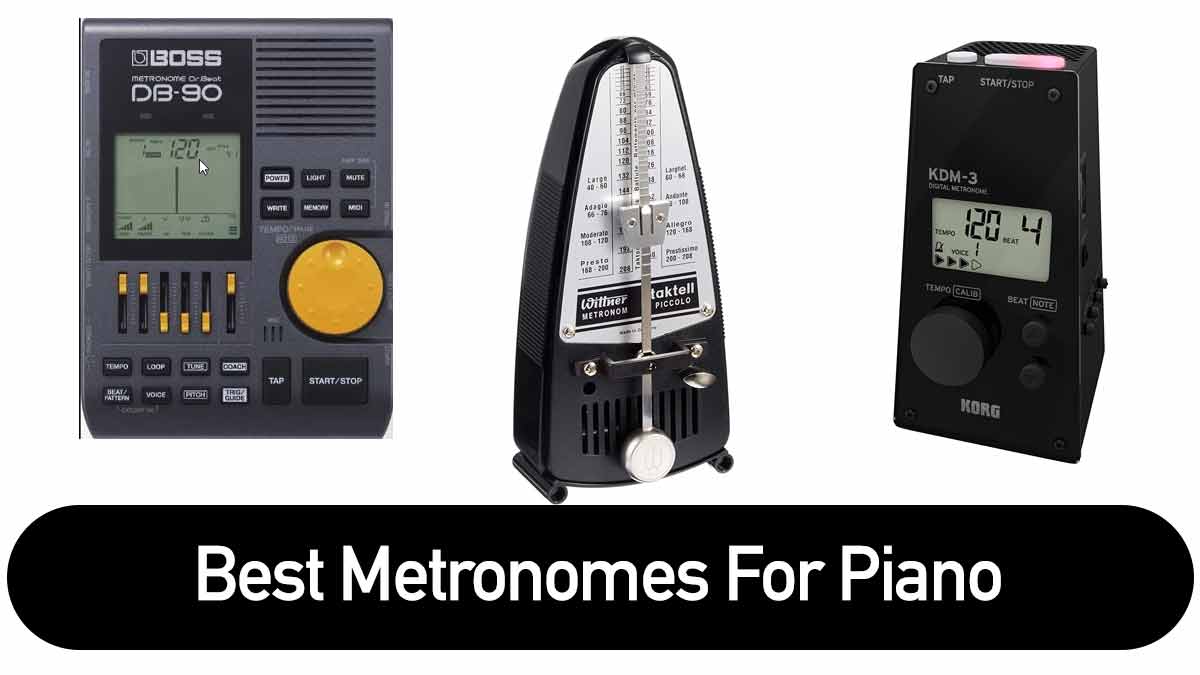
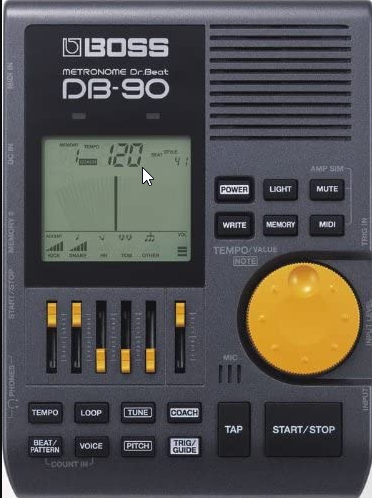
    BOSS DB-90 Dr. Beat Portable Metronome
    Specifications

    • Type: Digital
    • Dimensions: 8 x 6 x 2 inches
    • Tuner: No
    • Tap Tempo: Yes
    • Tempo Range (BPM): 30-250
    • No. of Tick Sounds: 4
    • Power: Battery / Mains
    • Connectivity: Instrument input, trigger input, MIDI Input, dual headphone output, footswitch input, memory up/down input, AC Adaptor input
    • Weight: 450 g

    Boss is the most recognizable brand in the metronome world, and the DB-90 is their most successful and versatile modal.

    The Boss DB-90 metronome is our top pick because of its many advanced features, including multiple voices and rhythms.

    It is one of the best digital metronomes (or Electronic metronomes) for both professional and amateur musicians.

    This metronome features multiple sounds, including human voices. Choose a tone that fits your learning style when you play your instrument.

    Also, it has a built-in “Rhythm Coach” feature that teaches you how to play in different time signatures and stay in time, which is one of its best features.

    The DB-90 offers realistic PCM drum sounds, 50 pattern memories, instrument input, and a 5-pin MIDI input for synchronizing an external sequencer. Because of its extensive memory, you won’t have to reprogram it daily.

    The large LCD panel lets you see what you’re doing, and its sliders and rotary dial let you control the tones and tempo. Also, a footswitch allows you to control the metronome hands-free while playing your instrument.

    The only downside is that it’s bulky, discouraging users from bringing it to rehearsals.

    Overall, if you are looking for an advanced, premium metronome that’s highly versatile and built to last, BOSS DB 90 Dr. Beat metronome is the one for you.

    Check On Amazon

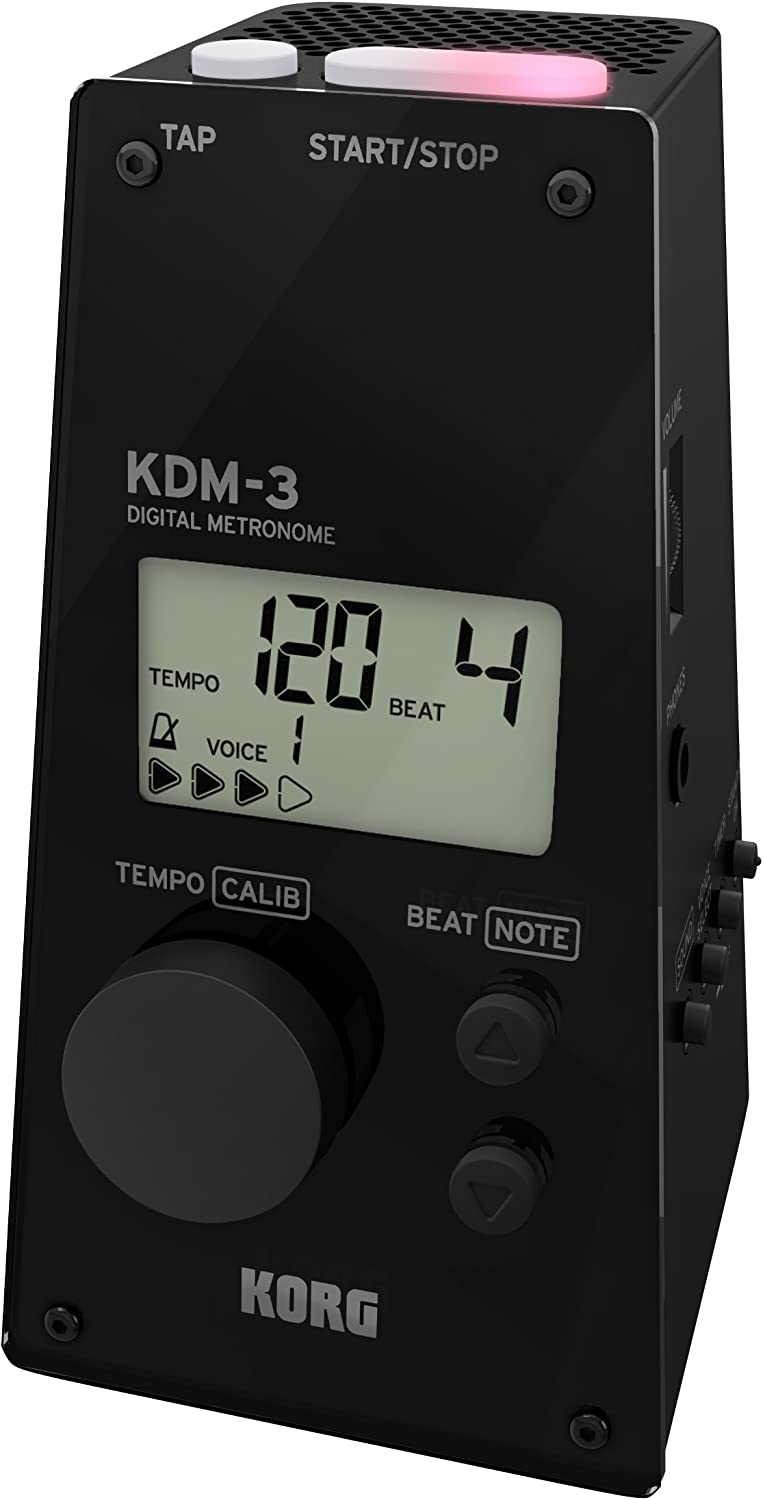
    Korg KDM-3 Metronome

    Specifications

    • Type: Digital
    • Dimensions: 2.36 x 2.87 x 4.45 inches
    • Tuner: No
    • Tap Tempo: Yes
    • Tempo Range (BPM): 30-252
    • No. of Tick Sounds: 8
    • Power: Four AAA batteries
    • Connectivity: 6.3mm headphone output
    • Weight: 167g

    The Korg KDM-3 metronome is one of the best metronomes due to its premium features and vintage appearance.

    Its style grabs everyone’s attention, as it resembles the traditional pendulum-looking mechanical metronomes. You can get it in various finishes, including one with a wooden front panel.

    The KDM-3 offers 19 beat patterns and eight selectable click tones to choose from, including a human 1,2,3,4 voice count and a sampled mechanical metronome tick.

    It also has a wide range of 30-252 bpm, ensuring you can practice any song at any tempo you choose.

    With the KDM-3, you can adjust the tempo with a single touch, and view the settings with ease on the large, easily readable display.

    The Sound Out mode lets you tune your instrument while listening to a reference tone, while the Timer mode automatically stops the metronome after a specified length of time.

    You can use the Memory Backup feature to preserve the specified tempo, beat, calibration, and reference tone even if the power is turned off.

    The KDM-3 lasts up to 120 hours on four fresh AAA batteries.

    Check On Amazon

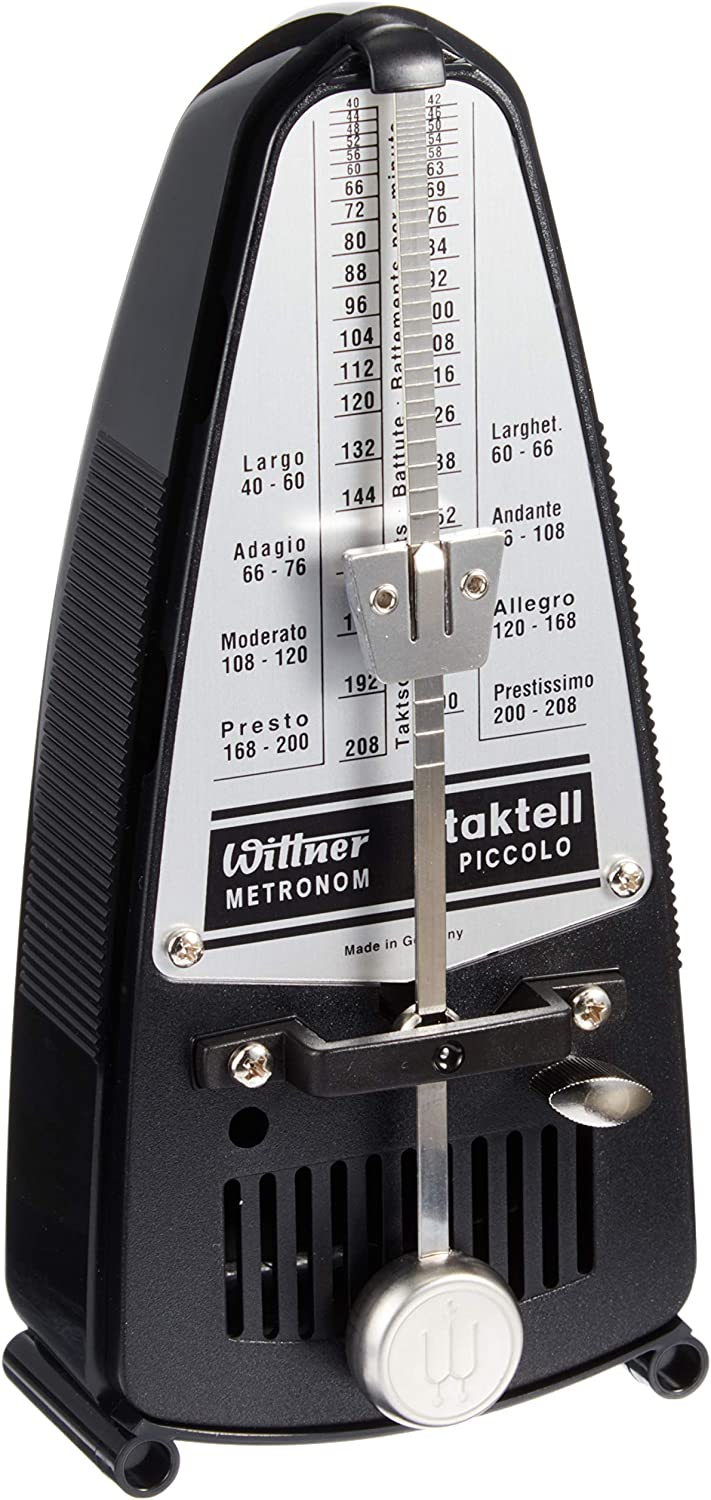
    Wittner 836 Taktell Piccolo Metronome

    Specifications

    • Type: Mechanical
    • Dimensions:
    • Tuner: No
    • Tap Tempo: No
    • Tempo Range (BPM): 40-208
    • No. of Tick Sounds: 1
    • Power: Clockwork
    • Connectivity: None
    • Weight: 170g

    If you are bored with digital stuff and want something classic, then Wittner 836 Taktell Piccolo metronome is the best choice. It can help you concentrate more on your music.

    This retro, plastic-bodied Piccolo sits perfectly atop an acoustic or digital piano and is available in a vast array of fun and bright colors.

    This instrument doesn’t have a bell, so it is best suited for experienced musicians who don’t need help finding the downbeat.

    Its clear markings from Largo to Prestissimo make it easy to identify the speed of the music in bpm (beats per minute).

    This clockwork device is easy to transport because of its small size. You won’t have to worry about plugging the 836 into a power source as it is a mechanical metronome.

    Check On Amazon

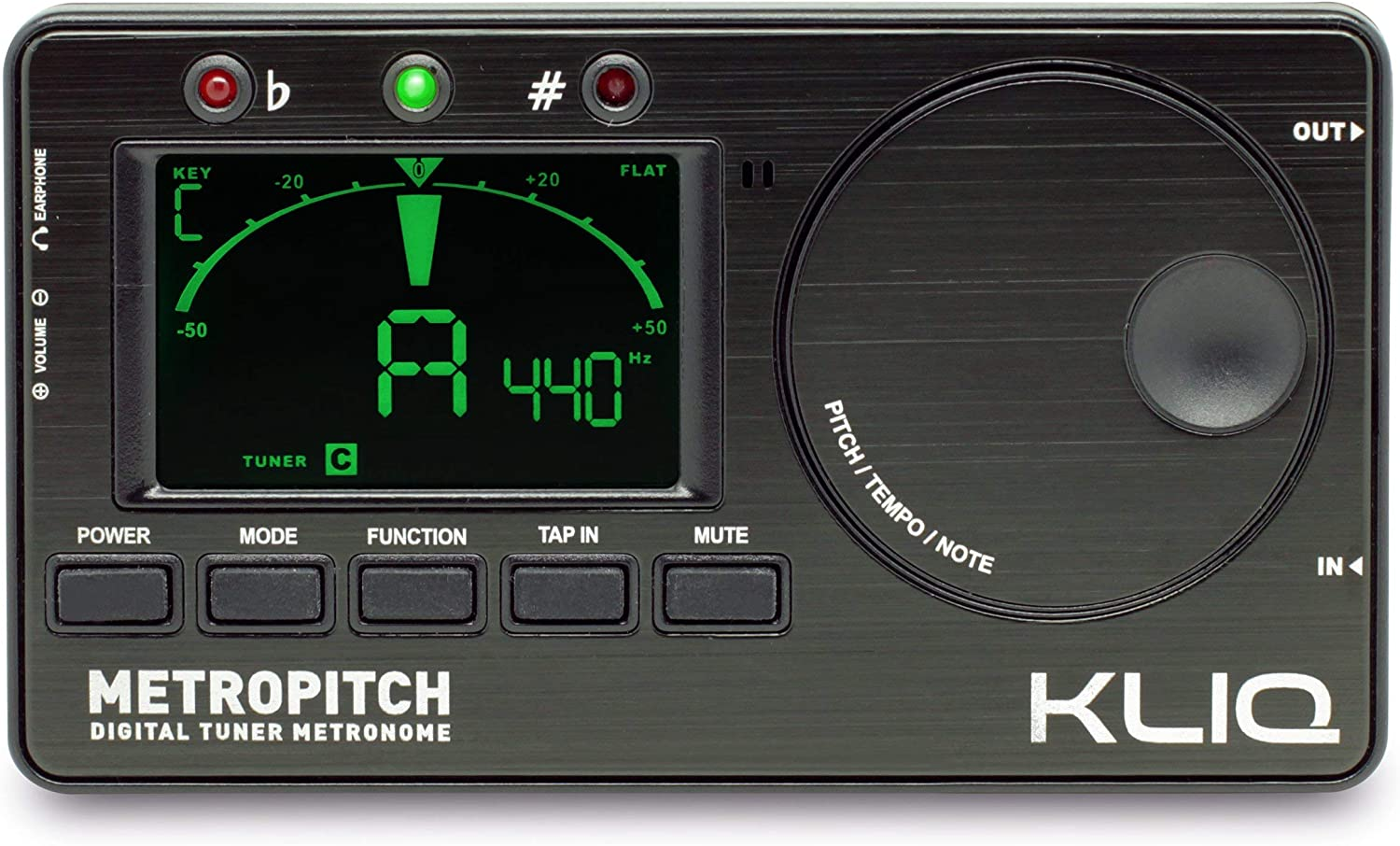
    KLIQ MetroPitch – Metronome Tuner

    Specifications

    • Type: Digital Standalone
    • Dimensions: 4.3 x 2.4 x 0.6 inches
    • Tuner: Yes
    • Tap Tempo: Yes
    • Tempo Range (BPM): 30-250
    • No. of Tick Sounds: 1
    • Power: Battery (2 x AAA)
    • Connectivity: 6.3mm instrument input, 6.3mm & 3.5mm headphone output
    • Weight: 91g

    The KLIQ MetroPitch is an incredibly versatile and easy-to-use metronome that is perfect for any musician.

    This pocket-sized device also includes a tuner and tone generator, making it ideal for practicing or gigging.

    It looks stylish in either metallic black, blue, gold, or red and features a bright LED display.

    On the metronome side, it has a broad range of 30-250 BPM, tap tempo, and various beats and rhythm patterns on the metronome side. And it is very easy to use.

    The tuner is fast and accurate. It has various tuning modes ranging from A0-C8 and a pitch calibration range of 410-450 Hz, making this chromatic tuner suitable for all popular musical instruments.

    The tone generator is also very user-friendly, with an intuitive JOG Dial that lets you quickly and easily dial your desired tempo.

    This advanced digital metronome runs for 40 hours on a pair of AAA batteries and comes with a protective pouch.

    Also, this product comes with a 3-year manufacturer guarantee, so you will get 100% of your money back or a replacement if this product stops working.

    Check On Amazon

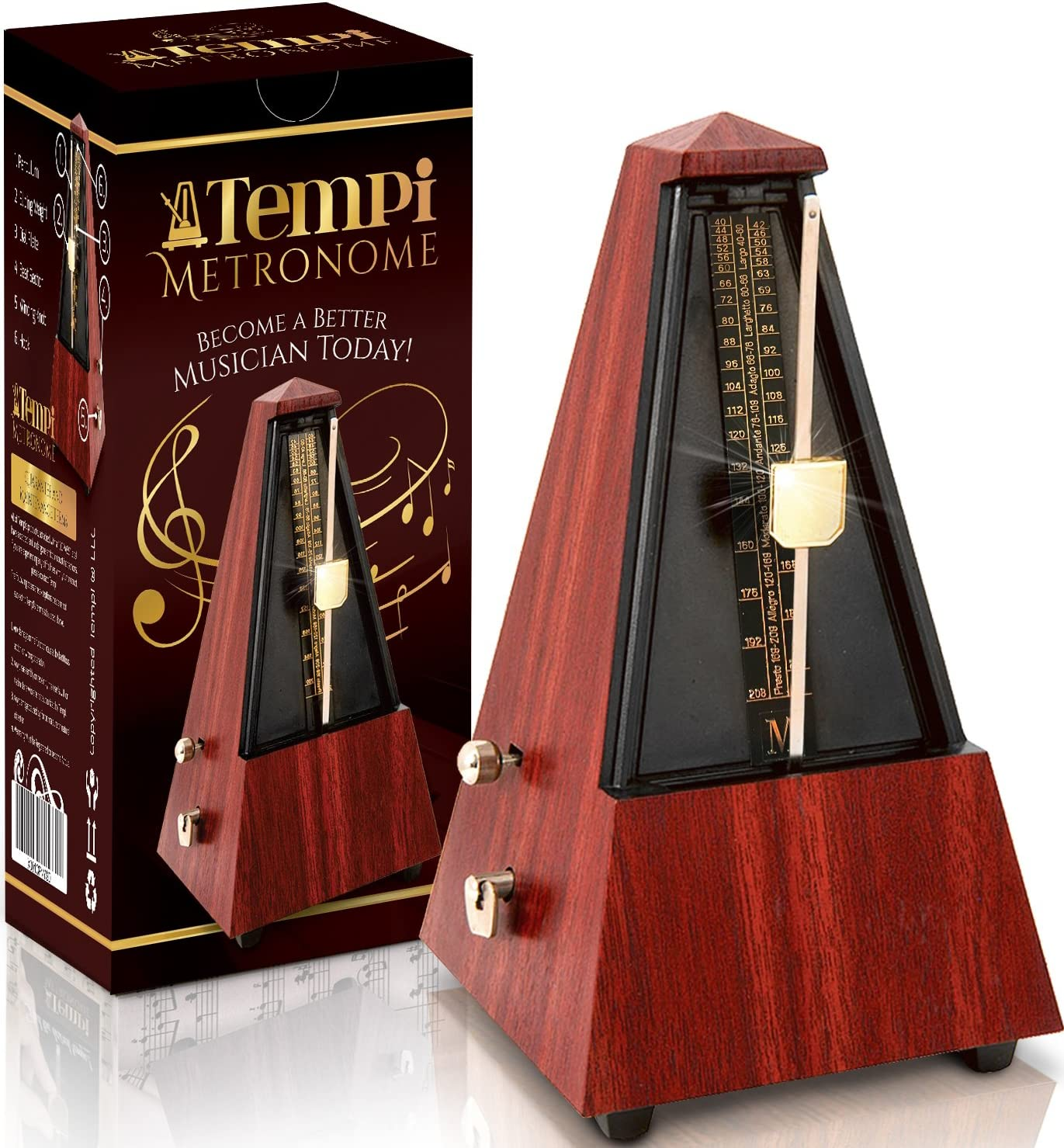
    Tempi Metronome

    Specifications

    • Type: Mechanical Metronome
    • Dimensions: 9.5 x 4.8 x 4.8 inches
    • Tuner: N/A
    • Tap Tempo: Yes
    • Tempo Range (BPM): 40-208
    • Power: Clockwork
    • Weight: 640g

    The Tempi mechanical metronome is an excellent choice for musicians looking for a classic product that’s affordable and lasts for decades.

    It is accurate and easy to use and has a classic look that will never go out of style.

    This metronome provides accurate timing, helping you to play at the proper pace, and develops finger agility and preciseness. Also, it has a built-in visual display of the timing from the pendulum, which is excellent for beginners.

    The Tempi Metronome features one wind that can go up to twenty minutes, allowing for prolonged practice and less frustration.

    Other excellent features include the 0/2/3/4/6 beat bell, allowing you to choose any tempo, and the steel gears that make it durable. Plus, the 2-year warranty is a great bonus.

    Overall, the Tempi metronome is an excellent choice for any musician looking for a classic and affordable product.

    Check On Amazon

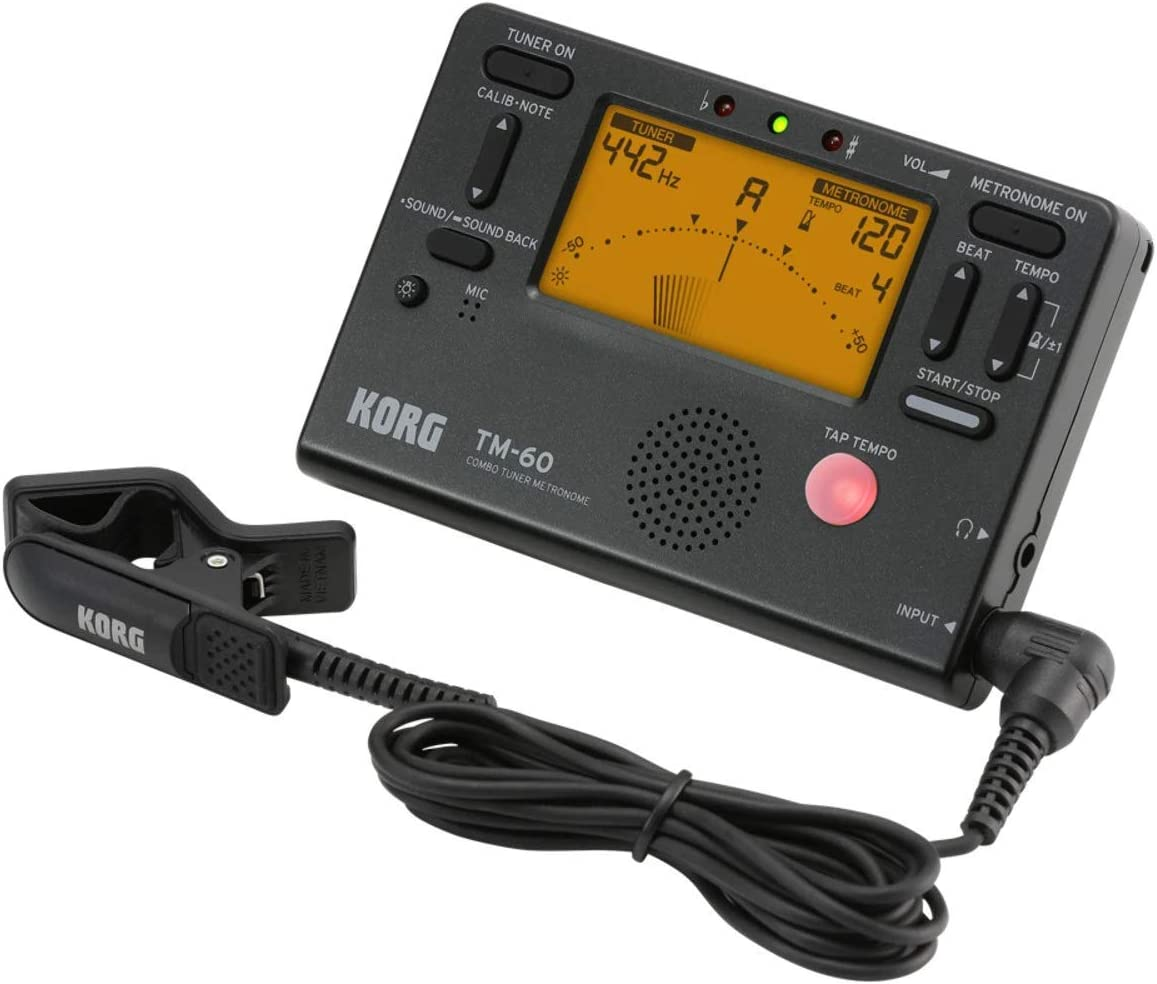
    Korg TM60 Tuner and Metronome Combo

    Specifications

    • Type: Digital Standalone
    • Dimensions: 6.25 x 5.2 x 1.35 inches
    • Tuner: Yes
    • Tap Tempo: Yes
    • Tempo Range (BPM): 30-252
    • No. of Tick Sounds: 1
    • Power: Two AAA batteries (3V)
    • Connectivity: 6.3mm instrument input, 3.5mm headphone output
    • Weight: 100g

    Korg is a brand highly trusted by many pianists, guitarists, and keyboard and synth players.

    With its stylish black design, the Korg TM-60 acts as both a high-precision tuner and a metronome. You can use the tune and metronome functions separately or simultaneously.

    The Korg TM-60 metronome tuner has a range of 30-252 BPM and can detect between C1 and C8 for tuning, making it suitable for various instruments.

    Also, it offers three types of tempo settings and 15 different rhythm variations, so you won’t have to stick to the same rhythm and pattern. Some may sound better than others, depending on the type of music or practice you do.

    In addition, the TM60 has a longer battery life and a larger LCD screen that’s easier to read than its previous TM50 tuner.

    The Korg offers an optional TM-200 contact microphone input jack to increase tuner sensitivity.

    The controls are easy to use. The tempo and beat buttons work like the volume buttons on a TV remote control.

    The Korg TM60 is an excellent choice for musicians who want an affordable and advanced metronome with an easy-to-read display, dual-stage backlight, and useful auto power-off features.

    Check On Amazon

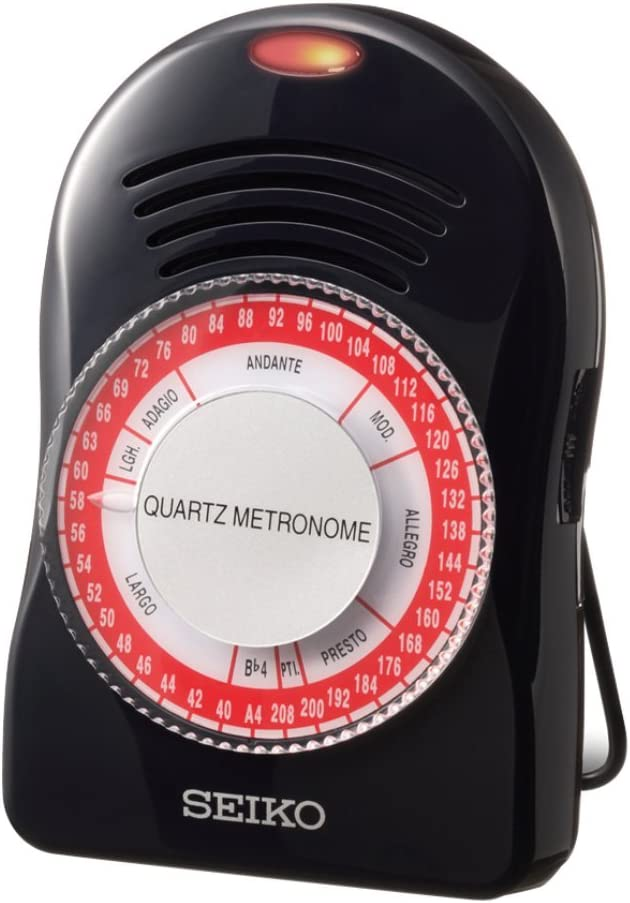
    Seiko SQ50-V Quartz Metronome

    Specifications

    • Type: Quartz Standalone
    • Dimensions: 1.7 x 5.1 x 3 inches
    • Tuner: No
    • Tap Tempo: No
    • Tempo Range (BPM): 40-208
    • No. of Tick Sounds: 2
    • Power: Battery (1 x 9V)
    • Connectivity: 3.5mm headphone output
    • Weight: 159 g

    The Seiko SQ50-V Quartz Metronome is a good budget metronome with two different click sounds and a tuning tone.

    There is a wide range of tempos from 40-208 beats per minute, making it ideal for use in a variety of practice and performances.

    The red LED light on the top is a clear visual tempo indication, which is helpful when practicing without a click or during the performance.

    You can also use headphones. However, it is only mono sound, so you will only hear sound from one earplug when using headphones.

    The only downside of this metronome is that it doesn’t have some of the more advanced features that other metronomes have, such as a tap tempo or built-in tuner.

    But overall, it’s a good, basic metronome that does what it’s supposed to do.

    This metronome may be a good option for those who want to use it only occasionally but want to see how fast a tempo is or do short practice sessions.

    Check On Amazon

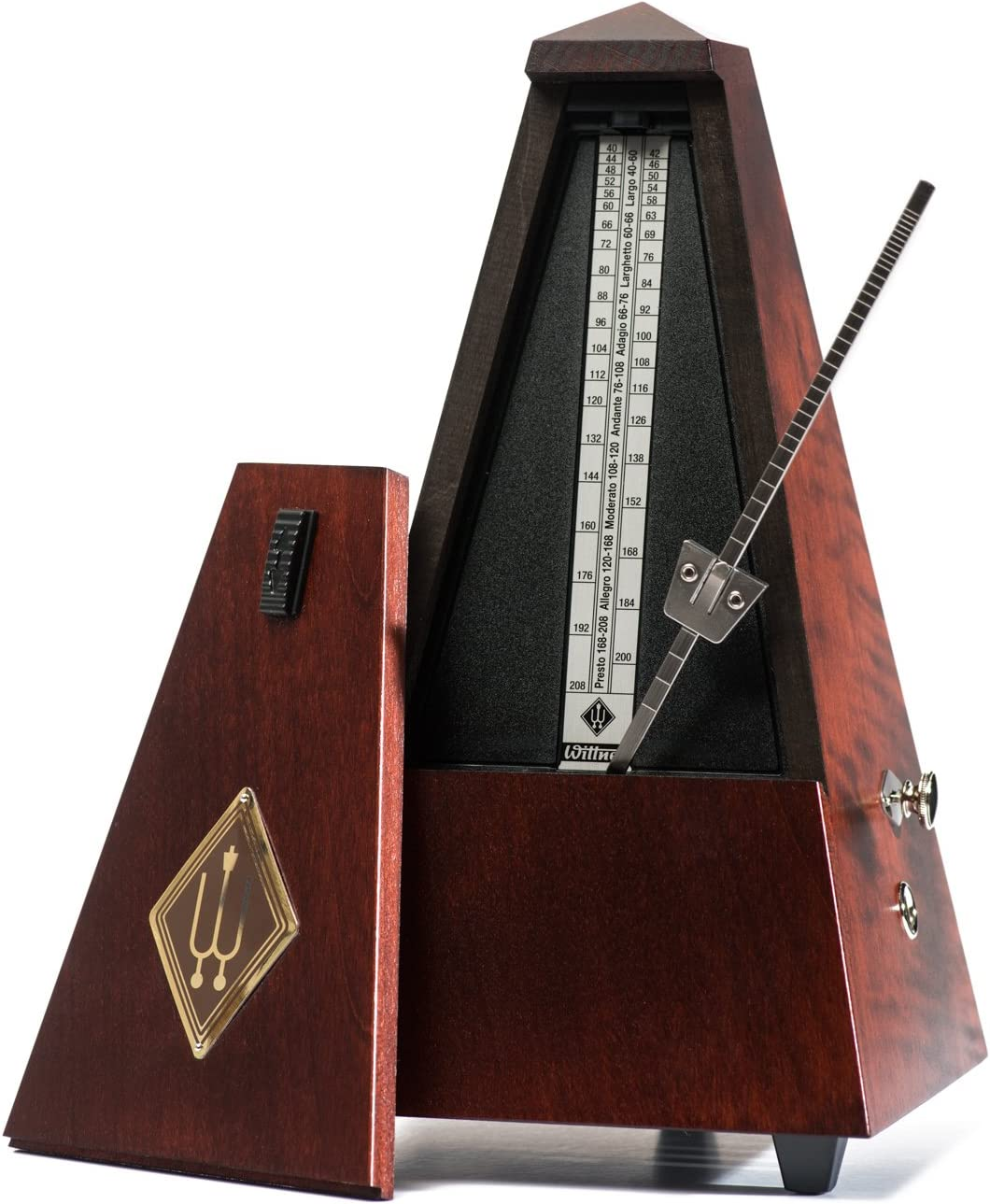
    Wittner wooden metronome with bell 811M mahogany finish
    Specifications

    • Type: Mechanical
    • Dimensions: 4.13 x 4.13 x 8.66 inches
    • Tuner: No
    • Tap Tempo: No
    • Tempo Range (BPM): 40-208
    • No. of Tick Sounds: 1
    • Power: Clockwork
    • Connectivity: N/A
    • Weight: 476g

    The Wittner 811 is the most popular model in the German company’s Maelzel range, thanks to its smart wooden finish and classical tempo scale on the shaft behind the pendulum.

    It is a high-quality, professional-grade metronome that is perfect for professional pianists.

    The Wittner 811 features a sleek mahogany finish, a 40-208 BPM tempo range, and a bell.

    You can set the bell to chime on the downbeat to indicate 2/4, 3/4, 4/4, or 6/8 time. If you push the bell selector in fully, the bell doesn’t ring, and you get just a metronome tick.

    Even though the 811 isn’t the cheapest option, its timeless quality makes it worth it.

    This metronome also has one tick sound and is powered by clockwork, making it an excellent choice for musicians looking for a reliable and accurate metronome.

    Check On Amazon

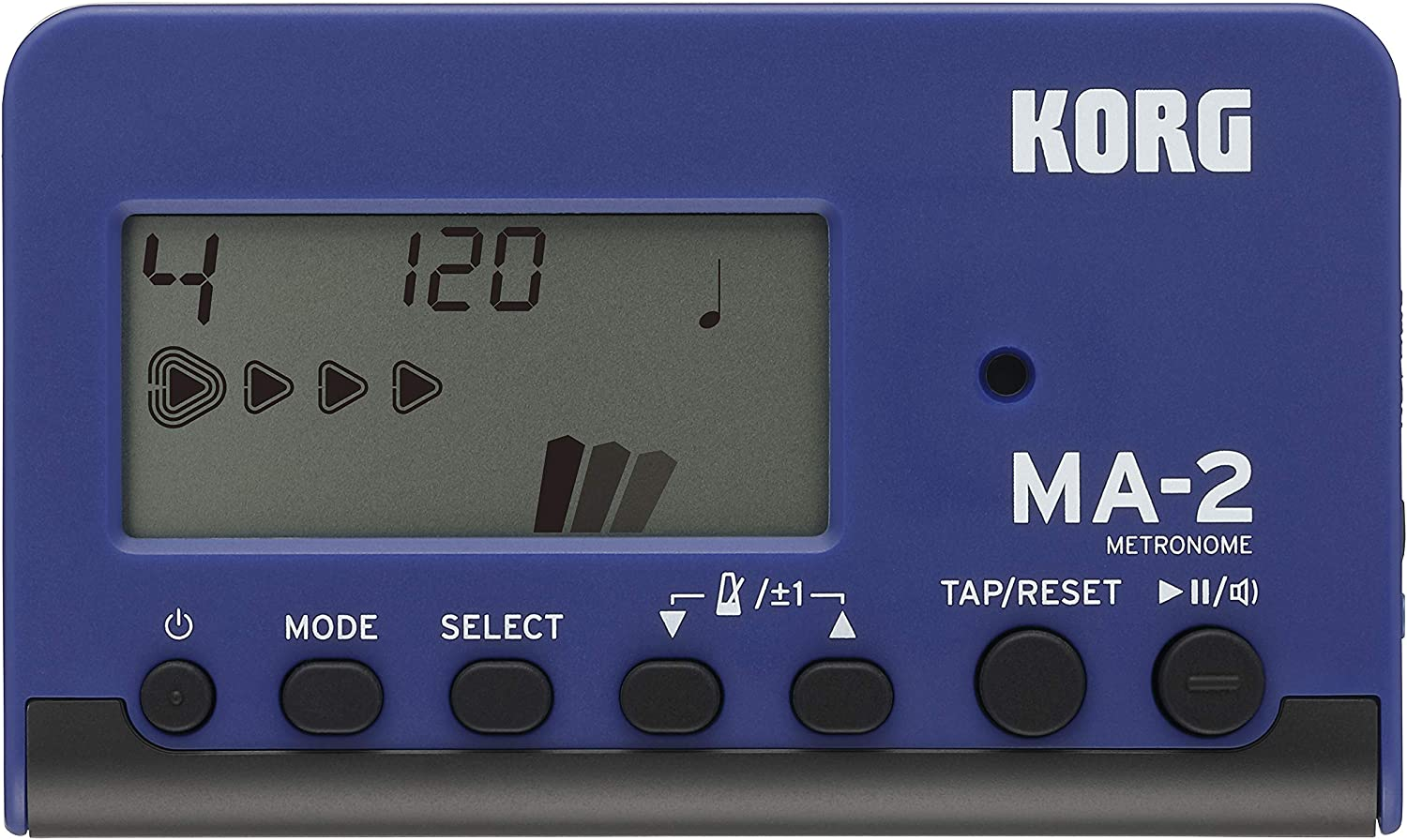
    Korg MA2-BLBK Pocket Digital Metronome
    Specifications

    • Type: Digital Standalone
    • Dimensions: 3.94 x 2.36 x 0.63 inches
    • Tuner: No
    • Tap Tempo: Yes
    • Tempo Range (BPM): 30-252
    • No. of Tick Sounds: 1
    • Power: Two AAA batteries, 3V
    • Connectivity: 3.5mm headphone output
    • Weight: 68g

    The MA-2 Compact Metronome is another best and most popular products from Korg. This instrument is top-notch in design and functionality, making it an excellent addition to any musician’s collection.

    It has a large, clear display and big buttons, making it very easy to use, especially for beginners. And it produces a loud and crisp sound that is perfect for practicing.

    The MA-2 has a broad tempo range and a variety of beats and rhythm patterns. Also, it comes with a 3.5mm headphone output.

    There are two unique features: “timer mode” and “sound out mode.” The Timer mode allows you to set a specific time for the metronome to run. It’s great for practice sessions that need to be timed precisely.

    And the Sound out mode allows you to hear the metronome beats without looking at the device. That’s great for musicians who want to focus on their playing rather than the metronome.

    Moreover, its all-body design and long battery life make it an extremely durable and practical metronome.

    The Korg MA-2 Metronome may be a great choice if you want an affordable and high-quality metronome.

    Check On Amazon

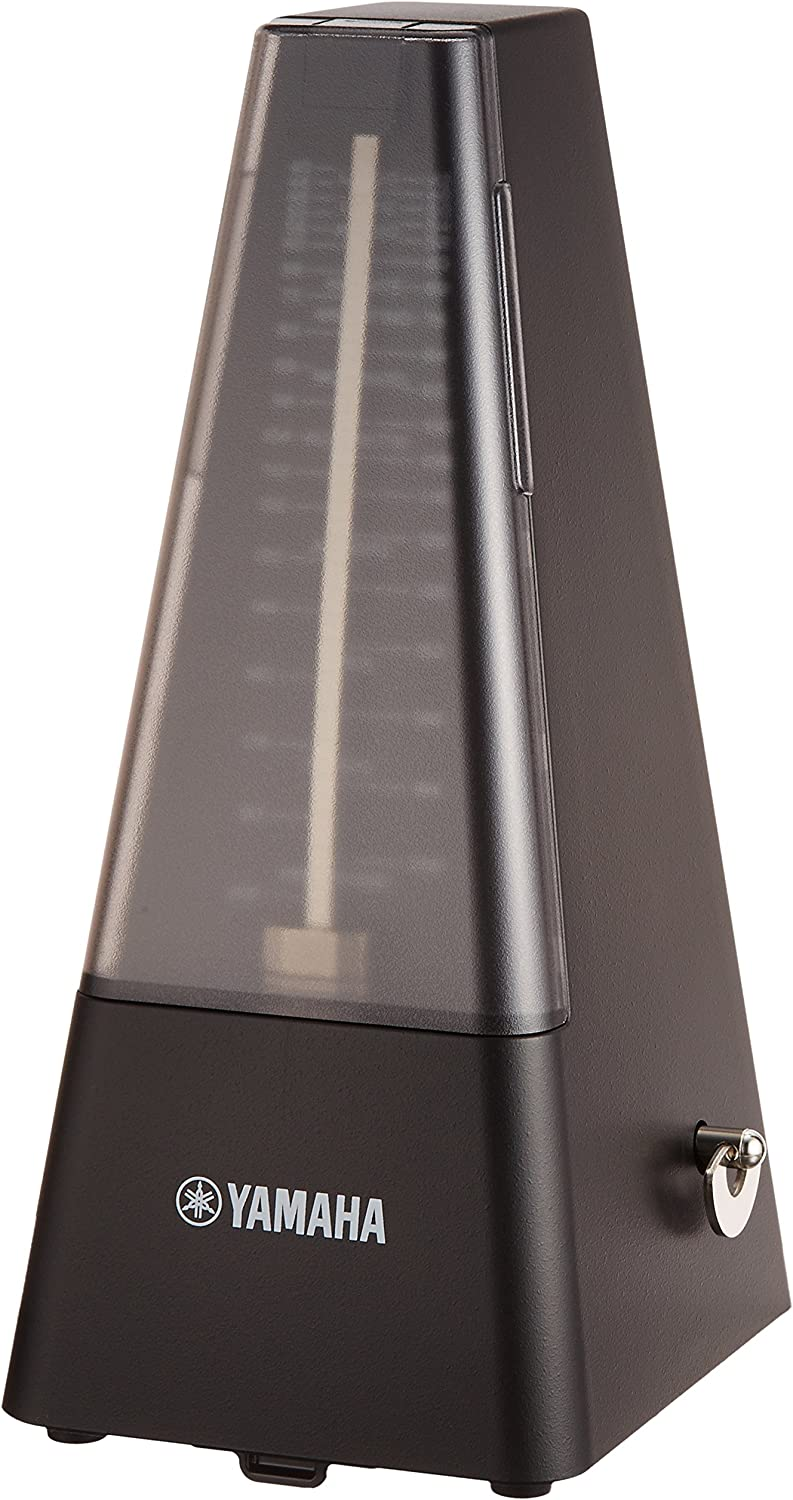
    YAMAHA metronome black MP-90BK

    Specifications

    • Type: Mechanical
    • Dimensions: 4.37 x 7.95 x 3.54 inches
    • Tuner: N/A
    • Tap Tempo: N/A
    • Tempo Range (BPM): 40-208
    • Power: Clockwork
    • Weight: 405 g

    The MP-90BK is one of Yamaha’s most popular metronomes, and for a good reason.

    The MP-90BK is one of Yamaha’s most popular metronomes, thanks to its simple design and classic black finish.

    With 39 tempo settings ranging from 40 to 208 beats per minute, you can find the perfect tempo for any song or practice session.

    The MP-90BK also features a time signature function with a choice of 0, 2, 3, 4, or 6 beats and bell options, making it ideal for any style of music.

    Even though there could be more reserve power (about 45 minutes at 60 bpm), it serves as a helpful reminder for musicians to take a break.

    You can also use headphones if you don’t want to disturb others.

    The Yamaha MP-90BK Metronome is a good choice if you’re looking for a classic metronome with a modern twist.

    Check On Amazon

    Conclusion

    These are the top 10 best metronomes for pianists. A good metronome is easy to use, have adjustable tempos, a large, easily readable display, and produces a clear sound.

    Whether you need a metronome for learning, teaching, practicing, or playing, this list has the right metronome for you.

    If you’re looking for a highly versatile, durable digital metronome with all the features, the BOSS DB-90 Dr. Beat metronome is your best bet.

    The Korg KDM-3 metronome is perfect for you if you want to adjust the volume, practice with headphones, and have the full functionality of a digital metronome at your fingertips.

    But if you’re looking for the most affordable and portable metronome with essential features, then the Korg MA-2 is a good choice for you.

    I hope this article has helped you figure out which metronome is best for you.

    Which metronome are you going to buy? Let me know in the comments below.
    Related Topics

  • Artesia Digital Piano Reviews

    Artesia Digital Piano Reviews

    Artesia is one of the most popular digital piano brands worldwide. It offers various digital pianos with excellent sound quality, superior performance, advanced features, and ease of use.

    If you are planning to buy a digital piano, Artesia is worth considering. Artesia has a digital piano to meet your needs and budget, whether you’re a beginner or a pro.

    This article will review the best Artesia digital pianos and help you choose the right one for your needs. Whether you are looking for console pianos, portable entry-level pianos, or intermediate pianos at a mid-range price point, you’ll find what you need in our review.

    Let’s take a look!

    10 Best Artesia Digital Piano Models Currently Available

    Let’s review our ten favorite Artesia digital piano models available now.

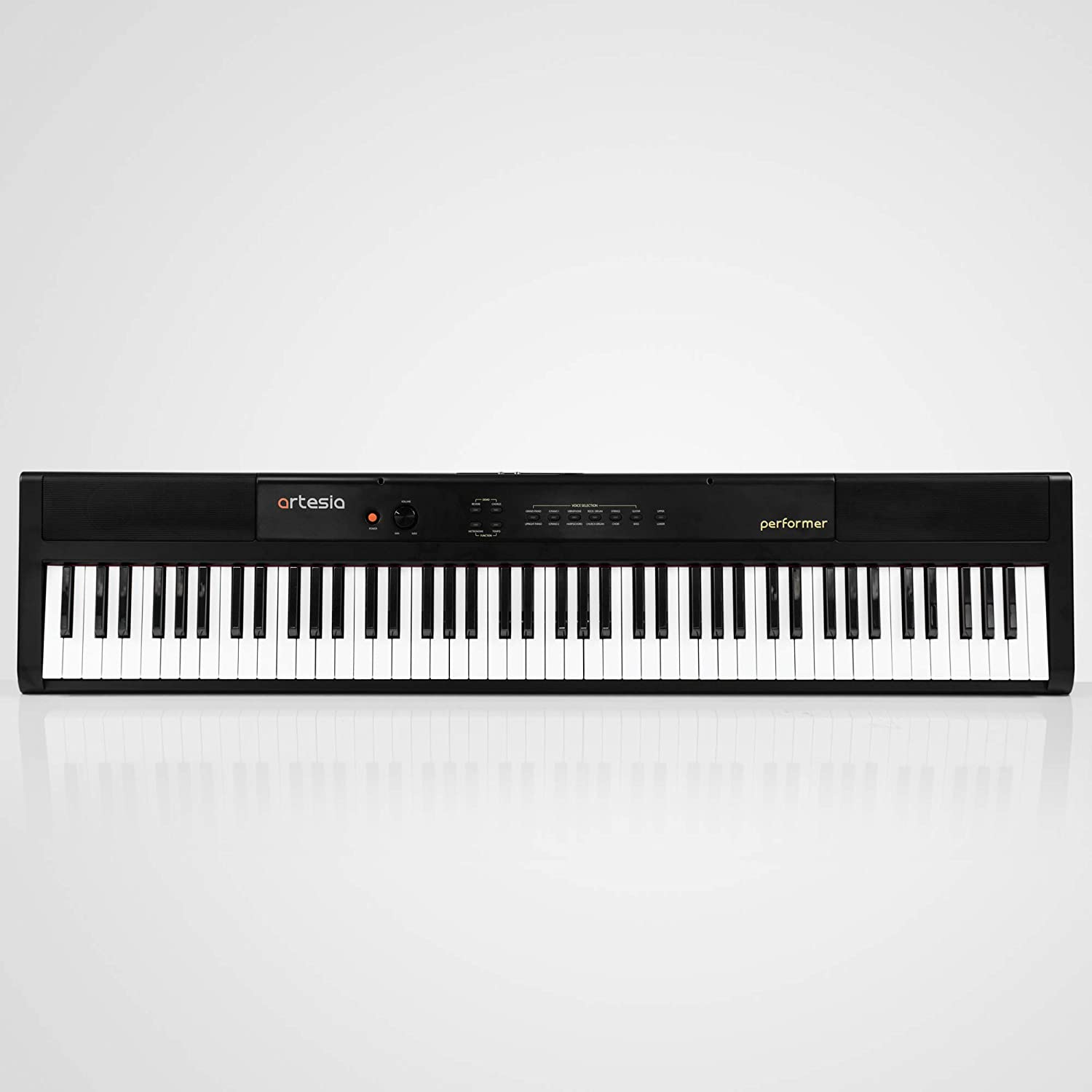
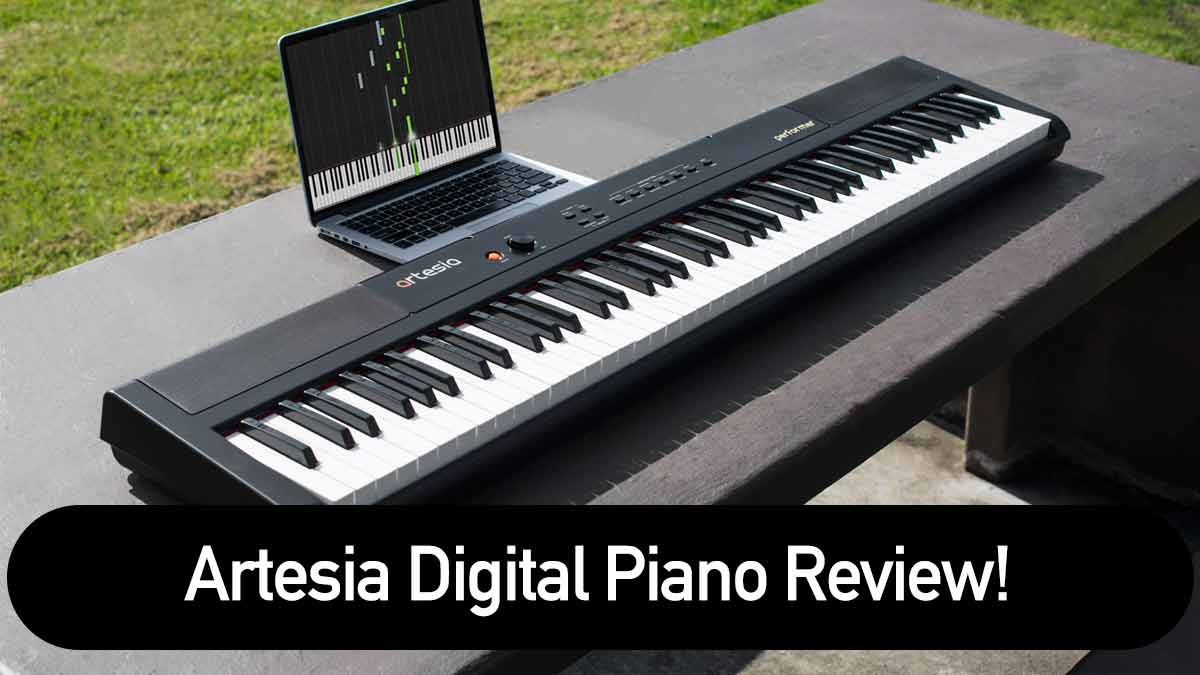
    Artesia Performer Digital Piano

    Specifications

    • Piano Size: 50 x 11 x 3.25 inches
    • Number of Keys: 88
    • Voices: 12
    • DSP Effects: Yes
    • Speakers: Yes
    • Pedals: 1 (sustain pedal)
    • Touch Sensitivity: 5 Levels + Fixed
    • Weight: 9 kg
    • Price: $299

    The Artesia Performer digital piano is an attractive and excellent choice for beginners due to its sleek, elegant, and simple design.

    It features 88 full-size semi-weighted keys with adjustable touch response that delivers professional touch and sound.

    This keyboard has a metronome and a transpose function, allowing you to play complex piano keys easily.

    You can also connect it to your smart device or laptop via USB/MIDI to record songs directly from your digital piano.

    Designed for beginners, it comes with 12 built-in voices, including grand piano, electric piano, church organ, rock organ, strings, and bass with tempo, reverb, and chorus DSP effects.

    Also, it includes four speakers that produce 15W each.

    In addition to a sustain pedal jack, it has a Stereo Line Out jack that can be plugged directly into a speaker system.

    It is compact, lightweight, and battery-powered, making it easy to take wherever you go.

    If you’re looking for the perfect digital piano to help you learn the basics of piano playing, the Artesia Performer would be your best bet.

    Check On Amazon

    Artesia A-61 Digital Piano

    Specifications

    • Piano Size: 46 x 14 x 7 inches
    • Number of Keys: 61
    • Polyphony: 32
    • Voices: 8
    • Effects: Yes
    • Speakers: Yes
    • Pedals: 1 (sustain pedal)
    • Touch Sensitivity: low, Normal, or High
    • Weight: 5.9 kg
    • Price: $199

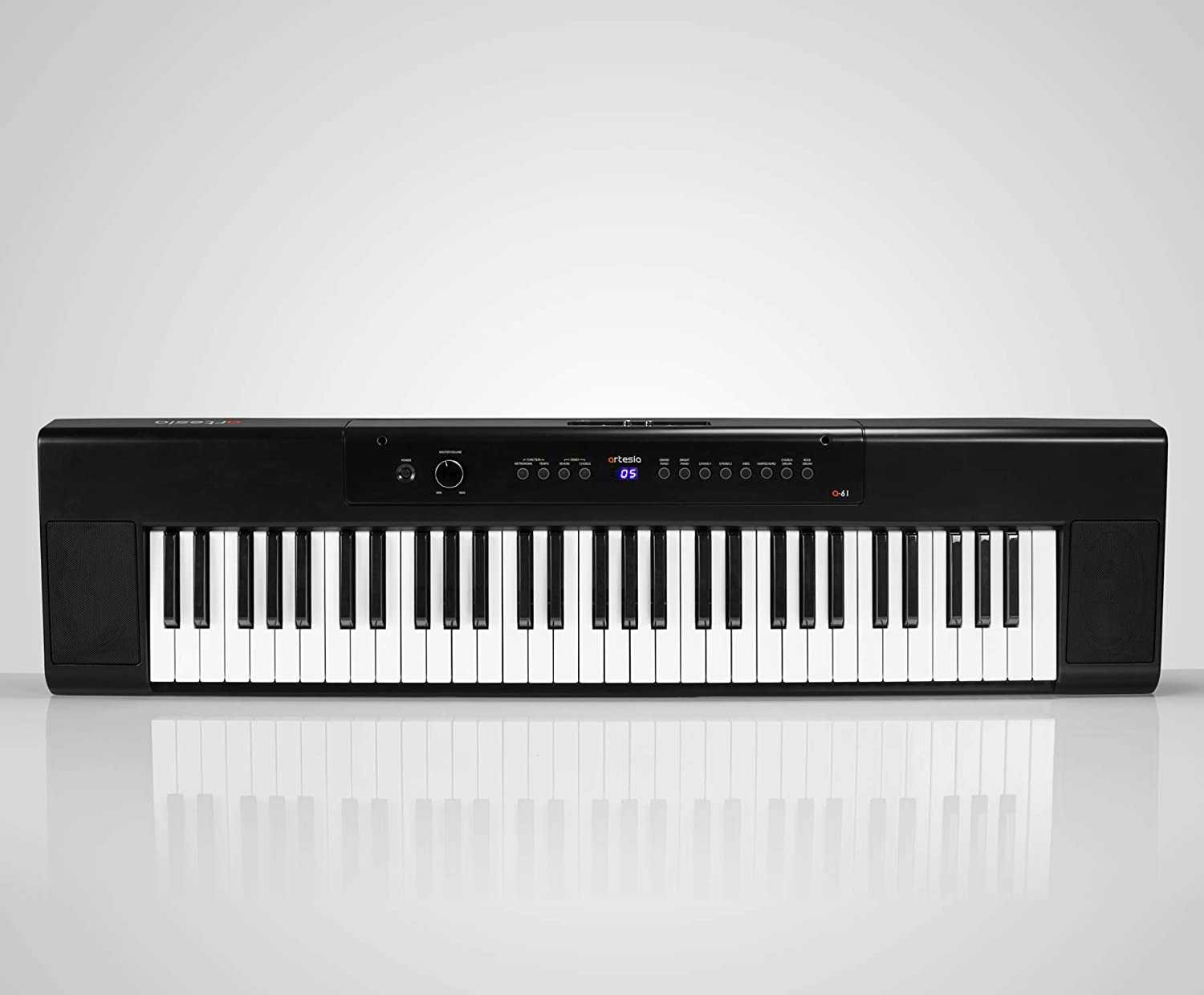
    The Artesia A-61 touch-sensitive digital piano delivers a realistic playing feel in a lightweight, portable chassis, perfect for students and beginners.

    It features eight onboard keyboard instruments with authentic voices, including a grand piano, a bright piano, two electric pianos, organs, guitars, and a harpsichord.

    Additionally, the A-16 includes effects such as reverb, chorus, and EQ to enhance the sounds.

    This instrument weighs just 13 pounds yet still features full-size semi-weighted keys and 32-note polyphony, so you can practice and play with complex arrangements.

    Additional Voice Control options let you layer sounds and split the keyboard into different sections.

    If you want to practice without disturbing others, you can use the headphone adapter to plug in headphones.

    Also, it comes with a USB port for connecting to computers and mobile devices to record songs directly from the A-61. You can power this Artesia piano either with the included adapter or six D batteries.

    Check On Amazon

    Artesia Harmony 88 Weighted Key Digital Piano

    Specifications

    • Piano Size: 57 x 19 x 15 inches
    • Number of Keys: 88
    • Voices: 16
    • DSP Effects: Yes
    • Speakers: Yes
    • Pedals: 3 (Soft, Sostenuto, and Sustain Pedals)
    • Touch Sensitivity: 5 Levels + Fixed
    • Weight: 21.7 kg
    • Price: $549

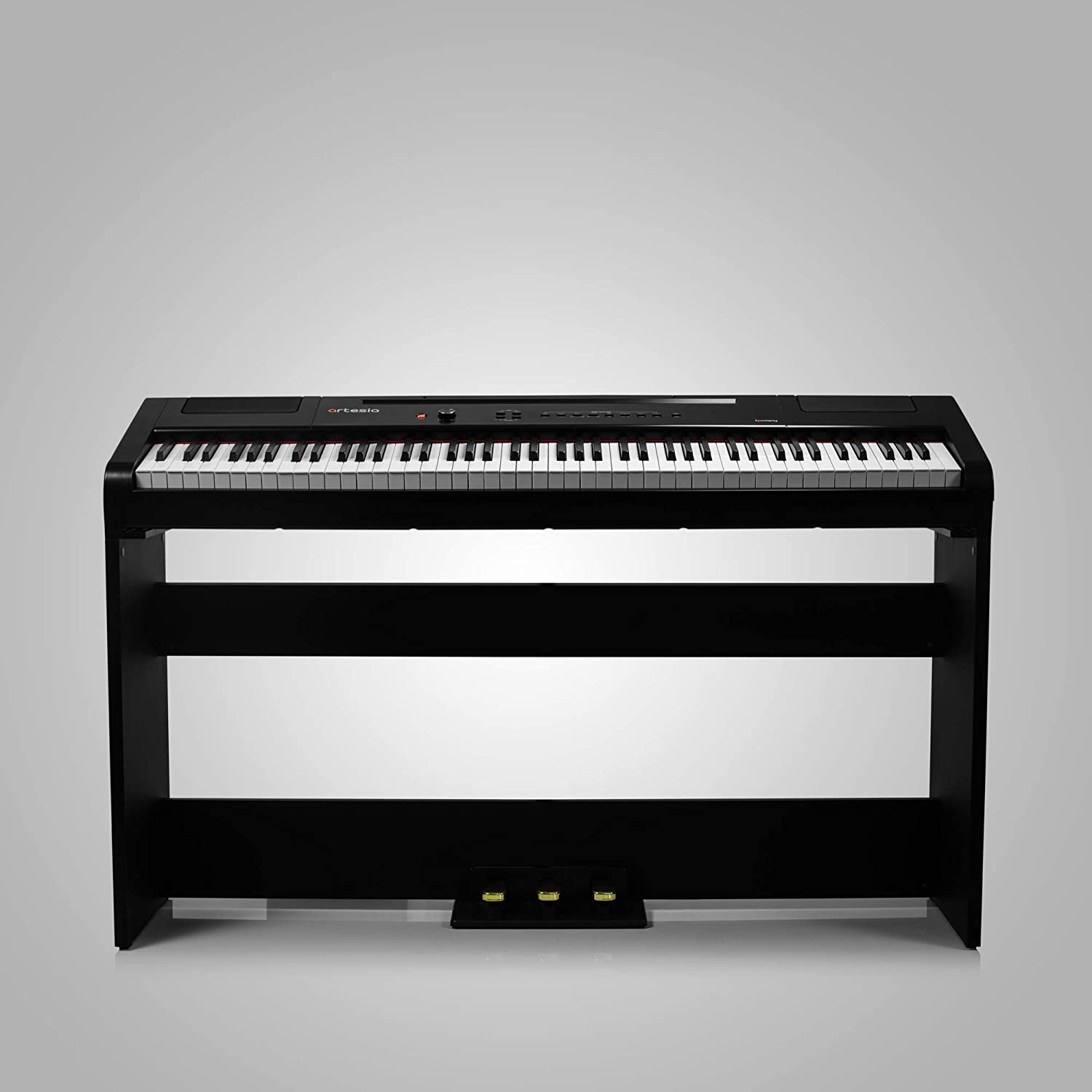
    The Artesia Harmony Digital Piano is a beautiful, traditional furniture piece that’s a full-featured, deeply expressive studio piano with a robust sound.

    It doesn’t take up a lot of space, which is nice.

    There are 16 instrument voices in the Harmony piano, including grand piano, E-piano, harp, vibes, nylon guitar, organ, strings, and bass.

    The keyboard has weighted hammer action keys that give you a smooth, natural feel that resembles a traditional acoustic piano.

    Featuring a three-pedal system, the digital piano comes with a matching furniture stand. The stand is easy to set up and looks great.

    Additionally, the harmony digital piano includes a USB to Host MIDI Connection port that lets you connect to digital recording software, learning apps, and other options.

    If you’re looking for a digital piano for lessons with a nice home furniture piano look, the Artesia Harmony is an excellent option.

    Check On Amazon

    Artesia PA-88H Digital Piano

    Specifications

    • Piano Size: 52 x 13.25 x 5.09 inches
    • Number of Keys: 88
    • Polyphony: 64
    • Voices: 16
    • DSP Effects: Yes
    • Speakers: Yes
    • Pedals: 1 (sustain pedal)
    • Touch Sensitivity: 5 Levels + Fixed
    • Weight: 17 kg
    • Price: $379

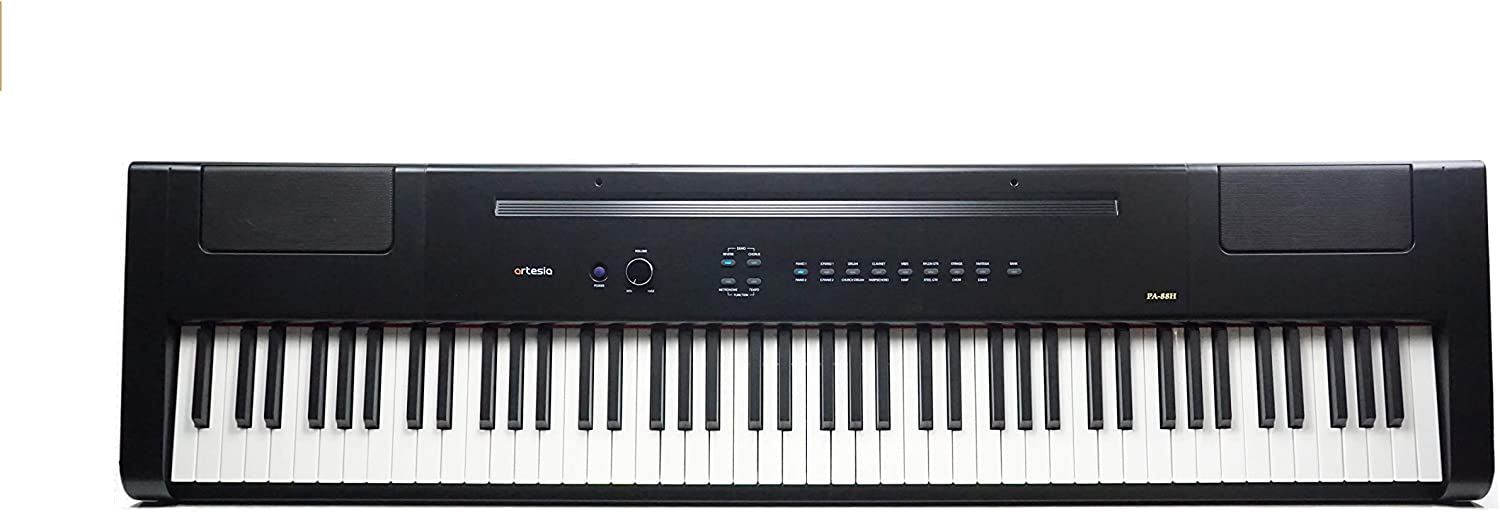
    The Artesia PA-88H digital piano is a beautiful instrument for all musicians, from beginners to stage pros.

    It has a sleek and modern design with a black (or white) finish that will complement any space.

    The keyboard’s fully weighted keys and versatility make it ideal for stage, studio, or home use. It also includes a USB MIDI Out port, so you can quickly and easily connect to your laptop or tablet for recording or instructional purposes.

    The sound quality of the PA-88H is fantastic, with a three-layer grand piano sample that provides a realistic and rich sound.

    This digital piano features the same triple-layered Grand Piano sound but includes 16 additional voices, and each can be customized to create a unique sound.

    And with the built-in speakers, you can enjoy your music without having to lug around an external sound system.

    The PA-88H even comes with a power supply and sustain pedal, so you’re ready to play right out of the box.

    You can’t go wrong with the Artesia PA-88H if you want a portable piano that sounds realistic and is easy to use.

    Check On Amazon

    Artesia DP-150e Plus Digital Upright Piano

    Specifications

    • Piano Size: 54.75 x 20 x 34.25 inches
    • Number of Keys: 88
    • Voices: 130+
    • DSP Effects: Yes
    • Speakers: Yes
    • Pedals: 3 (soft, sostenuto, and sustain pedal)
    • Touch Sensitivity: 3 Levels, Fixed
    • Bluetooth: Yes
    • Weight: 54.8 kg
    • Price: $1,439

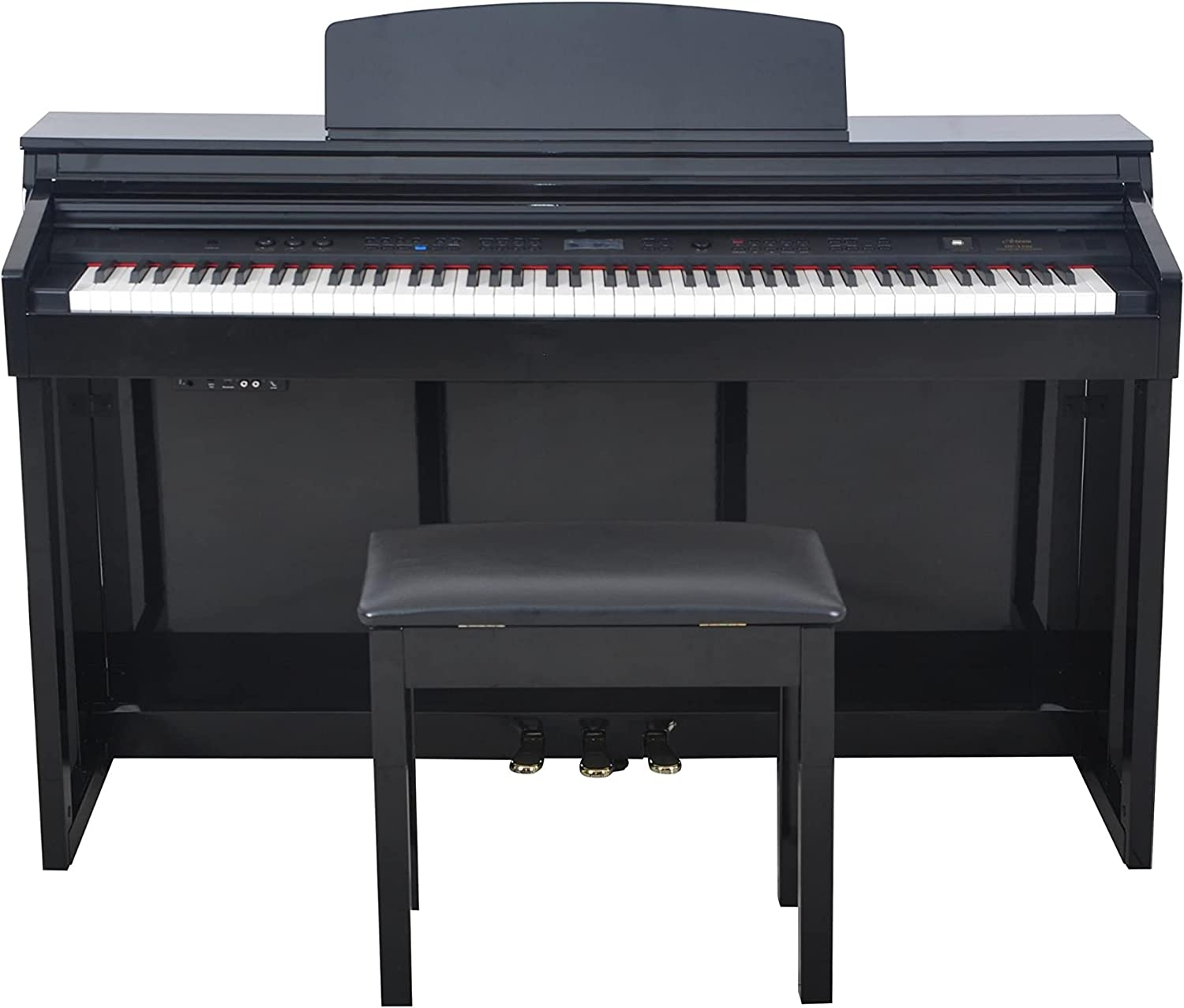
    The Artesia DP-150e Plus Digital Upright Piano is a fantastic instrument that blends style and elegance with the latest music technology.

    It has a sleek, high-gloss finish and comes with a fallboard to hide the control panel when not in use, giving the illusion that it is a real acoustic piano.

    The advanced hammer action design ensures excellent response and smooth playability, meeting the demands of even the most demanding musicians.

    In addition to its good looks, the DP-150e Plus digital piano comes with excellent features, including 137 expressive instrument voices, professional recording tracks, and a powerful sound delivery system.

    It also has Bluetooth connectivity, so you can play your favorite songs or use it as a home entertainment system.

    Furthermore, there’s an Aux In and Out port to connect external speakers, and the USB port comes with a thumb drive loaded with hundreds of prerecorded songs.

    The Artesia DP-150e Plus is a high-quality, stylish, and easy-to-use digital piano from Artesia.

    Check On Amazon

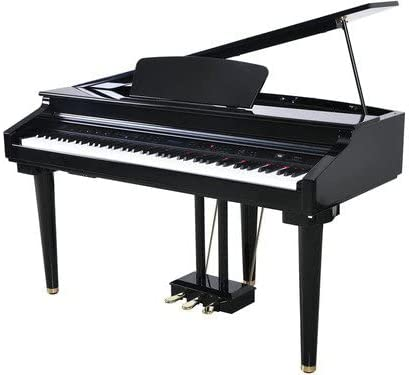
    Artesia AG-30 Micro Grand Digital Piano

    Specifications

    • Piano Size: 56 x 33 x 52 inches
    • Number of Keys: 88
    • Voices: 130+
    • DSP Effects: Yes
    • Speakers: Yes
    • Pedals: 3
    • Touch Sensitivity: 5 Levels, Fixed
    • Bluetooth: Yes
    • Weight: 77 kg
    • Price: $1,499

    The Artesia AG-30 is a gorgeous and highly polished ebony piano that reflects the classic grand piano aesthetic.

    Featuring natural hammer action keys and expressive Supra Sound sampling technology, the keyboard provides a dynamic experience that will surely delight its users.

    The AG-30’s Bluetooth capability lets you stream music from your tablet, phone, or laptop through the AG-30’s six-speaker concert hall sound system.

    Also, it offers a variety of piano apps for different ages and levels of practice and playing so that anyone can enjoy and improve their piano skills.

    Check On Amazon

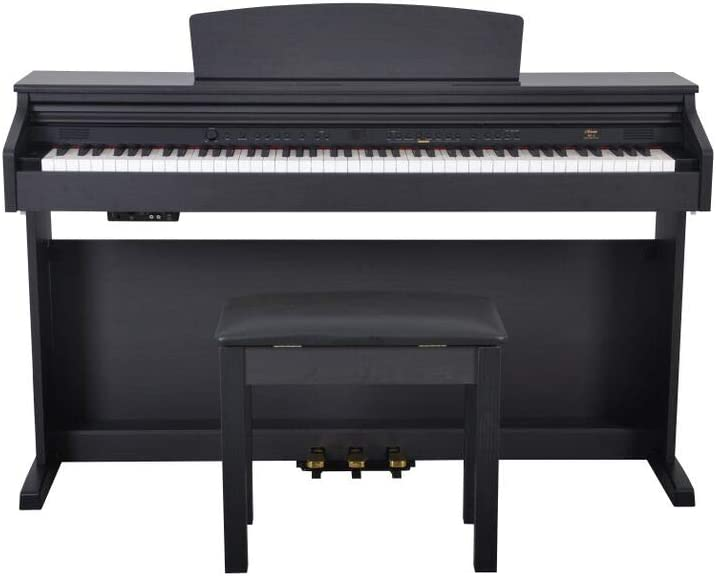
    Artesia DP-3 Plus Digital Piano

    Specifications

    • Piano Size: 59 x 22 x 14 inches
    • Number of Keys: 88
    • Voices: 8
    • DSP Effects: Yes
    • Speakers: Yes
    • Pedals: 3
    • Touch Sensitivity: 3 Levels, Fixed
    • Weight: 54 kg

    The Artesia DP-3 Plus is a sleek, stylish digital piano with a dark rosewood finish that adds elegance to any living space.

    Its keyboard features weighted hammer action keys that give you a smooth, natural feel similar to that of a real acoustic piano.

    There are five different velocity touch settings to customize your playing style.

    Additionally, the DP-3 Plus offers acoustic Supra Sound sound sample processing that lets you capture the piano’s depth, expression, and essence. It satisfies the most diverse tastes with its eight tones and instrument voices.

    You can connect the piano to laptops, tablets, and smartphones via the USB MIDI ports, so you’ll have access to more instrument voices, multi-track recording, and teaching apps.

    This product contains a matching seat bench, a songbook, two months of free online piano lessons with TakeLessons, and a 1-year limited warranty.
    Check On Amazon

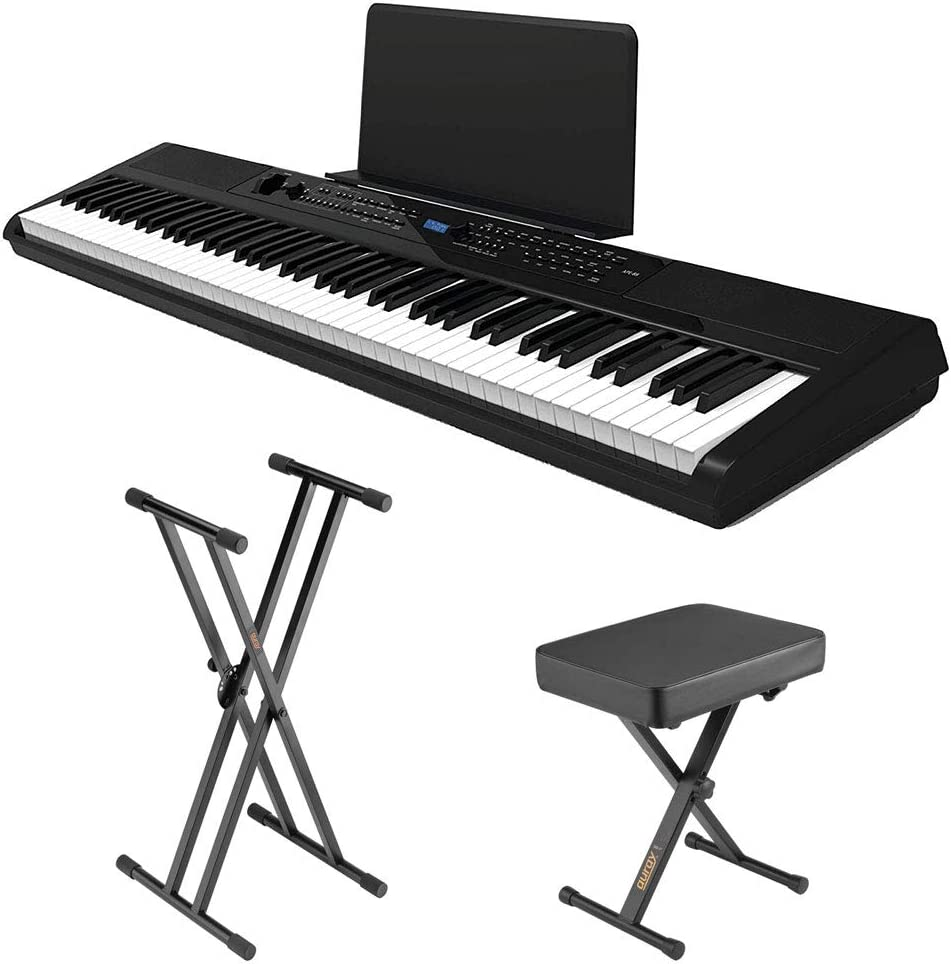
    Artesia PE-88 Digital Piano

    Specifications

    • Piano Size: 55.5 x 14 x 7.5 inches
    • Number of Keys: 88
    • Voices: 130+
    • DSP Effects: Yes
    • Speakers: Yes
    • Pedals: 2 (soft and sustain pedal)
    • Touch Sensitivity: 5 Levels, Fixed
    • Weight: 8.9 kg
    • Price: $379

    The Artesia PE-88 Digital Piano is an excellent choice for those who want a versatile and portable keyboard that still packs a powerful sound.

    With 130+ instrument voices and over 100 built-in rhythms, the PE-88 is perfect for players of any skill level. It also has an excellent sound delivery system, which makes it sound great even at high volumes.

    The PE-88 piano is USB MIDI compatible, which means you can use a computer or other devices for recording and composing.

    In addition, you can practice privately by plugging in your headphones. You’ll never miss a practice session, even if you live in a shared house.

    This bundle also includes an X-style piano bench and Double-X Keyboard Stand for stage and studio use, making it a great value.

    Overall, the Artesia PE-88 is a good choice for those looking for an affordable and portable digital piano with plenty of features and fantastic sound quality.

    Check On Amazon

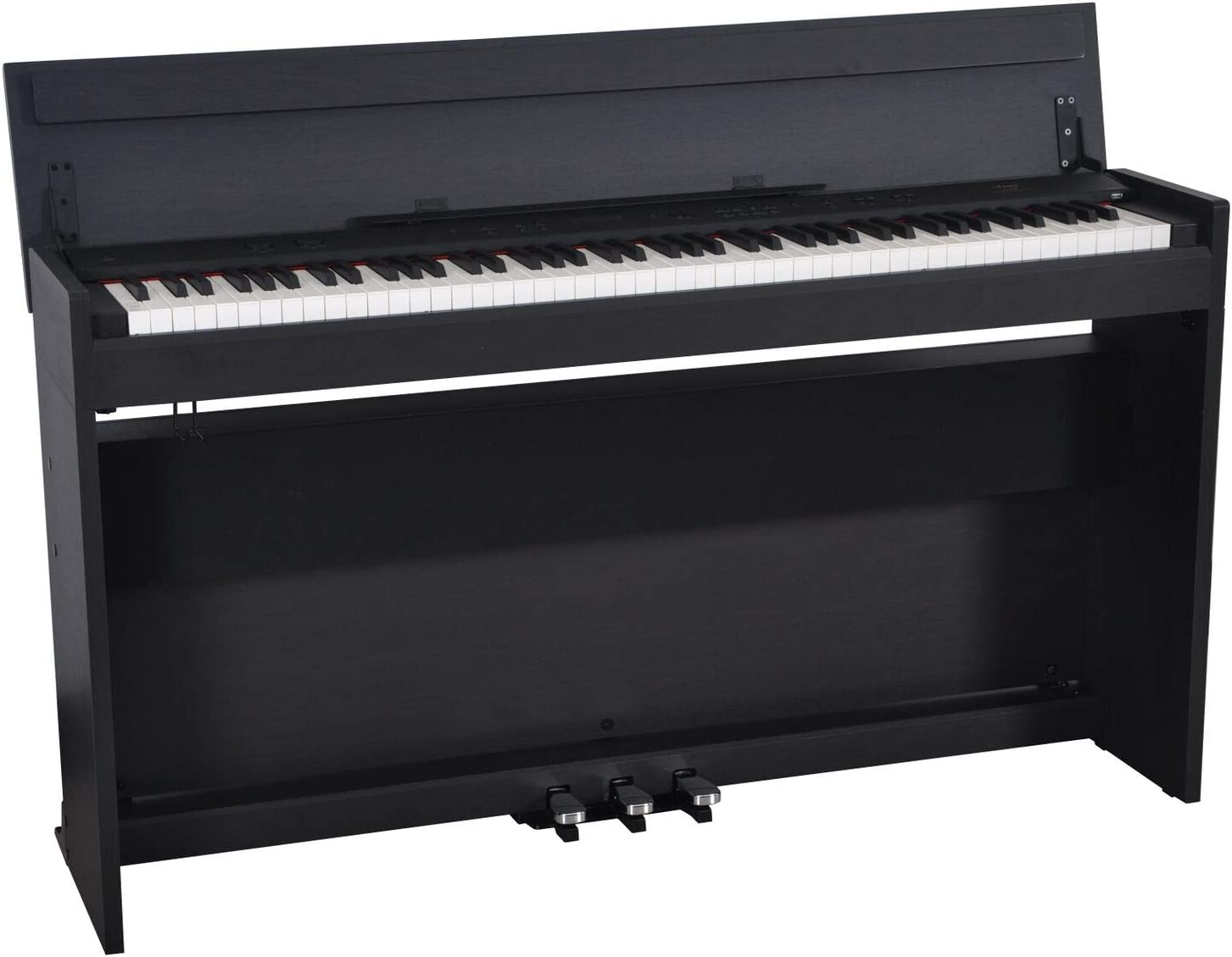
    Artesia A-20 Plus Deluxe Piano

    Specifications

    • Number of Keys: 88
    • Piano Sounds: 137
    • DSP Effects: Yes
    • Speakers: Yes
    • Pedals: 3 (soft, sostenuto, and sustain pedal)
    • Touch Sensitivity: 5 Levels, Fixed
    • Duet Function: Yes
    • Price: $1200

    The Artesia A-20 Plus Deluxe Digital Piano is a beautiful, modern piano that delivers authentic piano touch and tone suitable for every pianist.

    In addition to the sleek design, it is less than a foot deep, making it an efficient space saver.

    Its hammer-action keyboard builds proper fingering technique so that you can play other acoustic pianos.

    The A-20 mechanical piano offers 137 3D sampled “acoustic real” instrument voices that reproduce authentic acoustic sounds. Also, it is iPad-compatible, meaning allows you to interact with App Store teaching apps.

    Designed for beginners and experienced players, the A-20 Plus has an easy-to-use interface that makes it perfect for practice and performance.

    Other features include a metronome, recording tracks, duet mode, USB ports, tuning & transpose, digital effects, and split/layer functions.

    Players of all levels can easily access these features, making this piano a great choice.

    Check On Amazon

    Artesia FUN-1 Digital Piano

    Specifications

    • Piano Size: 40.5 x 16 x 11 inches
    • Number of Keys: 61
    • Voices: 8
    • Effects: Yes
    • Speakers: Yes
    • Pedals: 1 (sustain pedal)
    • Headphone jack: Yes
    • Weight: 13.6 kg
    • Price: $200

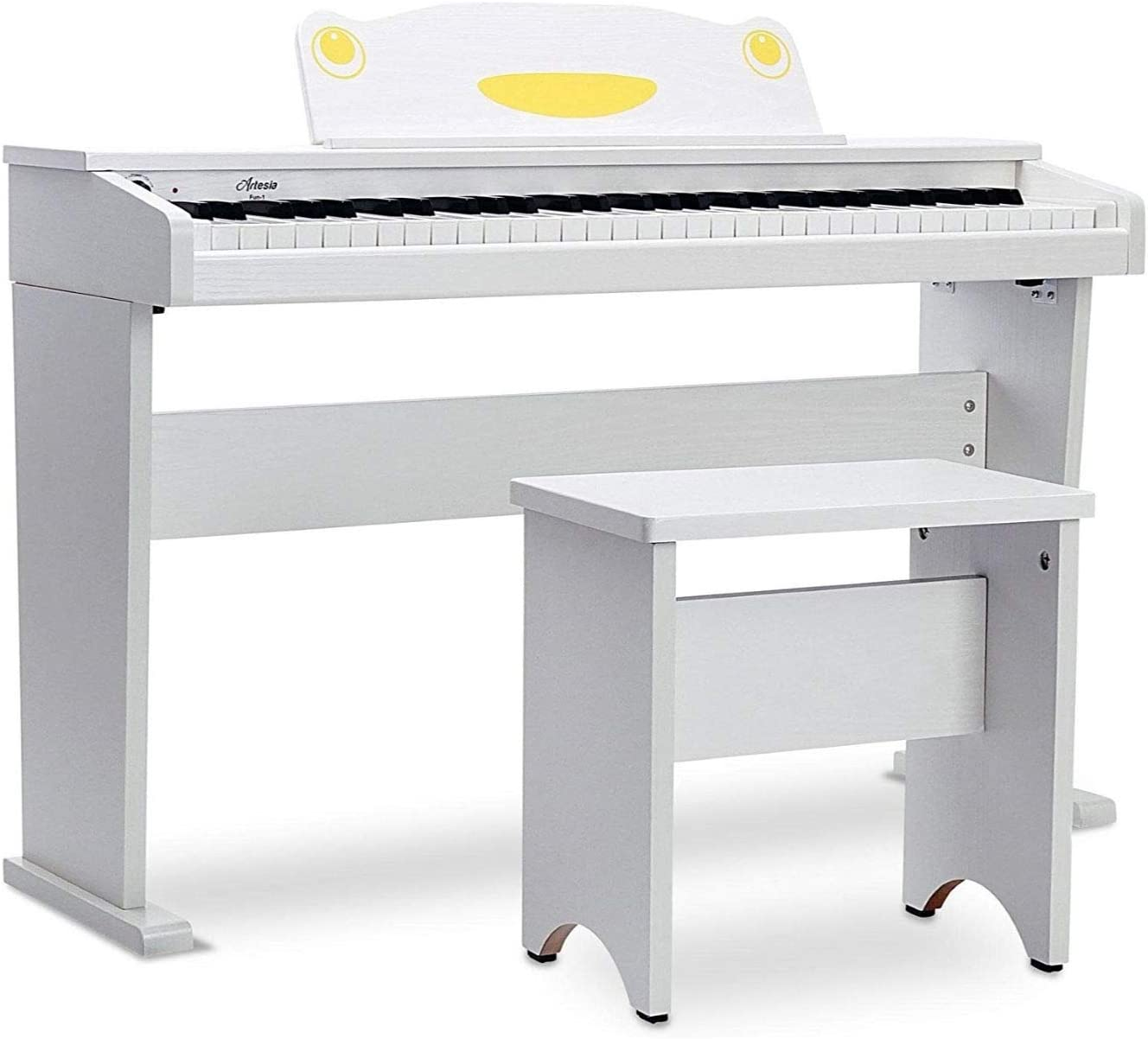
    The Artesia FUN-1 is a fantastic digital piano from Artesia designed for children interested in learning to play the piano.

    It comes with 61 velocity-sensitive full-sized keys that respond to the player’s touch and allow children to produce various sounds easily.

    Along with eight instrument voices, the piano offers animal sounds that make learning more accessible and enjoyable for budding pianists.

    In addition, the digital piano comes with a bench and headphones, so your child can learn quietly. It also features a USB cable and a sustain pedal.

    Also, the price of this piano is reasonable so that you can fulfill your child’s dreams without hesitation.

    Overall, this Artesia FUN piano is the best choice for your kids if they want an easy-to-use and fun digital piano.

    Check On Amazon

    Conclusion

    These are the ten best Artesia digital piano reviews available on the market. The Artesia Digital Pianos come in various styles to suit players of all levels.

    Some Artesia digital pianos are designed especially for beginners or even children, which helps them master the art of learning a piano and other things.

    The Artesia company understands the need for high-quality, low-priced products, which is why all its models are affordable. At the same time, these models also promise excellent sound quality and playability. Hopefully, you found the perfect model for your needs and budget on this list.

    Related Topics

  • What To Use To Clean Digital Piano Keys?

    What To Use To Clean Digital Piano Keys?

    What To Use To Clean Digital Piano Keys

    Ensuring the highest possible standards of a digital piano depend upon regular maintenance and upkeep. Although digital pianos are renowned for not requiring the level of upkeep that acoustic pianos do, they still need cleaning in certain areas, primarily when used often for piano lessons. One of the areas most prone to dirt and grime is the digital piano keys.

    If your piano keys look a bit kempt and feel somewhat greasy, immediate cleaning becomes essential. But were you contemplating cleaning the digital piano keys with the dishwashing liquid under your kitchen sink?

    If yes, hold your thought there, as cleaning piano keys requires more thought and care. The few steps mentioned below can help you.

    The Basics of Cleaning Digital Piano Keys

    To begin with, you should avoid harsh ingredients and gritty fabric while cleaning your piano keys. For instance, avoid products containing alcohol, chlorine, ethanol, benzene, peroxide, or salts, as they contribute to cracking and discoloration.

    The adept cleaning of digital piano keys depends upon the cleaning techniques and frequency. There is a common cleaning method for all types of piano keys. In addition, there are alternative cleaning processes vis-a-vis the type of material the keys are composed of.

    Plastic keys are the most hassle-free to clean and least sensitive. On the contrary, ivory keys need more attention and are highly sensitive. Cleaning frequency also matters. For instance, if you have to clean the keys of a piano used in a school or choir, the cleaning process should occur routinely every week or two.

    However, if the piano instrument is used at home or in a setting with seldom usage, then cleaning it once every few months is more than enough. No matter the situation, the crux remains that a clean piano keyboard is indispensable for its proper functioning and longevity.

    A Step-by-step Approach to Cleaning Digital Keys

    If you keep your piano in the best possible condition, then follow the steps given below:

    Step 1: Prepare the Cleaning Solution

    The first step is to create a simple solution by mixing a few drops of liquid soap in lukewarm water. Remember to opt for gentle cleaning products. Avoid harsh chemicals. Wash hands after preparing the solution.

    Step 2: Clean the White Keys

    To clean piano keys properly, take a white, soft cloth and dip it into the solution. After that, gently it all over the white piano keys. It is ideal to go over each key individually. It is a cleaning process that should remove any fingerprints and surface dust luting around the white keys of your keyboard. One pro tip: Use two clothes for the procedure. Use a fiber that is dye-free, soft, clean, and without any grittiness.

    Step 3: Clean the Black Keys

    Dip a separate cloth in a small bowl comprising the cleaning solution. Ensure to dampen the cloth and not soak it with dish soap liquid. Then, you have to gently rub the cloth over all the black keys one by one. It would be best if you remembered to clean the sides of the keys. Keep repeating the process till your keyboard keys seem squeaky clean.

    Step 4: Drying

    It is noteworthy to remember that you should wipe the piano keys you play with a dry cloth till the keys are completely dry.

    How to Clean Ivory or Ebony Keyboard Keys: A Step-by-step Approach

    • To clean your ivory keys, you must start by wiping all the white keys with a clean and dry microfiber cloth to remove the top layer of dust and debris.
    • Wipe the dry cloth towards yourself, from the top of the keys to the closest edge. It is essential to keep in mind that wiping horizontally can damage or misalign the keys.
    • Ivory keys are porous and prone to damage by specific cleaning methods. Make sure that you use two clothes; one slightly damp and the other completely dry.
    • You should also start cleaning from the lowest white key on the piano and work your up. Remove the dust from the keys by rubbing them back and forth or cleaning the piano keys.
    • Lastly, make sure to dry the areas in between the clean digital piano keys.

    You can also use toothpaste for deeper cleansing, but ensure to wipe off every bit of toothpaste and moisture after cleaning. You can also use white vinegar and water for a robust cleaning but do not remember under any situation.

    The key is to be extremely gentle with ivory or ebony keys. In keeping the keys white, you should not use stripping ingredients or harsh chemicals and only opt for mild detergent.

    How to Clean Plastic Keyboard Keys: A Crisp Overview

    The best thing about a plastic piano key is its resilience. Thus, you can use other items like vinegar and lemon juice to clean the piano keys. Like ebony piano keys, you have to clean your plastic keys with a soft, damp cloth with soapy water. Then, wipe the damp white cloth over the plastic keys gently.

    One pro tip is to place a piece of cardboard between the keys to prevent dust or moisture from accumulating between the keys and creating further issues. Always turn off your piano before cleaning, in case it is electric. In addition, when you are cleaning it, do not pour the solution directly onto the keys.

    It is a huge mistake that can force water between the keys, damage your piano, and make playing challenging. Furthermore, although plastic piano keys are durable, you should keep scrubbing agents and gritty fabric at bay, as they can scratch the keys.

    How to Make Piano Keys White Again?

    As a piano collects dust, the keys can lose their natural color. It mainly happens due to the oxidation of the white paint job. If you want to make your piano keys white again, the following steps can help-

    • Use Vinegar – Take half a cup of white vinegar and add two cups of warm water, then follow the cleaning mechanism mentioned above. Take a damp and soft washcloth to gently wipe the keys, and then use a dry and soft cloth to remove any moisture or vinegar.
    • Use a Whitening Toothpaste – You can also opt for a toothpaste solution to revamp the pearly white color of your piano keys. Put some white toothpaste containing baking soda on a soft-bristled toothbrush and gently rub it on the piano keyboard.

      The trick is to be mellow and mild, as harsh scrubbing can deteriorate the paint job. Then, remember to remove the excess and soak the leftover moisture from all the keys.

    Tips and Tricks to Keep Piano Keys in an Immaculate Condition

    Playing the piano always feels best when it is squeaky clean. In addition to the points mentioned above, you can follow some tricks and tips to ensure that your precious digital keyboard is in good condition.

    • A proper piano cleaning mechanism should always start with dusting. You can use a soft cloth and dry fabric to clean your piano free of dirt or residue.
    • Always cover your piano with a felt sheet when not in use. Keeping the piano covered when not used is important to keep dirt and grime at bay.
    • Provide your piano with some much-needed Vitamin D by placing it in indirect sunlight. A good piano cover comes in handy in such situations.
    • Wash your hands before playing the piano keyboard.

    Wrapping it Up

    So, there we have it, a crisp overview of how to clean the digital keys of your precious piano. The steps are simple. And we must remember that when you play a well-maintained piano, its melody becomes all the more prominent.

    Lastly, check the user’s manual that comes with your piano before starting the cleaning mechanism.

    Related Topics

  • How Often To Tune A Piano?

    How Often To Tune A Piano?

    How Often To Tune A Piano

    The first thing you need to understand when you get your piano tuned is that a professional piano tuner should do it. A piano tuner is like a technician who understands how the strings stretch and will tune the piano to a perfect pitch to create a beautiful sound.

    Another thing that you need to understand is that strings need to be tuned if these get disturbed due to temperature fluctuations and humidity levels. So here is what you need to know about piano tuning and piano sound.

    How often should you tune a piano?

    If you play an acoustic piano, you need to get the piano tuned by a qualified piano tuner. This will not just ensure that the piano sounds better, but it will also ensure that the instrument is in better health.

    Piano tuning is about ensuring that the piano sounds perfect and the instrument is in good working order.

    It would be best if you got the piano tuned depending on how often it is played and its usage. The standard rule of thumb is that as a professional pianist, you should tune a piano at least twice a year. It would be best if you also tuned pianos for the following reasons:

    • If the piano has undergone heavy usage
    • If the piano has been recently moved, which has resulted in heavy jostling and the tuning pins are out of order.
    • The piano can be out of tune due to unreliable internal mechanisms, such as a defective soundboard or pin block.
    • A piano can “sound bad” and go out of tune as the piano strings stretch. This will require regular tuning.
    • If you are maintaining a piano in a concert hall like a grand piano, then it requires tuning regularly.

    Thus, tuning an out-of-tune piano is essential to ensure that it produces a good sound. A piano technician will tell you that a new piano needs to be tuned regularly so it does not go out of tune.

    How often should you tune home pianos?

    There is no separate rule for tuning a home piano. However, it would be best to get it tuned like most pianos; if the soundboard expands, then the pianos need to be tuned immediately. Many pianists believe that home pianos need to be tuned regularly to ensure proper care is given to the instrument.

    In addition, you will have to tune your piano if the hammer strikes are not producing the correct note, which is often the issue with home pianos. Thus, you should check if the piano is out of tune and get technicians to get your piano tuned.

    How to tell if a piano is out of tune?

    If you have just brought your piano to a new environment, the instrument is out of tune, and you need to tune it. A good rule to check whether you need to tune your piano is playing the piano’s A below middle C, which is the same frequency as A 440.

    If the sound plays at the same pitch or the notes create different sounds, you need to tune your piano. Some of the other factors that will indicate that your piano needs to be tuned are as follows:

    Check that the keys’ strings are tuned together:

    You can do this by playing the notes and striking the keys. When you play a key in the mid and high range of the piano, a hammer strikes two or three strings.

    It would help if you started playing the octave below middle C and then moved up. The piano does not need tuning if the notes sound clear and have perfect pitch. Otherwise, you will have to hire professional tuning experts.

    Check if the octaves blend:

    Your piano will need tuning if the octave notes go out of tune. You need to play the notes an octave apart and if the tune should sound like a note. If you hear different notes, your piano needs to be tuned.

    Check that significant chords sound pleasant:

    Check if the c major chords sound pleasant when you play this in the middle of your piano. If the note sounds pleasant when played, your piano does not need to be tuned. Otherwise, it would help if you tuned the piano.

    Thus, you will need to check the pitch, note, and sound created by your piano to understand whether it needs to be tuned. For example, if the sounds are flat and do not create soft and pleasant music, you need to get your piano tuned.

    What do most piano manufacturers say about piano tuning?

    If you ask a piano manufacturer how often you should tune a piano, they will first say that you should tune pianos when you observe a difference in sound.

    A piano is mainly made of strings, hammers, and a soundboard. Humidity can adversely affect the wooden soundboard, which can change the piano’s sound.

    Temperature fluctuations and humidity levels can cause the piano body and the soundboard to expand. Humidity will also make your strings go flat quicker. Temperature changes and humidity is also responsible for putting more pressure on the strings as the strings become flat.

    The string tension will also change with temperature and humidity as the soundboard can contract and expand. Therefore to release the pressure on the string, you will have to opt for professional tuning.

    What will happen if you don’t tune your piano?

    If you are a piano teacher, you must understand the importance of getting your piano tuned; if you allow your piano to go out of tune for a long time, getting the strings tuned again can seem quite tricky.

    Piano tuning is a thorough job, and the longer you leave, the longer you go without tuning, and the more work is needed during each visit.

    Regular tuning makes it easier for a piano tuner to get your instrument back into proper tune. Proper maintenance is necessary to ensure that each piano string is perfectly tuned and produces the correct sound.

    The tuning of a piano depends on the condition of the instrument. Less maintenance is required in the first year you purchase the piano. But after the first year, you will need to tune your piano regularly. Tuning pianos is an essential part of maintaining the instrument.

    Conclusion

    A piano tuner will use a tuning pin to bring a piano string to the proper tune. When a piano starts playing you, you will find that it generally produces a perfect sound as the strings are perfect.

    So the short answer to the question of when you need to tune your piano will be whenever you feel the sound produced by the instrument is out of tune.

    Even if the side note is not perfect, your piano needs to be tuned. One of the factors you must remember is to avoid moving the piano in a room to prevent the strings from jostling.

    This can get the piano out of tune faster than any other mode. Thus, by taking some simple precautions, you can reduce your requirement for getting your piano tuned regularly.

    Related Topics

  • Who Makes the Best Keyboards for Beginners: Roland, Yamaha, or Casio?

    Who Makes the Best Keyboards for Beginners: Roland, Yamaha, or Casio?

    Let’s picture this:

    You are buying a new keyboard and learning piano; now you are looking for the best beginner keyboard options around.

    Millions of brands are working day and night in the innovation and creativity of keyboard designs. But actually, only three stand out: Roland, Casio, and Yamaha.

    You probably wandering in the market, and every other seller is trying to convince you the keyboard piano in front of you is the best! But who makes the best Keyboards for beginners?

    Choosing the best keyboard, especially when you are a beginner keyboard player, is very crucial. And most importantly, it depends on your preferences and the reason behind your purchase.

    Let us get you started with each spec to give you a closer idea about which brand you should go for.

    Yamaha Keyboards: Do They Make a Good Beginner Keyboard?

    Currently, Yamaha is globally known as the largest manufacturer of the piano. They have diversified the digital piano range broadly. The most astonishing part about their product is that they have excelled in every criterion you would expect from a traditional piano manufacturer.

    Yamaha has launched a range of acoustic piano with the latest modern and digital piano features in a hybrid called “TransAcoustic.” In this category, Yamaha is not only a leader but a trendsetter: an innovational benchmark for making acoustic grand piano.

    However, speaking about the new voices, electric piano sounds, organ sounds, revolutionary technology, and art synthesizers, Yamaha is not very well-positioned. Yamaha has lost some of its regular customers for being too conservative.

    If you visit a store with a display of synthesizers, you will hardly locate Yamaha keyboards because they are the most sober-looking ones. The montage line is impressive, but its display is more like an ordinary keyboard piano than a synthesizer.

    Significant Highlights of Yamaha Keyboards You May Not to Miss

    • Entry-level Yamaha portable weighted keyboard is sensitive and very easy to understand with ‘keys to success’ lessons, AUX-in, USB styles, weighted keys, etc., but they are not appealing to beginners.
    • Yamaha stage keyboards are best for those playing piano live with great grand piano sound. They are all-in-one solutions requiring little to no extra processing.
    • Synthesizer is like unknown territory for Yamaha; it is not meant to be made for synthesizers due to its extensive DAW capabilities.
    • Yamaha offers one of the best arrangers of digital piano workstations in terms of affordability, rhythms, sound quality, sustain pedal, and music rest.
    • Many users say that Yamaha is a great manufacturer of midi keyboard with all essential features making them like a real piano.

    Reasons for Choosing Yamaha Keyboards for Beginners?

    According to experts, Yamaha is not a beginner’s treat. It is the world’s best brand with 88 keys, variations of an acoustic piano, and that massive ground sounds, though.

    Still, it is not a synthesized brand and doesn’t produce impressive keyboards for beginners. However, they are known to make the best midi keyboard to learn piano.

    Casio Keyboards: Do They Make Good Beginner Keyboard?

    Many people specializing in playing digital piano are very fond of Casio. If you had some keyboard piano lessons at school from piano teachers, you might have a Casio one. Unlike Yamaha, Casio does not produce acoustic instruments.

    Undoubtedly, Casio is pretty famous for making beginner keyboards globally. The favorite Casio CTK series is in the heart of many who play piano due to its first black-and-white music creation tool. Imagine the brand’s popularity for beginner keyboards, that they have designated a section for beginners.

    The question might arise: Why sit with CTK when you can have an acoustic piano?

    The answer is: CTK is way more fun than playing an acoustic piano.

    That is the main reason behind the success of the Casio: they make the most affordable and beginner keyboards packed with fun features for children, helping them learn quickly and easily.

    Moreover, they have flooded the industry with the perfect products to help people learn how to play the piano lessons and started building their brand there. Like, if you are learning music, you should be able to read through sheet music that you can prop on a keyboard stand. Casio will always remain the best beginner keyboards.

    Significant Highlights of Casio Keyboards

    • Casio portable digital piano sound have gained the most popularity and recognition due to their touch sensitive keys and weighted keys and not being too pricey – a complete workhouse and virtually indestructible.
    • Casio workstations are considered suitable in this category due to their allowance of recording SDHC cards and featuring other valuable aspects like sustain pedal and music rest for sheet music.
    • The Casio stage piano keyboard range is an incursion in the industry that Yamaha long owns. The player interface is uncanny with the intuitive flow and massive touch screen and touch sensitive keys.

    Reasons to Buy Casio Piano Keyboards for Beginners?

    If you are a beginner or packed on a budget, Casio keyboards are a suitable pick. Casio keyboards are reliable, fun, and sturdy. If you are looking for a reasonable keyboard for your kids or want to learn keyboard playing from a piano teacher, look for the Casio pianos.

    In addition, Celviano, AP-series, and Privia are dedicated to wooden stands that are pretty good weighted keyboard for beginners. If you are looking for keyboards at a fraction of the price and reliability, Casio is the best beginner keyboard, but in terms of sound, Casio cannot match other brands.

    Roland Keyboards: Do They Make Good Beginner Keyboard?

    Believe it or not: Roland is solely responsible for setting a generation’s benchmark for musical instruments. Though it is comparatively new in the digital piano manufacturing industry, they have made the user interface more straightforward and focused on creating nano and micro technologies, making it easy to practice with different piano techniques.

    Furthermore, Roland is the newest and smallest in the industry, with less than 5,000 employees globally. That being said, it is the only company to manufacture musical instruments. They have been producing the keyboards with the necessary features like sustain pedal, excellent sound quality, and dance music mode.

    All the Roland keyboards have one significant characteristic: they are high-end. But on the other hand, they are costly. Still, there is no comparison to its magnificent sound. In addition, Roland is also known as a cutting-edge innovator in R&D.

    Significant Highlights of Roland Piano Keyboard

    • Speaking about the portable Roland keyboards, perhaps it is the weakest point of these digital pianos. They are not specialized in manufacturing the best beginner keyboards.
    • The starter line keyboard series manufactured by Roland is way too much as a beginner keyboard; it is a good upgrade for experts from another brand, though.
    • The user interface and teaching abilities of these keyboards cannot make it through for beginners; at the same time, these digital pianos are fun to use.
    • The workstation E-series of Roland comprise of built-in sound system with excellent sound. For instance, Roland E-09 has a boosted 64-voice polyphony and excellent audio build quality like a real piano.
    • The most popular Roland stage learning piano is Roland RD-2000; it is an art powerhouse and an ever-evolving one with a dual sound engine.
    • The Roland keyboards are lightweight, have non-weighted keys, and are affordable.
    • Hands down, Roland has manufactured one of the best synthesizers, Roland Jupiter X, regarding the user interface; however, they are not beginner keyboards.

    Why Buy Roland Keyboards for Beginners?

    If you are an accomplished keyboard player searching for new and powerful sounds and impeccable craftsmanship, Roland keyboards are for you. Roland must be a pick for someone ready to spend extra bucks to get a modern keyboard.

    Casio, Roland, or Yamaha? The Final Verdict for a Beginner Keyboard?

    The question seems straightforward, but isn’t it getting trickier than thought? Which brand manufactures the best keyboards for beginners?

    Every brand manufacturer consistently tries to outdo the other two but maintains its market importance and retains a position in a market segment of its own.

    To begin with, if you are looking for an expensive, good, state-of-the-art keyboard to play at home quickly, then Yamaha keyboards should be your pick. They play impressive, sober, and the closest one will get to an actual keyboard without breaking the bank. Also, they are considered the best piano keyboard makers if you are fond of a jazz piano keyboard.

    However, Casio owns the best section of beginner keyboards and is continuously working to introduce new models in the market, like Celviano and Privia lines. The act is not based on competing with other brands but on providing unique-sound and budget-friendly choices for people who cannot afford the real deal.

    At the same time, Roland keyboards are made for those looking for a modern and traditional piano with millions of the latest features to be as creative as they want. They are the best producers of synthesizers globally. They are good, however, not cheap, and don’t offer the sound as good as Yamaha.

    Thus, the choice entirely depends on your preferences and what you are looking for in your ideal beginner keyboard pick. And most importantly, what is your budget? So, make your decision wisely, and enjoy playing with keys and learning piano.

    Related Topics


  • How Many Keys are Most Electric Keyboards?

    How Many Keys are Most Electric Keyboards?

    Pianos come in a variety of types, each with its own specifications. One such specification is the number of keys. Depending on the type of piano, there could be as few as 36 keys or as many as 88 keys. The number of keys on a piano affects the range of notes that can be played, as well as the size and weight of the instrument.

    In this article, we will further discuss the number of keys in pianos, particularly electric keyboards. Electric keyboards often have more keys than traditional pianos, which can give musicians more flexibility when playing. However, some keyboard players prefer the smaller size of a traditional piano. Ultimately, it is up to the musician to decide which type of piano they prefer.

    Acoustic Pianos

    The average modern acoustic piano has 88 keys that span a range of 7 and a quarter octaves. This is an impressive range that provides the player with a wide variety of notes to choose from. This particular span of 88 keys on a piano is equivalent to 7 octaves plus 3 extra keys that are added to the bass notes.

    However, it wasn’t always standard to have 88 keys on a piano. The first widespread 88-key piano was built by Johann Andreas Stein in Augsburg, Germany in 1783. Before that, most pianos only had about 60 keys.

    Some more recent acoustic pianos do not follow this traditional standard. An example of this is Bösendorfer’s 97-key piano. This piano has an extended range, which allows for a greater variety of dynamics and expressive possibilities. Meanwhile, the Australian company Stuart and Sons have created a 108-key piano that spans 9 octaves. This is the widest range of any commercial piano currently available on the market, providing pianists with a wider range of notes to choose from.

    Digital Pianos

    The digital piano is a type of electronic keyboard designed to serve as a replacement for the traditional acoustic piano. Digital pianos typically use advanced sampling technology to faithfully reproduce the sound of an acoustic piano, and they often include features designed to emulate the playing experience of an acoustic piano, such as weighted or semi-weighted keys and touch-sensitive controls.

    The digital piano is designed to replicate the sound and feel of an acoustic piano. As such, it usually has the same number of keys as an acoustic piano. This allows for a greater range of notes and tones, making the digital piano a versatile instrument. The number of keys on a digital piano can vary from as few as 25 keys (mini keyboard) to 88 keys (full-size grand piano keyboard).

    Although digital pianos and acoustic pianos might look the same, they don’t have the same key range. The key range is the number of keys on a piano. Acoustic pianos have 88 keys, but digital pianos can have fewer or more, depending on the make and model.

    You will often find that manufacturers produce digital pianos with 76 keys in addition to those with 88 keys. The extra 12 keys found on 88-key digital pianos can come in handy for advanced piano pieces and offer a more realistic feel and sound. A standard piano has 88 keys, but a 76-key piano omits the eight keys farthest to the left and right. This leaves a 6 1/4 octave span on a 76-key piano, which is still plenty of room to play most pieces of music.

    Electric Pianos

    Electric pianos are, in many ways, similar to electric guitars. Both instruments use electricity to create their sound, and both can be plugged into amplifiers to make the sound louder. However, there are also some important differences between the two. Acoustic pianos have been around for centuries, while electric pianos were invented much more recently. Acoustic pianos usually have 88 keys, while electric pianos often have far fewer. Electric pianos typically make a brighter, sharper sound than acoustic pianos.

    Electric pianos have been used since the late 1920s, though they’ve only gained popularity in recent decades. Despite their name, electric pianos don’t use strings like acoustic pianos – instead, they use either tines or reeds to create sound. The most popular electric pianos are the Fender Rhodes (which uses tines) and the Wurlitzer Electronic Piano (which uses reeds).

    Also, there are many electric pianos on the market from manufacturers such as Baldwin, Kawai and Yamaha. These pianos often resemble traditional grand or upright pianos, with the addition of pickups to amplify the sound. Most electric pianos feature 88 keys, just like a standard piano.

    Electronic Keyboards

    While digital pianos are designed to closely imitate the look, feel, and sound of an acoustic piano, electronic keyboards were created for a different purpose entirely. Keyboards typically have more features than a digital piano, such as the ability to create and edit sounds, layer multiple sounds together, and connect to other devices and computers.

    Most electronic keyboards come with a huge range of pre- programmed sounds, such as different types of pianos, various orchestra instruments, and lots of different synth patches. This means that you can easily switch between different sounds without having to fiddle around with any settings. This variety of sounds can be extremely helpful for keyboard players who want to expand their sonic palette, or who simply enjoy having a lot of options to choose from.

    Electronic keyboards are not designed to perfectly imitate either digital or acoustic pianos. They serve different purposes and, as a result, have different features. For example, electronic keyboard keys may not have the same range or feel as those on a piano.

    There are two popular sizes of electronic keyboard: 76-keys and 61-keys. Most manufacturers make and sell keyboards in both of these size ranges. The76-key keyboard is the larger of the two sizes. It typically offers a wider selection of features than the 61-key model, making it a better choice for more experienced players.

    A 61-key instrument falls significantly short when compared to an 88-key instrument. The latter provides a much fuller range of notes, allowing for a richer, more complete sound. As a result, 88-key instruments are generally considered to be superior to their smaller counterparts.

    Should You Get 61-Key, 76-Key, Or 88-Keys?

    The number of keys on an acoustic piano, digital piano, or electronic keyboard can be overwhelming when purchasing one. There are 88 keys on a standard piano- from the lowest bass C to the highest treble C. This may seem like a lot to learn at first, but remember that each octave (group of 8 notes) repeats itself. You will only need to learn the notes in one octave before moving on to the next. The number of keys does not necessarily dictate the quality of the piano; it is important to choose a piano that is comfortable for you to play.

    If you’re just starting out, a 61-key keyboard could be a good choice for you. It can help to break things down and make it more manageable when you’re first starting to learn. Plus, having fewer keys can also make it easier to navigate and find the notes you’re looking for.

    On the other hand, the 76-key keyboard is perfect for intermediate users who want to improve their skills. The extra keys allow for more complex patterns and chords, making it the ideal choice for those who are serious about taking their playing to the next level.

    Lastly, the 88 key keyboard is the most versatile and therefore the most suitable for advanced players. Genres that require a range of both lower and higher notes benefit from having 88 keys available.

    Pianos come in a variety of price ranges, from digital to acoustic. Many people opt to invest in a higher-end instrument as they advance in learning the piano. This is because higher-end instruments tend to have more features and better sound quality than lower-priced options. Additionally, investing in a higher-quality piano now may save you money in the long run, as you will not need to upgrade to a better model as your skills improve.

  • Can You Learn How to Play Piano on a Keyboard?

    Can You Learn How to Play Piano on a Keyboard?

    There are many reasons why parents would want their children to have piano lessons, including the fact that it is a skill that can be used for a lifetime. Sadly, not all people can financially afford to pay for these lessons. These lessons can be quite expensive and out of reach for some people.

    In spite of the many different designs of pianos, even the most compact ones require a substantial amount of room. This is due to the fact that pianos contain a large number of strings which need to be stretched out in order to produce sound. Additionally, the frame and body of a piano can be quite bulky, making it difficult to fit into smaller spaces. Contrary to acoustic pianos, keyboards are much more compact and convenient to transport. This is due to the fact that electric pianos do not contain any actual strings or hammers. This makes them a great option for anyone who needs a portable piano solution.

    Piano teachers generally say yes when parents inquire whether their children may use a keyboard or a digital piano to study the instrument. The main reason for this is that both types of pianos have full-size keys, which is important for developing proper technique. In addition, both keyboards and digital pianos are capable of producing a wide range of sounds and can be plugged into headphones, so as not to disturb others in the household.

    Although a keyboard or digital piano may be used by a large number of students, there are critical differences to keep in mind when transitioning from an electronic instrument to the traditional piano. For example, the traditional piano offers more resistance than an electronic keyboard, which can help build strength in the student’s fingers over time. In addition, the traditional piano Cedar offers a wider range of dynamics and tones that can help the student better express themselves musically. As such, while an electronic keyboard may be a good starting point for some students, those who are serious about learning piano should eventually make the transition to a traditional piano.

    Weighted Action Keyboards Are Best

    When it comes to digital pianos and keyboards, one of the most important factors is the feel of the keys. Many keyboardists prefer weighted keys, as they more closely resemble the resistance of a traditional piano’s keys. Weighted keys also offer a greater level of control and precision when playing. If you’re serious about your piano playing, investing in a keyboard with weighted keys is highly recommended.

    When playing a keyboard, the weighted keys provide a varied response to player touch. In other words, more force is required to produce the same volume when using a light touch. This is due to the fact that the weight of the keys affects how they respond to being touched. The heavier the key, the harder it is to press down, which in turn makes it louder. Pupils who don’t get their feet wet on a weighted action keyboard may end up playing too quietly or too loudly when they go on to a real piano. In addition, they will be unable to develop a sense of dynamic range – the ability to add excitement or sadness to a song with different keystrokes at different times. This inability to create emotion in their music will limit their creativity and enjoyment of the piano.

    Acoustic pianos require muscles that are honed on weighted-action keyboards. If a person learned how to play on a non-weighted keyboard, they would need to unlearn incorrect skills before being able to play an acoustic piano effectively.

    Keyboard Size Is Also Important

    A weighted keyboard is great, but it’s also crucial to make sure the instrument is the right fit for your body and hands. Otherwise, you’ll have a harder time playing and may even develop pain in your wrists and arms. Luckily, most manufacturers list the dimensions of their keyboards on their website or in the product description, so you can easily find one that will work for you.

    Those who reside in smaller dwellings, such as apartments or townhouses, may not have the room needed for a full-sized keyboard. Some parents, recognizing that their children’s little hands may benefit from learning on a compact keyboard, may choose to purchase one for their child. This way, they can take up less space in the small dwelling and still receive the benefits of playing the piano. While you might be tempted to purchase a small keyboard, it is important to avoid doing so as this may lead to children developing incorrect skills that they will later have to unlearn. Much as playing on a non-weighted keyboard does, this can teach your youngster to play incorrectly on two fronts. Additionally, many compact keyboards are weightless, which can cause even more problems down the road.

    A complete 88-key keyboard is required to master the instrument. This way, your kid can explore the full spectrum of the keyboard and all its sounds. Even if you’re on a tight budget, resist the urge to go with the most economically sensible alternative when choosing a piano for a youngster who plans to play for a long time. A cheaper piano may be tempting, but it likely won’t hold up as well over the years or provide the same level of sound quality as a more expensive one.

    This is especially important if your child plans to perform on a piano rather than a keyboard. This is because pianos are typically used in settings such as recitals, concerts, and other similar performances. By ensuring that your child is comfortable and familiar with playing the piano, you can help them to feel more confident and prepared when it comes time to perform.

    Finding a Great Keyboard

    Although you can get a keyboard for sale just about everywhere, don’t forget that many music stores also offer keyboard rentals. To some extent, this may be the most cost-effective choice since it allows you to try out the instrument before committing to a purchase. You may also rent with the opportunity to buy in certain locations. This can be a great way to save money if you decide you want to keep the keyboard after all. By renting first, you can try out the keyboard to see if it’s a good fit for you. If you decide you want to keep it, you can then purchase it at a discounted price.

    To sum up, we can reasonably conclude that you can learn to play the piano on an electric keyboard. This is based on the assumption that electric keyboards are designed to mimic the feel and sound of a traditional piano. Therefore, with some practice, it stands to reason that you would be able to develop the necessary skills to play the piano on an electric keyboard.

  • Why Do Electric Keyboards Have Hammer Keys?

    Why Do Electric Keyboards Have Hammer Keys?

    Piano action is one of the most important aspects of playing the piano, and investing in a high-quality action can vastly improve your skills. This is because a good quality piano action will allow you to play with more control and precision. Additionally, a good quality piano action will also help to improve the sound of your playing. When it comes to choosing a keyboard, one of the most important factors is how it feels to type on. The keys should have a good amount of travel and be comfortable to press. They should also be responsive so that you don’t have to press too hard to register a keystroke. If you’re going to be doing a lot of typing, these are the things you’ll want to keep in mind.

    An acoustic piano is a type of musical instrument that makes sound when a player presses down on a key. The player causes a hammer to strike a string, which in turn sets the string into vibration. This produces waves of pressure that travel through the air and can be heard as sound. Each keypress is met with a satisfying amount of natural weight and resistance thanks to the hammer’s connection to the key through a system of levers. This mechanical design provides a superior typing experience compared to other types of keyboards.

    The question is, how can a digital piano convincingly mimic this weight and resistance?

    When a key is pressed on a keyboard or synthesizer, a spring-loaded mechanism ensures that the key always returns to the up position. This mechanism guarantees that the key will always be correctly positioned, allowing the musician to play with ease and precision. This is extremely important for guaranteeing a high level of performance from the musician. Digital pianos at the beginner level employ a similar action, but with a little weight applied to each key. A semi weighted action is a type of keyboard action that is somewhere in between a weighted action and a non-weighted action. Some players prefer this type of action, especially if they are constantly swapping between synths and pianos. This gives the keys a more authentic feel, closer to that of an acoustic piano.

    Types of Keyboard

    The actual hammers in a hammer action keyboard are raised when a key is pressed, and return to their resting position when the key is released. This option provides a more genuine feel. To top it all off, a Progressive Hammer Action keyboard makes the keys seem progressively heavier as you type. This is due to the fact that the strings in the treble region of an acoustic grand piano are shorter and narrower while the strings in the bass area are thicker and longer.

    A piano key’s overall length is significant for several reasons. The length of the key that is above the keybed, known as the visible length, affects the way the key looks. However, the length of the key that is below the keybed, which is not visible, is just as important to its operation. This hidden portion of the key helps determine how smoothly and evenly the key moves when it is pressed. As you progress, this will become more crucial.

    The keys of a digital piano are typically constructed of plastic, however wood is sometimes used.If the key’s weight or mass provides the same resistance as that of an acoustic piano, then it shouldn’t matter if the key is made of wood or some other material. The feel of the keys is what’s important, and as long as they provide the same resistance, the material they’re made out of is relatively unimportant. Touch is also an important factor to consider when choosing an acoustic piano. Because every piano has a unique touch, it’s important to find the one that feels right for you.

    There is no “proper” way to play the piano, so make sure you find an instrument with a touch that suits your style. While it’s true that a grand piano’s touch is often lighter than an upright piano’s, and that even uprights from the same manufacturer may differ, the instrument that’s best for you is the one you’re most comfortable playing.

    Pedals

    The piano’s pedals are also important to remember. Most pianos have three pedals, with the rightmost one, the damper pedal, being the most crucial.

    It’s hard to connect two distant notes since the music quickly stops as we release a key. This is due to the fact that when we release a key, the sound vibrates for a shorter amount of time which makes it harder for our ears to distinguish between two notes. The damper pedal, often known as the sustain pedal, is used for this purpose, allowing notes to continue playing after the player’s fingers have been removed from the key. The damper (or sustain) pedal on certain entry-level digital piano models functions primarily as an on/off switch. Nevertheless, when playing an acoustic piano, you can only fully activate the sustain pedal when the dampers are touching the strings. This is because the sustain pedal regulates the flow of air through the grand piano, which in turn allows the vibrations of the strings to be heard for a longer period of time.

    Half pedalling is a technique that allows a pianist more agency over a prolonged note. The term ‘half pedalling’ describes the use of the sustain pedal on a piano in which the pedal is only partially depressed. Using a technique called Progressive Damper Action, certain digital pianos are able to convincingly simulate this sound. This technique gives the pianist more control over how long a note is sustained for, as well as providing a more nuanced and expressive sound.

    You may hold a note or notes kept down while playing other notes on the piano by using the sostenuto pedal, which is in the piano’s center. This might be useful for creating certain effects, such as holding a note as the hands move to a different part of the keyboard. By pushing the center pedal to play a deep bass note and reverberating it, your doodles will take on the tone of the bass. Using this method, you may create a one-of-a-kind effect that can give your music a fresh sound.

    We hope that this article has helped to explain why electric pianos still have hammer keys, despite the fact that their digital counterparts do not. The main reason for this is that electric pianos are designed to mimic the sound and feel of a traditional acoustic piano, which means that they need to have identical key mechanics in order to produce the same results.

  • Why Do Some Electric Keyboards Come With 61 Keys?

    Why Do Some Electric Keyboards Come With 61 Keys?

    The electric piano is a popular musical instrument with a long and varied history. Not all are created equal, however; there are many different types of pianos available on the market today, each with its own unique features and capabilities. A brief survey of the history of the piano can help you to understand the different types of pianos available and find the one that best suits your needs. Some of the very earliest pianos were not at all like the pianos that we know today. Not only were the internal mechanisms and materials different, but the keys were also much shorter in allocation.

    In fact, if you were to see one of these first pianos without knowing what it was, you might easily mistake it for a harpsichord. This is because the design of the keys (black and white) is reversed in comparison to a typical harpsichord.

    61 Versus 88 Key Pianos

    Pianos were initially created with four to five-octave keyboards, which is significantly less than the seven and a quarter octave pianos that are common today. This limited range meant that pianos were much less versatile than they are now. This was because they could only produce a limited range of pitches, which made them less able to play a wide variety of music. At least partially, this was due to the manufacturing techniques of the time, which limited range, but it also reflected what was expected from musicians of the time.

    As composers began to experiment with new and more demanding musical concepts, the need for a piano with a complete set of eighty-eight keys became apparent. Fortunately, the piano manufacturing industry had also matured to the point where it was able to meet this demand dependably.

    The smaller range of early pianos was also due to the fact that they were restricted by the amount of space available. Pianos are large instruments, and early pianos could only be made with a smaller range because there was not enough room to accommodate a larger one. London’s Eavestaff Pianos was founded in 1823 and it was then that the company introduced their ‘Mini Piano’ to the market. The Mini Piano was designed to be smaller than a standard piano, making it more suitable for people who didn’t have enough room for a full-sized instrument. Eavestaff was tasked with designing a new instrument that could not only be played in tight quarters but also held up under rough treatment and produced a convincing sound.

    Although it may seem easy to create a small piano that can compare to its larger cousins, the solution left the instrument with tuning problems. Some keys on these instruments are shorter and less sensitive than those found on standard pianos. This is most likely due to the fact that they were designed for a different purpose and not intended to be used in the same way as a traditional piano. This, coupled with their diminished relevance, renders them, particularly in the present day, as something of a historical curiosity and a compromise too great to be worthwhile.

    Kemble pianos have been popular for many years, especially in England. The company was created in 1911 and has continued to produce high-quality, small pianos that are perfect for many different types of settings. Beginning pianists, particularly young children who wouldn’t require the entire range of a piano keyboard, sometimes started out with instruments like this or the Eavestaff counterpart. Young children would learn the fundamentals of piano playing on these instruments before moving on to more complex pianos.

    The company relocated its manufacturing to the Far East around 2009, meaning the small piano is no longer a member of their current range. This change likely occurred due to the company wanting to reduce costs and take advantage of cheaper labor in the Far East. As a result, those looking for a Kemble small piano may have difficulty finding one since they are no longer being manufactured.

    Over the past few years, electronic keyboards have become increasingly popular, while sales of upright, compact, and tiny pianos have declined. This is likely due to the numerous advantages that keyboards have over traditional pianos, such as their lower price point, lighter weight, and greater portability. Additionally, many modern keyboards come equipped with a wide variety of built-in features and functions that appeal to contemporary musicians. These are available on a dizzying variety of keyboard sizes, from 61 to 88 notes.

    Electronic musical instruments first hit the market in the early 1970s, but they were crude compared to today’s models. These early electronic instruments lacked many features that are now standard, such as the ability to create a variety of sounds and effects. While they may have been ahead of their time, these early electronic musical instruments simply cannot compare to today’s technology. Keyboards that generate sound electronically were pioneered by companies like Casio and Yamaha, and they continue to dominate the market today despite the competition. The ranges of several of these keyboards are purposefully limited in comparison to the standard piano’s 88 keys.

    Standard keyboards in many music study spaces have just 61 keys, which makes them quite small and portable – excellent for learning. This keyboard size is also beneficial because it takes up less space, making the room appear larger and more open. In many music classroom situations, a full-length keyboard is not necessary. A 61-keyed electronic instrument often provides the perfect compromise. This type of instrument is small and lightweight, making it easy to transport and store. Additionally, it usually has built-in speakers, which eliminates the need for external amplification.

    These instruments boast an impressive range of tutorials, sounds and loops that make them easy to play. In some cases, they even come with extensive libraries of pre-recorded material to help you get the most out of your instrument. They also have the ability to interface well with computers for music instruction through the MIDI standard which gives them an edge over other similar devices that do not have this capability.

    If you want to learn how to play the piano, then you should invest in a genuine, acoustic instrument. There is no digital alternative that can provide you with the same experience and learning opportunity as an acoustic piano. Also, an 88-key piano typically doesn’t cost any more than a 61-key piano, making the decision to buy an 88-key model an easy one. After that, you may take advantage of a piano that has every note you’re likely to need to play practically every work ever composed, along with all the resonant qualities you’d like to hear in a piano. As well as this, I have been searching for a 61-key piano producer, but have had no success as it seems that the market has now moved to prefer pianos with 88 keys instead.

    The deciding factors between 61 and 88 keys include the player’s preference for a certain sound, the size of the playing area, and the extent of their previous experience. With more keys, you have more tonal options, which might result in a fuller sound. It’s possible you may get by with only 61 keys if your setup is small or you’re just getting started. In contrast, 88 keys is the way to go if you want the highest possible sound quality or are more skilled.

  • When Were Electric Keyboards Invented?

    When Were Electric Keyboards Invented?

    Mechanical keyboard instruments

    Keyboard instruments are a type of musical instrument that have been around for centuries, with the hydraulis (a water organ) being one of the earliest examples dating back to the 3rd century. Usually classified as either chordophones or aerophones, it can be played either by pressing keys on a keyboard, or by using a system of levers, buttons, or pedals. During the 14th century CE, additional keyboard instruments were developed, including the clavichord and harpsichord.

    The clavichord is a keyboard instrument in which the strings are struck by tangents, while the harpsichord is a keyboard instrument in which the strings are plucked by quills. The pianoforte was invented in the 18th century and quickly became popular due to its distinctive sound and increased range. The piano allowed for a greater range of dynamics and expression than its predecessors, making it a favorite among composers and performers alike. As technology improved, more advanced musical keyboards were developed. New features were added, such as the ability to create different sounds and noises. The size of the keyboard also increased, making it easier for people to play.

    Early electrified keyboards

    This was done by studying the behavior of sound waves and experimenting with different ways to create and control them. Once this was understood, what followed was to apply this knowledge and technology to create keyboard instruments that could be played using electricity.

    The earliest electric musical instrument ever created was the Denis d’or stringed instrument, made in 1748 by Václav Prokop Diviš. This innovative instrument paved the way for all future electric musical instruments, and is therefore a truly remarkable invention. The Denis d’or utilized a metal rod running through the center of each string that acted as a conductor for an electrical current. This allowed the instrument to be amplified without the use of acoustical means.

    Elisha Gray’s musical telegraph, invented in 1874, was an electric musical instrument that allowed for the transmission of music over telegraph wires. The sound was created by the movement of the electrons in the circuit, which caused a disturbance in the surrounding air molecules. This disturbance propagated through the air as a sound wave. A basic single note oscillator and a loudspeaker were later incorporated into his machine to make the notes audible. This was a major development as it meant that his machine could now be used to create music.

    Electric keyboards and synthesizers

    In 1906, Lee de Forest led the way in electronic valve innovation with the invention of the triode. This was a significant invention because it was the first time that electricity could be used to control a beam of electrons. The triode allowed for greater control over the electrical current, which made it possible to create more sophisticated electronic devices. In 1915, he invented the first vacuum tube instrument, which he called the audio piano. This early version of the electronic keyboard was made up of a series of vacuum tubes that amplified sound waves.

    The Hammond organ was launched in 1935 and quickly became a popular choice for musicians looking for a portable organ that could create a range of sounds. The Hammond made the most from preceding production efforts, like the Robb Wave Organ from 1923, and quickly became a mainstay in churches, homes, and music venues around the world. In 1929, the electric piano was invented and was designed to imitate the sound of a traditional piano.

    In 1939, the Hammond Corporation introduced the Novachord, one of the first polyphonic synthesizers. The Novachord was originally developed as an electronic organ and released to the consumer market in 1942. It featured 72 keys, each with its own individual note oscillator and amplifier. The instrument also had a built-in envelope generator and low-frequency oscillator for vibrato and tremolo effects.

    In 1941, Georges Jenny’s Ondioline became the first truly compact synthesizer keyboard. The Ondioline was a portable electronic instrument that was played by pressing keys on a keyboard. It was also the first electronic instrument to use reed-solicitors for sound production. Between the late 1940s and early 1950s, further developments were made with the Chamberlin Music Maker and the Mellotron. One of the earliest steps towards the creation of the electric piano was initiated by Harold Rhodes, who created numerous prototypes using bits from B-17 aircrafts that were being discarded. Harold Rhodes’ work laid the foundation for future engineers to create instruments that would be powered by electricity.

    The Wurlitzer Company released its first electric piano, the model 100, in 1955. The instrument was an immediate success and helped to cement the company’s reputation as a leading manufacturer of quality keyboard instruments. This invention of the transistor in 1959 paved the way for increasingly smaller keyboards. The advances in miniaturization opened up a world of possibilities for electronics manufacturers, and the keyboard is just one example of how its impact is still felt today.

    The combo organ was a popular instrument in this era, used by famous bands like the Doors as well as the Beatles. The Gibson G101 was an exceptionally popular model, but there were also many other brands like Wurlitzer, Acetone (Roland), Farfisa and others.

    Synthesizers

    The 1960’s were the heyday of musical synthesizer exploration, which lead to the introduction of the modern keyboard. This new type of instrument allowed for a wider range of sounds and textures, giving composers and performers a greater degree of control over their music. The introduction of the electronic keyboard changed the landscape of music forever, opening up new possibilities for creativity and expression.

    In 1964, Bob Moog produced his groundbreaking Moog synthesizer. This instrument revolutionized the way music was made, and shaped the sound of popular music for decades to come. The remote keyboard allowed the device to be used without being directly connected to it, and the modular design made it possible to reconfigure the components without having to replace the entire unit. In 1970, his next generation of Moog synthesizers was equipped with a built-in keyboard, called the Mini-Moog. This made the instrument much more portable and affordable, opening it up to a wider range of users. With its user-friendly interface and compact size, the Mini-Moog quickly became one of the most popular synthesizers on the market.

    Duo-phonic instruments were used in 1972, which allowed for the creation of two different tones at the same time. This type of instrument was perfect for creating a more complex soundscape and expanding the possibilities for music composition. Yamaha produced a four-voice synthesizer in 1976, which didn’t need to be specifically arranged in order to sound the same. This was very popular, and there were many entries followed by a sea of others.

    The Yamaha GX-1 was produced in 1973 as Yamaha’s answer to the VCS 3. The GX-1 featured a full polyphonic 49-note keyboard with velocity and aftertouch sensitivity. It was one of the first polyphonic synthesizers and is considered by many to be one of the finest analog synthesizers ever made.

    In 1974, the Roland Corporation released their EP-30, a touch-sensitive keyboard that was groundbreaking for its time. The innovative device allowed users to varied dynamics and volumes simply by varying the pressure on the keys. In addition to releasing early polyphonic string synthesizers, Roland also released the RS-101 in 1975 and the RS-202 in 1976. These synthesizers were some of the first of their kind and allowed for a much wider range of sound than previous synthesizers.

    The Yamaha CS-60 and CS-80 polyphonic synthesizers carried out ‘memory’ in 1976. This allowed for the storage of settings and recall of those settings at a later time. However, it was just an option hidden behind a hatch. The Oberheim OB-1, released in 1978, was one of the first synthesizers to feature actual electronic storage of sound settings making it a pioneering instrument at the time. The Sequential Circuits Prophet-5, which was released the same year, offered this feature in a five voice polyphonic synthesizer. This synthesizer allowed users to create sounds that were not possible with other synthesizers on the market at the time.

    While Dave Smith’s firm was responsible for a number of firsts, the most notable may be the Fender Rhodes Chroma. This keyboard was the first to be controlled by a computer, and was completed after Fender’s acquisition of the struggling business in 1979. The addition of the ARP engineers to the Fender team proved invaluable in bringing this innovative product to market. The Apple computer, released in 1981, allowed users to run sequencing software that made it easy to program which notes were hit at particular moments in song production. However, the ‘Chroma’ port only emerged next-in-line of the Apple computer, the Chroma Polaris, which was released in 1984.

    MIDI keyboards

    In order to standardize the transfer of digital code, MIDI was created in 1983. This innovation sparked further groundbreaking progress in keyboard technology by allowing keyboards from various manufacturers to talk to one another using a low-cost cable, jack, and code set. The Yamaha DX7 was the world’s first commercial digital synthesizer and it used entirely digital circuitry, which eliminated the need for calibration. It also had vast numbers of parameters that could be accessed, making it much more versatile than earlier analog synthesizers.

    There has been relatively little exploration of the potential of frequency modulation (FM) synthesis. FM synthesis creates complex sounds by modulating the frequency of one waveform with another, and this technique can produce a wide range of sounds, from percussion to bells to leads. FM synthesis can be used to create both simple and complex sounds, making it a versatile tool for sound design.

    In 1983, Dave Smith’s company released the Six-Trak, the first polyphonic synthesizer that could play multiple sounds simultaneously. This groundbreaking instrument allowed users to create richer and more complex sounds than ever before, giving them unprecedented control over their music. The Six-Trak quickly became a favorite among musicians of all genres, and its success paved the way for many other great polyphonic synthesizers that would follow in its footsteps.

    In the same year, the SCI Prophet T8 became the first piano action reproducing MIDI keyboard . This new technology allowed pianists to have more control over their sound by allowing them to send MIDI messages to external devices.

    As ARP’s popularity waned, the companies that produced analog synthesizers were feeling the stress of the newly popular digital synths. With fewer and fewer people interested in buying analog synths, these companies were struggling to stay afloat. Roland and Korg, two Japanese companies, developed innovative keyboards that became popular in the late 1980s. The Roland D-50 and the Korg M1 were both successful products.

    The Yamaha DX series reached over a million in unit sales, with the others from Roland and Korg surpassing above 250,000. This success can be attributed to the innovative design of the DX series, which set it apart from the competition. M1 and D-50’s triumph was made possible by the Kurzweil K250, which used this technology effectively as early as 1984.

    This device was the first completely digital workstation with the ability to record acoustic sounds using a microphone and play them back at a pace inversely proportional to the note being struck. This meant that it could take a recorded sound, like someone playing the piano, and then play it back faster or slower without affecting the pitch of the original recording. The unit includes many great samples, including a piano sound that is still used in the 2000s.

    To sum things up, electric keyboards were invented as an alternative to acoustic pianos. Acoustic pianos have a lot of moving parts and are typically very heavy, making them difficult to transport. Electric pianos are much more portable and can be plugged into an amplifier to make the sound louder, making them a more convenient option for musicians.