Blog

  • Piano brands logo | Top 10 Famous Ones

    Piano brands logo | Top 10 Famous Ones

    A brand’s logo is more than just a graphic; it’s an integral part of the company’s history. Whether a letter, a word, a design, or a crest, a logo often uncovers the story of a particular brand and conveys its values and goals.

    When shopping for a piano, you should pay attention to the Piano brand’s logo, as it can provide potential buyers with a wealth of information. It can tell you everything from the quality and craftsmanship of the musical instrument to the company’s history and reputation.

    Many piano brands have developed iconic logos that embody their values, tradition, and craftsmanship.

    From Steinway & Sons to Yamaha, I’ve rounded up some of the world’s best piano brands with their respective logos in this post.

    So, let’s take a closer look at the most famous Piano brands logo!

    10+ most famous piano brands’ logos in the world

    Here are my favorite 11 best piano brand logos I selected based on the popularity of the brand and the attractiveness of its graphic mark – logo.

    Steinway & Sons

    Steinway & Sons logo

    At the top of the list is Steinway & Sons, a world-famous German-American piano manufacturer. Founded in 1853, this company produces some of the world’s finest grand and upright pianos. Artisans handcraft both upright and grand pianos to ensure the best quality possible.

    The Steinway & Sons logo is an iconic combination of a stylized grand piano and the brand’s name. It is a beautiful and elegant design with references to sheet music, indicating it is a brand affiliated with music. The company name appears in bold black letters below the main piano logo. The font and style give off an air of luxury and quality.

    In addition, this company also uses its logo in a gold color, conveying even more value and luxury. Considering the price of a grand or upright piano, it is not surprising that they cost more than a new car or even a house.

    Bӧsendorfer

    Bӧsendorfer logo

    Bosendorfer is a centuries-old Austrian company that has been crafting exquisite pianos since 1828. The company is known for its quality craftsmanship and elegant designs.

    Its logo is an image of a stylized black bumblebee with its wings spread. It is also accompanied by the brand’s name in black letters, further reinforcing the company’s commitment to high quality and traditional craftsmanship.

    This Piano logo is often seen in gold, taking on an even more luxurious look.

    Its lengthened keyboard makes this brand unique. Unlike most pianos with 88 keys, Bösendorfer adds a few more piano keys onto the lower end. These piano models have 92- and 97-keys, which gives you more resonance and extended compositional capabilities.

    They are the bass-heavy stars of the piano industry and cost a lot of money to own.

    Yamaha

    Yamaha piano logos

    Next up is Yamaha, one of the most famous piano companies in the world. Founded in 1887, the company has earned a reputation for producing high-quality and fantastic musical instruments.

    In the company’s logo, three tuning forks represent Yamaha’s three pillars of business: technology, production, and sales.

    Through the enclosing circle, they convey the robust vitality that has earned its reputation for sound and music worldwide. The mark also symbolizes the brand’s commitment to quality in terms of melody, harmony, and rhythm.

    In addition to its beautiful logo, Yamaha makes excellent digital pianos, which are perfect for those on a budget or with limited space. It offers digital, upright, and hybrid instruments to suit any musical situation.

    Baldwin

    Baldwin logo

    Another iconic piano company is Baldwin. Founded in 1857, this American company has produced over one million pianos. The Baldwin logo displays a majestic bird soaring above the brand’s name. The logo represents the brand’s commitment to excellence and ambition to reach the highest level of craftsmanship.

    Bechstein

    Bechstein logo

    Bechstein is one of the world’s oldest and most luxurious piano manufacturers. Founded in 1853, this German company has earned a reputation for superior craftsmanship and sound quality.

    Its logo features a stylized letter B in a crown shape, the traditional Japanese symbol of strength and beauty. And the company’s name is written underneath. This logo reflects Bechstein’s commitment to creating aesthetically stunning and musically powerful instruments.

    The Bechstein company pianos are well-built and reliable, with a warm, welcoming sound.

    Kawai

    Kawai logo

    Kawai is a well-known Japanese company producing high-quality pianos since 1927.

    The company logo looks simple and consists of the company’s name written in an easy-to-read red font with a plain white background. The logo is modern yet timeless, reflecting its dedication to crafting high-quality, top-of-the-line instruments.

    This logo reflects the company’s commitment to precision and excellence. The streamlined production and quality materials make it an excellent choice for those looking for a mid-range piano.

    Aside from making a range of high-end acoustic grand and upright pianos on the market, Kawai also manufactures some of the best digital and hybrid pianos.

    Fazoli

    Fazoli logo

    Fazoli is one of the best piano brands with a unique and recognizable logo. The Fazoli logo has a golden treble clef and the brand’s name in cursive. The clef is a symbol of music, which is what Fazoli pianos are all about.

    This piano brand is one of the best piano manufacturers in Italy. It has been in business since the 1970s, opening its first shop in 1981.

    Fazoli’s pianos are renowned for their superior craftsmanship and sound quality. They offer a wide range of grand and concert pianos, but their specialty is the modern design of digital pianos.

    Casio

    Casio piano logo

    Casio is a Japanese brand best known for its diverse range of digital products. Its logo contains the company’s name in its custom-designed font. The company’s name appears in uppercase letters in the logo, which is blue. It symbolizes the company’s commitment to innovation, technology, and modernity.

    As one of the first digital piano models introduced by Casio in 2003, the Privia provides innovative touch-sensitive piano keys and high-quality sound at an affordable price, keeping up with more expensive pianos.

    In addition, Casio digital pianos are incredibly lightweight and portable, making them ideal for practicing at home or taking on the road. They are also very affordable compared to other brands.

    Roland

    Roland logo

    Roland is one of the best piano brands producing top-of-the-line pianos since 1972. This Japanese company’s logo features the brand’s name in a circular shape, conveying its commitment to innovation and progress. The logo is orange in color.

    Roland offers a range of digital pianos for both beginners and professionals, including the flagship RD series.

    These pianos are renowned for their realistic sound, feel, and design elements. They are also known for their intuitive user interface and portability.

    Schimmel

    Schimmel logo

    Established in 1885, Schimmel is a German company that produces high-end grand and upright pianos for intermediate to expert players. Their bright, clear tone and easy action make them famous.

    As you can see in the picture, the Schimmel logo represents a crown seventh-century German state, emphasizing their heritage and tradition. Below the crown, this logo contains the company’s name in an elegant and memorable sans-serif font. It conveys the quality and sophistication associated with Schimmel’s pianos.

    Compared with Bechstein and other big names, the company claims to be the “most highly awarded German piano.”

    Schimmel pianos are known for their superior craftsmanship and attention to detail. They emphasized design and sound, claiming to have achieved the balance of both worlds for a comfortable and expressive display.

    Grotrian-Steinweg

    Grotrian-Steinweg logo

    Founded in 1835, Grotrian-Steinweg is one of Germany’s oldest and most respected piano makers. Its logo features the company’s name in a classic font, representing the brand’s dedication to excellence and tradition.

    Grotrian-Steinweg pianos are reliable and affordable without compromising quality. The company offers upright and grand pianos in the traditional German piano-making style. It can include unique models available to mark company anniversaries.

    You can rely on this manufacturer when your wallet does not stretch as far as it needs to accommodate competitor brands.

    Conclusion

    As you can see above, we discussed the top 10+ excellent examples of piano brands’ logos. These brand piano logos represent the world’s best-known, most respected piano manufacturers.

    Each one offers something unique, from classic designs to modern technology.

    No matter which piano you choose, make sure it is a brand with a history of excellence and high-quality craftsmanship. That is how you can guarantee a great sound and an enjoyable playing experience.

    Related Topics

  • Piano hands vs. Normal hands : Everything You Need To Know

    Piano hands vs. Normal hands : Everything You Need To Know

    Musicians are often perceived as having a special gift that sets them apart from the rest of us. And while it’s true that many musicians have a natural aptitude for their craft, there is also a great deal of hard work and dedication to becoming a proficient player.

    One area where musicians often seem to have an advantage in developing their fine motor skills. A quick Google search will reveal countless articles and blog posts with titles like “Do Piano Players Have Better Hand-Eye Coordination?” But what does the research say about the relationship between Pianos and hands?

    If you plan to learn piano playing, you will probably hear about Piano hands vs. Normal hands. However, there is no such thing as piano hands precisely when it comes to piano playing; individuals with average-sized hands can play piano.

    On the other hand, piano hands can mean the well-developed hands of professional pianists. This can be achieved with the proper position of the fingers and increasing finger strength.

    Here is all that you need to know about the hands of piano players and how these can differ from non-pianists hands.

    Average hand sizes and the gender differences

    At the 12th Australasian Piano Pedagogy Conference in 2015, Rhona Boyle and 2 other researchers presented a study of 473 pianists’ hand spans. A hand span is a distance between your index finger and thumb when your hand is extended.

    According to the study, the hands’ span was categorized based on race and gender. It is also related to hand strength. Following is the list made by Boyle.

    • The average hand sizes of Caucasian males can range from 9 cm to 22 cm
    • The average hand size of Asian males can range from 8.7 cm to 22 cm.
    • For Caucasian females, the average hand size can range from 8 cm to 20 cm.
    • The average hand sizes of Asian female pianists can range from 6.2 cm to 15.8 cm.

    Thus, the hand sizes differ based on gender and race. However, hand span usually only affects playing the piano. The only factor you will find necessary is finger flexibility to play the entire octave.

    For women with smaller hand spans, it becomes difficult playing complicated pieces. Nevertheless, there are sever more factors important than hand span when it comes to playing the piano.

    Playing the piano with consistent practice and improving hand play.

    You will need to develop your hand muscles when playing piano to ensure you can play faster. Pianists’ hands need practice like musicians’ vocal cords to be developed. Here is what you need to know about hand position when you learn to play the piano:

    Length of fingers

    The finger strength often depends on the length of the fingers. Most pianists have long piano fingers, which helps them while playing piano. Pianists have longer fingers than nonpianists; this enables them to reach specific notes on the piano with ease and fluidity.

    Sometimes they also use their index fingers to cover up certain sounds to prevent the sound from becoming too harsh or sour.

    The curvature of the wrist

    Pianists learn to use their middle and middle fingers equally while playing piano. You will find that even with smaller hands and ranges, pianists’ wrists are curved, whereas nonpianists are straight.

    This allows them to make quick changes and play them faster. Even with larger hands, a pianist needs to have highly developed muscles on the wrist and even learn to bend backward while playing the piano.

    Wrist and finger coordination

    A pianist’s fingers must have better coordination with his wrist than a nonpianist’s hand. The fingers, be it the fourth fingers, his thumb on his right or left hand, should work together.

    The piano player’s hands play most piano music, and the fingers have to work in coordination with the wrist.

    When you compare female hand sizes and child prodigies’ hand spans, you will find that they have smaller hands than the ideal hand side.

    However, they still play piano faster or even play most composers’ music. It would help if you did not think that larger hands and longer fingers make piano playing easier. To play the piano with expertise, you need to practice playing piano music.

    Ideal hand size and hand positions – Choice of Repertoire Limit One’s Playing Capability

    This might seem contrary to the opinion already made because, as mentioned earlier smaller hand span does not mean you cannot play certain pieces. However, racing all the keys of the octave with your right hand can be challenging if you do not have a large hand span. Hence, sometimes you should consider playing music that is ideal for shorter fingers. Here are some factors that you need to consider if you have shorter fingers:

    • You must choose simple pieces if you have short fingers and average hands. You can play great music. A pianist’s hand needs to be coordinated with his fingers, eyes, ears, and brain. A pianist’s and a nonpianist’s hand does not differ in appearance.
    • The only difference is that a nonpianist will have different coordination. However, while choosing the pieces, you must select ones that do not have to move your fingers farther, as these pieces are ideal for people with large hands.
    • You should choose pieces designed for larger hands if you have larger hands. Moreover, if you have difficulties playing with closed-hand positions because you have large hands, you should choose musical instruments with more open-hand positions.
    • If your fingers are longer, you will find that you can play the white and black keys with equal ease. You can choose complex music pieces, but you will also need excellent coordination between your hands, fingers, wrist, brain, eyes, and ears to play the piano.

    Nevertheless, an expert pianist does not need fingers longer than the average just because he can play all keys easily. A pianist who can finger chromatic octaves with 5–1 on white keys and, astonishingly, 4–2 on black keys need not have fingers longer than you. Still, he needs finger flexibility which is more than average. You will find that there is almost no difference in the length and size of fingers between experts.

    Importance of modifying passages to avoid hardest finger twisters

    Some music pieces require significant finger flexibility and can be played only by expert pianists. The “Hammerklavier” Sonata by Beethoven, which contains a fugal last movement, is notoriously one of the most difficult pieces to play. If you have fat fingers, good luck- you’ll need it.

    You will need your fingers always to be curved, and they should never bend backward at the joints while playing the piano.

    Moreover, you can never play the piece with one hand. Hence, sometimes the passages should be slightly modified while playing this piece. For instance, you can leave out the B-flat part, and very few will notice the change.

    Usually, it’s just a single note in the chord that you need to change to make all the difference. In such cases, we should use our musical judgment. Rather than disrupt the musical flow by just trying to obey the composer’s orders, it’s at least worth seeing whether we can find a more musical solution to that spot. Moreover, it does not make much difference to the original composition.
    Does playing the piano change the size of your hand span?

    Your hand will remain the same size even if you play the piano regularly. Your fingers will only grow if you become a pianist.

    Many people think your hands will become veiny and long if you become a pianist. However, compared to the hand of an average individual, there is hardly any difference in the piano players hands

    Some individuals are born with a pianist’s hand, which means they have wide hand spans and longer fingers. This makes it easier for them to play different pieces. However, it would be best to practice playing the piano regularly to develop better coordination, even with a wide hand span and long fingers.

    Piano playing requires hand, eye, ear, and finger coordination. You will have to ensure that your fingers move smoothly over the keys; this only depends partially on the length of your fingers or the span of your hand.

    Are there differences between a pianist’s hand and an average person’s hand?

    Compared to other people, Chopin’s hands have some distinct differences. For example, his palm has an extremely developed muscle to his constant playing and composing throughout his life. Therefore, you shouldn’t expect your hand to be as flexible.

    It would help if you had years of practice to make your hands flexible, and for that, it is not always the size of your hands or fingers that matters, but how well coordinated your hands and fingers are.

    Conclusion

    Much like singers, pianists need to work with what they have; if you have shorter fingers, you must work with these to your advantage in your Piano journey. Even if some pianists have what seem to be natural “piano hands,” all concert pianists’ hands come in various shapes and sizes. With time and practice, you’ll realize that your hands are pretty flexible. Frequently, the best solution is simply picking the right repertoire.

    The main difference between a pianist’s hand and a nonpianist one is that a pianist’s hand can execute specific actions with ease. In contrast, it would take many attempts for a nonpianist to perform the same action. Therefore, you should work towards developing the hand of a pianist, and you will find that you can play nearly all musical pieces.

    Related Topics

  • How Much Does A Player Piano Weigh? Everything You Need To Know

    How Much Does A Player Piano Weigh? Everything You Need To Know

    Player pianos were once a common sight in homes across America. These mechanical instruments could be used to play any piece of music, and they were often seen as a symbol of status and wealth. Today, player pianos are much less common, but they remain fascinating objects. People often ask about player pianos: “How much does one player Piano weigh?”

    The answer to this question is much more relevant on dozens of occasions. For example, if you own a piano or want to own one, this is the question you should ask before you are ready to move a piano. Pianos vary in size as well as weight, hence the key to this question may be figuring out what type of piano you have.

    Pianos are euphonious. But moving pianos can be cumbersome, and understanding why it is so is the reason is its weight and complexity. For the safe moving of the piano, we must take significant precautions so that piano parts remain intact, and for that, we need to analyze the piano dimensions.

    Among all, piano weight is a vital point to consider. Player pianos typically weigh differ among a variety. If you know the exact details about the model, brand, and built material of your piano, it is very helpful to know the piano weight by surfing online. Even if you are unaware of all this no need to worry.

    This article will guide you through different types of pianos with their key features and weights including new and old pianos. Also, it will give you a rough idea about the process of relocation of the instrument. This article will give you an overview of estimated piano weight, and what method should be preferred for relocation.

    The piano weighs by style.

    The piano weight may vary with the type of piano. Based on the type, they are classified into upright pianos, baby grand pianos, and grand pianos. But as a professional, knowing how much does a piano will approximately weigh is much wiser. Hence, here is a quick breakdown of it.

    One of this popular piano that are preferred are of an upright piano, which weigh around 300-500 lbs or 136-226 Kg. While baby grand pianos weigh around 500-650 lbs or 226-294 Kg. The first choice of professional pianists grand pianos are quite heavy and weigh anything between 700-1200 lbs or 317-544 Kg.

    The above measurement shows the average of almost seven to eight piano weights from all major brands, considering new and old models. If we take an average of all, the piano weighs around 753 lbs (342 kg).

    How to know your piano weight?

    If you are reading this article about moving a piano and to decide to hire a professional company or not. There are some factors you should consider before moving a piano. For example, one can’t just stick to a particular measurement but should have a general idea about popular brands, styles, and the average weight of these brands.

    The material used for built

    Most of the portion of the piano’s weight is due to the heavy cast iron plate used. Older upright pianos weigh more than the new versions because of the use of wood in the making.

    Overall Construction

    Acoustic pianos are heavy due to the overall weight added by construction. Typically they are heavy due to building with wood, Fully weighted keys, and primarily heavy cast iron plates. Also, wheels attached to the structure make them heavier; in comparison, Digital pianos are way lighter due to their construction with plastic.

    Know your piano weight by its kind

    An average of any measurement would not clarify the actual thing. In below section will provide a detailed assessment of piano weights.

    Upright Piano/ Vertical pianos

    These common and favorite acoustic pianos are mostly chosen for churches, music schools, and homes. They are designed by placing the keys above the strings. Due to this, it occupies less space and is easier to relocate than other types.

    Spinet piano

    Spinet pianos are the smallest vertical piano found and weigh around 200 – 400 lbs or 91- 181 kg. It can be easily relocated with the help of two healthy adults.

    console pianos

    They are the most popular among upright pianos, console pianos weigh around 350-450 lbs or 159-205 Kg, almost equal to what spinet pianos weigh, and can be relocated similarly.

    studio pianos

    Studio pianos weigh and measure slightly more than console pianos. But they are popular in music schools due to the best bargain between size and tone. Studio pianos weigh around 400-500 lbs or 158 to 227 Kg and can be shifted with the help of three healthy adults.

    Upright piano

    Upright pianos are the tallest of all vertical pianos, primarily old ones found in Churches or grandparents’ basements. Upright piano’s weight may vary drastically based on the era of manufacturing, type of wood, or make and size. Generally, upright pianos weigh approximately 500-1000 lbs or 227-454 Kg.

    Grand piano

    Grand pianos vary more widely than vertical pianos. They come in various sizes, prizes and weights. The concert grand pianos measure up to nine feet long. Hence below are measurements for the piano weights that may help you choose between moving a piano by yourself or hiring professional movers.

    Petite/miniature grand pianos

    As the name suggests, any piano under five feet is considered a petite or miniature grand piano. They are relatively light to be a grand piano. Considering the average grand piano’s weight, it is pretty low weighted and weighs between 400-500 lbs or 181-227 Kg.

    Miniature grand pianos weigh almost the same as studio pianos and can be relocated with the help of three strong adults.

    Baby grand pianos

    They are the widest choice in the grand piano category due to their modest size, attractive tone, playing capacity, and economical pricing compared to a professional grand piano. On average, a baby grand piano weighs around 500-600 lbs or 226-272 Kg.

    They can be shifted from place to place with the help of four strong adults, or if you know its construction, you can move a piano weight by parts.

    medium grand pianos

    Medium grand pianos have a whole tone but are designed to fit in homes and apartments. This type of piano weighs 500-600 lbs or 226-272 Kg. Medium grand pianos are owned mainly by professionals, music schools, and piano hobbyists.

    living room grand pianos

    The living room grand piano contains all technical amenities compared to the concert grand piano. They come slightly larger than the medium grand pianos, and their average weight is 700 lbs or 318 Kg. They are a great choice between professional tone and space management.

    Professional grand pianos

    A piano measuring more than six feet is considered a professional piano. The professional grand piano length varies between 5’9″ and 6’2,” and the piano weighs around 700-800 lbs or 318-362 Kg.

    Recital grand piano

    Recital grand piano also called the Model A piano and often chosen for university concert halls/recital halls, is also preferred by semi-concert halls. The Grand piano BB model known for its robust sound, precise touch and consistent action is considered a recital grand piano. This type of piano weighs around 750-850 lbs or 340-385 Kg. Considering the piano’s weight, size and price, it will be wise to hire a professional company.

    Ballroom/semi concert grand pianos

    Ballroom grand piano length is anything above seven feet. They are primarily preferred in medium/semi concert to large concert halls and recording studios. Ballroom grand pianos weigh around 900-1000 lbs or 408-453 Kg and should be relocated with the help of professional movers.

    concert grand piano

    Concert grand pianos are the pinnacle and are only preferred for professional halls, venues, and studios. Model D concert grand piano is the greatest and finest choice made by a professional pianist. This type of piano weighs 900-1200 lbs or 408-544 Kg. Concert grand pianos are chosen for their excellent tone.

    Electric pianos

    This type of piano’s weight varies accordingly, but they are much lighter and easy to port than any of the above pianos.

    BEGINNER’S electric keyboard

    They are made of plastic, have a light essential structure, and are digital. Beginners’ electric pianos are affordable and made for kids and beginners. They weigh approximately 20-40 lbs or 9-18 Kg.

    Professional digital keyboard

    Professional digital pianos that have semi-weighted or fully-weighted keys. They are costly and weigh more than beginner keyboards due to the incorporation of metals and wood. This type of piano weighs approximately 25-60 lbs or 11 to 27 Kg.

    professional stage pianos

    These pianos have a heavy build and are more extensive. They do not usually come with speakers and require external attachment. As they are heavy and oversized, they are easily relocated with hard cases with wheels. The weight of these pianos can be 40-120 lbs or 18-24 Kg.

    A standalone digital piano or digital upright piano

    Digital upright pianos are designed to look like spinet pianos and are made to replace small spinet pianos. Features like fully weighted keys, in-built speakers, and 88 keys are available in this version of the upright piano. Digital upright pianos weigh 100-300 lbs or 45-136 Kg.

    Digital Grand piano

    This type is a grand version of standalone digital/ digital upright piano. Their design style matches that of a miniature grand piano. They have features like fully weighted keys, in-built quality speakers, 88 keys, and incredible sound quality. This piano weighs 150-350 lbs or 68-158 Kg less than a spinet piano, which is the lightest upright piano.

    Should you consider the weight of the piano while purchasing?

    One should be open to the piano’s weight as a piano enthusiast. The weight should be different from the factor in bargain your choice. While purchasing any piano, individuals should think about tone, quality, and comfort.

    Heavy pianos, like Grand pianos, have incredible and delicate tones, with more keys and other features. But are only suitable for professional handling. One should consider buying heavy or lightweight pianos according to the need and use of the piano.

    If you are comfortable with heavy pianos, go for it; transporting may cost extra, but it will be worth it. But before any purchase planning out price, size and space will be a much better move. Almost all the pianos last longer, so you have to move a heavy piano for few times, that is all.

    Conclusion

    Let’s start with first, how much does a piano should weigh to be a practical purchase? The piano’s weight should be the factor considered during the relocation of the instrument to make a proper decision. Acoustic pianos weigh more than electric ones due to the use of wood and metals for construction.

    Moving acoustic pianos may be a tedious task, due to their heavy weight. But some moving tips, such as moving with four caster dolly for lightweight piano, or measuring the surroundings before moving the instrument may ease the process. While electric pianos can be moved very easily without much precaution and headache.

    The weight of the different pianos is measured differently. For example, an average piano weighs around 753 lbs or 342 Kg. Based on various parameters piano may vary in weight. But one should not consider heavyweight pianos are good purchases or lightweight pianos as having the wrong keys.

    It depends on individual to individual. Also, with time, electric pianos are getting much better; one should consider that fact also. The quality of the sound and the comfort of playing the piano should be the parameter of your choice.

    This article is a compilation of all the information that you might be searching for, with the one question in your head, “how much does a piano weigh?”.

    Related Topics

  • Best Light Up Keyboard Piano

    Best Light Up Keyboard Piano

    Do you want to learn to play piano but don’t have time or money for traditional lessons? If that’s the case, you need a light-up keyboard piano!

    Lighting keyboard Pianos are an excellent way to learn how to play without spending money on expensive lessons. They have illuminated keys that show you exactly which notes to press, making the learning process easier and quicker.

    Beginners and young players can significantly benefit from light-up keyboard pianos since they make piano playing more exciting and fun. With the help of the lights, you will be able to learn to play simple tunes in no time.

    Not sure which light-up keyboard piano is best for you? Don’t worry!

    In this article, we’ve compiled the ten best Light Up Keyboard Pianos available on the market after extensive research.

    Our reviews cover features, pricing, and overall value to help you make an informed decision.

    Now, let’s dive into our top recommendations!

    10 Best Light-Up Keyboard Pianos You Can Buy Right Now

    Here are the ten best light-up keyboard pianos for beginners:

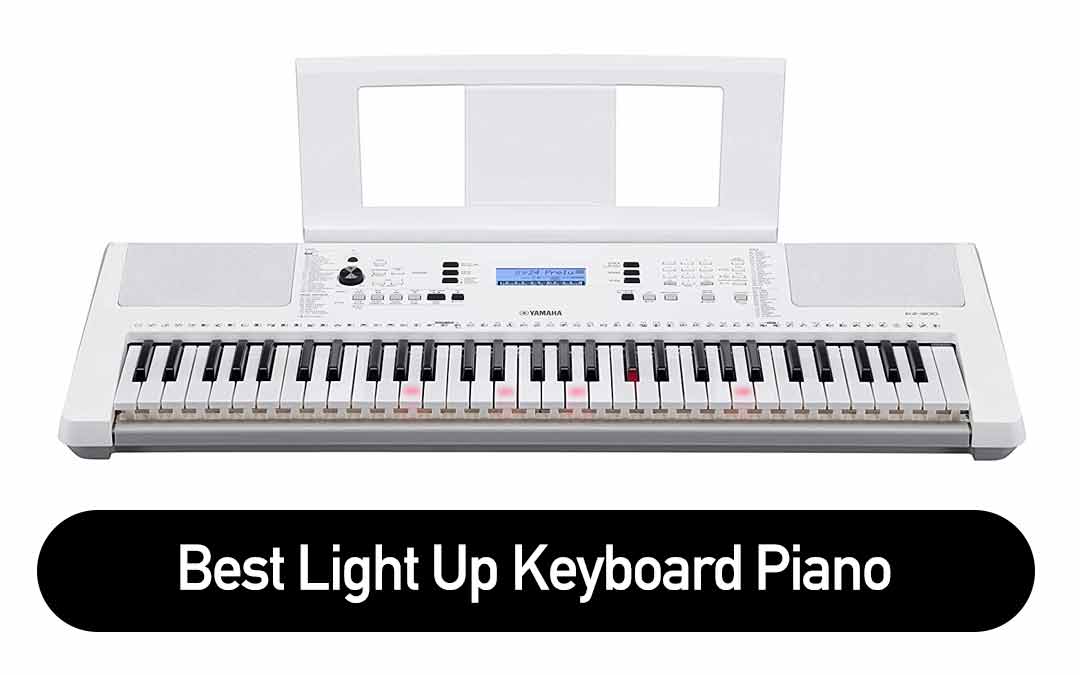
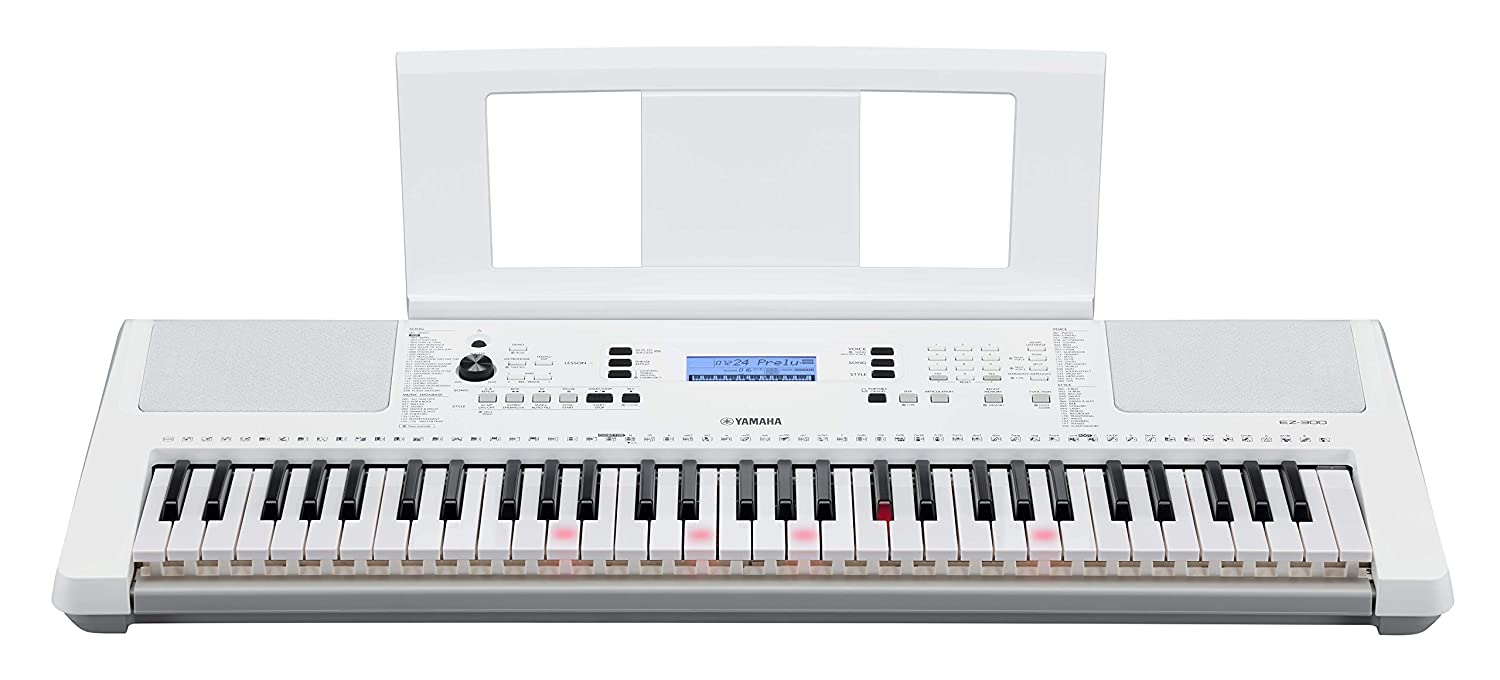
    Yamaha EZ300 61-Key Portable Keyboard

    Key Specifications

    • Dimensions: 37.19W x 4.63H x 14.5D inches
    • Type of Keys: Lighted, Synth Action
    • Number of Keys: 61
    • Velocity Sensitive: Yes (Soft, Medium, Hard, Fixed)
    • Polyphony: 48
    • Voices: 622
    • Speakers: Yes
    • Connectivity: USB TO HOST, Headphones jack, Sustain Pedal input, AUX IN
    • Weight: 4.8 kg
    • Price: $249

    The Yamaha EZ300 is our top pick for the best light-up keyboard piano for beginners and is one of Yamaha’s newest models. This portable keyboard piano has many great features designed to make learning piano easy and quick for beginners.

    It has 61 lighted keys that are touch sensitive, and the keys illuminate to indicate the right notes, making it easy to learn to play.

    It has impressive sound quality. The EZ300 features 622 built-in instrument sounds and 202 built-in songs to play with, including classical music pieces.

    With the Dual Voice feature, you can mix two different voices across the keyboard to create unique sounds.

    What’s great is that the keyboard piano offers three different learning modes; Keys to Success, Touch Tutor, and Smart Chord lesson mode.

    The ‘Keys to Success’ mode helps you learn how to play songs. The ‘Touch Tutor’ mode lets you track the velocity or strength of the keys to teaching dynamics. And the ‘Smart Chord’ mode helps you learn chords.

    Aside from all that, the lighted keyboard piano features a Style function that adds real-time chord accompaniment, rhythm accompaniment, and bass accompaniment.

    The downside is that there are only nine slots for storing songs and presets in the registration memory. However, as an entry-level keyboard, this isn’t a dealbreaker.

    Further, the power adapter and cable are sold separately, which raises the price.

    Overall, the Yamaha EZ300 is an excellent piano keyboard with lighted keys and different learning modes for beginners to learn to play and have fun.

    Check On Amazon

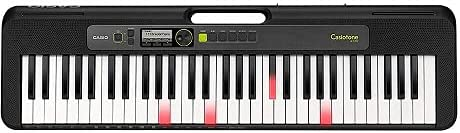
    Casio LK-S250 Keyboard

    Key Specifications

    • Dimensions: 36.6W x 2.9H x 10.1D inches
    • Number of Keys: 61
    • Velocity Sensitive: Light, Normal, Fixed
    • Polyphony: 48
    • Voices: 400
    • Speakers: Yes
    • Connectivity: USB, Headphone output jack, sustain pedal input
    • Weight: 5 kg
    • Price:  $179

    The Casio LK-S250 61-key is the latest edition of Casio’s lighted keyboards series. It has a slim and ultra-compact stylish design, making it easy to move and carry around.

    It features 61 full-size touch responsive keys with Casio’s key lighting system. That means the correct keys will light up when you play along with the Step Up lesson or one of the 60 built-in songs, so you know what note to play.

    The Step-Up Lesson Mode, which features 60 songs and exercises, lets you control how quickly you progress through the levels. This allows you to learn at your own pace.

    This LK-S250 piano has 77 rhythms and 400 acoustic and synth sounds, including electric pianos, organs, strings, synths, drum kits, and a grand piano concert.

    It is easy to use and fun to play, thanks to its LCD and intuitive controls, including the “My Setup” button, which quickly recalls your favorite sounds and settings.

    In addition, it has a Dance Music Mode that allows you to create and remix EDM tracks easily.

    This device has a built-in speaker so that you can listen to what you’re playing or plug in your headphones to listen to yourself. Additionally, it has an audio input for playing music from your favorite device and a mic input for adding your voice.

    Other features include the Chordana Play app, MIDI files, USB port, power supply, and music rest. You can connect the keyboard to your PC, android, or other devices through the USB port.

    Check On Amazon

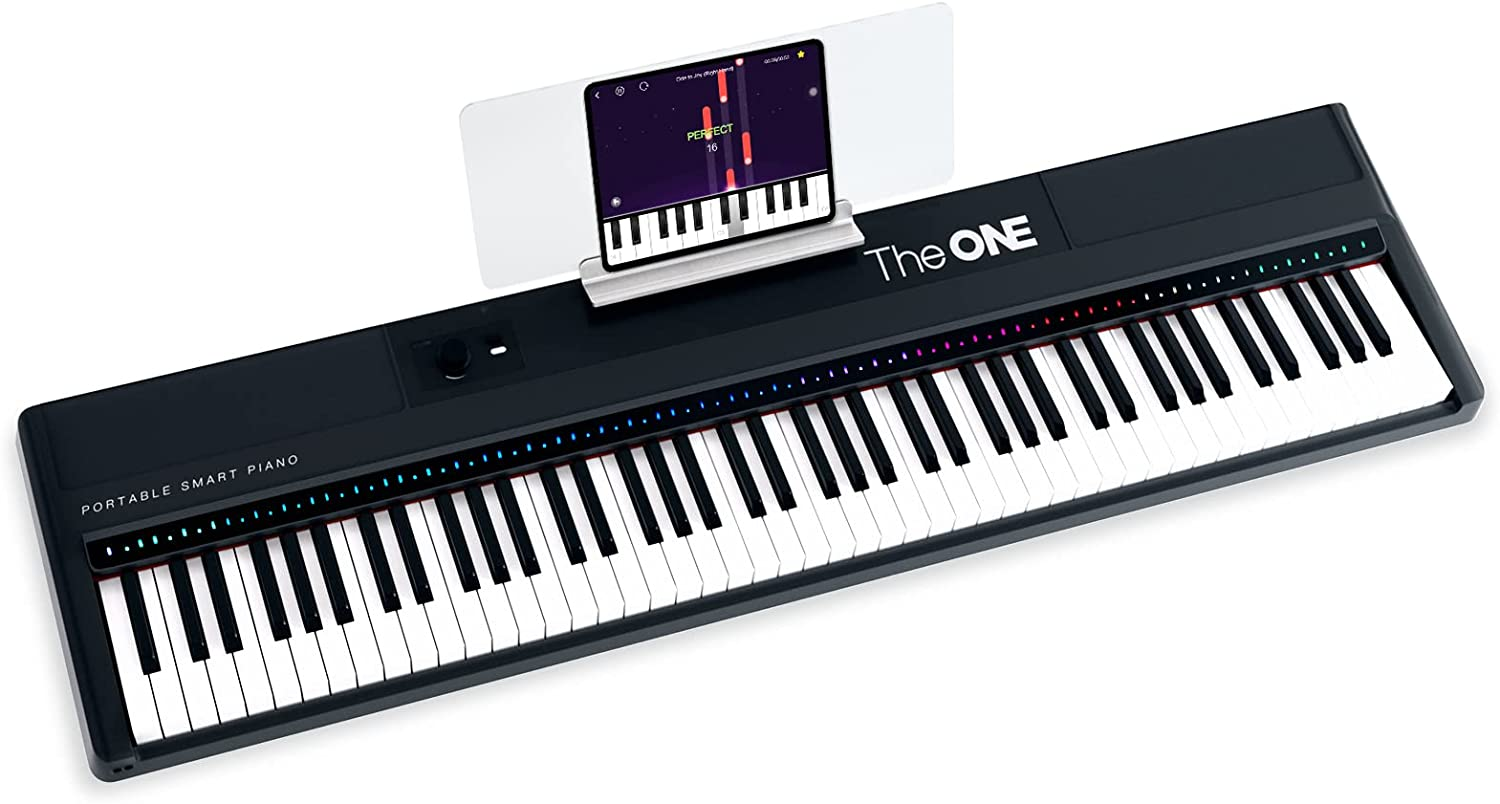
    The ONE Smart Stage Keyboard Piano

    Key Specifications

    • Dimensions: 52.36 x 13.78 x 5.51 inches
    • Type of Keys: Lighted
    • Number of Keys: 88
    • Velocity Sensitive: Yes
    • Polyphony: 128
    • Voices: 619
    • Speakers: Yes
    • Connectivity: USB TO HOST, Headphones jack, Sustain Pedal input, AUX IN/OUT
    • Weight: 14 kg
    • Price:  $594

    The ONE is one of the best light-up digital pianos, featuring 88 lighted keys and excellent learning functions. The hammer action keys are fully-weighted and touch-responsive.

    It has a minimalist and stylish design. It delivers a beautiful sound that simulates a real acoustic piano.

    This instrument has 88 presets and eleven different drum kits with 10-layer acoustic samples. It also has powerful built-in speakers to ensure excellent piano sound.

    Among its best features is its learning features. There are video lessons and quick courses, and the keys light up as you navigate.

    The keyboard lights are integrated with more than 100 video lessons. Videos start with an introductory class and progress to more advanced ones.

    You can pause and rewind the video to return to a specific topic. This allows you to learn according to your own schedule.

    There is also an app that teaches you as a teacher would. You can access the learning software via the USB-MIDI port on your computer. In addition, you have access to hundreds of genre-specific sheet music options.

    There are also plugins for virtual instruments, which take the sound options up to almost 300. Its Record Mode lets you record your playing and review it later.

    If you’re looking for a digital piano that looks and feels like a traditional upright acoustic piano with modern electronic learning features, the ONE smart piano keyboard would be your excellent choice.

    Check On Amazon

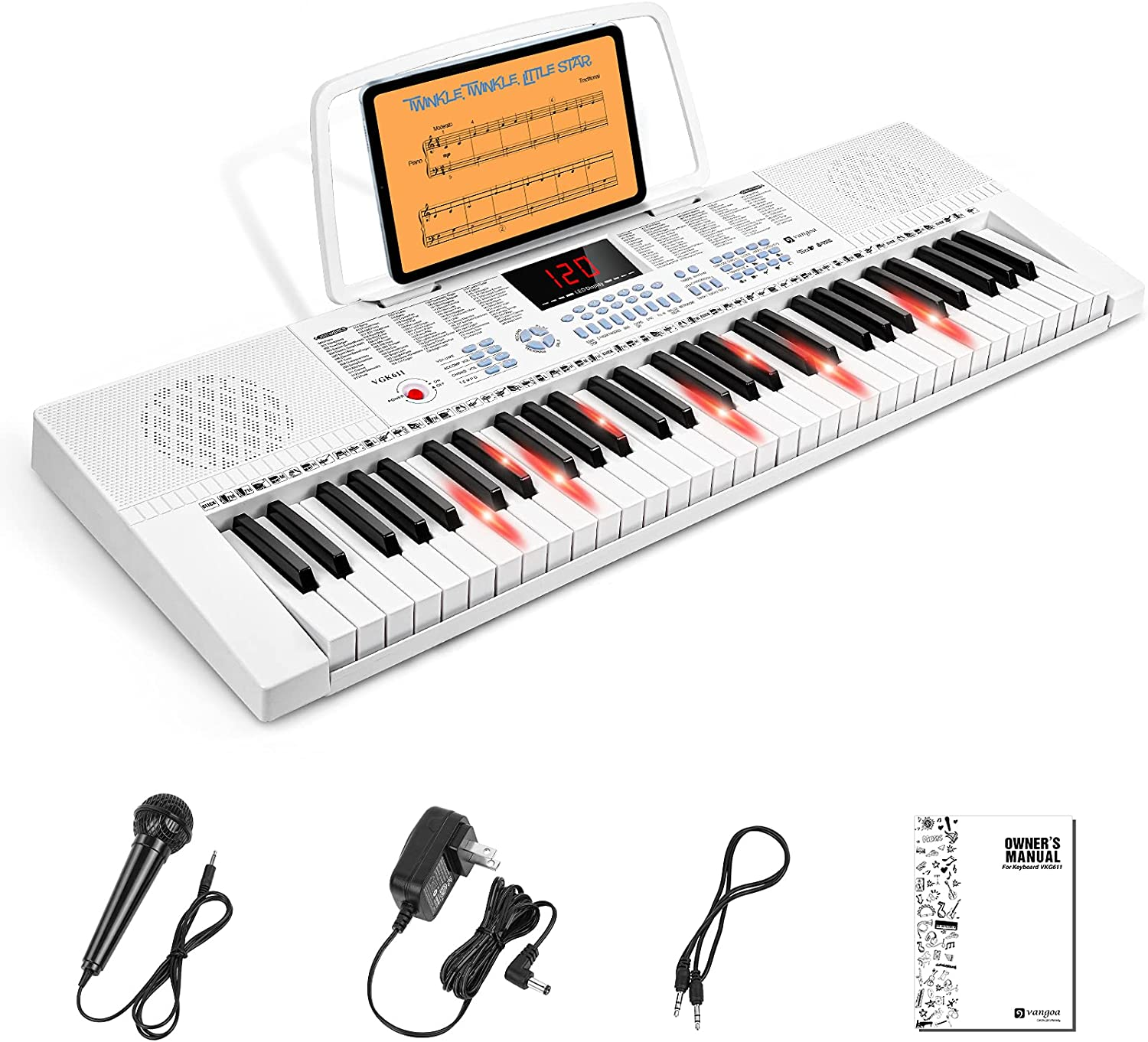
    Vangoa VGK611 Piano Keyboard

    Key Specifications

    • Dimensions: 52.36 x 13.78 x 5.51 inches
    • Type of Keys: Lighted
    • Number of Keys: 88
    • Velocity Sensitive: Yes
    • Polyphony: 128
    • Voices: 619
    • Speakers: Yes
    • Connectivity: USB TO HOST, Headphones jack, Sustain Pedal input, AUX IN/OUT
    • Weight: 14 kg
    • Price:  $594

    The Vangoa VGK611 is one of the best-lighted keyboard pianos for children. It has 61 mini-size LED keys with less weight and small finger spacing.

    Specially designed for tiny fingers, they will make practicing easier.

    This piano offers various features to make music more interesting, vivid, and easier to play for beginners to help them master playing piano skills quickly and experience the magic of music.

    It offers three teaching modes that help you learn, giving hints on what notes to play along with the selected demo song.

    During the demo displays, the keys light up. This shows the student where to place their fingers. And its large LED screen displays the notes clearly.

    In addition, this piano comes with an impressive sound library. It contains over 350 timbres and rhythms, 30 demo songs, and eight beats. It has a microphone so you can record what your child plays and play it back later.

    This device includes a USB HOST, headphone jacks, sustain pedal input, and AUX input/output connectivity.

    Finished in white ABS plastic, the device runs on 6 AA batteries so you can take it anywhere. As an alternative, you can use the mains supply.

    Overall, you won’t be disappointed with this piano if you’re looking for a perfect piano for your kid.

    Check On Amazon

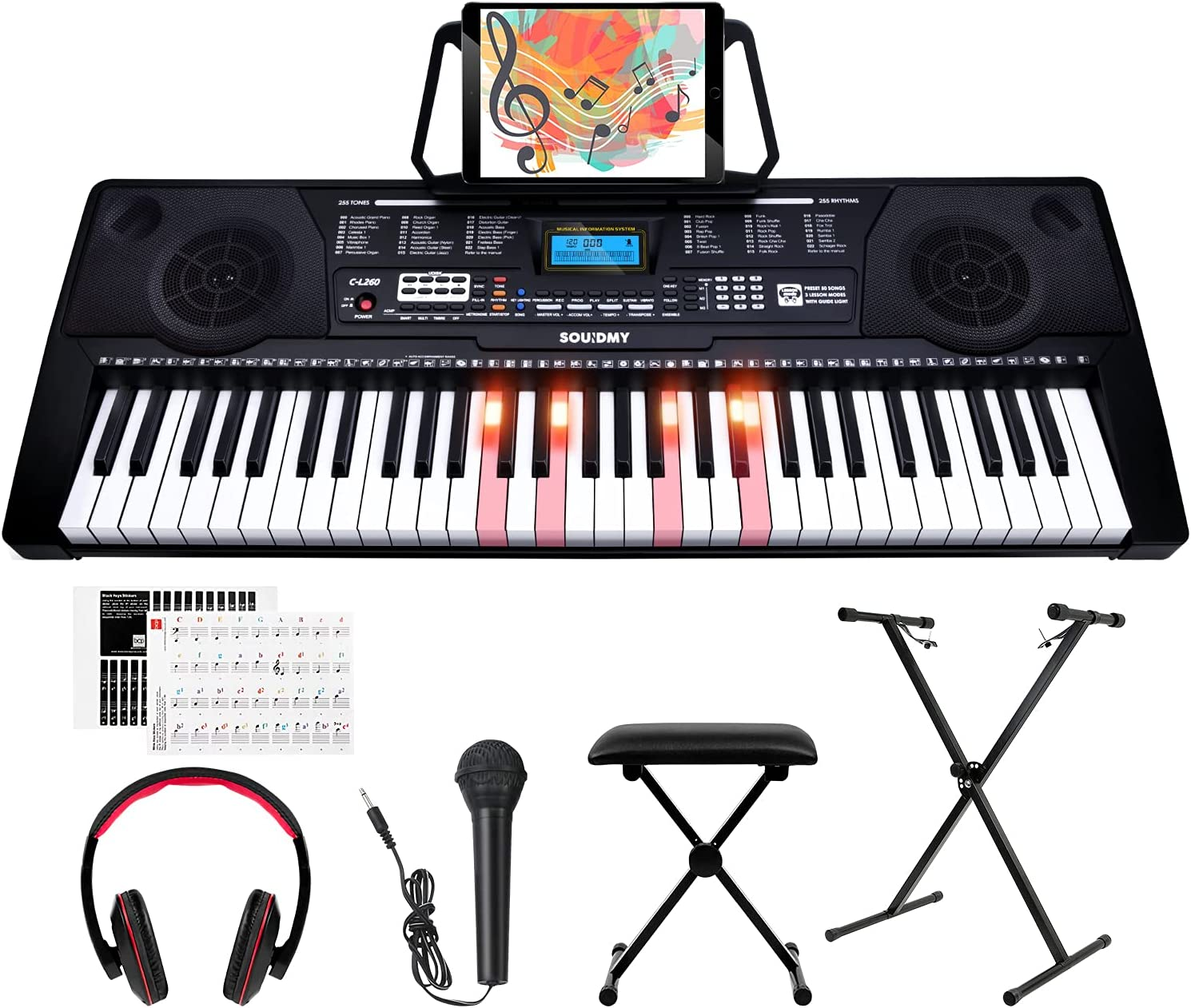
    SOUIDMY C-L260 61 Key Beginner Piano

    Key Specifications

    • Dimensions: 38.8 x 17 x 11.8 inches
    • Type of Keys: Lighted
    • Number of Keys: 61
    • Velocity Sensitive: Yes
    • Polyphony: 64
    • Voices: 225
    • Speakers: Yes
    • Connectivity: USB Port, Mic Jack, Headphone output, Audio Input, and Audio Output
    • Weight: 11 kg
    • Price: $129.99

    This C-L260 piano keyboard kit is best for both kids and adult learners.

    This complete learning system includes three powerful lesson modes, lighting keys, a wide LCD screen, and various entertainment features.

    It has a lovely design and looks elegant in black. It has 61 full-size keys that are sensitive to your touch. Its light-up keys make it an ideal piano for beginners.

    This lighted keyboard piano is very lightweight and transportable. It also supports battery-powered operation with a dual-power system. So, you can take it anywhere and play wherever you like.

    You can easily fit it into your home because of its compact size.

    The C-L260 features 50 in-build songs, 255 tones, and 255 rhythms. You can rebuild the sound effect or enhance the melody tentatively, even if you are a beginner.

    In its package, you’ll get X shape support, a height-adjustable seat, a headphone, a microphone, note stickers, and a music rest.

    Check On Amazon

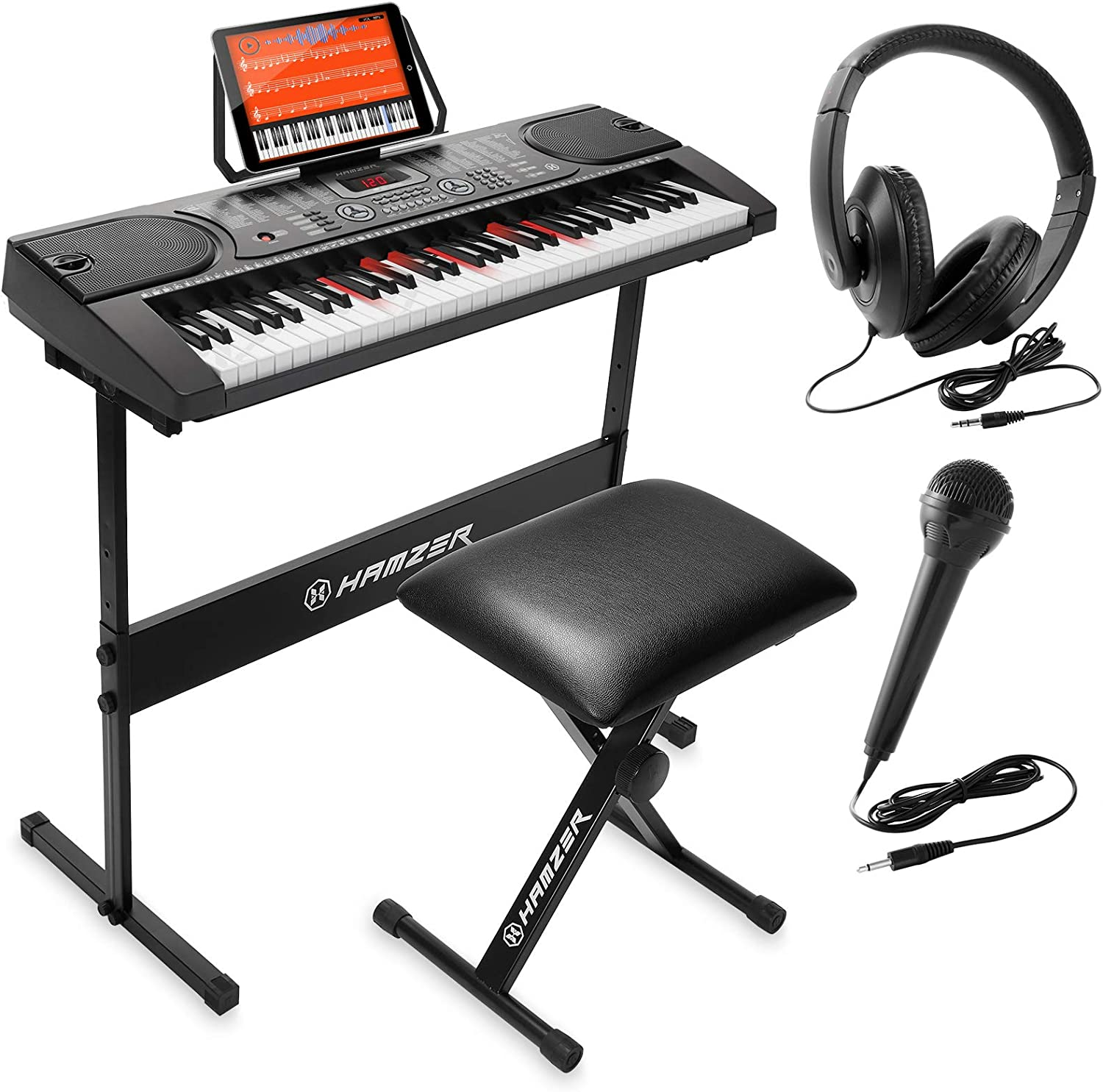
    Hamzer 61-Key Electronic Keyboard Piano

    Key Specifications

    • Dimensions: 33.5 x 13 x 4 inches
    • Type of Keys: Lighted
    • Number of Keys: 61
    • Velocity Sensitive: No
    • Voices: 255
    • Speakers: Yes
    • Connectivity: Mic Jack, AC, DC, Audio Input, Phones output
    • Weight: 5 kg
    • Price: $119.99

    The Hamzer 61-key Digital Music Piano Keyboard is a perfect all-digital piano keyboard for beginners and intermediate musicians.

    It provides so many features for such a low price that it makes a great value.

    It features 61 lighting keys. This keyboard is configured to make it easy to finger the keys with one hand while using the multiple sound buttons with the other.

    The instrument comes pre-programmed with hundreds of sounds, including percussion, that you can add with a touch of a button. It offers 255 tones, 255 rhythms, 61 keyboard percussions, and ten demonstration songs.

    It has two built-in speakers that deliver exceptional sound. There’s also a record/playback function. The headphone jack allows you to listen to recorded music and play music directly.

    Accessories include a 120v UL A/C adaptor, metal keyboard stand, microphone, headphones, sheet music stand, and Transparent Note Stickers.

    This device runs on batteries. There are two ways to power it: battery-powered or through the mains adapter.

    Overall, the Hamzer 61-key digital piano is an excellent choice for those who want an affordable piano with plenty of features.

    Check On Amazon

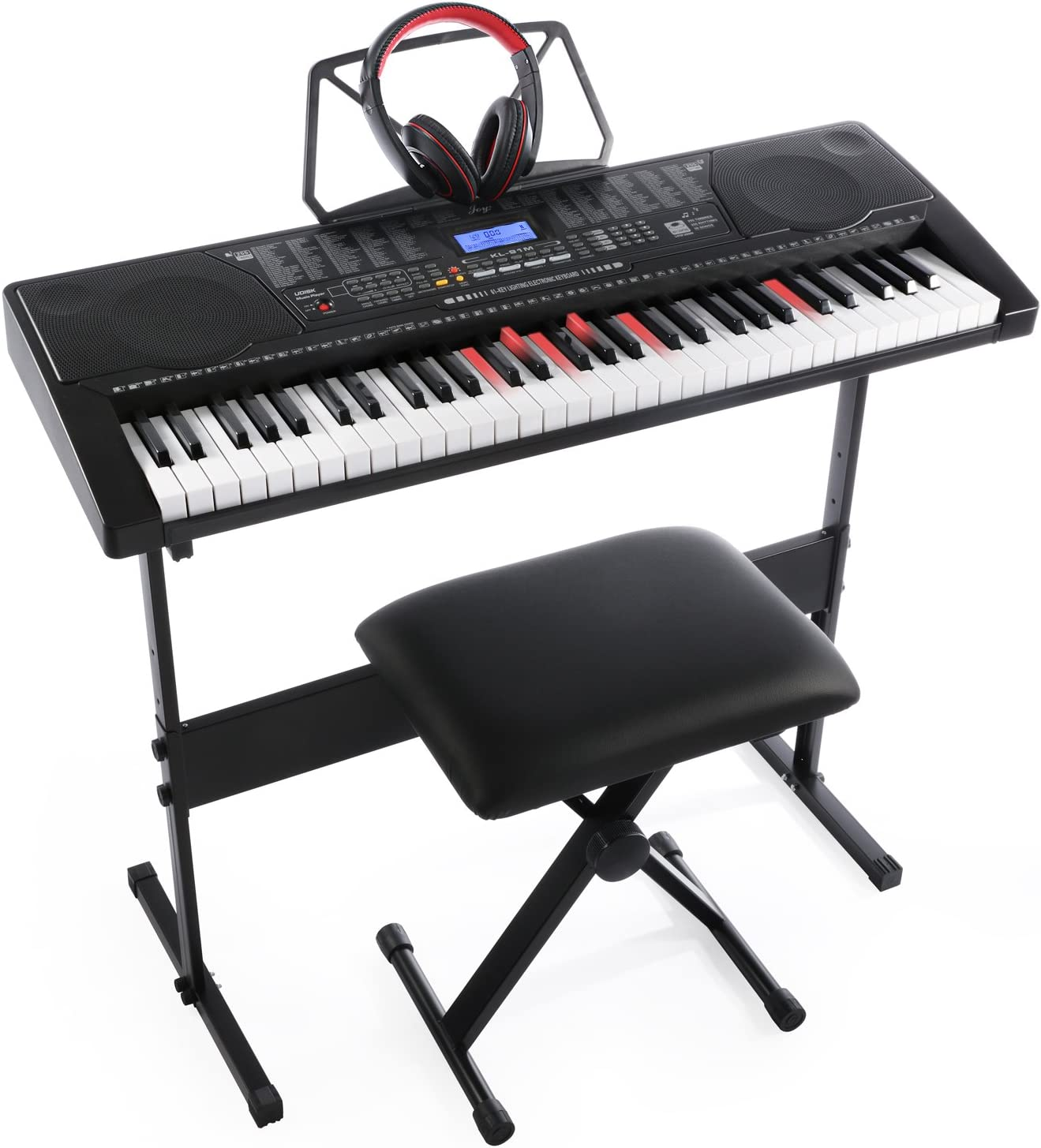
    Joy KL-91M 61-Key Lighting Keyboard

    Key Specifications

    • Dimensions: 38.9 x 11 x 17.7 inches
    • Type of Keys: Lighted
    • Number of Keys: 61
    • Velocity Sensitive: Yes
    • Polyphony: N/A
    • Voices: 255
    • Speakers: Yes
    • Connectivity: USB Port, Mic Jack, U-disk jack, Audio Input, phone output
    • Weight: 8 kg
    • Price: $144.99

    The Joy KL-91M is one of the best and most popular lighted keyboards in 2022 with its lighting function and multiple functions.

    It offers a variety of sounds and teaching options. Both adults and junior beginners will benefit from this keyboard.

    Playing the piano is smooth and attempts to mimic the action of a real piano. Even though the top panel may seem confusing, everything is clearly labeled.

    LCD screen displays information about what you are trying to access and the current status. It also has illuminated keys that guide new players to play the correct keys.

    This piano comes with 255 different rhythms and sounds to assist in teaching and 50 demo practice songs.

    Furthermore, it has a built-in sound system with speakers, offering excellent sound quality.

    This package includes a high-quality music stand, keyboard stand, music Stool, a DC adapter, and a set of headphones for private practice.

    The Joy KL-92UT-KIT keyboard offers an app function that lets you utilize the free piano training apps for iOS, Android, and computers through a USB-MIDI cable.

    Check On Amazon

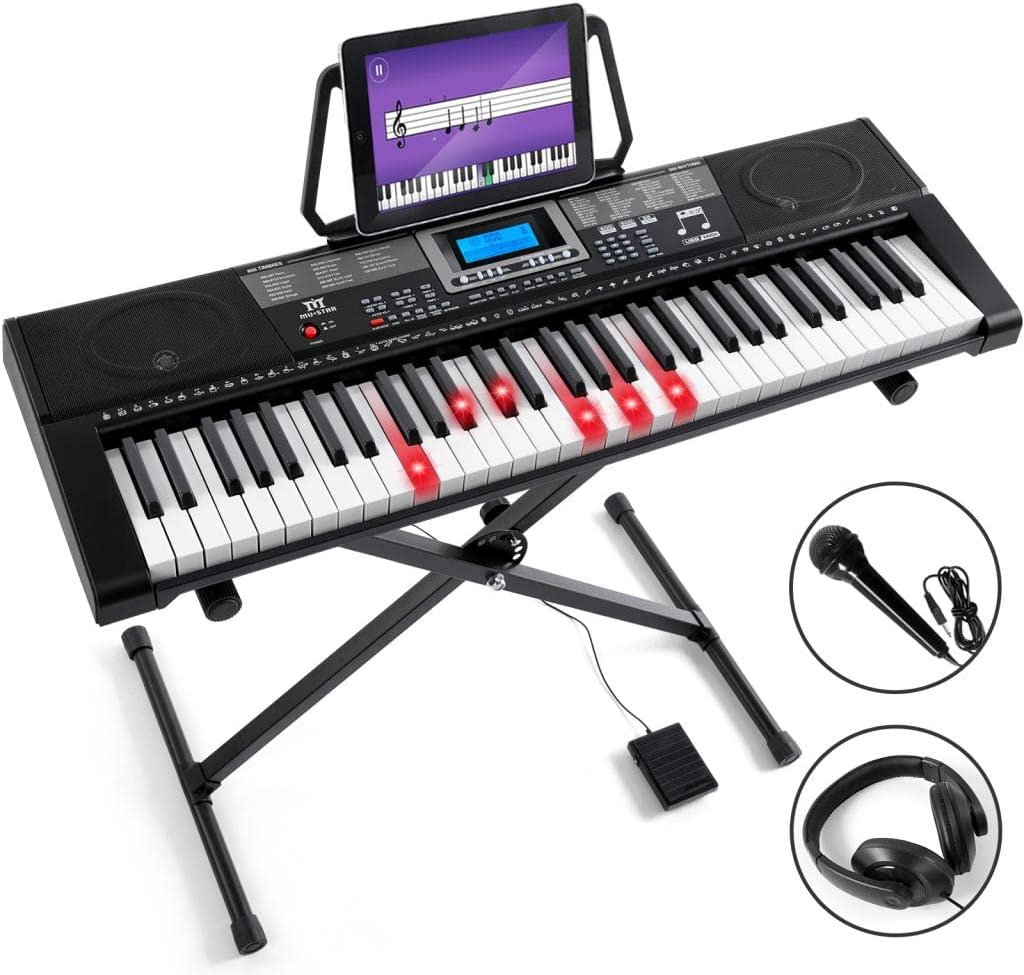
    MUSTAR 61 Key Piano Keyboard

    Key Specifications

    • Dimensions: 36.6 x 12 x 12.6 inches
    • Type of Keys: Lighted
    • Number of Keys: 61
    • Velocity Sensitive: Yes
    • Voices: 600
    • Speakers: Yes
    • Connectivity: MIDI IN/OUT, AUDIO Input, Mic Input, Phones output, DC 9V in JACK
    • Weight: 7.6 kg
    • Price: $139.99

    The Mustar Piano keyboard is an excellent option for those looking for an affordable and versatile beginner keyboard with lighted keys.

    It has 61 full-size keys with a lighting function.

    This piano offers 500 tones and 500 rhythms, 65 demo songs, nine teaching apps, a 3-step education system, and an array of input/output options.

    In addition to the keyboard piano, you’ll get a power adapter, a music rest, an adjustable keyboard stand, and a manual to help you set it up.

    It also comes with a microphone and headphones for private practice.

    Check On Amazon

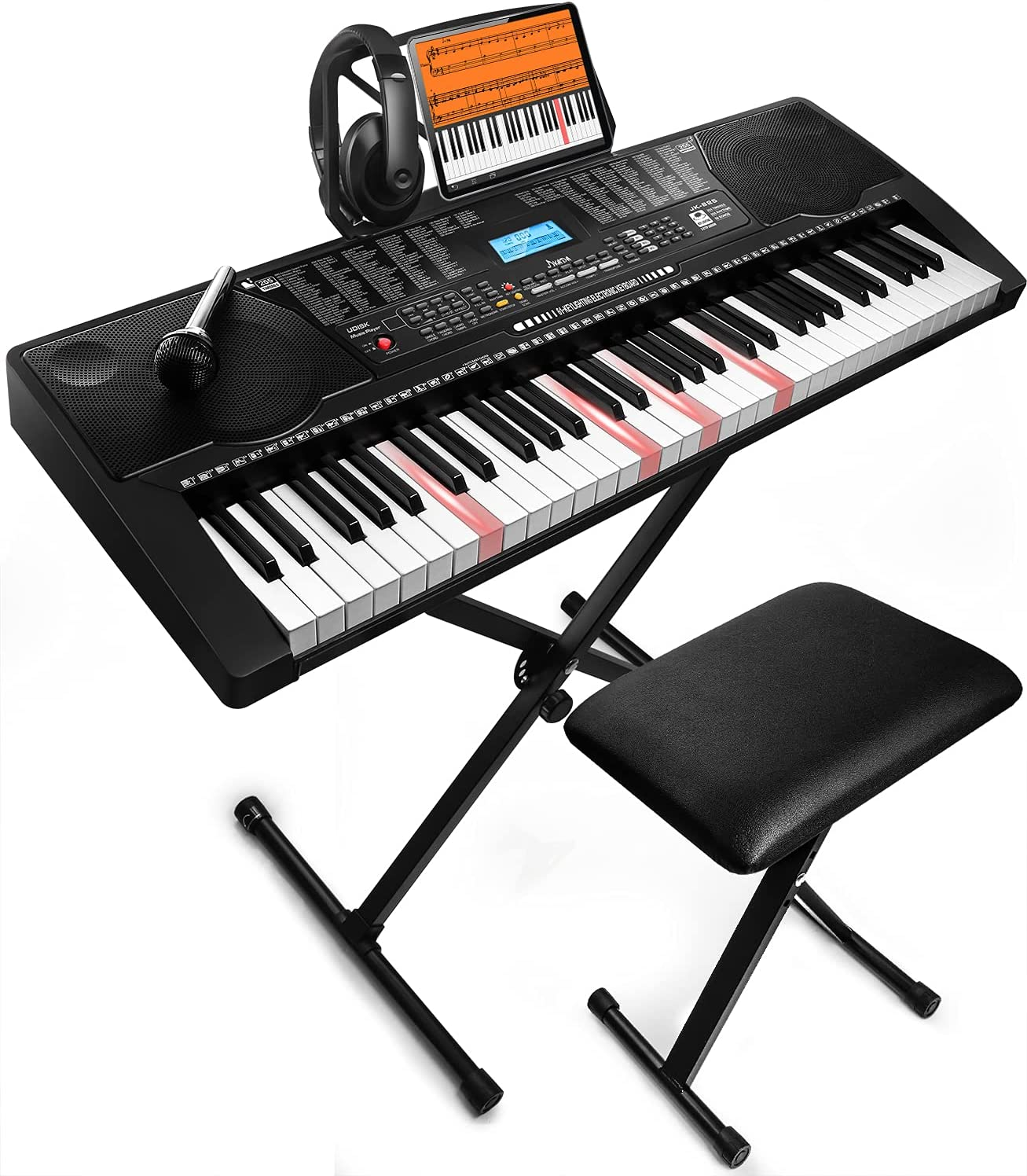
    JIKADA 61 Key Portable Electronic Keyboard Piano

    Key Specifications

    • Dimensions: 36.4 x 12 x 3.7 inches
    • Type of Keys: Lighted
    • Number of Keys: 61
    • Velocity Sensitive: Yes
    • Voices: 255
    • Speakers: Yes
    • Connectivity: USB Port, Mic Jack, Headphone output, Audio Input/Output
    • Weight: 11.2 kg
    • Price: $159.99

    The JikADA 61 Key portable digital keyboard piano has been designed to offer as many features as possible but on a budget. Suitable for both kids and adult beginners.

    It features 61 illuminated keys and has an in-build recorder, a LED display, a rhythm programmer, a playback function, and many other surprising features.

    The piano offers 255 tones, 255 rhythms, 50 sample songs, and 61 types of keyboard percussion. Additionally, two built-in stereo speakers produce high-quality sounds.

    Beyond all, it has three powerful teaching modes that take you from a complete beginner to an intermediate level.

    Connectivity options include headphones, the supplied microphone, audio input, and a USB port.

    As a whole, JikADA 61 Key electronic keyboard piano is a good choice both for kids and beginner adults.

    Check On Amazon

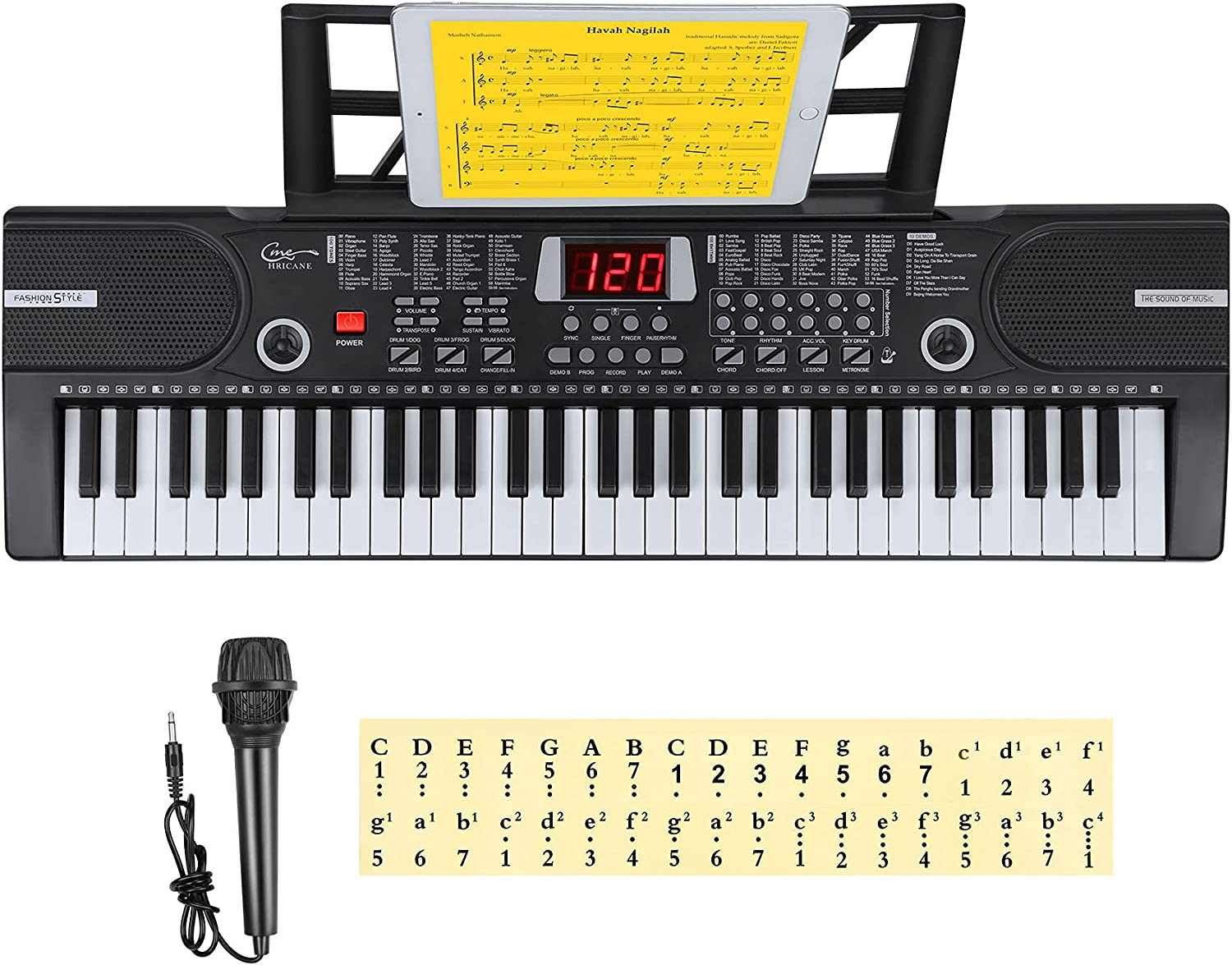
    Hricane Keyboard Piano

    Key Specifications

    • Dimensions: 30 x 9 x 2.3 inches
    • Type of Keys: Lighted
    • Number of Keys: 61
    • Touch Sensitive: Yes
    • Voices: 100
    • Speakers: Yes
    • Connectivity: USB Port, Mic Jack, Headphone output, Audio Input
    • Weight: 2.1 kg
    • Price: $47.99

    This Hricane keyboard piano is the most affordable and lightweight electronic Keyboard piano on this list.

    Due to its non-toxic, environmentally friendly ABS materials, children can safely play with it. It can be powered either by 4 AA batteries or mains power, making it suitable for indoor and outdoor use.

    This keyboard has 61 light-up keys, making it easy to follow along, and several tones and rhythms. Also, it has musical notes that you can stick on each key to learn to play it faster.

    It contains 100 sounds, 100 rhythms, five animal sounds, and ten demo songs so children can enjoy the different sounds.

    In addition, this device produces fantastic and unique sound quality.

    Accessory items include a USB cable, audio line, microphone, music sheet stand, keyboard sticker, and instruction manual.

    Check On Amazon

    Conclusion

    This was a list of our ten best Light Up Keyboard Pianos available this year. Most light-up pianos have 61 keys and are more cost-effective than other pianos.

    Ultimately, it depends on your budget and needs which light-up keyboard piano is best for you.

    The Yamaha EZ300 is our top recommendation for lighted keyboards due to its price, versatility, features, build quality, and ease of use.

    If you want something more affordable, you should consider the MUSTAR and Hricane keyboard pianos. They are easy to learn with their cost-effective design and essential features.

    Which light-up keyboard piano do you want to choose? And why? Let us know in the comments below!

    Related Topics

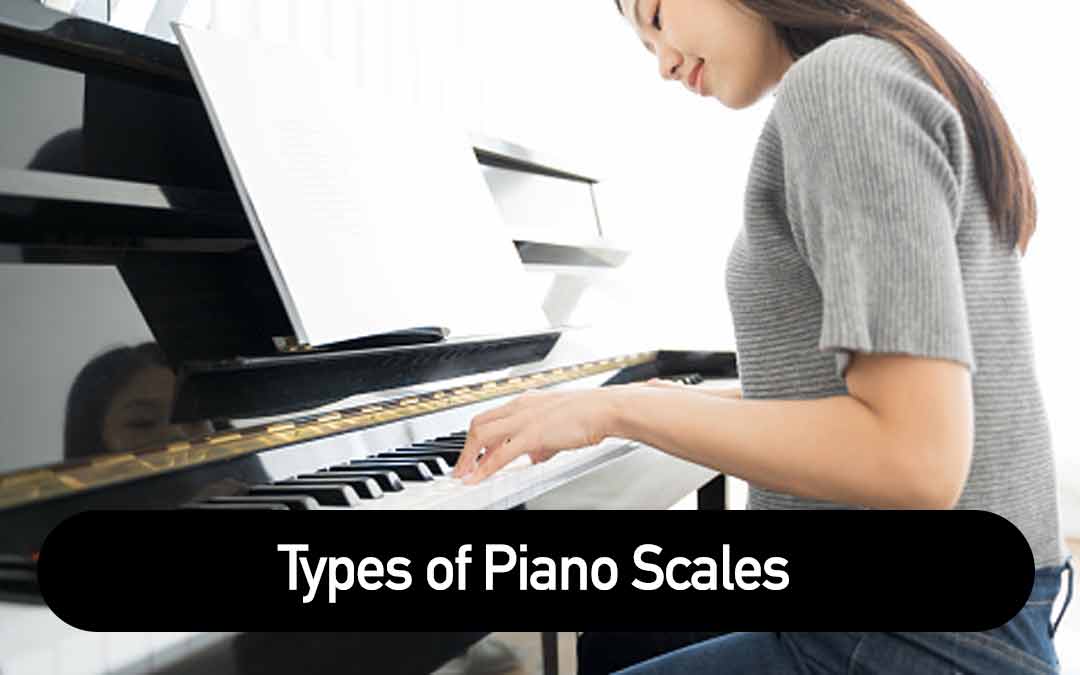
  • Types of Piano Scales : Everything You Need To Know

    Types of Piano Scales : Everything You Need To Know

    The piano is a versatile instrument used to play different music. From classical sonatas to popular hits, the piano has something to offer everyone. One of the things that makes the piano so versatile is that it can be played in multiple keys.

    Each key has its unique sound, and by learning different types of piano scales, musicians can create an endless variety of melodies. Major scales are the most common type of scale, and they are used in many popular songs.

    However, minor scales also have different sounds and are often used in classical music.

    There are also Pentatonic scales, which are used in jazz and blues music. By learning different piano scales, musicians can open up a new world of possibilities.

    This blog post will discuss the main types of piano scales and how they are used.

    As you know, Piano scales are precious tools for any pianist, from beginners dabbling in piano to the most seasoned professionals. Piano scales provide the technical and theoretical foundation that helps an individual understand the patterns that comprise any Western music style.

    Practicing scales drastically improves a person’s knowledge and technique on the piano and renders them with the essential toolkit, streamlining the entire learning methodology. Most importantly, piano scales are pivotal in the understanding of key signatures. Now that we have touched upon the basics of piano scales, let us get into the nitty-gritty of the topic.

    Piano Scales: Definition

    Piano scales are a collection of notes in alphabetical order, played in succession on a standard 88-key piano. Scales are a specific distance apart from one another. Scales can be major or minor, utilizing any combination of white and black keys on the piano keyboard. For instance, a significant scale entails seven notes – c d e f g a b, whereas a minor scale includes six notes – c d be f g ab.

    Furthermore, it is critical to mention that 12 major and 12 natural types of minor scales can be played on a piano. Each major scale comprises its unique sequence of intervals between each note of the musical scales. For instance, the interval between c and d is one semitone (or half steps), while the interval between c and e is two semitones.

    Before we get into the crux of the types of piano scales, let us first briefly delve into the two pertinent aspects of a scale: Half Steps and Whole steps.

    What Are Half Steps and Whole Steps?

    Half Step

    It is the smallest distance on the piano. It occurs between any key and its immediate nearest key. By immediate, we do not mean a jump from white to black or from white to white; instead, it means the adjacent note above or below.

    Whole Step

    It is two-half steps in either direction. It would help if you remembered that two halves make a whole, and two half steps make a whole step.

    Types of Piano Major Scales

    The major scale is the most common of all scales. The key signature is based on major scales and keys. The major piano scales include – C major scale, D major scale, E major scale, F major scale, G major scale, A major scale, and the B major scale.

    Each of these major scales has its unique sound that we can use in different musical situations. For example, the C major scale is primarily used in classical music, whereas the G major is typical of country music. Therefore, learning the different types of piano scales increases the ability to create more diverse and exciting sounds.

    Tips to Build a Major Scale

    There are easy tricks to build a major scale. As we already know, a major scale has eight notes arranged in a pattern of whole and half steps. To construct a major scale, you can follow the steps given below –

    • You have to start it with the name of the scale (also called the root)
    • Follow the root by a whole step, whole step, half step, whole step, whole step, whole step, and half step pattern.
    • Thus, the formula for building major scales, irrespective of the key signatures – W-W-H-W-W-W-H

    Types of Piano Minor Scales

    The different minor scales include:

    • The E natural minor scale.
    • G harmonic minor scale.
    • Melodic minor scale.
    • Dorian mode.

    Each minor scale has its own unique sound, and you can use them in diverse scenarios to produce music of the desired effect. For example, the melodic minor scales are atypical of jazz music, as they give a composition a more romantic feel. On the contrary, the harmonic minor scale is a frequent element of classical music. Lastly, we can find the Dorian scale to be commonly co-opted in blues and rock music.

    How to Form a Minor Scale

    To begin with, each major key has its subsequent minor key. The relative minor scale is premised upon the sixth tone of the major scale. For example, the sixth tone in the C major scale is A. Thus, the relative minor of C is A minor. Therefore, C major and A minor have identical key signatures. And here, the major and the minor scales have the same tones. There are three variants of minor scales, and let us learn how to build these separately.

    Forming a Natural or Pure Minor Scale

    It is a scale that begins on the sixth degree of its relative major scale. It increases or decreases for one octave using the signature of the major scale. The formula for forming a natural minor scale is- W-H-W-W-W-W-W.

    Forming a Harmonic Minor Scale

    The harmonic minor scale begins on the sixth degree of its subsequent major scale. It increases or decreases for one octave using the major scale’s key signature, except the 7th tone raised a half step. The formula for building a harmonic minor scale is W-H-W-W-W-W 1/2 – H.

    Forming a Melodic Minor Scale

    Like the above two scales, the melodic minor also begins at the sixth degree of the relative major scale. It ascends or descends for one octave by utilizing the major scale’s key signature. However, the 6th and 7th tones are raised half a step when ascending. On the other hand, when descending, the player has to use the tones of nature or pure minor scale. The formula you can use for a melodic minor scale is W-H-W-W-W-W-H.

    Other Types of Piano Scales

    Apart from the major and minor scales, we also have other scales, such as the tone, whole, pentatonic, and chromatic scales:

    1. Tone scales are simplistic piano scales with only seven notes.
    2. Chromatic scales have twelve notes, and whole-tone scales have six notes.
    3. The pentatonic scale has five notes.

    Although these ancillary scales are less common than their major and minor counterparts, we can use them to add variety and diverse flavors to our composition.

    Importance of Learning Piano Scales

    Let us wrap up this blog post by briefly outlining some significant benefits of learning piano scales. To begin with, scales help pianists within different ends of the learning spectrum to develop robust techniques. Knowing about scales allows individuals to improvise and build their music. Second, scales also help pianists understand how to build chords and melodies. Lastly, sales also help a person buy the right kind of piano. If you have been trying to learn piano scales, then you can follow the tips given below –

    • Try playing piano in different octaves with both your hands.
    • You can also use an online metronome.
    • Try different keys each week, as it will help you learn the keys and key signatures better.
    • Keep a practicing diary to record your practice sessions.
    • Use different rhythms. Also, playing at different speeds using different rhythms is a great strengthening exercise for your fingers.

    Now that we’ve gone over the different types of piano scales, you will better understand how to use them. Scales are a great way to improve your technique and maintain muscle memory.

    They can also be used to create exciting and unique-sounding compositions. So whether you’re just starting or a seasoned pro, don’t be afraid to experiment with different scales and see what sounds you can create. Who knows, you might just come up with the next big hit!

    Related Topics

  • Best Way To Move A Piano Across The Country

    Best Way To Move A Piano Across The Country

    Are you looking for the best way to move a piano across the country? If so, you’ve come to the right place. Pianos are the most valuable and beautiful musical instruments that bring life to any space. But moving them from one place to another can be daunting as they are so sensitive, expensive, and heavy.

    If you’re moving to a new place or managing an estate and want to take your piano with you across the country, you’ll need to handle it with the utmost care. Make sure you choose the best shipping method for your piano.

    No worries if you don’t know how to move a piano safely.

    In this article, I’ll discuss the best way to move your piano, whether you’re shipping a piano across town or the country. By the end of this article, you’ll have four options.

    So, let’s check out these options!

    4 Ways To Move A Piano Across The Country

    The following are the four ways to successfully ship your piano across the country:

    Rent A Truck And Move Yourself

    Renting a truck is one of the most common methods to move your piano for small or short distances.

    This option requires you to pack and load the piano onto the moving truck yourself, but it can be very cost-effective. Also, it will save you the hassle of waiting for third parties to handle the piano.

    However, moving an upright piano without professional assistance is not recommended, especially if it is large, valuable, or fragile.

    Here’s a step-by-step guide on how to move a piano if you want to do the job yourself:

    • First of all, rent a truck and gather the necessary equipment, such as a furniture dolly, straps, and protective padding. But the specific supplies you’ll need may vary depending on the type of piano you have:

      For a grand piano: Moving a grand piano requires a piano skid board. You’ll need additional strapping and padding for this piano board, and make sure it is the right size for your piano.

      For an upright piano: Piano dollies.

    • Once you have all the necessary supplies, it’s time to prepare the piano for transport.
    • Securely the piano to the dolly, skid board, or other equipment with straps and padding. If it’s a baby grand piano, close the lid, wrap it with movers tape, and remove the legs.
    • Next, cover all the delicate parts of the piano with moving blankets to prevent scratches or other damage.
    • With the help of your family members and friends, carefully load the piano onto the truck using a furniture dolly. Then secure it with straps.
    • Transport the piano to the new location. Take extra care when driving over bumps or through curvy roads to reach your destination.
    • Unload and reassemble the piano in your new place.

    Pros

    • More affordable than hiring professional movers.
    • Your piano remains in your care the entire time.
    • It gives you a sense of satisfaction from taking on the job yourself.
    • You can move it according to your timeline.

    Cons

    • It’s a complex and time-consuming process.
    • It takes a lot of effort and involves a lot of risks.
    • Require a few people to help with lifting and loading.

    How Much Does It Cost To Rent A Truck And Move Your Piano?

    The cost of a DIY move depends on the size of the rented vehicle and your moving distance. You will pay a day rate based on the vehicle’s size, mileage, and fuel costs. Additionally, you may need to pay extra for moving supplies, equipment, and insurance.
    Typically, the day rate for a 10′-17′ pickup truck is $19.99 to $29.99 or $29.99 to $39.99 for a 20′-26′ truck. The average mileage is between $0.89 and $1.39 per mile. However, the price can be higher on weekends and during peak moving seasons.
    You may also have to pay an extra fee if you move long distances and leave your rented vehicle in a different city.

    Hire Professional Movers

    It is the most reliable and safest way to move your piano, as experienced piano movers know how to handle it. They are qualified to do this job and have experience moving items locally and across the country.

    Movers know how to successfully execute the operation. They will take all the necessary precautions and use the best equipment to move it.

    Finding professional piano movers in your area is not difficult. The best way to find a moving company is to search online and compare different moving companies online.

    Always ask for a quote from a moving company before booking their services. If you call for a quote, mention your piano so they can provide an accurate price and advise you about packing requirements.

    If there are additional fees, make sure you know what they are in advance so you won’t be surprised when you receive the bill.

    Pros

    • It saves you time and energy.
    • Reduce the risk of additional expenses.
    • The professionals will take care of all the legwork.
    • They use special equipment to move your piano safely.
    • Peace of mind knowing that your belonging is insured in case movers cause damage to your piano.

    Cons

    • Expensive.
    • If you don’t pay extra, household movers won’t pack or move the piano.
    • You have less control over your piano’s timeline and route.

    How Much Does It Cost To hire piano movers?

    The cost of hiring professional Piano movers to move a piano will depend on the distance, type of piano, the time of the year, and the services required.

    According to the American Moving and Storage Association, the average low estimate cost of a long-distance move is around $2,300, while a long-distance move for 1,000 miles is $4,890.

    Local piano moves are typically cheaper and could range from $100 to $1,000.

    Consolidated Freight

    You can also move your piano with a consolidated freight company. Consolidated freight is a service that will transport large items long or short distances.

    Your piano will share space with other cargo inside a carrier truck. A licensed and insured shipping company provides this service.

    Consolidated freight companies will pick up the piano from your home and transport it to a designated location (usually a warehouse). From there, you’ll have to pick it up.

    It is the safest and best method to ship upright pianos across the country.

    Pros

    • The cost-effective and relatively safe way to move a piano.
    • The cost of shipping includes insurance coverage.
    • The service always includes packing, indoor loading, and unloading.

    Cons

    • It takes a while for the piano to reach its destination.
    • You may have to arrange separate transport from the freight company’s depot to your house.

    How Much Does It Cost To Ship A Piano Using Consolidated Freight?

    The cost of shipping a piano with a consolidated freight method depends on your piano’s size, weight, and style. Also, delicate components, stairs, and tight spaces increase the cost.

    Typically, the cost of shipping a piano is between $950 and $2500. Companies use the White Glove service when shipping pianos by consolidated freight.

    Rideshare or Peer-to-Peer Shipping

    Rideshare and peer-to-peer shipping platforms are becoming increasingly popular for moving large items like pianos across the country. Rideshare and peer-to-peer marketplaces are typically much more cost-effective, flexible, and convenient than professional movers.

    How it works is that customers post their piano moving request on a Rideshare or peer-to-peer shipping websites like Roadie or uShip. And then drivers within their area who have the necessary van or truck can offer to transport the piano for a fee.

    When you post your piano on a peer-to-peer shipping website, ensure you include accurate information about pickup and drop-off locations, including stairs and tight spaces. Also, you need to provide detailed information about the piano type, including its exact dimensions and weight.

    It is handy if you need the piano to move quickly and don’t want to wait for a professional mover to be available.

    However, it is essential to ensure the driver you choose has experience transporting pianos and is appropriately insured to ensure that you and your piano remain safe during the move.

    Additionally, it is essential to thoroughly check the piano before and after the move to ensure it arrives at its destination without damage.

    Pros

    • The cheapest method out of all four options.
    • Flexible and convenient.
    • Can be arranged quickly.

    Cons

    • Risk of damage due to inexperience with piano transport.
    • There’s no insurance if your shipment gets damaged.
    • No guarantee of delivery time.
    • If something goes wrong, there is less accountability since you aren’t working with a professional.

    How Much Does It Cost To Move A Piano Using Peer-to-Peer Shipping Method?

    The cost of shipping a piano using peer-to-peer shipping services can vary widely on the size, age, value, and fragility of your piano, as well as pick-up and loading conditions.

    The cost can be negotiated based on the piano, however. The average price is around $750 and more than $1,000.

    The Challenge of Moving A Piano Long Distance

    Since pianos are one of the heaviest objects in a household, moving it can be pretty challenging. You can’t just slide them out like other items. Instead, it takes careful planning and multiple people to keep things steady on their sides so that nothing gets damaged or broken.

    Grand pianos are pretty heavy and have peculiar shapes, whereas upright pianos tend to be tall. The piano’s extreme weight and shape pose a particular problem, even when you move them across the room.

    That means slight shifts in any direction can cause extreme shifts in the balance and weight of the piano. This makes it hard to turn and move around corners and steep stairs without injuries, property damage, costly structural damage to the piano itself, or even worse.

    In addition, moving a piano can be challenging if it involves transporting it over long distances and through multiple transfer points.

    For these reasons, you must have a plan for moving your piano either short or long distances. This plan should include professional equipment and qualified personnel to ensure your piano is safe and secure during its journey.

    Things You Need To Consider When Shipping A Piano

    When shipping a piano, it is crucial to consider the following things:

    Don’t use the DIY method

    Trying to move your piano independently is not recommended. Since pianos are very delicate, they can be easily damaged without proper care. Therefore, it is best to a hire professional piano mover to ensure the safety of your piano.

    Prepare Your Piano

    Before transportation, remove external attachments, such as a music stand, legs, pedals, and fragile items. Since these parts are delicate, they should be packed separately in foam or bubble wrap. Also, Ensure the outside pathway is free of obstructions and clear the space of any furniture or boxes.

    Use a Professionally Designed Piano Cover

    It protects the surface of your piano from scratches and damage. Additionally, it will make moving the piano easier and provide additional support.

    Provide All Details

    When asking an expert piano shipping company for a price quote to ship a piano, provide as many details about the musical instrument as possible. It should include the piano’s size and any special transportation requirements.

    Check Your Insurance

    Ensure your shipment is adequately insured and covered if anything goes wrong.

    Tuning After the Move

    After your piano has been moved, it is essential to tune the musical instrument to retain its original sound. If you do not have sufficient experience, hiring a professional to do the tuning and a check-up is best.

    Following these tips, you can safely transport your piano across the country with minimal disruption.

    Conclusion

    As you can see above, I’ve outlined the four ways to move a piano across the country. The best and safest option for moving a piano is to hire professional movers specialized in transporting this delicate and valuable instrument.

    However, you can do other stuff yourself, like packing and loading. With the proper preparation, your piano will arrive in perfect condition.

    Moving a piano alone is not a good idea since it’s not ordinary furniture. If you do so, you might regret it later.

    Do not forget to check your insurance coverage, prepare the piano for transport, and hire a professional tuner after the move.

    Related Topics

  • Piano vs. Synthesizer : Which One is Best For you?

    Piano vs. Synthesizer : Which One is Best For you?

    If you’re considering learning to play a musical instrument, you might wonder whether a piano or a synthesizer is the right choice. Both instruments have their unique capabilities and benefits.

    Pianos are typically considered one of the most versatile instruments, capable of playing various genres. They also tend to be more robust and durable than synthesizers, making them a good choice if you’re looking for an instrument that will last for many years.

    However, pianos can be expensive to purchase and maintain, and they can also be bulky and difficult to transport.

    On the other hand, synthesizers are often more affordable than pianos and much easier to carry around. They also usually have a more comprehensive range of sounds you can create, giving you more flexibility in your playing.

    However, synthesizers can be harder to learn to play than pianos, and they may not have the same level of durability as a piano.

    In this blog post, we’ll explore the key differences between pianos and synthesizers so that you can decide which one is right for you.

    Let’s understand the essential features of acoustic pianos and how they differ from digital or electric pianos.

    When you think of electronic instruments, the first thing you will find is that you can easily connect these musical instruments to a speaker system, the digital pianos give in-depth editing options and offer additive synthesis.

    Here are some of the essential features of acoustic pianos and their differences from digital pianos:

    • Acoustic piano differs from the digital piano in size and design. Digital pianos and electric pianos aim to create sound waves the same as an acoustic piano with the portability of the keyboard.
    • The keyboard produce sound that makes the musical instrument similar to acoustic pianos. However, the portability of electric and digital pianos is the primary difference.
    • An acoustic piano is often thought to be a real piano as the piano sounds are similar to a grand piano. However, a digital piano is no less of a real piano.
    • The 88 keys of a digital piano can create a sound similar to stage pianos. The only difference is that they take up less space than stage pianos or acoustic pianos.
    • When it comes to frequency modulation and creating different sounds, you will find that the electric piano and the digital pianos offer better frequency modulation synthesis. Most digital pianos use computer connectivity and digital signals to create sounds.

    With the help of midi keyboards, you can create a better sound. A midi keyboard is similar to electric piano. However, when it comes to keyboard vs. synthesizer or piano vs. synthesizer, midi keyboards are identical to synthesizers and less like digital pianos.

    Therefore, you can use electronic keyboards to create a sound similar to sound designers, which sets the electronic instrument apart from the upright and acoustic pianos.

    Understanding electric pianos and how these are different from synthesizers.

    When you think of digital pianos, you first have to understand that it differs from your regular synthesizers.

    Most digital pianos will be similar to acoustic pianos in appearance, the only difference being these use the digital keyboard.

    In addition, digital pianos have weighted keys and sustain pedals like grand pianos. Using digital pianos, you can also create sounds similar to grand pianos. Here is how these are different from synthesizers:

    • The small midi keyboard is the first difference between digital pianos, electric pianos, and synthesizers.
    • The synthesizer’s keyboard makes it portable, and you can even create realistic sounds using these keyboards.
    • Synthesizers utilize electricity to create sounds, and digital synthesis is done to create musical styles.
    • Unlike acoustic or digital pianos that use fully weighted keys and chord progressions to create sounds, synthesizers utilize electricity to create sound modules.
    • Unlike synthesizers, acoustic pianos generate sounds using hammers and strings. Digital pianos are musical instruments that use the original hammer and string method to create sound.
    • Synthesizers have built-in sounds and all the features that make are one of the most accessible instruments to play in the keyboard family.
    • Piano players often mention that if you find it challenging to play acoustic piano, you can start by learning to play the synthesizer.

    The midi controller in a synthesizer makes it easier to play the instrument. With the help of the midi controller, you can even learn to play the polyphonic synthesizer and create a sound similar to experts.

    The midi controllers can handle the pitch and velocity of notes. This allows manufacturers to assign different sound samples to other conditions.

    In addition, the midi controllers make subtractive synthesis easier, and you can create sounds perfect for concert halls.

    How does the synthesizer’s ability to create different sounds make it the perfect digital piano?

    When you think of stage pianos, the first thing that will strike you is the piano sound. However, when it comes to piano vs. synthesizer, it isn’t easy to choose between musical instruments.

    Both the digital pianos and synthesizers produce great sound. However, if you were to pick only one instrument, you would have to consider several factors before you state that midi controllers can create a better sound.

    Some of the reasons why synthesizers sound better are as follows:

    Subtractive synthesis:

    Just as adding to the sound designs is essential, you must subtract information from the signal via filters. With the help of polyphonic synthesizers and sound design experts, you can ensure that the sound developed is perfect.

    Selecting the best keyboard:

    Regarding acoustic and digital pianos, it is all about understanding the behavior of the fully weighted keys. If you are not an expert in sound design, you can end up with cheap keyboards. But with the synthesizers, you can get some of the best keyboards and ones you can easily play with other instruments.

    Enhancing the sound:

    No matter how expensive, an excellent digital piano or a grand piano will not have features like built-in speakers. But if you purchase a synthesizer instead of a grand piano, you can enjoy something like built-in speakers.

    The built-in speakers make it easier for you to understand the own sound of the keyboard. Similarly, with the built-in speakers, you can do away with the requirement of attaching the keyboard with an external speaker.

    The synthesizer makes creating audio signals similar to pop music easy, and you can develop your sound module.

    Expert piano players often mention that a better understanding of sound and the behavior of the sine waves make it easier for you to understand the instrument.

    The synthesizer is an instrument that is easier to master than digital pianos but no less interesting.

    Once you have mastered this instrument, playing a digital piano or an acoustic piano becomes easier.

    What is a good digital piano? Are these simply digital musical instruments?

    When it comes to selecting electric pianos or digital pianos, you need to select ones that produce audio signals and own sounds similar to that of Dave Smith instruments.

    Here is what you can expect from good digital pianos:

    • Dave smith’s instruments are essentially synthesizers; hence, you should distinguish them from a digital piano. A digital piano will have a sustain pedal like grand pianos but produce slightly different sounds.
    • The Dave Smith instruments include polyphonic synthesizers, and like the earliest digital pianos, it is one of a kind.
    • A synthesizer generates sound by converting electricity to audio signals. In the case of a digital piano, the sound is defined based on its design.
    • If you are looking for good digital pianos, you will have to check the manufacturer and their ability to create various sounds within a given range. However, in the case of a synthesizer, you can get all the features and a variety of other sounds.

    A digital piano will be a good purchase because it is more affordable than an acoustic or grand piano. You will also find that with a digital piano, you can create various tone samples, effects, and production features.

    Pianos and synthesizers, which sound better and which should you choose

    When it comes to sound, digital pianos and synthesizers are different. This can create confusion because both trigger sounds utilizing a keyboard.

    In the case of digital pianos, you might find that the appearance and behavior of the piano are akin to your standard piano. Digital pianos use magnetic pickups to convert the string vibration to electric audio signals you can amplify further.

    Synthesizers are electrophones, meaning they do not create sounds through strings but rather by manipulating electricity.

    Thus, when evaluating sampled sounds and understanding keyboard vs. piano vs. digital piano sound, you must understand that each has a different audio synthesis. You can choose an instrument depending on your requirement and preferred frequency modulation.

    Conclusion

    When trying to understand the difference between a piano and a synthesizer, you first have to realize that the sounds of the instruments will be different.

    You will find that the sound of upright pianos is different from a digital piano; subsequently, it will be different from that of a synthesizer. Hence, the first step to understanding the difference between the instruments would be to understand the sounds of the keyboards.

    Next, you need to understand that upright and digital pianos tend to have more space than synthesizers. So, if you do not have sufficient space to install a digital piano, the next best thing is to purchase a synthesizer and learn how to play the instrument.

    Digital pianos need to be connected to a source of electricity, and you need to ensure that it is always plugged in.

    On the other hand, synthesizers are portable electronic instruments that can run on batteries. Thus, depending on your requirement and what you want to learn, you can choose between a digital piano and a synthesizer.

    Related Topics

  • How Much Do Piano Teachers Make? & How To Earn More

    How Much Do Piano Teachers Make? & How To Earn More

    The piano is a hugely popular instrument, and many dreams of becoming professional pianists, but few people realize how much work goes into becoming a successful musician.

    In addition to years of practice, most pianists must complete a rigorous academic education. After years of dedication, many pianists go on to teach piano themselves. But how much do piano teachers make?

    This blog post will look at the average salary of piano teachers in the United States. We’ll also explore factors that can affect how much a piano teacher can earn.

    So if you’re curious about how much money you could make as a piano teacher, read on!

    How much will a piano teacher make in a year depends on piano teaching?

    The answer to the average piano teacher salary will depend on several factors, such as the

    • Teaching experience
    • Number of Hours
    • Location of the Jobs
    • And the course.

    When you start your career as a piano instructor, you need to ensure that you have enough time for practice and you can focus on increasing your knowledge of the instrument. Some of these factors are as follows:

    Teaching hours

    When calculating piano teachers’ salaries, you need to consider the per-hour wage paid to the piano instructor. The per-hour salary of a piano teacher can start from $25.38. The average salary of a piano teacher will then have to be calculated based on the number of hours she puts in her classes.

    A piano teacher who puts in nearly forty hours weekly for piano lessons will attract more people, so her salary will increase.

    Thus the per-hour salary of a piano teacher plays a crucial role in ensuring you get a higher salary. In other words, the hours you put in play an essential part in increasing your average wage.

    Multiple teachers

    A piano and voice teacher will earn more than a piano instructor. As a piano instructor, you must be attached to a piano studio. Therefore, before asking for compensation, you must master the skills to become an excellent piano and voice teacher.

    A piano studio will pay the average piano teacher’s salary to entry-level piano teachers. However, if you want to make more than the average piano teacher’s salary, you need to add to your skills to ask for more compensation. Therefore, your teaching experience plays a crucial role in calculating your salary.

    Location

    The highest-paying cities, such as San Francisco and New York, tend to have a higher median salary for piano teachers.

    Here you will find that a piano teacher’s salary will be higher than a music teacher placed elsewhere in the country. A piano studio will also pay its piano teachers more for the education that they provide.

    Thus, it would be best to consider several factors when calculating a piano teacher’s salary. Similarly, your compensation will also depend on the studio and the companies you are associated with during your teaching career.

    Creating a good business plan can increase the salary of a piano teacher.

    For your piano teaching profession to succeed, you need a good business plan to attract more candidates. For example, you can start by giving free lessons. As a piano teacher, you will need to establish your position in the industry to become successful.

    When you give a free lesson, you will find more candidates interested in taking your class. You can then teach a larger class than expected, and you will become an asset to your studio with practice. In addition, you must remember some points to create a suitable business scheme and attract more students.

    • You must create a separate identity to ensure your student can differentiate you from other teachers. At the beginning of the program, you should provide details of your education and college.
    • It would help if you also mentioned the jobs and companies you have been associated with. Similarly, if you have worked in a private studio, say its location and your teaching experience there.
    • When a studio hires more teachers, it is essential to ensure that you set yourself apart, as this can help increase your average pay. Your plan should be to give more lessons so that the studio considers you an asset to their program.
    • Doing your research well when introducing new concepts and ideas is essential. Music companies always welcome new ideas. However, these notions should make sense to the companies, and you need to search for the best way to add to the existing program followed by the companies.

    The salaries of piano teachers depend on how well they can advertise their skills. To increase your average salary as a piano teacher, you must ensure that you provide something unique in your location.

    For example, when teaching a student in a studio, you must ensure that the education you provide is ideal for them.

    Evaluating the lessons and the salaries of a piano teacher

    The average salaries of experienced piano teachers will be higher than those just beginning. However, you will find that the lessons experienced music and music teachers give are always more sought after by students and parents.

    Even the average hourly salary of an experienced music or piano teacher will be higher than a novice.

    They are sometimes even paid for each lesson they teach. For example, students outside her class often attend an experienced music teacher’s lesson. Students usually pay to participate in such lessons. Therefore, the basis of your high tuition rate and salary will depend on your success as a teacher.

    When you can select your students, design your lessons, and your students respond favorably to your lessons, you will find that they are prepared to pay more. The salary of a piano teacher is often dependent on the students and how much your students enjoy the lessons you create for them.

    How to earn more as a Piano teacher?

    Create a website

    To earn more as a piano teacher, it is best to start teaching online. Create a website to attract more students to your piano lessons

    As most students have become tech-savvy, piano teachers must also change. If you expect to attract more candidates to your teaching style, then as a piano teacher, you need to create a website promoting your lessons.

    Piano teachers with a website will attract more candidates than piano teachers without one. As a bonus, you will find that several students sign up for online lessons and free classes if you were to offer these.

    It is no longer possible to find high-paying families or other such resources. However, if you wonder how much a piano teacher makes by giving such lessons, you need to understand how many hours a week you teach such students.

    Piano teachers with websites tend to attract more candidates. For example, a modern-day student will associate easily with piano teachers who have their websites compared to ones who don’t.

    Sell your online course.

    When you create a website, you must mention what your student can learn through the program when they join. For example, when candidates join your studio, you must ensure that the teaching methodology and the compensation you get in a week match.

    For example, the lesson you give as a piano teacher in a week should reflect the average salary you get in a week. While teaching, you will understand the areas you need to improve as a teacher, and as you keep updating your skills on the website, you can increase your average salary as a piano teacher.

    The best way to increase your website’s revenue is to create a course and sell it through your website; you can divide the classes into Beginner, Intermediate, and Advanced.

    Conclusion

    As a piano teacher, you must be patient about teaching young students. The most sought-after teachers in music are the ones who ensure that the program and lessons are all student-oriented.

    When you become a piano teacher, you will be paid based on your experience and how invaluable you are in the location. In addition, you will be paid for teaching the students to handle a piano, and you have to teach them the best way to master it.

    Related Topics

  • Best Metronomes For Piano

    Best Metronomes For Piano

    If you’re a pianist, you know how important it is to have a good metronome.

    A metronome is a practice tool that produces a regular and steady beat to help musicians play rhythms accurately.

    It is an essential tool for practicing piano, as it helps you develop a sense of timing and improve your rhythm.

    If you want to become a professional musician, getting the best metronome will help you.

    But with so many different metronomes on the market, choosing the right one can be daunting.

    That’s why I’ve put together a list of the ten best metronomes for piano after thorough research so you can find the best one.

    We have included both digital and mechanical metronomes in this list.

    Without further ado, let’s jump right in!

    10 Best Metronomes For Piano (2022)

    Below are the top 10 best metronomes for piano, listed in no particular order:

    BOSS DB-90 Dr. Beat Portable Metronome

    Specifications

    • Type: Digital
    • Dimensions: 8 x 6 x 2 inches
    • Tuner: No
    • Tap Tempo: Yes
    • Tempo Range (BPM): 30-250
    • No. of Tick Sounds: 4
    • Power: Battery / Mains
    • Connectivity: Instrument input, trigger input, MIDI Input, dual headphone output, footswitch input, memory up/down input, AC Adaptor input
    • Weight: 450 g

    Boss is the most recognizable brand in the metronome world, and the DB-90 is their most successful and versatile modal.

    The Boss DB-90 metronome is our top pick because of its many advanced features, including multiple voices and rhythms.

    It is one of the best digital metronomes (or Electronic metronomes) for both professional and amateur musicians.

    This metronome features multiple sounds, including human voices. Choose a tone that fits your learning style when you play your instrument.

    Also, it has a built-in “Rhythm Coach” feature that teaches you how to play in different time signatures and stay in time, which is one of its best features.

    The DB-90 offers realistic PCM drum sounds, 50 pattern memories, instrument input, and a 5-pin MIDI input for synchronizing an external sequencer. Because of its extensive memory, you won’t have to reprogram it daily.

    The large LCD panel lets you see what you’re doing, and its sliders and rotary dial let you control the tones and tempo. Also, a footswitch allows you to control the metronome hands-free while playing your instrument.

    The only downside is that it’s bulky, discouraging users from bringing it to rehearsals.

    Overall, if you are looking for an advanced, premium metronome that’s highly versatile and built to last, BOSS DB 90 Dr. Beat metronome is the one for you.

    Check On Amazon

    Korg KDM-3 Metronome

    Specifications

    • Type: Digital
    • Dimensions: 2.36 x 2.87 x 4.45 inches
    • Tuner: No
    • Tap Tempo: Yes
    • Tempo Range (BPM): 30-252
    • No. of Tick Sounds: 8
    • Power: Four AAA batteries
    • Connectivity: 6.3mm headphone output
    • Weight: 167g

    The Korg KDM-3 metronome is one of the best metronomes due to its premium features and vintage appearance.

    Its style grabs everyone’s attention, as it resembles the traditional pendulum-looking mechanical metronomes. You can get it in various finishes, including one with a wooden front panel.

    The KDM-3 offers 19 beat patterns and eight selectable click tones to choose from, including a human 1,2,3,4 voice count and a sampled mechanical metronome tick.

    It also has a wide range of 30-252 bpm, ensuring you can practice any song at any tempo you choose.

    With the KDM-3, you can adjust the tempo with a single touch, and view the settings with ease on the large, easily readable display.

    The Sound Out mode lets you tune your instrument while listening to a reference tone, while the Timer mode automatically stops the metronome after a specified length of time.

    You can use the Memory Backup feature to preserve the specified tempo, beat, calibration, and reference tone even if the power is turned off.

    The KDM-3 lasts up to 120 hours on four fresh AAA batteries.

    Check On Amazon

    Wittner 836 Taktell Piccolo Metronome

    Specifications

    • Type: Mechanical
    • Dimensions:
    • Tuner: No
    • Tap Tempo: No
    • Tempo Range (BPM): 40-208
    • No. of Tick Sounds: 1
    • Power: Clockwork
    • Connectivity: None
    • Weight: 170g

    If you are bored with digital stuff and want something classic, then Wittner 836 Taktell Piccolo metronome is the best choice. It can help you concentrate more on your music.

    This retro, plastic-bodied Piccolo sits perfectly atop an acoustic or digital piano and is available in a vast array of fun and bright colors.

    This instrument doesn’t have a bell, so it is best suited for experienced musicians who don’t need help finding the downbeat.

    Its clear markings from Largo to Prestissimo make it easy to identify the speed of the music in bpm (beats per minute).

    This clockwork device is easy to transport because of its small size. You won’t have to worry about plugging the 836 into a power source as it is a mechanical metronome.

    Check On Amazon

    KLIQ MetroPitch – Metronome Tuner

    Specifications

    • Type: Digital Standalone
    • Dimensions: 4.3 x 2.4 x 0.6 inches
    • Tuner: Yes
    • Tap Tempo: Yes
    • Tempo Range (BPM): 30-250
    • No. of Tick Sounds: 1
    • Power: Battery (2 x AAA)
    • Connectivity: 6.3mm instrument input, 6.3mm & 3.5mm headphone output
    • Weight: 91g

    The KLIQ MetroPitch is an incredibly versatile and easy-to-use metronome that is perfect for any musician.

    This pocket-sized device also includes a tuner and tone generator, making it ideal for practicing or gigging.

    It looks stylish in either metallic black, blue, gold, or red and features a bright LED display.

    On the metronome side, it has a broad range of 30-250 BPM, tap tempo, and various beats and rhythm patterns on the metronome side. And it is very easy to use.

    The tuner is fast and accurate. It has various tuning modes ranging from A0-C8 and a pitch calibration range of 410-450 Hz, making this chromatic tuner suitable for all popular musical instruments.

    The tone generator is also very user-friendly, with an intuitive JOG Dial that lets you quickly and easily dial your desired tempo.

    This advanced digital metronome runs for 40 hours on a pair of AAA batteries and comes with a protective pouch.

    Also, this product comes with a 3-year manufacturer guarantee, so you will get 100% of your money back or a replacement if this product stops working.

    Check On Amazon

    Tempi Metronome

    Specifications

    • Type: Mechanical Metronome
    • Dimensions: 9.5 x 4.8 x 4.8 inches
    • Tuner: N/A
    • Tap Tempo: Yes
    • Tempo Range (BPM): 40-208
    • Power: Clockwork
    • Weight: 640g

    The Tempi mechanical metronome is an excellent choice for musicians looking for a classic product that’s affordable and lasts for decades.

    It is accurate and easy to use and has a classic look that will never go out of style.

    This metronome provides accurate timing, helping you to play at the proper pace, and develops finger agility and preciseness. Also, it has a built-in visual display of the timing from the pendulum, which is excellent for beginners.

    The Tempi Metronome features one wind that can go up to twenty minutes, allowing for prolonged practice and less frustration.

    Other excellent features include the 0/2/3/4/6 beat bell, allowing you to choose any tempo, and the steel gears that make it durable. Plus, the 2-year warranty is a great bonus.

    Overall, the Tempi metronome is an excellent choice for any musician looking for a classic and affordable product.

    Check On Amazon

    Korg TM60 Tuner and Metronome Combo

    Specifications

    • Type: Digital Standalone
    • Dimensions: 6.25 x 5.2 x 1.35 inches
    • Tuner: Yes
    • Tap Tempo: Yes
    • Tempo Range (BPM): 30-252
    • No. of Tick Sounds: 1
    • Power: Two AAA batteries (3V)
    • Connectivity: 6.3mm instrument input, 3.5mm headphone output
    • Weight: 100g

    Korg is a brand highly trusted by many pianists, guitarists, and keyboard and synth players.

    With its stylish black design, the Korg TM-60 acts as both a high-precision tuner and a metronome. You can use the tune and metronome functions separately or simultaneously.

    The Korg TM-60 metronome tuner has a range of 30-252 BPM and can detect between C1 and C8 for tuning, making it suitable for various instruments.

    Also, it offers three types of tempo settings and 15 different rhythm variations, so you won’t have to stick to the same rhythm and pattern. Some may sound better than others, depending on the type of music or practice you do.

    In addition, the TM60 has a longer battery life and a larger LCD screen that’s easier to read than its previous TM50 tuner.

    The Korg offers an optional TM-200 contact microphone input jack to increase tuner sensitivity.

    The controls are easy to use. The tempo and beat buttons work like the volume buttons on a TV remote control.

    The Korg TM60 is an excellent choice for musicians who want an affordable and advanced metronome with an easy-to-read display, dual-stage backlight, and useful auto power-off features.

    Check On Amazon

    Seiko SQ50-V Quartz Metronome

    Specifications

    • Type: Quartz Standalone
    • Dimensions: 1.7 x 5.1 x 3 inches
    • Tuner: No
    • Tap Tempo: No
    • Tempo Range (BPM): 40-208
    • No. of Tick Sounds: 2
    • Power: Battery (1 x 9V)
    • Connectivity: 3.5mm headphone output
    • Weight: 159 g

    The Seiko SQ50-V Quartz Metronome is a good budget metronome with two different click sounds and a tuning tone.

    There is a wide range of tempos from 40-208 beats per minute, making it ideal for use in a variety of practice and performances.

    The red LED light on the top is a clear visual tempo indication, which is helpful when practicing without a click or during the performance.

    You can also use headphones. However, it is only mono sound, so you will only hear sound from one earplug when using headphones.

    The only downside of this metronome is that it doesn’t have some of the more advanced features that other metronomes have, such as a tap tempo or built-in tuner.

    But overall, it’s a good, basic metronome that does what it’s supposed to do.

    This metronome may be a good option for those who want to use it only occasionally but want to see how fast a tempo is or do short practice sessions.

    Check On Amazon

    Wittner wooden metronome with bell 811M mahogany finish

    Specifications

    • Type: Mechanical
    • Dimensions: 4.13 x 4.13 x 8.66 inches
    • Tuner: No
    • Tap Tempo: No
    • Tempo Range (BPM): 40-208
    • No. of Tick Sounds: 1
    • Power: Clockwork
    • Connectivity: N/A
    • Weight: 476g

    The Wittner 811 is the most popular model in the German company’s Maelzel range, thanks to its smart wooden finish and classical tempo scale on the shaft behind the pendulum.

    It is a high-quality, professional-grade metronome that is perfect for professional pianists.

    The Wittner 811 features a sleek mahogany finish, a 40-208 BPM tempo range, and a bell.

    You can set the bell to chime on the downbeat to indicate 2/4, 3/4, 4/4, or 6/8 time. If you push the bell selector in fully, the bell doesn’t ring, and you get just a metronome tick.

    Even though the 811 isn’t the cheapest option, its timeless quality makes it worth it.

    This metronome also has one tick sound and is powered by clockwork, making it an excellent choice for musicians looking for a reliable and accurate metronome.

    Check On Amazon

    Korg MA2-BLBK Pocket Digital Metronome

    Specifications

    • Type: Digital Standalone
    • Dimensions: 3.94 x 2.36 x 0.63 inches
    • Tuner: No
    • Tap Tempo: Yes
    • Tempo Range (BPM): 30-252
    • No. of Tick Sounds: 1
    • Power: Two AAA batteries, 3V
    • Connectivity: 3.5mm headphone output
    • Weight: 68g

    The MA-2 Compact Metronome is another best and most popular products from Korg. This instrument is top-notch in design and functionality, making it an excellent addition to any musician’s collection.

    It has a large, clear display and big buttons, making it very easy to use, especially for beginners. And it produces a loud and crisp sound that is perfect for practicing.

    The MA-2 has a broad tempo range and a variety of beats and rhythm patterns. Also, it comes with a 3.5mm headphone output.

    There are two unique features: “timer mode” and “sound out mode.” The Timer mode allows you to set a specific time for the metronome to run. It’s great for practice sessions that need to be timed precisely.

    And the Sound out mode allows you to hear the metronome beats without looking at the device. That’s great for musicians who want to focus on their playing rather than the metronome.

    Moreover, its all-body design and long battery life make it an extremely durable and practical metronome.

    The Korg MA-2 Metronome may be a great choice if you want an affordable and high-quality metronome.

    Check On Amazon

    YAMAHA metronome black MP-90BK

    Specifications

    • Type: Mechanical
    • Dimensions: 4.37 x 7.95 x 3.54 inches
    • Tuner: N/A
    • Tap Tempo: N/A
    • Tempo Range (BPM): 40-208
    • Power: Clockwork
    • Weight: 405 g

    The MP-90BK is one of Yamaha’s most popular metronomes, and for a good reason.

    The MP-90BK is one of Yamaha’s most popular metronomes, thanks to its simple design and classic black finish.

    With 39 tempo settings ranging from 40 to 208 beats per minute, you can find the perfect tempo for any song or practice session.

    The MP-90BK also features a time signature function with a choice of 0, 2, 3, 4, or 6 beats and bell options, making it ideal for any style of music.

    Even though there could be more reserve power (about 45 minutes at 60 bpm), it serves as a helpful reminder for musicians to take a break.

    You can also use headphones if you don’t want to disturb others.

    The Yamaha MP-90BK Metronome is a good choice if you’re looking for a classic metronome with a modern twist.

    Check On Amazon

    Conclusion

    These are the top 10 best metronomes for pianists. A good metronome is easy to use, have adjustable tempos, a large, easily readable display, and produces a clear sound.

    Whether you need a metronome for learning, teaching, practicing, or playing, this list has the right metronome for you.

    If you’re looking for a highly versatile, durable digital metronome with all the features, the BOSS DB-90 Dr. Beat metronome is your best bet.

    The Korg KDM-3 metronome is perfect for you if you want to adjust the volume, practice with headphones, and have the full functionality of a digital metronome at your fingertips.

    But if you’re looking for the most affordable and portable metronome with essential features, then the Korg MA-2 is a good choice for you.

    I hope this article has helped you figure out which metronome is best for you.

    Which metronome are you going to buy? Let me know in the comments below.

    Related Topics

  • Artesia Digital Piano Reviews

    Artesia Digital Piano Reviews

    Artesia is one of the most popular digital piano brands worldwide. It offers various digital pianos with excellent sound quality, superior performance, advanced features, and ease of use.

    If you are planning to buy a digital piano, Artesia is worth considering. Artesia has a digital piano to meet your needs and budget, whether you’re a beginner or a pro.

    This article will review the best Artesia digital pianos and help you choose the right one for your needs. Whether you are looking for console pianos, portable entry-level pianos, or intermediate pianos at a mid-range price point, you’ll find what you need in our review.

    Let’s take a look!

    10 Best Artesia Digital Piano Models Currently Available

    Let’s review our ten favorite Artesia digital piano models available now.

    Artesia Performer Digital Piano

    Specifications

    • Piano Size: 50 x 11 x 3.25 inches
    • Number of Keys: 88
    • Voices: 12
    • DSP Effects: Yes
    • Speakers: Yes
    • Pedals: 1 (sustain pedal)
    • Touch Sensitivity: 5 Levels + Fixed
    • Weight: 9 kg
    • Price: $299

    The Artesia Performer digital piano is an attractive and excellent choice for beginners due to its sleek, elegant, and simple design.

    It features 88 full-size semi-weighted keys with adjustable touch response that delivers professional touch and sound.

    This keyboard has a metronome and a transpose function, allowing you to play complex piano keys easily.

    You can also connect it to your smart device or laptop via USB/MIDI to record songs directly from your digital piano.

    Designed for beginners, it comes with 12 built-in voices, including grand piano, electric piano, church organ, rock organ, strings, and bass with tempo, reverb, and chorus DSP effects.

    Also, it includes four speakers that produce 15W each.

    In addition to a sustain pedal jack, it has a Stereo Line Out jack that can be plugged directly into a speaker system.

    It is compact, lightweight, and battery-powered, making it easy to take wherever you go.

    If you’re looking for the perfect digital piano to help you learn the basics of piano playing, the Artesia Performer would be your best bet.

    Check On Amazon

    Artesia A-61 Digital Piano

    Specifications

    • Piano Size: 46 x 14 x 7 inches
    • Number of Keys: 61
    • Polyphony: 32
    • Voices: 8
    • Effects: Yes
    • Speakers: Yes
    • Pedals: 1 (sustain pedal)
    • Touch Sensitivity: low, Normal, or High
    • Weight: 5.9 kg
    • Price: $199

    The Artesia A-61 touch-sensitive digital piano delivers a realistic playing feel in a lightweight, portable chassis, perfect for students and beginners.

    It features eight onboard keyboard instruments with authentic voices, including a grand piano, a bright piano, two electric pianos, organs, guitars, and a harpsichord.

    Additionally, the A-16 includes effects such as reverb, chorus, and EQ to enhance the sounds.

    This instrument weighs just 13 pounds yet still features full-size semi-weighted keys and 32-note polyphony, so you can practice and play with complex arrangements.

    Additional Voice Control options let you layer sounds and split the keyboard into different sections.

    If you want to practice without disturbing others, you can use the headphone adapter to plug in headphones.

    Also, it comes with a USB port for connecting to computers and mobile devices to record songs directly from the A-61. You can power this Artesia piano either with the included adapter or six D batteries.

    Check On Amazon

    Artesia Harmony 88 Weighted Key Digital Piano

    Specifications

    • Piano Size: 57 x 19 x 15 inches
    • Number of Keys: 88
    • Voices: 16
    • DSP Effects: Yes
    • Speakers: Yes
    • Pedals: 3 (Soft, Sostenuto, and Sustain Pedals)
    • Touch Sensitivity: 5 Levels + Fixed
    • Weight: 21.7 kg
    • Price: $549

    The Artesia Harmony Digital Piano is a beautiful, traditional furniture piece that’s a full-featured, deeply expressive studio piano with a robust sound.

    It doesn’t take up a lot of space, which is nice.

    There are 16 instrument voices in the Harmony piano, including grand piano, E-piano, harp, vibes, nylon guitar, organ, strings, and bass.

    The keyboard has weighted hammer action keys that give you a smooth, natural feel that resembles a traditional acoustic piano.

    Featuring a three-pedal system, the digital piano comes with a matching furniture stand. The stand is easy to set up and looks great.

    Additionally, the harmony digital piano includes a USB to Host MIDI Connection port that lets you connect to digital recording software, learning apps, and other options.

    If you’re looking for a digital piano for lessons with a nice home furniture piano look, the Artesia Harmony is an excellent option.

    Check On Amazon

    Artesia PA-88H Digital Piano

    Specifications

    • Piano Size: 52 x 13.25 x 5.09 inches
    • Number of Keys: 88
    • Polyphony: 64
    • Voices: 16
    • DSP Effects: Yes
    • Speakers: Yes
    • Pedals: 1 (sustain pedal)
    • Touch Sensitivity: 5 Levels + Fixed
    • Weight: 17 kg
    • Price: $379

    The Artesia PA-88H digital piano is a beautiful instrument for all musicians, from beginners to stage pros.

    It has a sleek and modern design with a black (or white) finish that will complement any space.

    The keyboard’s fully weighted keys and versatility make it ideal for stage, studio, or home use. It also includes a USB MIDI Out port, so you can quickly and easily connect to your laptop or tablet for recording or instructional purposes.

    The sound quality of the PA-88H is fantastic, with a three-layer grand piano sample that provides a realistic and rich sound.

    This digital piano features the same triple-layered Grand Piano sound but includes 16 additional voices, and each can be customized to create a unique sound.

    And with the built-in speakers, you can enjoy your music without having to lug around an external sound system.

    The PA-88H even comes with a power supply and sustain pedal, so you’re ready to play right out of the box.

    You can’t go wrong with the Artesia PA-88H if you want a portable piano that sounds realistic and is easy to use.

    Check On Amazon

    Artesia DP-150e Plus Digital Upright Piano

    Specifications

    • Piano Size: 54.75 x 20 x 34.25 inches
    • Number of Keys: 88
    • Voices: 130+
    • DSP Effects: Yes
    • Speakers: Yes
    • Pedals: 3 (soft, sostenuto, and sustain pedal)
    • Touch Sensitivity: 3 Levels, Fixed
    • Bluetooth: Yes
    • Weight: 54.8 kg
    • Price: $1,439

    The Artesia DP-150e Plus Digital Upright Piano is a fantastic instrument that blends style and elegance with the latest music technology.

    It has a sleek, high-gloss finish and comes with a fallboard to hide the control panel when not in use, giving the illusion that it is a real acoustic piano.

    The advanced hammer action design ensures excellent response and smooth playability, meeting the demands of even the most demanding musicians.

    In addition to its good looks, the DP-150e Plus digital piano comes with excellent features, including 137 expressive instrument voices, professional recording tracks, and a powerful sound delivery system.

    It also has Bluetooth connectivity, so you can play your favorite songs or use it as a home entertainment system.

    Furthermore, there’s an Aux In and Out port to connect external speakers, and the USB port comes with a thumb drive loaded with hundreds of prerecorded songs.

    The Artesia DP-150e Plus is a high-quality, stylish, and easy-to-use digital piano from Artesia.

    Check On Amazon

    Artesia AG-30 Micro Grand Digital Piano

    Specifications

    • Piano Size: 56 x 33 x 52 inches
    • Number of Keys: 88
    • Voices: 130+
    • DSP Effects: Yes
    • Speakers: Yes
    • Pedals: 3
    • Touch Sensitivity: 5 Levels, Fixed
    • Bluetooth: Yes
    • Weight: 77 kg
    • Price: $1,499

    The Artesia AG-30 is a gorgeous and highly polished ebony piano that reflects the classic grand piano aesthetic.

    Featuring natural hammer action keys and expressive Supra Sound sampling technology, the keyboard provides a dynamic experience that will surely delight its users.

    The AG-30’s Bluetooth capability lets you stream music from your tablet, phone, or laptop through the AG-30’s six-speaker concert hall sound system.

    Also, it offers a variety of piano apps for different ages and levels of practice and playing so that anyone can enjoy and improve their piano skills.

    Check On Amazon

    Artesia DP-3 Plus Digital Piano

    Specifications

    • Piano Size: 59 x 22 x 14 inches
    • Number of Keys: 88
    • Voices: 8
    • DSP Effects: Yes
    • Speakers: Yes
    • Pedals: 3
    • Touch Sensitivity: 3 Levels, Fixed
    • Weight: 54 kg

    The Artesia DP-3 Plus is a sleek, stylish digital piano with a dark rosewood finish that adds elegance to any living space.

    Its keyboard features weighted hammer action keys that give you a smooth, natural feel similar to that of a real acoustic piano.

    There are five different velocity touch settings to customize your playing style.

    Additionally, the DP-3 Plus offers acoustic Supra Sound sound sample processing that lets you capture the piano’s depth, expression, and essence. It satisfies the most diverse tastes with its eight tones and instrument voices.

    You can connect the piano to laptops, tablets, and smartphones via the USB MIDI ports, so you’ll have access to more instrument voices, multi-track recording, and teaching apps.

    This product contains a matching seat bench, a songbook, two months of free online piano lessons with TakeLessons, and a 1-year limited warranty.
    Check On Amazon

    Artesia PE-88 Digital Piano

    Specifications

    • Piano Size: 55.5 x 14 x 7.5 inches
    • Number of Keys: 88
    • Voices: 130+
    • DSP Effects: Yes
    • Speakers: Yes
    • Pedals: 2 (soft and sustain pedal)
    • Touch Sensitivity: 5 Levels, Fixed
    • Weight: 8.9 kg
    • Price: $379

    The Artesia PE-88 Digital Piano is an excellent choice for those who want a versatile and portable keyboard that still packs a powerful sound.

    With 130+ instrument voices and over 100 built-in rhythms, the PE-88 is perfect for players of any skill level. It also has an excellent sound delivery system, which makes it sound great even at high volumes.

    The PE-88 piano is USB MIDI compatible, which means you can use a computer or other devices for recording and composing.

    In addition, you can practice privately by plugging in your headphones. You’ll never miss a practice session, even if you live in a shared house.

    This bundle also includes an X-style piano bench and Double-X Keyboard Stand for stage and studio use, making it a great value.

    Overall, the Artesia PE-88 is a good choice for those looking for an affordable and portable digital piano with plenty of features and fantastic sound quality.

    Check On Amazon

    Artesia A-20 Plus Deluxe Piano

    Specifications

    • Number of Keys: 88
    • Piano Sounds: 137
    • DSP Effects: Yes
    • Speakers: Yes
    • Pedals: 3 (soft, sostenuto, and sustain pedal)
    • Touch Sensitivity: 5 Levels, Fixed
    • Duet Function: Yes
    • Price: $1200

    The Artesia A-20 Plus Deluxe Digital Piano is a beautiful, modern piano that delivers authentic piano touch and tone suitable for every pianist.

    In addition to the sleek design, it is less than a foot deep, making it an efficient space saver.

    Its hammer-action keyboard builds proper fingering technique so that you can play other acoustic pianos.

    The A-20 mechanical piano offers 137 3D sampled “acoustic real” instrument voices that reproduce authentic acoustic sounds. Also, it is iPad-compatible, meaning allows you to interact with App Store teaching apps.

    Designed for beginners and experienced players, the A-20 Plus has an easy-to-use interface that makes it perfect for practice and performance.

    Other features include a metronome, recording tracks, duet mode, USB ports, tuning & transpose, digital effects, and split/layer functions.

    Players of all levels can easily access these features, making this piano a great choice.

    Check On Amazon

    Artesia FUN-1 Digital Piano

    Specifications

    • Piano Size: 40.5 x 16 x 11 inches
    • Number of Keys: 61
    • Voices: 8
    • Effects: Yes
    • Speakers: Yes
    • Pedals: 1 (sustain pedal)
    • Headphone jack: Yes
    • Weight: 13.6 kg
    • Price: $200

    The Artesia FUN-1 is a fantastic digital piano from Artesia designed for children interested in learning to play the piano.

    It comes with 61 velocity-sensitive full-sized keys that respond to the player’s touch and allow children to produce various sounds easily.

    Along with eight instrument voices, the piano offers animal sounds that make learning more accessible and enjoyable for budding pianists.

    In addition, the digital piano comes with a bench and headphones, so your child can learn quietly. It also features a USB cable and a sustain pedal.

    Also, the price of this piano is reasonable so that you can fulfill your child’s dreams without hesitation.

    Overall, this Artesia FUN piano is the best choice for your kids if they want an easy-to-use and fun digital piano.

    Check On Amazon

    Conclusion

    These are the ten best Artesia digital piano reviews available on the market. The Artesia Digital Pianos come in various styles to suit players of all levels.

    Some Artesia digital pianos are designed especially for beginners or even children, which helps them master the art of learning a piano and other things.

    The Artesia company understands the need for high-quality, low-priced products, which is why all its models are affordable. At the same time, these models also promise excellent sound quality and playability. Hopefully, you found the perfect model for your needs and budget on this list.

    Related Topics