Blog

  • Simply Piano vs Yousician: Which One is Better?

    Simply Piano vs Yousician: Which One is Better?

    Want to learn to play piano at your own pace or improve your piano skills without spending lots of money on a keyboard or piano? If so, a piano learning app may be the best choice. This post compares the two best in the industry, Simply Piano vs Yousician: so which one is better?

    When learning piano, Simply Piano and Yousician are the most popular and commonly used piano apps.

    Both piano learning applications are excellent in their different ways. They offer a variety of features and instructional methods to help you learn piano and other instruments.

    But which one is the best fit for you? The answer depends on your learning style, previous piano experience, and the overall goal you want to achieve.

    In this blog post, I will review two of the most famous piano learning apps: Simply Piano and Yousician.

    I will compare their key features, prices, user experiences, advantages, and disadvantages, so you can determine which one is right for you.

    By the end of this post, you’ll have all the information you need to make an informed decision and start on your piano-playing journey.

    So, let’s dive in!

    Simply Piano: An Honest Review

    In this section, I will review one of the best learning piano apps, Simply Piano!

    Overview

    Simply Piano, developed by JoyTunes, provides a fast and fun way to learn the piano for players of any skill level.

    This piano learning app is highly popular and has won multiple awards, such as Apple’s Editor’s Choice Award, Best App from Google Play, and Parents’ Choice Award.

    According to JoyTunes, their piano apps are used by tens of thousands of piano teachers worldwide each week to teach millions of songs. Their goal for Simply Piano was to create an easy-to-use, educational, and fun app for learning piano quickly and easily.

    Use an acoustic piano, a digital piano, or a keyboard with 88 weighted keys for the piano lesson. The app works only on tablets and smartphones – not on computers. You’ll also need to install the Android or Apple app on your smart device to start using it.

    Lesson Flow

    Simply Piano uses a video game-like approach to teach students how to play the piano. The lessons are easy to follow, step-by-step. The app breaks down music pieces into small sections, allowing you to practice and master them.

    Beginners and intermediate students can benefit from the lessons as they emphasize the basics of piano playing.

    The lessons use a combination of video tutorials, interactive games, and quizzes to help you learn the basics of reading music and playing piano. You can also find helpful instructions on how to practice at home and how to use the app.

    In addition, the app identifies mistakes or notes missed as it hears what keys are pressed. The app has a practice mode to help users master the lessons. And it doesn’t move forward if they don’t master them. It allows you to measure your progress and track how much you’ve improved over time.

    What’s Included

    Simply Piano offers several features to help you learn the piano quickly and effectively. Let’s take a closer look at some of the features!

    COURSES

    Currently, Simply Piano has 27 courses, each with a different focus. The courses are divided into two streams: Soloist and Chords.

    Though you don’t have to choose between them, you can do them simultaneously, one after another, or focus on one.

    The courses begin with an introductory video explaining what you’ll learn and then move on to videos demonstrating the new concepts.

    After that, you’ll get to the learning interface. On the upper part of the screen, you’ll see a musical staff, and on the bottom is a keyboard. New notes will be highlighted on your keyboard as you learn them.

    The app lets you practice a few bars at a time by first hearing it and then reading it from the staff. After you learn several short sections, you will put them together with a backing track and music scrolling through the screen.

    When you play a note on your keyboard, it will light up as the following:

    • Blue – Correct
    • Red – Incorrect
    • Yellow – You have to pick up the note

    In simple terms, if you get a note right, it turns blue; if you don’t, it turns red. And when you take too long to find the note, it will turn yellow to show you where it is on your keyboard.

    Remember to repeat those few bars if you play more than a few yellow notes.

    And you will go into practice mode if you play more than two red notes. Practice mode has you playing with a metronome at a much slower speed than you usually would.

    SONG LIBRARY

    The Simply Piano song library offers hundreds of songs, a good selection for each level. You can easily find the right level by scrolling across the top.

    Although you can sort by ability level, you cannot sort by genre. And almost all of the songs in the library are pop songs.

    Each piece is divided into sections like “intro” and “chorus” to make learning easy. You learn a few bars at a time by listening, sight reading, and playing longer sections with the backing track.

    When you’re practicing a song from the library, the app will show you your accuracy and rhythm and give a rating out of three stars. As you learn each piece, the app will break it down into smaller sections so that you can learn how to play it completely.

    5-MINUTE WORKOUTS

    This piano learning app includes five-minute workouts. These short practice sessions will help to keep your piano skills sharp even when you’re too busy to do a lesson. There is no general menu; instead, you’ll get a workout based on your current level.

    Although you don’t learn anything new in these workouts, they reinforce the musical concepts you learn in the courses.

    SHEET MUSIC

    Simply Piano also offer sheet music for those who prefer to have it in front of them rather than on their phones. It provides printable sheet music, so you don’t have to read from the scrolling music all the time.

    The Curriculum

    Before the courses are divided into Soloist and Chords streams, there are two courses designed to give students a quick foundation of piano basics. They include Piano Basics and Essentials I.

    These courses will teach finger numbers, basic rhythm, easy chords, and a few notes on the keyboard and musical staff. Piano learners need to take these courses before proceeding to either of the two major courses:

    • Soloist: This mode emphasizes sheet music, sight reading, coordination, and piano technique. Additionally, you will be able to learn your favorite songs and compositions with these best piano lessons.
    • Chords: Chords teach how to play different chord progressions in your favorite songs so you can learn to play them. It is great if you want to learn piano improvisation and accompaniment.

    Pricing

    Simply Piano has a variety of pricing options. It offers monthly, quarterly and annual plans that start at $9.99 and go up to $119.88. It also provides a free seven-day trial to see if it is the right app for you.

    If you like it, you can purchase a 3-month subscription for $59.99, a 6-month subscription for $89.99, or a year-long subscription for $119.99. There is no lifetime subscription available.

    However, this piano learning app lets you create multiple player profiles on an account if you want your whole family to learn piano.

    Pros and Cons of Simply Piano

    Pros

    Works with any piano or keyboard: Simply Piano can work with any piano or keyboard, including acoustic pianos, since it listens to the notes. It is not necessary to have a digital piano or midi cables.

    Does not require an internet connection: The app works without an internet connection, so you don’t need the internet at all times to work on lessons. It is a great benefit for users to practice and learn anywhere at any time. The only time you need the internet is when you download new stuff.

    Teaches Basic Piano Theory Early: The app teaches basic piano theory early on, which helps you understand the piano note reading and develop your skills as you progress through the course.

    Makes you review previously learned material: A recap prompts you to review previously learned content before moving on to the next. It is essential for retention and improvement.

    Multiple profiles on one account: The app allows multiple profiles on one account, which is helpful for families or friends to share the app and learn together.

    Cons

    Not compatible with computers: Simply Piano does not work with computers. You will need to use a tablet or smartphone for online piano lessons.

    Can’t Skip Ahead: The app does not allow you to skip ahead to new material if you are already familiar with a task. It may be frustrating for more advanced players to follow the lessons linearly.

    Doesn’t teach advanced music reading or theory: Simply Piano focuses on teaching users how to play the piano, but it does not cover advanced music reading or music theory. The piano lessons do not cover many musical symbols and terms needed to read more advanced music.

    Additionally, the app is very light on music theory compared to other online piano courses and traditional methods.

    Who is Simply Piano Best For?

    Simply Piano is a good choice for kids and adults looking for an easy-to-use, visually appealing program to learn piano.

    It has a colorful design and images that kids will enjoy. In addition, the courses and song library are suitable for learners of all generations.

    Since the app progresses slowly, it is perfect for young learners. However, it is not a good choice for faster learners because the format makes it difficult to skip through and ensure you’re not missing anything you might need a refresher on.

    Yousician: An Honest Review

    Now let’s review the Yousician app in detail!

    Overview

    Yousician is a music learning app that helps you “unleash your inner musician” with virtual, game-like lessons. It provides instant feedback on your timing and accuracy as you play the notes on the screen.

    Unlike Simply Piano, this app is compatible with mobile devices, tablets, and computers. It recognizes notes played on the instrument based on microphone audio.

    The app uses a combination of video lessons, interactive exercises, and feedback tools to help users learn and improve their musical skills. It offers a variety of skill levels, from beginner to advanced, and allows users to track their progress and set goals.

    With the Yousician app, you can learn piano, guitar, ukulele, bass, and singing. However, I will focus on the piano aspect of the Yousician app.

    This popular app has won several awards, including Apple’s “Editor’s Choice” and Google Play’s “Best of 2016 Apps”.

    Overall, Yousician is a comprehensive and user-friendly music-learning app that can help users of all skill levels to learn and improve their musical abilities.

    Lesson Flow

    Yousician offers progress-based guided lessons, where you decide how much time to devote to them.

    Each class is structured into levels with videos that explain the concepts and exercises to practice the lessons.

    The app also includes “Workouts” to enhance piano techniques, scales, chords, note reading, and ear training.

    To make learning more exciting, Yousician has weekly “Challenges” where students from the same level can compete by playing the same songs and earning points based on accuracy.

    What’s Included

    Yousician offers several features that make learning piano fun and interactive for both beginners and experienced players.

    Let’s take a closer look at some of the features!

    GUIDED LESSONS

    One of the main features of Yousician is the guided lessons. These lessons are designed for you based on your progress in other areas of the app.

    You can choose between the 10-minute “Quick” lesson, the 20-minute “Casual” lesson, or the 30-minute “Intense” lesson.

    Though the name sounds like you’ll receive virtual teaching guiding you through the concepts, this is not true. Instead, you are shown interactive lessons that give you hands-on and cognitive exercises that reinforce concepts.

    In Guided Lessons, you get instant feedback on your notes’ accuracy, but you don’t actually play a game.

    MISSION

    Another best feature of Yousician is the “mission” feature. This category has nine levels, each with a different number of lessons. Each level contains a few video lessons explaining the level’s main concepts.

    You can practice in two different modes: practice mode and performance mode.

    • Practice Mode: This mode allows you to adjust the tempo and turn on or off the right or left hand. Also, you can use the looper’s handles to mark the part of the song you want to practice.
    • Performance Mode: During this mode, you can play a song or practice an exercise while the app checks whether you played the music correctly. After each lesson, you’re given a star rating, and three golden stars mean you did well.

    You can choose from three notation styles in both modes (practice, play):

    • Enhanced: It displays colored bubbles with the notes’ names in the respective lines instead of notes. Correctly played tones turn green while playing. The length of the bubble determines how long you should play a note.

      The visual representation is helpful for complete beginners, but for serious practice, classical notation is a better option.

    • Sheet: Classical notation with no colors or note names. This is the mode for you if you want to learn about reading music without using crutches.
    • Colored: Each note has the same color as the virtual keyboard’s tones. You can use this tool to control tones and finger movements.

      You can turn on or off the metronome, adjust the tempo of the song, and turn off the backing sound if you only want to play only the piano in the settings below the arrow.

    NOTE: If you want to skip the previous lesson without completing it, you will have to pass a test that will test your skills.

    WORKOUTS

    Workouts are an excellent source for improving technique, playing chords and scales, sight-reading, and ear training.

    The lessons are taught in the same way as the missions. Depending on your level, you can choose individual Workouts within broad categories, such as Major Scales and Pop Chords.

    It is highly recommended that you complete the Workouts and the Missions and Guided Lessons, as they reinforce important concepts more deeply.

    CHALLENGES

    If you like challenges, you can participate in these optional weekly challenges against other students at your level, in your friend list, or in general. You will play the same song, and the system will evaluate and compare your performance.

    SONG LIBRARY

    Yousician’s song library offers a wide array of songs in levels 0 to 10. It features various genres like classical, pop, Jazz, blues, and even metal.

    There is usually an accompaniment to most songs that is fun to play along with, but there are also solo piano pieces that you can play.

    You can search by artist, song name, genre, and level to find the perfect song.

    The Curriculum

    In levels one and two, students learn proper hand technique, basic notes in the treble and bass clefs, and simple tunes using both hands.

    When you reach level three, the app offers three paths: Classical, Knowledge and Creativity, and Pop.

    Classical: You will learn to play classical pieces by great composers in this path. It teaches new notes, keys, and styles using well-known pieces. When you get to level nine, you’ll know a lot of scales, know how to read music in several keys, and have good hand coordination.

    Knowledge and Creativity: This path aims to give you an understanding of music so that you can write your own songs. It teaches students the foundations of songwriting and key signatures, chords, scales, and ear training.

    Pop: The music on this path is primarily rock, pop, and blues. It emphasizes chords, patterns, and riffs.

    Pricing

    Yousician offers two plans: Premium plan and Premium+ plan.

    The premium plan costs $9.99 monthly and offers unlimited lesson time for one instrument. With this plan, you can only access a limited number of songs.

    The Premium+ costs $14.99 per month. It includes access to all songs, all instruments, and unlimited lesson time.

    You can choose the Premium or Premium+ plan and pay monthly or annually. Additionally, both plans offer a free 7-day trial so that you test out the app for yourself.

    Once you’ve created an account, you’ll have to download the app. Then you select the instrument (piano) and decide whether to use an acoustic or digital piano. If you’re playing an electronic keyboard, ensure your USB or MIDI cable is connected.

    Pros and Cons of Yousician

    Pros

    Works with any piano keyboard and most devices: Yousician works with various piano keyboards and devices, making it a versatile tool for learning piano. It is compatible with iOS, Android, and desktop computers.

    Helps you move at the right pace: Yousician helps users progress comfortably. When you take a skill test to enter a level or ace a lesson, ensure you’re not going too fast or too slow.

    Wide song selection: The song library offers a wide selection of songs, allowing users to learn a diverse range of music. It is suitable for all levels and has a variety of genres.

    Many practice options: It provides various practice options, including Guided Lessons, Missions, Workouts, Songs, and challenges, to keep users engaged and motivated.

    Price flexibility: The app provides different pricing options to suit different budgets.

    Cons

    No fingering and dynamics: This app does not guide fingering and dynamics, which are essential to playing piano.

    Allows note-reading crutches: Unlike in-person teachers, Yousician lets you keep color labels and labels for as long as you want, making it harder to adjust to sheet music outside the app.

    No printable materials: No printable materials are available, meaning you will have to memorize the song or use the game-like sheet music in the app to show off your skills. Additionally, you won’t get a feel for how traditional sheet music works.

    Does not measure note length: The app does not measure note length, which is an important aspect of timing and rhythm.

    Who is Yousician Best For?

    Yousician is best suited for adult pianists who want to learn piano quickly and independently.

    Almost every Yousician piano review recommends this app for children and teens. Because the video tutorials are easy to follow, and the interface looks like a game.

    They can play more “visually” with colored and enhanced notation, but it can be a disadvantage over time.

    Most children will need a piano teacher or adult’s help to use this app.

    Simply Piano vs. Yousician: Which One Is Best For You?

    Now that you have reviewed both of the best piano-learning apps, it’s time to decide which is right for you!

    The decision between Simply Piano and Yousician largely depends on what you want from a course. The following are our recommendations for who should use each:

    Use Simply Piano If:

    • Mostly, you want to learn how to play along with popular songs.
    • An on-screen keyboard appeals to you.
    • You want an app that ensures you get each section right before moving on to the next.
    • You want multiple profiles on your account.

    Use Yousician If:

    • You prefer a more self-directed learning experience.
    • You want to learn quickly and appreciate a bit less spoon-fed approach.
    • You enjoy a game-like format and interactive exercises.
    • You want access to a massive song library.
    • You want to use the app as a supplement to regular piano lessons.
    • You want to learn a variety of instruments, not just the Piano.

    The Best Alternatives To Simply Piano And Yousician

    The following are some of the best alternatives to Simply Piano and Yousician learning piano apps:

    • Flowkey
    • Playground Sessions
    • Skoove
    • Piano Marvel
    • Pianoforall

    Final Thought

    Simply Piano and Yousician are great options for learning piano, but they have different features that cater to different learning styles and preferences.

    Simply Piano is ideal for beginners who want a step-by-step approach to learning popular songs. Yousician is a better choice for those who wish to learn piano at their own pace. With it, you can learn fast or slowly according to your preferences.

    Ultimately, it depends on your learning style and preferences which app is best for you. Since both apps offer free trials, log in and see which suits you best.

    Hopefully, this article has helped you decide which piano-learning app is right for you.

    Which piano learning app are you going to use? And why? Please let us know in the comments!
    Related Topics

  • How To Ship A Keyboard Piano?

    How To Ship A Keyboard Piano?

    Shipping a keyboard piano can seem like an intimidating task, especially for those who have never done it before. Our guide on how to ship a keyboard piano will help make the task delightful and straightforward. From choosing the right materials to determining the right shipping process, you’ll have all the answers in one place.

    Keyboard and digital pianos are expensive and fragile musical instruments that must be handled carefully while playing and transporting from one place to another. The transportation involves proper packaging and shipping of the musical instruments to avoid any damage or misplacement of any part during transit.

    All piano keyboards are assembled at the time of purchase, which is a good way because if it has to be moved again to another place, the shipping becomes easier. It is also advisable to retain the box of the piano and its parts along with the foam pads.

    Shipping and packing of the keyboard piano are usually the same. First of all, you need to decide whether you wish to move the piano on your own or you are going to get this done through movers and packers. If the moving distance is less, the shipping can be done quickly with professional help. And in the case of long-distance shipping, a professional, reliable shipping company or a courier service is essential.

    Basic guidelines and tips for shipping the Piano keyboards

    It is always a good idea to plan well before time and follow some essential tips for shipping of musical instruments. These are:

    Shipping company and Courier services

    Finding a few good shipping companies with reasonable rates and safe shipping experience is crucial.

    Using a good freight or a cargo service is better as they can handle a larger shipment with more care. Another thing is to consider is the shipping cost they are offering. Usually, all shipping companies are careful while packing musical instruments as they are fragile and use good quality packing material and packaging techniques.

    Along with shipping costs, another critical aspect is safe shipping, and they need to ensure that the keyboard piano can be delivered safely.

    While selecting the shipment company, it is essential to discuss the declared value of the package, as it is the shipper’s responsibility to take care of the shipment and compensation in case of any damage, loss, delay, or misdelivery of the shipment.

    Packaging

    Packaging is an other significant feature while shipping. From disassembling the piano to packing it for final shipping, it is a critical and tedious process. To properly seal the grand pianos, digital piano, and its parts, it is recommended to use excellent quality packing material and padding material to protect the piano from any damage during transit.

    Before starting the packing process, cleaning the piano keyboard, especially the keys, is vital to avoid dust accumulation on the musical instrument.

    The packaging material includes:

    Bubble wrap:

    Bubble wrap is a very reliable, suitable, and effective way of protecting your fragile and delicate shipment, especially the piano keys, as they can break or get scratched if not appropriately packed. It would help if you got a thick roll of plastic bubble wrap and heavy-duty packing tape to tie it tightly.

    Foam pieces:

    Foam pieces are usually kept behind the keyboard to prevent them from directly touching the wall or a hard surface. It keeps the instrument safe and avoids damage.

    Packing Peanuts:

    Packing peanuts are available in different shapes and are used to fill in the empty spaces in the packing boxes to prevent the piano parts from moving and touching outside the boundary.

    Foam Corner Protectors:

    As the name suggests, foam corner protectors are used to protect the corners of the keyboard to avoid damage. Sometimes these are used to save and guard the keys as well.

    Bubble wrap, Foam pieces, packing peanuts, and foam corners are suitable padding materials for transporting musical instruments like digital pianos.

    Original box of the piano keyboard and pedals: Retaining the original tubes of the piano keyboards and other parts, these boxes should be in excellent and sturdy condition so that different piano parts are packed nicely.

    Empty box:

    After properly packing the bubble-wrapped keyboard and the other parts, they should be safely kept in open cardboard boxes to ship them safely. After individually packing all the parts, they should be kept in a big box.

    Markers, Stickers, and labels:

    After packing the boxes, it is essential to label the individual packed boxes with stickers with details like the name of the piano parts, fragile/ delicate, side up or side down, full shipment address and location, etc.

    Packing tape:

    Packing tape is the most crucial piece of equipment used for bubble wrap packing and packing boxes.

    The other essential types of equipment are Scissors/Knives for cutting purposes, measuring tape to measure the boxes (height and width), the keyboard, the keys, the pedal, and a weighing machine. It is essential to weigh your boxes before sending them to the shipping company as it can give you an idea of the shipping costs, and you should be aware of the weight of your shipment.

    Shipment Details

    Add all the dimensions related to your packaged keyboard piano- height, width, length, and weight. The shipment details should be accurate as usually the shipment company is particular with their processes and calculate the shipping costs on the actuals. The best way to ensure this is to write the exact specifications closest to the decimal point. The shipment details should also include the complete address and location of the receiver and the emergency contact in case the shipment is lost.

    Shipping of Large Instruments

    There are two options to ship the large musical instrument like an Acoustic Piano or a grand piano; one is through a freight service that will be solely responsible for packing securely and shipping the piano, which is quite challenging. The other more reliable option is through the piano companies specializing in moving pianos.

    Packing Process for the shipment of the keyboard

    The first and foremost step is to arrange all the boxes for packaging. Finding the right size boxes; there could be a possibility to cut a few big boxes to the required size. Count the number of packed instruments and prepare the packages for each part. Also, keep some space to add the foam packing material to protect the instruments.

    Disassembling the keyboard is essential and quite tricky. Dismantling of the keyboard should be done per the manufacturer’s product manual. Extra precautions must be taken in the case of digital pianos with console bodies dismantling the console from the keyboard along with pedals, legs, and music stand.

    The next step is to wrap the keyboard and the keys. You should put two to three layers of bubble on the keyboard, and if required, put some small pieces of foam on the keys of the piano and the sides of the keyboard. Then using the packing tape, tape the keyboard neatly and smoothly. After you have wrapped the keyboard, fold the power chords, portable leads, and any other power cable nicely and cover it with at least two layers of bubble wrap.

    Now to secure the delicate corners of the keyboard, use the foam padding material and foam pieces and tape it nicely in the corners using good quality packing tape. This padding material helps prevent any damage during transit.

    After packing the keyboard nicely, we will take the cardboard boxes we arranged to fill. An important step here is to put one or two layers of foam pieces, packing peanuts, and other packing material in the boxes and then put your instruments in the empty box. Now put some more padding material, and seal the package nicely with the help of packing tape. Once the boxes have been closed, check thoroughly by shaking the box for any sound of something moving inside.

    This step is optional; if your shipping services are secure and reliable, you can ship the individual boxes separately. If you wish, you may keep all the small boxes in a big portable wooden box to ship musical instruments.

    Once the packing is complete as per the guideline, label the boxes with stickers with correct details like dimensions, weight, address of a location, fragile/delicate, etc. written on it.

    While the packing has been done and checked, the next step is to ensure that the shipment is lifted carefully and kept in the transit vehicle; get this done under your supervision.

    Make sure the official paperwork is complete before the shipment is sent, including the sender’s address, the location, and the receiver’s address, along with the emergency address and declared value, in case the shipment is lost.

    Challenges faced while moving a Piano keyboard.

    High Cost involved: A high cost is applied while moving a piano, including the packaging and shipping costs.

    Transit Distance: If the distance is less, it will be relatively more straightforward, but if the space is more, there could be a possibility of damage in the transit.

    Doors and staircases: This has to be kept in consideration that navigating through sleek doors ad stairs could be risky; the professional shipment needs to be very careful while moving through doors and stairs.

    Shipment of delicate parts is always tricky and challenging. A slight mistake can prove to be a huge blunder. So it is essential to be very careful and take the services of professional people in their field.

    Some natural factors like weather conditions, road transport, or a clearance department can also become a road in the block for the shipment.

    The Crux

    Shipping and moving a piano is not a one-day s work; it requires making a proper plan or a strategy. It may be expensive, but it is essential to ship the instrument with utmost care and the correct measures to reach the destination without any damage during transit.

    Related Topics

  • Can You Play Piano With Long Nails?

    Can You Play Piano With Long Nails?

    If you are learning the piano or are a professional pianist, you might have wondered whether playing piano with long nails is possible. That’s a commonly asked question among female pianists. If you are like most women, you’d love to grow your nails and practice lovely nail art on them. But does it affect your piano-playing ability? What if your nail chips on the keyboard? Or worse, your nail length interferes with the piano sound?

    Some women can’t remove their natural long nails or have flat fingers, as growing them is tricky. It takes months of care and patience to grow them big enough to get nail art done. While you might be passionate about piano and other musical instruments, you might be equally excited about growing your nails. So, is there any way you can play the piano while keeping your long nails intact?

    Those who have just started learning this instrument are often asked to keep their nails short enough to hit the right keys properly. The question is, do your nails affect your piano skills? Or is it just a myth that you can’t play the piano with long nails due to nails hitting? In this post, we have discussed all you should know about the connection of your nails with the piano and how it affects the sound quality. Keep reading.

    Piano Playing: Can You Play Piano With Long Nails?

    The short answer to this question is yes. It’s possible to play piano with long nails, but it’s highly recommended that you cut your nails to get a better grip on the keyboard and play the instrument without the risk of chipping your nails accidentally.

    Long nails present a lot of problems when you hit certain keys. To play this instrument effortlessly, it’s important that your hands and fingers are in a good position and you can use the keyboard without putting in the extra effort.

    Usually, it is the fingernails that strike different keys, and that’s considered the correct position. You shouldn’t stretch your fingers more than required, as that makes playing difficult and disrupts the noise.

    Downsides to Playing with Fake Nails

    If you are a regular player, you shouldn’t keep long nails. We’ve already mentioned some reasons, but unfortunately, those are not the only downsides. Below we have listed some downsides to playing piano with long fake nails.

    The Tapping Sound is Irritating

    If you haven’t already noticed, your fingernails will produce a tapping sound as soon as you are done hitting the key. The sound is pretty obvious and can be easily heard, disrupting your session. If it’s complex music, the tapping sound will easily get annoying.

    You don’t want your audience listening to your music to get annoyed by the click-click sound just because you couldn’t trim your nails or get rid of those fake nails. Remember, it’s possible to paint your small and original nails, but you can’t get rid of the click-click noise with your long nails.

    Lack of Contact Between Your Fingers and the Keyboard

    When hitting the keyboard, your natural instinct is to bring perfect coordination between your fingers. However, with long nails, your fingers won’t be striking the keys. It’s rather those fake nails that will play the piano.

    If you need a finger-contact with the piano, you should trim the nails and use your fingers properly. This small sacrifice will help you achieve immense pleasure and get greater control of the instrument.

    Not touching the fingers to the keyboard also means you won’t be able to express the emotions in the music, which affects the overall performance. You cannot understand the weight of the keys, which ultimately affects your ability to play nicely.

    Difficulty Playing

    The most obvious disadvantage of playing piano with long nails is the inability to keep your fingers firmly on the keyboard.

    The long fingernails tend to slide and slip as you press several keys simultaneously. In addition to ruining the performance, this can create great discomfort for the pianist.

    You don’t want your audience to think that you are incapable of playing perfectly. And the only way to do that is to keep your nail length short enough to ensure perfect coordination between your fingers and excellent contact with the keyboard.

    Possibility of Injuries

    Another problem with long nails is that there’s a risk they might get chipped in the middle of the session, causing pain. It can also cause bleeding if the nails get stuck in the space between two keys.

    Likewise, it’s tricky to play complex music with longer nails, irrespective of whether they are fake nails or the original ones. As your nails are bigger than your fingertips, it’s obvious that your fingertips won’t hit the piano keys. As a result, your nails might bend out and get torn off.

    Tips For Playing Piano with Long Nail Length

    While it’s highly recommended that you trim your nails before starting a piano session, some people can’t just sacrifice their long nails.

    Fake nails can be easily removed. You can remove them before the session and glue them to your original nails once you play. That’s the safest way to play piano without sacrificing your long nails.

    Then again, this tip doesn’t work for people with naturally long nails. Once they are trimmed, there’s no way you are growing them back quickly. If you can’t trim them, practicing simple music is the ideal way to play piano with long nails. Avoid too many alterations. Instead, it would be best if you stuck to a straightforward music session.

    Some pianists believe that your nail shape and size are not a big deal. If you can adjust your piano playing strategy to what fits you and can be played easily, there shouldn’t be any problem.

    We understand women’s desire to have long, pretty nails that are naturally curved and stunning. The good news is that regular practice can help you learn the art of playing this instrument without having to shorten your nail length. Just keep one thing in mind, consistency is key to quick learning. If you are considering fake nails, make sure you don’t change the length and shape frequently.

    Playing piano with long nails is not a challenge. If you used to have short nails and have recently grown them, you might need some time to get used to the new playing technique. But that’s certainly not the end of your passion.

    To answer the above question of “whether you can play the piano and get to keep the nails,” the short answer is yes. You can get fake nails. If you love nail art and piano, your best bet is to get fake nails. It’s easier to experiment with different nail arts and nail colors on them. And you can take them off when playing piano.

    Why Keeping Short Nails is Better for Pianists?

    By now, you must already know the reasons professional pianists keep short nails. First, the length of your nails directly impacts the level of comfort you enjoy when playing this instrument. Besides, the music is much better when your fake nails do not hit the keys.

    Let’s check out some common reasons why shorter nails are better for piano players and why you should trim them before playing the instrument.

    It helps You Maintain the Right Hand Position

    Short nails allow you to get more control over the keys, making your piano session far more comfortable and better than those with longer nails. It also removes the stress of hitting the keyboard with one of your fake nails and having them torn off badly.

    You can play the piano without worrying about damaging your nail or getting any injury on your hand. The best part is that it ensures seamless coordination between your hands. Keeping your hand curved is easier, which is the natural position for playing piano correctly and effortlessly.

    Good Expression and Sensitivity

    Thprimaryin purpose of trimming your nail is to get perfect contact between your fingertips and the keyboard. Being able to touch the keys with your fingertips will allow you to play them properly. As mentioned before, you can focus on playing the instrument instead of looking at your nails frequently.


    In addition, touching the keyboard allows you to express the emotions in the songs better than playing the piano with your long nails.

    It’s believed that touching the piano with your fingertips is not only a proper technique to play this instrument right but is also important to get all the chords correct and bring emotion to the song.

    Excellent Speed

    Long nails are not an option for pianists learning or playing difficult passages. Some types of music require complex passages. You need to hit the keys constantly and quickly. So, if you want to play tricky notes, it’s best to get those nails off.

    Playing with long nails won’t only cause injury if your nail gets stuck in the middle of the keys, but it will ruin your song. Short nails are your best bet if you want to enjoy excellent speed and amazing music.

    If you are currently taking a piano lesson, you should keep your nails trimmed so that you learn all the chords easily. It will keep your nails from hitting the keys and getting torn. Learn to play piano with excellent speed and enjoy this musical instrument with neat and short nails.

    Piano Students with Long Nails

    A common question people ask is, do piano students need to cut their nails? Since you are in the learning phase, you might wonder if you need shorter nails or the long nails are okay. Being a piano student, you might not yet perform live. But that doesn’t mean making mistakes is okay.

    Piano teachers will most likely want you to keep the length of your nail tips as short as possible. This is because the shorter your nails, the better your control over the keyboard, and the easier it is to press all the keys efficiently. So, it’s advisable to keep your nails short.

    However, some teachers may not mind the children using artificial nails or keeping the nail length longer, as it’s better to learn with longer nails. Since it’s just a learning phase, growing your nails shouldn’t be a problem. It’s going to be better. Once you learn to play piano with longer nails, playing any instrument with longer nails becomes much easier. So, if a situation comes up, you should be ready to play piano with long nails.

    Some piano teachers are strict about the kids growing their nails, as they believe it affects the playing quality significantly and might injure the nails. If you are still confused about whether it’s a good idea to keep the nails longer or shorter, it’s best to seek advice from your teacher and do as they say.

    Conclusion

    I hope this post answered your questions about playing piano with long hands. If you are considering expert advice, you need to keep the nails short enough to play piano with your fingertips so that your fingers get in contact with the keys.

    This way, you will spend more time playing the piano and learning different chords instead of worrying about getting your nails stuck in the middle of the keys.

    Fake nails are the best option for those who can’t sacrifice their nails but also want to play piano like a pro. You can remove these nails during piano lessons and put them back on once the session ends. While the size of your nails matters when it comes to musical instruments, once you get the hang of the piano and learn the proper technique to play it, nails will hardly be a problem. I hope you have a great time playing this magical instrument.

    Related Topics

  • Is it too late to learn piano?

    Is it too late to learn piano?

    Is it too late to learn piano? Well, as they say, It is always possible to learn something. Life has ample opportunities to offer when we decide what is best for us and what we want to do.

    Likewise, learning a new skill or starting a hobby is always independent of age, even if it’s about learning music or a musical instrument. If someone is keen to learn music, they can start learning it at any age. Then, moving further, let’s learn about the various benefits, ways to proceed, the barriers crossed, and much more when people of all ages and all walks of life start piano lessons.

    Piano Lessons for all ages

    Age is never a barrier to learning something new. Especially to start piano lessons, the first and foremost thing is to make up your mind and just get started. Usually, we only pursue a hobby or interest for various reasons like lack of time, resources, prior engagements, studies, work, etc.

    But to learn to play piano, you must choose a good instrument, get a good piano teacher and begin piano lessons, regardless of age.

    Playing music – the perfect getaway to peace.

    Playing music is an ideal activity for all ages, which helps you manage stress, improve your social skills, and uplift your mood with an abundance of happy and positive thoughts. It’s your best escape from the daily mundane life and chaos.

    Starting Piano lessons

    When younger students begin piano lessons early, it is more of a learning through concepts, notes, chords, etc.

    Young kids learn piano more like a subject and gradually move towards making it a hobby. In contrast, adult piano students are more likely to start it as an interest or a hobby and thus get more immersed in its feel and vibe than just learning it at the surface level.

    Advantages of playing piano for adult students

    While it’s true that playing piano helps children in many ways, be it their overall growth or the development of their senses, there are equally important benefits for adult piano students as well.

    Intellectual and Cognitive Benefits

    When you start piano lessons, its mellow music and healing vibes increase brain activity, enhance creativity, and improve memory by relaxing your senses.

    Reduces Stress, Anxiety, and depression

    Playing music is a form of meditation that helps adult students to balance their stress and improve their efficiency. Music, especially playing piano, can also become a magical way to treat ailments like depression.

    Playing the piano has some scientific benefits as well.

    It helps in improving your hearing and listening skills, cognitive and mathematic skills, while also largely improving your memory. It is also proven to enhance IQ and help in developing hand-eye coordination.

    While the long list of advantages holds, the big fact remains that the amount of feeling the grown-ups can invest in learning music is much more than their young counterparts as it refines and grows over age.

    The depth of understanding music and its wide applicability has evolved over the years; thus, age can be an edge over younger students.

    Learning piano at various stages in life

    College Life

    When adults start college, they get ample opportunities to learn music and explore their creative side by playing a musical instrument. They get the platform to learn and to perform in events in addition to their professional studies. All colleges and professional institutes provide a platform to help them harness their musical side.

    Professional/ Corporate Life

    When an individual enters a professional life, work-life balance plays an enormously important role in maintaining a healthy lifestyle and sanity of mind. Starting a new hobby like music lessons or learning musical instruments from a professional music teacher helps them develop a new skill and, in addition to that, helps them balance the stress and chaos of their work life.

    Post Retirement

    It is said that age is just a number, and many people plan to learn music when they retire to have ample time to invest in a new skill like playing piano. Activities like learning to play the piano help stimulate brain cells and help to keep your mind active and vibrancy going on even in your second inning.

    The only thing that could be important to consider for elderly persons while learning piano is that it might take some more time and effort for them, but remember, in the end, it would be much more fruitful than you thought.

    Learning piano at any age helps develop patience and perseverance, which helps you meet a better version of yourself. Learning piano at an older age also helps in being focused and disciplined, as learning requires a lot of concentration and hard work.

    Playing piano is a self-care, which everyone should focus on to maintain a better life and move away from the chaos and the regular hustle-bustle of mundane life.

    Learning piano at a later stage in life

    Playing the piano actually makes you smarter, happier, and more focused.

    It helps in sharpening memory.

    Piano playing is a learning process that helps our brain function more efficiently. Studying piano helps in enhancing the working memory of adults. Studies have shown that playing the piano may improve our brain’s thinking ability.

    Developing Aural skills

    Aural skill is the ability to understand the sounds we make and hear. Piano playing and taking piano lessons help develop a musical ear, which further helps develop these skills.

    Maintaining concentration and being focused.

    Any musical journey requires focus and concentration, whether playing piano, guitar, or any other instrument. And piano students multitask while playing piano, remembering the chords, and focusing on rhythm, tempo, pitch, melody, and everything simultaneously. Thus they are more focused and attentive.

    Building fine motor skills

    Playing the piano encourages one’s inclination to move and develop fine motor skills and gross motor skills. Piano lessons help build hand and eye coordination in children and adults.

    Increased finger grip

    This is helpful, especially for older people, as learning and playing piano improves the finger grip and strengthens the arm muscle.

    Teaches hard work, patience, and perseverance

    Playing piano requires knowledge, focus, and concentration; learning the basics takes time, practice, and a little more hard work. When we put in so much effort and hard work, we automatically develop skills like patience and perseverance. Yes, Piano students are quite hard working.

    Effectively dealing with stress and anxiety.

    Due to the hustle and bustle of work and life, many people suffer from stress and anxiety. Playing the piano is effective in relaxation and stress management. It overcomes negative emotions and depression in older people.

    Healing

    Any learning process, be it piano lessons or music theory, helps heal the soul by distracting from the negative environment and increasing the overall positive vibes.

    Facing the world with more confidence

    Playing the piano helps to overcome shyness; it is a very effective way of expressing your thoughts with music without speaking or communicating directly with the audience. Learning piano is a musical journey, and your confidence increases as and when you take a step ahead.

    Feeling of contentment and happiness from within

    Learning piano not only reduces negative emotions but also increases the positivity in an individual. The positive emotions make you feel happy from within. When you play the piano, you feel content and satisfied from within.

    Societal

    At any stage in life, one must go out, meet and interact with people. Music has the power to help connect people. Several benefits of playing piano can help a person gel well with society as a whole.

    • Meeting new people with the same interests and genre.

    Playing piano connects you to people worldwide with similar interests in music. It helps you connect with people who understand music, especially the music teacher.

    • Being part of a devotional or a musical group of people who play piano

    People who play piano are more likely to meet like minded people who play piano or a musical instrument and are part of some devotional, religious groups or a band/ musical group. This gives a chance to participate and be a part of some event or a musical group.

    • Being more outgoing and extrovert

    It is obvious that when you meet people, you are likely to become more extroverted and outgoing.

    • Feeling of contentment and happiness from within

    Success and achieving something in life, be it pursuing a hobby like playing the piano, gives a sense of fulfillment and happiness.

    • Above all, playing piano relaxes the mind and the soul.

    In this era of corporate work life, it is important to relax and unwind; your mind also needs rest. Playing the piano diverts not only your mind but also rejuvenates your soul.

    • Positive effect on the life of other people

    Our actions and reactions affect other people as well. Your happiness and your positive thoughts have an optimistic effect on the other person as well.

    Challenges one might face

    While we talk about a host of benefits and advantages of learning to play piano, there are a few challenges as well, faced by people at later stages in their life.

    • The biggest challenge while trying to learn piano is finding time from their busy schedules
    • Family responsibilities
    • Having a bad work life balance
    • Health issues that require intensive care
    • Finding a good music teacher
    • Motivation and support from loved ones
    • Lack of resources

    Bottom line

    But as they say, once you decide, there’s no looking back. So get going, step out and buy a new piano for yourself – digital piano or acoustic piano. Don’t fear your age, and don’t think you’re a misfit; don’t care about what the world would say.

    Enroll for private lessons and trust that good musical education will help you add a new skill and explore a new side of yourself. So, don’t hesitate, don’t stop; do it.

    Related Topics

  • Piano Easy Songs With Letters

    Piano Easy Songs With Letters

    Are you having difficulty learning to play piano songs from sheet music? Do you find yourself struggling to remember which note is which? Well, fear not!

    I have the solution for you – piano easy songs with letters. That’s right, these songs have notes labeled with letters, making learning and playing easier. It will make learning piano more enjoyable and increase your chances of becoming a good pianist.

    In this post, I’ve compiled a list of the best easy piano songs with letters for beginners.

    I also included a video tutorial for each of them, explaining how to play each hand’s notes with letters and showing the notes visibly.

    So, without further ado, let’s dive in!

    An Overview of Notes And Letters On A Piano Keyboard

    Before we get into the list of easy popular piano songs with letters, let’s first grasp the notes they are attached to on a piano keyboard.

    When learning to play the piano, it’s essential to understand the layout of the notes and letters on the piano keyboard. A digital piano keyboard typically has 88 keys, 52 white keys, and 36 black keys (sharps and flats).

    Note: Different piano keyboards have different numbers of keys, so your keyboard might have fewer keys.

    The white keys represent the natural notes, including A, B, C, D, E, F, and G. The black keys represent the sharps and flats, which are the notes between the natural notes. For example, the black key between C and D is C# or Db.

    Remember that the notes repeat in a pattern of seven natural notes and five sharps or flats.

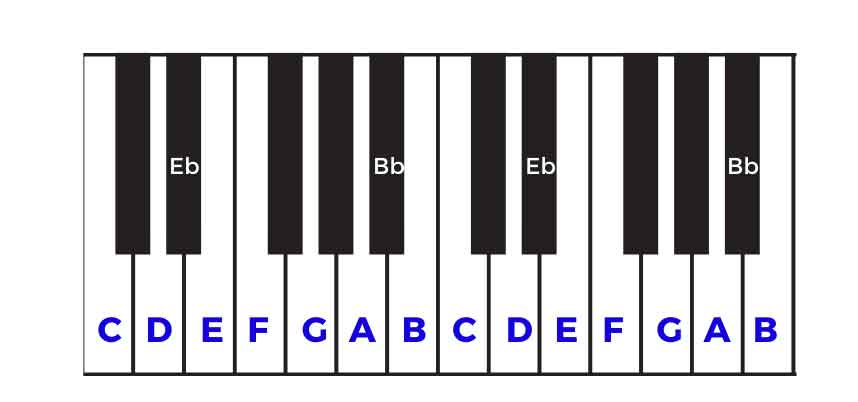
    Here, I’m showing you where each note is in an octave so you can easily play the songs listed below.

    The following diagram shows the piano keys chart:

    This diagram will help you understand where all the notes are on the piano keyboard. So, you must read it carefully. If you know these music notes well; you’ll find it much easier to follow the piano song tutorials below.

    8+ Piano Easy Songs With Letters (For Kids & Adult Beginners)

    Even though there are several easy piano sheet music options available on the internet, not everyone knows how to comprehend a score.

    In that situation, learning to play piano with easy tutorials and less complex systems, such as letters on notes, is the best option.

    The following are the 8 Easiest Piano Songs to Play with Letters and Notes:

    Twinkle Twinkle Little Star

    “Twinkle Twinkle Little Star” is one of the world’s most popular songs and is very easy to play on the piano. Therefore, beginners frequently play it on the piano.

    It is a famous English lullaby. Its lyrics are from Jane Taylor’s early-19th-century English poem “The Star. Jane Taylor first published this poem in 1806 in Rhymes for the Nursery, a collection of poems by Jane and her sister Ann.

    Now, let’s learn how to play Twinkle Twinkle Little Star on the piano, starting with the right hand and moving to the left hand.

    The great thing about this song is that almost every note is played twice in a row, meaning there are fewer notes for you or your kid to locate.

    Here are the notes of the right hand to play this song:

    These letters above represent the sequence of notes in the entire right hand of Twinkle Twinkle Little Star. Play all of these notes in a loop, one after another.

    After a while, you will become fluid at playing this song on the piano with the right hand.

    Here are the notes of the left hand to play this song:

    Play all these letters one after the other on your piano, and you’ll learn the entire melody in your left hand.

    Now that you know how to play Twinkle Twinkle Little Star with the left and right hands, you need to play both hands simultaneously. To do this, watch this tutorial video that shows the notes to play and the corresponding letters.

    Twinkle Twinkle Little Star is a classic nursery rhyme that any beginner pianist will love playing on the piano. It is a simple and easy song to play on the piano.

    Happy Birthday to You

    “Happy Birthday to You” is one of the most popular easy piano songs for beginners to learn to play. It was inspired by the famous song, Good Morning to All, composed by American sisters Patty and Mildred J. Hill in 1893.

    This tune can come in handy anytime. Whether you’re celebrating someone’s birthday or looking for an easy piano song for children to practice, you’ll find this one useful.

    Therefore, this song became one of the most played songs on the piano.

    See how you can play this song’s melody with both hands and the letters of all the notes.

    Here are the notes of the right hand to play this song:

    G – A – G – C – B – G – G – A – G – D – C – G – G – G – E – C – C – B – A – F – F – E – C – D – C.

    Play the above sequence of notes on the piano to learn how to play the right hand of Happy Birthday:

    Here are the notes of the left hand to play this song:

    C – C – G – G – C – C – F – F – C – G – C.

    Watch this tutorial video to play “Happy Birthday” using both hands.

    Overall. “Happy birthday to You” is a simple piano song you can learn quickly. If a piano or keyboard is nearby at a birthday party, you can lead the singing, which might help people sing in tune.

    If You’re Happy and You Know It

    “If You’re Happy and You Know It” is one of the most fun piano songs for kids and adult beginners. The song’s simple and repetitive melody makes it easy to play on the piano.

    The song’s catchy lyrics and upbeat tempo make it an excellent choice for sing-alongs and group performances. The tune allows your little musician to clap and dance while playing.

    Let’s learn how to play this song’s melody with both hands and the letters of each note.

    Play all the notes (mentioned below) to play this song on your piano keyboard.

    C C F F F F F F E F G

    C C G G G G G G F G A

    A A Bb Bb Bb Bb D D

    Bb Bb A A A G F F

    A A G G G F E E D E F

    Alternatively, you can watch this video tutorial to play “If You’re Happy and You Know It.”

    Ode to Joy

    “Ode to Joy” is one of Ludwig van Beethoven’s most recognized and beloved melodies. This popular classic song was first published in Germany in 1786.

    It is very easy to play on the piano. This song is an excellent choice for beginner pianists since it has a repetitive tune that is easy to play.

    The song’s uplifting and joyful melody makes it a perfect choice for any occasion.

    Now learn how to play the two hands of Ode to Joy using the letters that correspond to the notes of the music!

    You’ll need to play these in the following letter sequence to play the entire right-hand melody of this song on your piano keyboard.

    To play the entire left-hand melody on your piano keyboard, play these in the following letter sequence.

    Note: The “+” symbol indicates two notes played simultaneously, constituting a chord.

    Once you have mastered the left and right hands of Ode to Joy, it is time to play both hands simultaneously. In the image below, you can see which notes should be played by each hand:

    Click this link to watch the tutorial video showing how to play the notes of the “Ode to Joy” song with both hands simultaneously.

    Star Wars Theme

    Star Wars Theme is a popular song composed by the world-famous musician John Williams. It is the main musical theme of Star Wars and was released in 1977 as a part of the movie Star Wars: A New Hope.

    It is straightforward to play for a beginner and captures the iconic melody and spirit of the Star Wars theme. Besides being easy to play, this song is relatively short, which makes it the perfect music to practice on the piano.

    It’s one of the world’s most famous themes today, and many amateur pianists play it.

    The right hand notes for this theme are as follows:

    C – G – F – E – D – C – G – F – E – D – C – G – F – E – F – D – C – G – F – E – D – C – G – F – E – F – E – D – C – D – E – D – F – E – D – C – G – D – F – E – D – C – C – C – D – E – D D – E – D – C – A# – G# – G – F – D# – C – G – F – E – D – C – G – F – E – D – C – G – F – E – D – C – G – F – E – D – C – G – F – E – D – C – G – F – E – F – D – C – C – C.

    Here are the left hand notes for this theme:

    G – G – G – G – G – G – G – G – A – A – A – B – G – G – A – A – G – A – B – G – G – G – G – G – G – G – G – G – G – G – A – C – G – G – G – G – G – G – G – G.

    Playing Star Wars Theme isn’t tricky at all. You need to play all these letters in a row on your piano.

    Click here to watch the video tutorial to learn how to play Star Wars Theme with both hands simultaneously, paying attention to the time and tempo of the notes.

    Overall, the Star Wars Theme is a great way to learn piano while immersing yourself in the Star Wars universe. It’s easy to follow and fun to play, making it perfect for Star Wars fans.

    Jingle Bells

    “Jingle Bells” is a festive song usually sung at Christmas time. James Lord Pierpont composed this song’s lyrics and published it under the title “The One Horse Open Sleigh” in 1857.

    In 1859, Oliver Ditson republished the song with the new title “Jingle Bells” in the city of Boston in the United States.

    Today, it became one of the most popular Christmas songs played on the piano worldwide.

    It is easy to learn and play this song since there are a lot of repeated notes, and everyone knows the tune.

    You can learn a song faster if you know the melody instead of playing one from notes you’ve never heard before. Even though the verse is a bit more complex, it isn’t too tricky.

    Here’s the sequence of letters corresponding to the notes of the music, so you can learn and start playing Jingle Bells using both hands:

    (Oh) Jingle Bells, Jingle Bells, Jingle All The Way

    (D^) B – B B B – B B B-^D G A B

    Oh, What Fun It Is To Ride

    C C C C C B B

    In A One Horse Open Sleigh

    B B B A A B A

    Click here to watch the easy tutorial video for the Christmas song, Jingle Bells.

    Mary Had a Little Lamb

    “Mary Had a Little Lamb” is one of the best easy piano songs for children that a piano teacher can teach to their students.

    It is an English nursery rhyme of American origin dating back to the 19th century. American writer Sarah Josepha Hale published it first in 1830.

    The melody of this song is simple to play on the piano. The best part about this song is that it includes additional verses about the adventures Mary and her lamb have, making the song so fun.

    It is one of the most commonly performed piano songs for beginners in the US.

    Now let’s learn how to play Mary Had a Little Lamb on the piano!

    Press the following keys one after another on the piano to play Mary Had a Little Lamb using both hands:

    Mary had a little lamb

    E D C D E E E

    Little lamb, little lamb

    D D D E G G

    Mary had a little lamb

    E D C D E E E

    Its fleece was white as snow

    E D D E D C

    Alternatively, you can watch this video tutorial, showing all the notes labeled.

    London Bridge Is Falling Down

    “London Bridge Is Falling Down” is a classic nursery rhyme and one of the most popular children’s songs that originated in 18th-century England.

    During the 19th century, it gained popularity, particularly in Britain and the United States.

    London Bridge Is Falling Dawn is the most popular song worldwide, especially among children who want to start learning to play piano.

    This song is simple to play on the piano for beginners. You can also teach your kid how to play this piano song easily. Now I will explain how you can learn it simply by following the letters of the notes.

    To play this song on the piano, here are the right-hand notes:

    D – E – D – C – C – D – C – D – D – E – D – C – C – D – D.

    The following are the left-hand notes for playing this song on the piano:

    B – A – B – C – B – B – A – B – G.

    Once you have mastered the right hand and left hand, watch this video to learn how to play London Bridge Is Falling Dawn on the piano with both hands at the same time.

    Overall, “London Bridge Is Falling Down” is one of the easiest piano songs for anyone looking for a fun and easy-to-play version of the beloved nursery rhyme.

    In addition to these easy piano songs for beginners with letters, here are some more:

    • Bella Ciao
    • HAVANA – Camila
    • All You Need Is Love – The Beatles
    • Fur Elise by Ludwig van Beethoven
    • A Whole New World – Aladdin
    • Can You Feel The Love Tonight – The Lion King
    • We Know the Way – Moana
    • Feed the Birds – Mary Poppins
    • When You Wish Upon a Star – Pinocchio
    • Once upon a Dream – Sleeping Beauty

    FAQs

    What Is The Easiest Song To Learn On Piano For Kids?

    The following are a few popular and easiest songs to learn on the piano for kids:

    • Twinkle Twinkle Little Star
    • Mary Had a Little Lamb
    • Happy Birthday
    • Chopsticks

    What Song Can You Play With Five Keys?

    “Ode to Joy” is a song you can play with only five keys on the piano. You can play the first part of this famous melody with only five notes.

    What Are Easy Christian Piano Songs With Letters?

    Some easy Christian songs you can play on the piano include;

    • Amazing Grace
    • How Great is Our God
    • Here I Am to Worship
    • Jesus Loves the Little Children
    • Revelation Song
    • Blessed Assurance
    • Nothing I Hold Onto

    These songs often have simple melodies and chord progressions, making them suitable for beginners.

    Conclusion

    As you can see above, I’ve shared a list of some easy piano songs with letters and notes. These piano songs with letters are great for beginners who don’t know how to decipher a score.

    They are easy to learn and play on the piano. In addition, children will surely enjoy them during piano lessons since almost all the songs are fun to play.

    You can master these songs with practice and dedication and impress your family and friends with your musical ability.

    So grab your piano keyboard and start practicing today!

    Which piano song with letters do you want to play? Or did I miss any song in this article that’s your favorite and easy to read? Please let us know in the comments!
    Related Topics

  • How To Get Good At Piano Fast

    How To Get Good At Piano Fast

    If you’re eager to learn how to get good at piano fast, you’ve come to the right place! Undoubtedly, mastering this fantastic instrument takes time, dedication, and practice, but with some expert tips and tricks, beginners can play piano in no time.

    This blog post will provide an insider’s perspective into techniques any experienced piano teacher use to get your hands run faster on a piano. Through practical exercises and helpful advice, you’ll be playing like a pro in no time.

    So put your hands at the ready, and let’s start learning; here are some of the easiest ways to become an expert piano player:

    Manage your piano playing practice time

    To become an expert, you need to practice piano apart from being patient. There is no replacement for piano practice to become an expert; even professional musicians have regular practice sessions. When you are planning your piano playing practice time, remember the following factors:

    • You should schedule a regular practice session in your daily piano routine. If you think you can learn piano by playing the instrument whenever you get the time, you are mistaken. You must play the piano for at least 30 minutes every day.
    • The more practice you get at playing the piano, the better you will become at playing the instrument. You must practice the same piece several times to avoid missing notes and become perfect when learning piano.

    Hence, there is no alternative to practicing to become an expert and play the piano like an advanced player. So you make to keep practicing playing the piano and avoid making mistakes. This will help you become a better piano player faster.

    Become a better piano player by practicing reading sheet music

    You must learn to read sheet music when playing the piano and practicing the instrument, which is essential to becoming a professional pianist. When you are practicing reading sheet music, you must keep the following things in mind:

    • When you are practicing sight reading and trying to play the piano with the help of sheet music, do not worry about missing notes and mistakes. Instead, it would be best to play the entire music before moving to a new piece.
    • Simply playing the music from start to finish to your best ability and running through it a few more times is essential to the practice time and the reading of sheet music.

    Hence, sitting at your piano to play an entire song from sheet music during a practice session is a good idea. As a piano player, incorporating this during your p practice time can be pretty helpful in becoming an expert. When you plan your practice routine to practice the piano at home, you need to design the schedule to give you time to complete an individual piece of music during each session.

    Avoid missing out on taking piano lessons.

    To ensure that you get sufficient piano practice, you must put aside a specific time during the day for practice. However, along with your piano practice routine, you need to ensure that you do not miss out on taking piano lessons. If you miss a lesson, you will find that you have fallen behind the other piano students of your teacher.

    You cannot expect to become an expert in piano in one session. But at the same time, you must attend classes regularly to understand your progress and compare it with other students. Your teacher might find it challenging to teach a song that she has already taught in a lesson you have missed. You will have to work extra hard to learn the music and play the piano.

    Avoid practicing music or song that you already know

    It might be fun to play the same piece or song. However, it can slow your progress, and you will find that you are getting bored playing the same music. According to tips given by piano teachers, students need to learn something new and complex as this can keep them motivated.

    Students need to be taught the keyboard in a fun way. But that does not mean they have to play the same piece repeatedly. To keep your students interested in playing the piano, you must introduce them to new pieces and ensure they can play the songs.

    When students practice playing the piano, it is essential to teach them to identify their mistakes while playing. This is also one of the most important tips given by experts, as this can help you to play better. If you can hear and identify your mistakes, you will play the piano without making errors.

    Tips for playing the piano from Youtube videos

    If you plan to play the keyboard by watching a youtube video, you need first to understand that here, too, you will need to do piano practice regularly. So make a practice schedule and adhere to it. Some of the tips that will help you learn piano from a youtube video are as follows:

    • Among all tips about learning piano from an online video, the most important is that you must be prepared for hard work. As no teacher will guide you, it is essential to be diligent and play the piano with all seriousness.
    • When it comes to tips for learning piano from a youtube video, you must remember that you must develop a sense of music. When you develop a sense of music, you must diligently follow the tips given in the video and play the piano regularly.

    If you want to learn to play the piano fast, you must be prepared to put in hard work. Learning the instrument requires putting in at least thirty minutes of practice daily. If you put in the necessary time, your progress will be faster, and you will feel satisfied. Hence, even if you are learning from online videos, you must have a schedule and follow it.

    Set a clear goal and work towards it

    It is essential to set a goal and work towards it. If you feel your progress could be faster, check if you have set your goals correctly. For example, your goal should be something like you should learn one song in a single session or you will complete practicing two songs in a single sitting. Of course, taking a break during your practice sessions is essential, but it should not divert you from what you want to achieve in the session.

    However, students sometimes need to set the right goals. For example, if you plan to practice for three hours at a stretch, you will find it quite formidable. Similarly, if you want to learn a complete piece of classical music in a single session, you will find that it is more than just formidable; it might be impossible. If you set such goals, you will be demotivated and give up on the piano before playing your first successful piece. Thus it is essential to set a clear goal and work towards it.

    Practice each hand separately to become an expert at playing the keyboard

    You must check your hand movements if you feel slow learning the piano. You need to ensure that your hands move swiftly across the keyboard so that you can play the sound you want. Sometimes pianists need to work on their hand movements separately. Here is what you need to know about hand movement across the piano.

    • It would be best if you played an entire piece with each hand before using both hands to play the song or the piece.
    • When you have played the piece with your left hand separately, you need to proceed to play it with your right hand. You will learn to use each hand and then use both hands to play the piece.
    • You can practice playing one to two bars with your left hand and the same with your right hand. You will find that initially, it is slow, but slowly you can play the same bars with both hands. It is a good idea to break the piece into manageable segments so you can expertly play the piano with both hands.

    Do not think this will increase your time to play the piano. Instead, you will find that you can learn to play the instrument with both hands faster if you give equal time to both hands separately. On the other hand, using two hands to play the instrument right from the beginning can make learning to play the piano quite challenging and slow you down.

    Practice playing classical music

    Learning to read and play classical music when you play the piano is essential. It might seem daunting, but with practice, you will find playing classical music is essential and can help you learn the piano faster. Here is how classical music can be helpful in learning piano faster:

    • When you play classical music, you learn the instrument’s technique faster.
    • The technique of playing the piano would mean learning to hold a note longer, swifter movements of your fingers, and better control of the keyboard.
    • With classical pieces, you will find that the movement of your fingers across the keyboard has become better and swifter. As a result, you have become a better piano player.

    Most piano teachers give their students essential advice to play sheet music, especially classical pieces, to get to a point where they can understand and play even the most complex pieces. This is essential advice because, as a student, if you want to learn piano faster, becoming an expert in finger movement is essential. You can achieve it by playing classical pieces.

    Finding a good teacher

    If you want to learn piano from the beginning, you need to get a good teacher who can guide you through the process. You will find that she will schedule classes weekly, and you need to attend them regularly. Your teacher will also guide you regarding the number of practice hours you must put in a week to become an expert.

    Practice is vital to becoming a good piano player within a short period. However, when you practice, you must refrain from repeating the mistakes because it will become quite challenging to rectify. When you join a piano class with a teacher, she will help you understand the best way to develop the skill to become a good pianist.

    You must also update your teacher about the number of hours in a week that you managed to put in. It is essential to be honest with your teacher so that she can guide and help you with your progress. Finally, you must work with your teacher and listen to her advice to improve your keyboard skill.

    Always warm up before you start playing.

    You need to warm up and strengthen your fingers and wrists to avoid fatigue when playing the piano. In addition, if you want to learn piano fast, it is necessary to ensure that you do not hurt your hand in the process.

    Many pianists complain of carpal tunnel syndrome because they have spent hours practicing on the keyboard. However, you can easily avoid it if you spend some time warming up your hands and relaxing the muscles.

    It only takes a moment to injure your hand and fingers, which can be pretty painful. The key to avoiding such matters is to warm up properly before a session and then play the instrument. This will ensure that you do not hurt your hand even if you play the piano for more than an hour.

    Sometimes it might be good to go slow.

    Although you want to learn the piano fast, it is essential to remember that it takes time to pick up complex pieces. You must gain a certain amount of expertise before playing complex pieces. You will find that you will have to play a complex piece at least three times before you can play it with expertise.

    Conclusion

    Sometimes students feel that the right teacher can help them learn the piano fast. However, you need to understand that you will have to practice hard and regularly to become an expert in playing the piano.

    Developing a schedule and setting goals to improve your playing skills are vital in order to master music. To become an expert, it is essential to interpret and comprehend what is heard. Additionally, following the advice of one’s instructor is critical in order to achieve the desired results.

    Related Topics

  • Piano Keyboard Types and With Pros & Cons

    Piano Keyboard Types and With Pros & Cons

    If you’re a musician or music enthusiast, you know that pianos come in all shapes and sizes. But did you know that there are different piano keyboard Types as well? That’s right – not all pianos are created equal, and the kind of keyboard you choose can greatly impact your playing experience.

    In this post, I’ll dive deeper into the different types of piano keyboards available and discuss the pros and cons of each.

    From professional stage pianos to portable digital and MIDI keyboards, there’s a keyboard piano for every playing style and approach.

    So, let’s dive in and learn more about the different types of piano keyboards!

    Understand The Keyboard Better

    Before we get into the types of piano keyboards, let’s first understand the keyboard better!

    The piano keyboard is a beautiful and complex instrument, capable of producing a wide range of sounds and emotions.

    The main feature of the keyboard is its ability to simulate other sounds, which is true of most keyboard types. You can play the musical notes with the keys to produce a variety of sounds, including those of brass and string instruments.

    Keyboards have different numbers of keys, divided into two sections: white and black. The white keys are the natural notes (A, B, C, D, E, F, and G), and the black keys are the sharp and flat notes (also known as accidentals).

    The pattern of white and black keys repeats itself every octave, a range of eight notes. The lowest key on the 88-key keyboard is an A, and the highest one is a C.

    One of the main reasons people choose keyboard pianos over acoustic pianos is convenience and cost. Keyboard pianos are often more portable and versatile, making them an excellent choice for gigging musicians or those who don’t have room for a full-size piano in their home.

    However, it’s important to note that there’s nothing quite like an acoustic piano’s rich, natural sound. It’s all about finding the right balance for your needs and budget.

    7 Types Of Piano Keyboards (2023)

    Below are the seven different types of piano keyboards:

    Digital Piano Keyboard

    As the name implies, a digital keyboard piano is a keyboard that simulates the sounds and feels of a piano. It is probably the best keyboard for students who need to focus on practicing musicianship and for adult beginners who want to learn piano.

    Digital keyboards use analog sensors for keyboard action and different versions of chips that reproduce the sound of an acoustic piano.

    Unlike many other keyboards, this piano keyboard typically has 88 full-size keys. The best digital piano keyboards have graded and weighted keys to replicate the feel of a real piano.

    They come with various features, such as built-in speakers, touch sensitivity, and the ability to save and play back recordings.

    They also offer extra features such as excellent maximum polyphony, demo songs, lesson modes, USB MIDI connections, and more for added versatility.

    Digital piano keyboards are more portable and cost-effective than acoustic pianos.

    Pros

    • Digital piano keyboards are portable and lightweight, making them easy to move and store.
    • They are much cheaper than traditional pianos.
    • They have various sounds and features, such as changing instrument sounds and computer connectivity.
    • They do not require tuning, saving the cost and hassle of regular maintenance.

    Cons

    • Their tactile feel isn’t like an acoustic piano, which can be a drawback for some pro players.
    • The sound quality may not be as good as an acoustic piano.
    • Some digital pianos can be expensive, especially if you want a high-end model with advanced features.

    Stage Keyboard Piano

    These keyboard pianos are professional digital pianos specifically designed for live performances. They are generally more lightweight and portable than digital piano keyboards.

    Due to their portability and durability, you can easily move between stages, and the sound quality is pro-level. They often have a built-in sound library to access sounds such as electric pianos, organs, and synthesizers.

    These keyboard pianos are also highly customizable, allowing the performer to tailor their sound to fit the needs of the gig.

    A portable digital piano differs from a stage piano primarily in terms of construction, materials, and overall performance. Stage pianos are sturdier and more portable. The keys feel excellent, and the sonic performance is often superior to that of entry-level to mid-level portable digital pianos.

    While the extra features and overall quality may differ from brand to brand and model to model, they are typically top-notch and high-quality musical instruments.

    Pros

    • They are very lightweight and portable, making them easy to carry and transport to different gigs.
    • Suitable for live performances due to their portability and durability.
    • They have a built-in sound library with various sounds, allowing for greater flexibility in terms of sound.
    • Highly customizable.

    Cons

    • They don’t have the same level of sound quality as a traditional piano.
    • They may be more expensive than entry-level digital pianos.
    • They don’t offer as many features as some other digital pianos.

    Arranger Keyboard

    Arrangers are electronic keyboards that come with auto-accompaniment features. They are designed for solo musicians who want a versatile keyboard at their fingertips on stage.

    One of the best features of arranger keyboards is their auto-accompaniment feature, which allows you to create music that sounds like a full band or orchestra is playing it.

    That makes arranger keyboards perfect for live performances, where you need to create complex and dynamic music on the fly.

    In addition to their versatility and live performance capabilities, they offer different instrument sounds, effects, and USB connectivity. With USB connectivity, you can easily record and edit your music on the keyboard.

    In short, arranger keyboards are an all-in-one solution for solo musicians who want to create and perform professional-sounding music. They are incredibly versatile, allowing the user to create complete songs independently.

    Pros

    • Suitable for composition.
    • The auto-accompaniment feature encourages students to play.
    • They have a user-friendly interface and easy-to-use controls.
    • Ideal for musicians who want a single instrument that can handle various tasks.

    Cons

    • Starting prices can be higher for keyboards than for less advanced keyboards.
    • While arranger keyboards are generally easy to use, the range of programmable options can overwhelm beginners.
    • They have limited sound options.

    Workstation Keyboard

    Workstation keyboards are a type of keyboard that is essentially a computer in a keyboard form. They are designed for music production and are great for use in the studio or on stage.

    These keyboards allow you to easily manipulate music by sampling, sequencing, recording, editing, and more. They often come with weighted keys, making them ideal for advanced beginners.

    It is the versatility of workstation keyboards that makes them so popular. Workstations allow you to do almost everything a digital audio workstation (DAW) can do on a computer or smart device with a DAW. That makes them a great all-in-one solution for musicians, arrangers, and producers of all levels.

    However, it’s important to note that workstation keyboards are not the best choice for classic piano players. That’s because the keys on workstation keyboards are not typically designed to simulate the feel of an acoustic piano. Instead, they focus on the functionality and versatility of music production.

    Workstation keyboards come in various sizes and with different features, depending on the brand and model. While they can be pricey, they have generally considered the best all-around instruments for music production in their price range.

    Pros

    • Highly versatile and perfect for advanced beginner piano students.
    • These keyboards feature weighted keys.
    • Wide range of built-in sounds.
    • Workstation keyboards are much lighter and take up less space than traditional pianos, making them easier to transport.

    Cons

    • Their prices tend to be higher, especially high-end models.
    • Piano beginners can find these instruments too advanced.

    Synthesizers

    Synthesizer keyboards have been a popular choice for a long time due to their ability to create unique sounds, layer effects, and manipulate sound.

    With their digital or analog processing capabilities, synths are commonly used to create particular sounds and beats for studio recordings and on stage.

    Synthesizers have many sound manipulation functions that standard keyboards do not, such as an effects library, filters, tones, samples, and more.

    A workstation keyboard is a synth with MIDI and DAW controllers and has some additional features.

    Synthesizers come in analog and digital forms. It is essential to note the difference between analog and digital synthesizers.

    Digital synths operate using a numerically-controlled oscillator, resulting in digital signals. These synthesizers are relatively new and typically feature a keyboard and LCD display.

    On the other hand, analog synths use a voltage-controlled oscillator with analog signals and consist of sound-generating circuitry and modulators.

    The major difference for musicians is that analog synths provide a continuous signal with a richer sound, while digital synths offer more versatility and additional functions.

    Since professionals use synthesizers to create unique sounds and soundtracks, they require considerable music knowledge and experience.

    Pros

    • They can create unique sounds and manipulate sound in various ways.
    • Excellent for studio recordings and live performances.
    • They offer multiple sounds and output to amps or recording equipment.
    • Digital synths offer more versatility and additional functions.
    • Analog synths provide a continuous signal with a richer sound.

    Cons

    • Require a significant amount of music knowledge and experience to utilize their capabilities thoroughly.
    • The quality can vary between brands.
    • A bit pricey.

    Electric Organs

    Electric organs are electronic keyboard instruments that mimic the sound of traditional pipe organs or Hammond organs.

    They are primarily used in churches. These musical instruments have been popular for decades and were often used in rock music during the 1970s and 1980s.

    Digital organs come in various sizes and key numbers, so you can have the vintage organ sound whenever you want.

    Like other piano keyboards, they offer various sound effects and sound sets. Furthermore, they are compatible with both hardware and software. Some high-quality electronic organs produce a sound that resembles a pipe organ.

    Several manufacturers have retained the pipe organ parts in the electronic versions, including drawbars, pedal boards, and multiple key decks.

    However, this instrument is different from a piano. An electronic organ may not be the best choice if you’re serious about learning about the piano.

    Pros

    • Digital organs mimic the sound of traditional pipe organs or Hammond organs.
    • They are available in various sizes and key numbers.
    • They offer different sound effects and sound sets.
    • It is easier to transport and set up electric organs because they are portable and lightweight.
    • They tend to require less maintenance than traditional organs.

    Cons

    • They rely on electricity, which can be a limitation in certain situations or locations.
    • They may not be the best choice if you’re serious about learning the piano.

    MIDI Controllers

    MIDI controllers are specialized keyboards designed to control other electronic instruments or software.

    MIDI stands for Musical Instrument Digital Interface, a technology introduced in the 1980s. The purpose of this is to communicate between electronic instruments and computers.

    The controllers do not produce sounds on their own, but they can trigger sounds or control parameters in other devices. These keyboards transmit MIDI data between the device and the computer to trigger the sounds on your computer.

    Because controllers lack built-in sound-generating capabilities, they have lower price tags than other keyboards for beginning pianists.

    The right DAW and virtual instrument plug-ins make MIDI keyboards highly versatile. They are advanced mouse and keyboard combinations for playing music and producing it.

    MIDI controllers are popular in live and studio projects. You can use them to play any instrument, manipulate sound with effects, create loops, and control your DAW.

    Many different MIDI keyboard models are available on the market, from basic 25-key models to highly advanced 88-key models for greater control over your music.

    Pros

    • MIDI controllers are a good choice for computer composition.
    • They send MIDI information to synthesizers and computer programs.
    • Affordable.
    • You can use them to trigger sounds and control various parameters in real time.
    • Portable and easy to take to gigs.
    • Available in various sizes and styles, it is easy to find a controller that fits your needs and budget.

    Cons

    • It requires a computer or laptop to run virtual instruments and music production software.
    • No onboard sounds.

    Types of Pianos

    Now let’s take a quick look at the different types of pianos!

    There are three primary types of pianos: acoustic pianos, digital pianos, and hybrid pianos.

    Acoustic Piano

    First up, we have the classical acoustic piano. These instruments are made with wood, metal strings, and hammers and produce sound when the keys are pressed, and the hammers hit the strings. Acoustic pianos are known for their rich, full sound and are the go-to choice for many professional musicians.

    They are the most traditional pianos, based on vertically and horizontally arranged strings. Since their strings are arranged differently, they are classified into grand and upright pianos.

    Grand Pianos: Grand pianos (aka grands) are known for their elegant appearance and rich, full sound. They have a longer, horizontal design with the strings stretched out horizontally.

    In grand pianos, strings and hammers are arranged diagonally from the keyboard. They also have soundboards, which help amplify the sound.

    Grand pianos are famous for concert pianists and professional recording studios due to their exceptional sound quality. However, they can be expensive and require more space, making them less practical for the average home.

    Upright Pianos: These pianos are more compact and cost-effective. They have a vertical orientation, and the strings and hammers are arranged vertically behind the keyboard.

    Upright pianos are an excellent option for those with limited space or a tighter budget. While they may not have the same rich, full sound as a grand piano, they can still produce beautiful music and are an excellent choice for beginners and amateur musicians.

    They are often found in homes and smaller venues.

    Remember, acoustic pianos require regular maintenance, such as tuning and voicing, to keep them sounding their best.

    Digital Piano

    The next type of piano is a digital piano. These electronic instruments use samples of real piano sounds and amplify them through speakers or headphones.

    In addition to reproducing the sounds of a piano in a memorized manner, this piano model can also increase or decrease the volume of the keys, and its appearance is similar to an acoustic piano.

    They offer a range of sounds beyond just the traditional piano so that you can get creative with your playing.

    In addition, digital pianos include numerous features such as built-in metronomes, rhythm patterns, recording capabilities, connectivity options, and more. These features allow you to expand your musical possibilities.

    They’re also more affordable than traditional acoustic pianos, and you don’t need to worry about tuning or transporting them.

    Digital pianos are an excellent option for beginners or those who don’t have the space or budget for an acoustic piano.

    Hybrid Piano

    This type of piano is a mixture of acoustic and digital pianos. Hybrid pianos combine the best of both worlds – the sound and feel of an acoustic piano with the convenience and versatility of a digital piano.

    That means you can enjoy a grand piano’s rich, authentic sound and access a variety of sounds and effects on the digital side.

    Hybrid pianos often have real strings, hammers, and a digital component that allows for additional sounds and features.

    So, which type of piano is right for you? Well, that depends on your needs and preferences. Acoustic pianos offer a classic, authentic sound but require more maintenance and space.

    Digital pianos are more convenient and affordable, but they may not have the same level of depth and nuance as acoustic pianos. Hybrid pianos offer a good balance of both but can be pricier.

    Ultimately, the best piano for you is the one that fits your playing style and meets your needs.

    How To Choose The Right Piano Keyboard

    When choosing the right piano keyboard, there are a few key things to consider. Here are some tips to help you make the right decision:

    Keyboard Size

    The keyboard size is an essential factor to consider, mainly if you have limited space in your home or plan on taking your keyboard with you on the go. In addition to the layout, you should consider the number of keys.

    A full-size keyboard typically has 88 keys, just like a traditional piano. If you have the space and plan on playing more advanced pieces, a full-size keyboard is a good choice.

    If you have limited space or plan on traveling with your keyboard, a smaller option with 76 or even 61 keys might be a better fit.

    Sound

    The sound quality of a keyboard is another crucial factor to consider. If you’re a beginner, you might not be as concerned with the nuances of sound quality.

    But as you become more advanced, the sound of your keyboard can make a big difference in your playing experience. Keyboards from the best brands produce sounds similar to those produced by a real piano.

    You should also consider polyphony (how many sounds the keyboard produces at any given time) and multiple sounds, such as drums, strings, and woodwinds.

    Action

    The action of a piano keyboard refers to how well the keys respond when pressed. A keyboard’s action varies in firmness and resistance depending on its model.

    Keyboards with weighted keys are more responsive than unweighted keys, making them good pianos for beginners.

    Some keyboards have a lighter action, which can be easier to play but might not feel as authentic as those with a heavier action. A lighter action might be a good choice if you’re a beginner. But if you want a more authentic piano feel, consider a heavier action keyboard.

    MIDI Compatibility

    MIDI, or Musical Instrument Digital Interface, is a technology that allows keyboards to connect to computers and other digital devices.

    MIDI compatibility is an important feature to consider if you want to use your keyboard to create music on your computer. Many keyboards come with USB MIDI, which makes it easy to connect to your computer.

    Budget

    Last but not least, you should consider your budget when choosing a keyboard. There are options available at different prices, from budget-friendly options for beginners to high-end keyboards for more advanced players.

    Determine how much you’re willing to spend and look for a keyboard that fits within your budget while still offering the features you need.

    Conclusion

    As you can see, I’ve discussed different types of piano keyboards. Each piano keyboard type has its own unique features and benefits, and the right choice for you will depend on your needs and preferences.

    So, you can choose the most suitable piano keyboard type for your playing needs.

    A portable digital piano is the best option if you’re a beginner looking for your first keyboard piano at a reasonable price.

    If you’re more interested in music production, you should consider using a MIDI keyboard with your DAW (digital audio workstation).

    Read More

  • How To Play E flat On Piano

    How To Play E flat On Piano

    Piano chords are an essential part of playing piano effectively. If you’re a beginner piano player, you may wonder, “how to play an E flat chord on a piano?”

    E flat is a commonly used chord in music, and it’s relatively easy to learn how to play.

    Like all triads, this piano chord consists of three notes. With just a few simple steps, you can master this chord and use it to create beautiful piano music.

    You can play E flat in any octave on your piano with either hand.

    In this article, I will show you a step-by-step guide on how to play an E flat chord on the piano. Also, I will include keyboard diagrams in this guide to better aid you with learning the piano chord.

    So, let’s get started!

    What Is An E Flat Chord On A Piano?

    E flat is a musical pitch half step lower than E. It is also known as Eb, where the latter “b” stands for flat in music theory.

    On a piano, the key for E flat (Eb) is located to the left of the key for E. When you play the E flat key on a piano, you will hear a one-half step lower pitch note than the E key.

    The E flat key is also the black key located between the D and E white keys on the keyboard.

    How to make an Eb chord on a piano?

    E flat major chord consists of three notes. This chord consists of a root (E♭), a major third (G), and a perfect fifth (B♭) of the major scale on piano.

    Eb – G – Bb

    That means you play notes 1, 3, and 5 on the scale. When you play these notes simultaneously, the result is an E-flat major chord.

    Alternatively, you can use the formula of half steps to build the E flat major chord.

    The Formula of Half Steps – R + 4HS + 3HS

    Here, the R stands for root, the 4HS for four half steps, and the 3HS for three half steps. You can form almost all major chords on a piano keyboard using this formula of half steps.

    Here’s how you can build an Eb major chord on the piano using half steps:

    First, locate the root note (E flat) on your piano keyboard. On your keyboard, there are two black keys. The second black key is E flat. Now move four half steps to the right to find the major third (G). And then three more half steps to the right to find the perfect fifth (B flat).

    In simple terms, once you have found Eb, play the 4th key (G) and the 3rd key after G (Bb) on your piano keyboard. Press all three keys simultaneously to play the E flat major chord.

    Eb Chord Piano Finger Position

    Before we get to our main topic, “how to play an E flat on the piano,” it’s essential to know what fingers play what keys.

    In piano sheet music, the fingers are numbered. They tell players which finger to use to play a specific note.

    Let’s quickly discuss how your fingers are numbered!

    We have five fingers in one hand. And each finger has a number from one to five.

    The thumb represents finger 1, the index finger represents finger 2, the middle finger represents finger 3, the ring finger represents finger 4, and the pinky (little) finger represents finger 5.

    The numbers are the same on both hands.

    When we play the Eb piano chord on the piano, we typically use the first, third, and fifth fingers.

    How to Play an E flat (Eb) On The Piano

    Now you know what Eb is and how it is made up. In this section, I’ll explain how to play an E-flat piano chord with the right hand, the left hand, and both hands.

    Playing the E-flat (E♭) Chord with the Right Hand

    You will use the following fingers to play the root position chord with your right hand:

    • B♭ – Fifth finger (5)
    • G – Third finger (3)
    • E♭ – First finger (1)

    To play the E-flat major chord with the right hand, place your pinky finger on B-flat, the middle finger on G, and the thumb on E-flat. In this position, the Eb chord is at its root.

    See the image below for the correct finger placements to play an E-flat major chord in its root position with the right hand:

    You’ll hear the Eb piano chord sound as you press all three keys together.

    Remember that you play black keys with your pinky and thumb while you play white keys with your middle finger.

    Try to line up your fingers on your piano keyboard and let them relax so you can get a feel for the hand position.

    The key difference between a chord and a note (or melody) is that a chord involves multiple keys played simultaneously, while a melody involves multiple notes played in succession.

    So, press down on Eb, G, and Bb simultaneously to create the Eb piano chord. Beginners often press down with all four fingers (two and four included), which can create an unpleasant sound.

    To avoid this, lift fingers two and four as high as you can while still feeling comfortable, and press down on all three keys at once. It will take some practice to find the right amount of pressure.

    Playing the E-flat (E♭) Chord with the Left Hand

    We’ve played the Eb major piano chord with the right hand. Now let’s play this chord with the left hand.

    You will use the following fingers to play the root position chord with your left hand:

    • B♭ – First finger (1)
    • G – Third finger (3)
    • E♭ – Fifth finger (5)

    To play the Eb major chord with the left hand, place your first finger (thumb) on B-flat, third finger (middle finger) on G, and fifth finger (pinky finger) on E-flat.

    Remember that your third finger will play a white key, while one and five fingers will play black keys.

    The image below shows the correct fingering for playing an E-flat major chord with the left hand:

    Spend a few minutes to line your fingers up and practice the same as you did with your right hand, ensuring that fingers 2 and 4 are comfortably out of the way. Once you’re comfortable, try it with both hands together.

    Playing the E-flat (E♭) Chord with Both Hands

    Now let’s learn how to play the Eb chord with both hands!

    First, pick an Eb, G, and Bb in the right hand with the exact finger placement as previously described. Now, place the left hand in the same position as the right.

    Once both hands are in position, line up all the needed fingers and press down on all the keys at the same time to play the chord.

    For a visual example, here is a diagram:

    Ensure that your 2 and 4 fingers on both hands are out of the way, and then try it out.

    What are the inversions of E♭ major?

    In addition to its root chord position, E♭ major chord has two inversions. Here we’ll learn how to play the Eb major chord’s 1st inversion and 2nd inversion.

    How to play the 1st inversion of E♭ major

    The 1st inversion of the Eb chord means that the G is played as the lowest note, followed by E♭ and B♭.

    To play the 1st inversion of an E♭ major chord on piano with your right hand, use the following fingers:

    • E♭ – Fifth finger (5)
    • B♭ – Second finger (2)
    • G – First finger (1)

    Once you’ve positioned your fingers correctly, press down all the notes simultaneously to create the chord.

    How to play the 2nd inversion of E♭ major

    The 2nd inversion of the Eb chord means that the note B-flat (Eb) is played as the lowest, followed by G and E♭.

    Use the following fingers on your right hand to play the 2nd inversion of E flat major:

    • G – Fifth finger (5)
    • E♭ – Third finger (3)
    • B♭ – First finger (1)

    Practice playing this piano chord a few times until you are comfortable with the fingering and the sound of the chord.

    Conclusion

    As you can see above, I’ve explained how to play E-flat (Eb) on the piano. Now you know what notes make up the E-flat major chord and how to play E-flat major scale well.

    Playing an E flat on the piano is a simple but essential skill for any pianist. If you follow the steps outlined in this blog post, you should be able to play an E flat on the piano with your right hand, left hand, and both hands together.

    Practice is key, so keep practicing until you feel comfortable and confident playing this note. If you devote some time and effort, you’ll soon be able to play an Eb major scale like a pro.

    So, grab your piano keyboard and start practicing the E-b major chord!

    Related Topics

  • Piano Playing Tips For Beginners

    Piano Playing Tips For Beginners

    Piano playing can be a rewarding experience but starting out can seem overwhelming. If you’re a beginner, fret not! Here you will find Piano Playing Tips for Beginners which have been designed to help make your journey easier and more comfortable. From understanding the basics of the piano keys to more advanced techniques that you can use to take your skills closer to mastery, this blog post has it all. So if you’re ready to get started on your piano journey, strap in and let us take off!

    Practice scales, chords, and arpeggios daily

    The first step in your learning experience begins with practice:

    1. It would help if you learned your way around the keyboard.
    2. You must ensure that your daily practice sessions last at least twenty minutes.
    3. During a practice session, you must remember to do the following:
    • The first step in the learning process of playing piano is to understand the scales. You must learn to differentiate between the 12 scales in piano music.
      When you play piano, you must learn to master the c major scale, as this is the basis of music theory.
    • For beginner pianists, starting with C significant scales with the left hand and then using both hands together is essential. It would help if you started playing C major scale in parallel and contrary motion when you have mastered this.
    • When you have mastered your scales, you must learn to play the chords and the arpeggios. This will increase your practice time and make the sessions interesting for beginning pianists.

    When you learn piano, it is essential to enjoy playing, and when you start enjoying your practice time, you will find that you can learn how to play the piano quickly. Sometimes students feel that learning the chord structure can be complex, but you can learn it quickly if you start slowly and play the piano regularly.

    Learn to play the notes

    Your piano teacher will tell you that the next step in playing the piano is to learn to play the notes. When you learn a song, ensure that you follow the correct order: notes, fingering, rhythms, expression, and speed.

    When you practice the notes on the keyboard as a beginner pianist, you should start practicing at half speed and then increase the tempo. It would be best if you practiced notes on the keyboard while playing piano.

    You need to develop an ear for the notes to identify when you play a wrong note on the piano while playing the piano. One of the great tips that your piano teacher can give you when you play the piano is that correct notes can be played only with the correct fingering.

    When you play music on the piano, you must consider the notes adding to the melody because it adds to the expressive elements indicated in the music. The correct notes will create crescendos or dimuendos, ritardando, staccato and sforzando.

    Thus, when you practice playing the piano, you must concentrate on playing the correct notes with a consistent tempo.

    Avoid sitting in the wrong way when you play piano.

    Maintaining the correct posture is essential when you play the piano. Sometimes when you try to play complex musical notes, or you are trying to reach the black keys at the far end of the piano, you should not bend yourself in such a manner that you damage your posture. Here is what you should remember about your posture:

    • While playing the instrument, maintaining a good posture is essential; hence, while practicing, position your stool so that you can reach the keyboard quickly and all keys are within your reach.
    • When you practice playing the piano, you must remember to keep your forearms at the same level as the keyboard. While playing the instrument, if you have to keep moving your arms far apart to reach the keys, you will find it challenging to play the songs.
    • You must develop a technique that suits you when maintaining a posture. Most pianists believe that the best posture is keeping your back straight and using your right hand to play most of the keys. With practice, you can quickly develop a technique that suits you perfectly.

    You must practice maintaining the best posture while playing the keyboard right from the beginning. As you continue practicing, you will avoid developing bad habits, and it will become easier to play the instrument.

    Learn how to do sight reading

    An essential part of learning to play the piano is sight reading. Sight reading means reading and playing a song you’ve never played before without preparation or practice.

    Several sight reading books are available in the market, and you can purchase one to test your ability to sight read. You need to develop a knowledge of understanding sheet music to do sight reading.

    When you can do sight reading successfully, you will know that you have developed a thorough knowledge of music theory.

    This is necessary because if you are placed in a performance and have not practiced a particular piece of music before, sight reading is necessary to play the notes successfully.

    Among the many tips that expert pianists will give you, they will tell you that sight reading plays a crucial role because it helps build your confidence. You will know that you can play the instrument even if you are faced with a piece of music you have not played before.

    This is essential to prove your instrument expertise and your understanding of music.

    Developing muscle memory with practice

    Practice is necessary to ensure you learn to play the keyboard continuously without concentrating on the instrument. For example, if you have observed a professional pianist play the grand piano, you might have observed that he sometimes plays with his eyes closed. He has achieved this level of perfection with practice.

    Since the beginning, he trained himself to understand the sound of the keyboards and the individual keys. This helps him to identify the individual note and subsequently develop muscle memory. As a result, he can play the keyboard without consulting the sheet music all the time.

    You, too, need to develop this capacity or memory, which can be achieved only through practice. You will develop muscle memory for the keys with particular notes as you practice playing the same music repeatedly.

    Training your ear to understand music

    You must train your ear to identify the chords and the gaps in the music. So when it comes to tips for playing the piano, an essential part of it is developing a musical ear.

    This is necessary to ensure that you can identify the chords, rhythms, notes, and gaps in the chords. When you can identify these, you can easily play the music.

    When you train your ear to identify the music, you also train it to identify the mistakes. This is essential to ensure that you refrain from repeating it.

    For example, when you practice playing the piano, you will have to train your ear to understand the music played. This is also essential to understand the differences between the different musical pieces.

    Practice playing songs

    When you play a song on the piano, you must concentrate on the individual notes. This is because a single note you play wrong can completely change the tune, and the song will sound different. Hence each note has to be played carefully, and when you practice playing a song, you must concentrate on all notes with equal attention.

    To learn classical music, you must practice playing songs with classical notes. As a beginner, you will find it challenging to master the eighth notes in a musical sheet. This is especially true in the case of classical sheet music.

    However, with practice, you can master the white notes and then move on to the black notes. This will make it easier for you to play songs on the piano. In addition, playing songs will make learning to play the piano fun, and you will start to enjoy the process.

    Pianists often mention that to make students interested in playing a keyboard, it is a good idea to help them learn to play a whole song on the instrument.

    It helps them get a sense of achievement and keeps them interested in playing the piano. One of the easiest ways to do it would be to introduce yourself to new music and have fun learning it. You will learn a new song and keep playing the keyboard.

    Play easy passages and then move to difficult ones

    When you are learning to play the piano, you need practice time and to first learn to play easy passages before moving to difficult ones. Getting control over your fingers is essential to learning to play the instrument. Hence, it is essential to understand that you must learn your way around the keyboard. When you practice playing easy passages, here is what you will get to understand about the instrument:

    • First, you will learn the manipulation of your wrist, which is essential to playing complex pieces.
      You do not want to stretch your hands to play the intricate pieces, so you must learn how to play the simple pieces at varying tempos. This can help you control your finger movements and wrist better.
    • When you learn to manipulate your wrist better, you will find that your hands do not get fatigued even when you play complex pieces and piano for a longer period.
    • When playing a simple passage, you must look through the sheet music and find the most complex part. While playing the instrument, you must visualize yourself playing the complex parts without making a single error. When it comes to piano playing tips for beginners, this might seem a bit unusual, but it is pretty helpful.
      When you visualize yourself playing the problematic part of an easy passage without any error, you will find it easier to master the technique.

    The primary reason behind mastering the easy passages is that when you get to the difficult ones, you will have to learn to hold the notes, move from one note to another and play complete songs in a single sitting. Hence, learning to manipulate your hands, fingers, and wrists is essential to quickly mastering the keyboard technique.

    Avoid expecting too much of yourself.

    Unless you are born talented, it takes time to master playing the piano. You will have to progress from one note to another. According to the tips provided by expert pianists, it is wrong to expect too much from yourself.

    You are not a piano virtuoso; hence, you will have to expect slow progress. You must wait to become an expert pianist. Therefore, it is essential to keep your expectations within the accepted limits.

    You must listen to your teacher and follow his instructions carefully. It is important to practice regularly, but sometimes your progress will be slow.

    However, you can become an expert pianist in time with slow practice. Therefore, you need to be patient while learning to play the keyboard.

    There are several things that you need to learn about the instruments, and it is not just the keys. You will have to learn how to hold the notes, manipulate the pedals, and play complex notes on a simple keyboard.

    This takes time; hence, you must be patient while playing the piano.

    Conclusion

    When you learn to play the piano, having fun and enjoying the entire process is essential. Of all the tips that expert pianists provide, the most important is to enjoy learning to play the instrument. You must be careful about being slow in learning to play the instrument.

    This will help build a strong foundation necessary to play complex musical pieces. If you want to become an expert pianist, you will have to play complex pieces, and you can learn this only with time and patience. Therefore, enjoying, practicing, and having fun while playing the instrument is essential.

    Related Topics

  • How To Play b On Piano? Everything Explained

    How To Play b On Piano? Everything Explained

    Many musicians, both beginners, and experienced players alike wonder how to play b on piano, Understanding piano chords is a real struggle. For someone who’s just discovered their passion for this musical instrument, it might feel pretty overwhelming to press those keys that appear in the black and white pattern. When you sit in the chair with all those keys before you, minor and major chords might appear similar and confusing.

    You have no clue which key does what exactly and how to use them to produce the best sound. Of course, it’s just a matter of time before you learn how to play different songs and get better at it, but starting isn’t going to be easy.

    Should you press one key at a time or a bunch at once? Should you use all ten fingers? What about those three pedals at the bottom? How do they affect the sound? When you have just started learning a piano, there’s so much on your mind, and it’s quite normal to be confused.

    If you learn from a pianist, things might get a little easier, but then again, learning all the chords and using them correctly will take time, patience, and effort.

    In this post, we will walk you through one of the most vital chords on a piano, i.e., the B major chord. Keep reading to learn more about the role of B major on the sound and how you should use it with other chords. But before we discuss the B major chord, you should know what notes, scales, and chords mean on a piano. Let’s start with the scales.

    What are the Scales on the Piano?

    The seven notes combined on the piano that is played in a row (one after the other) make a scale. When you play these notes, you will hear the sound of space between them, which are called intervals. These small intervals are called semitones.

    Although there are a total of 12 notes, only 8 characters are used to define them: A. B, C, D, E, F, G. Now, the keyboard is a combination of black and white keys grouped together to create different notes. The black ones are called sharp and flat keys.

    Some notes get two names that are used interchangeably. For example, a C# is also known as a Db because the key is between the C and D keys.

    Let’s see what a Major scale is and how to use it.

    Major Scale

    Most western music produced over the last few decades is based on the Major scale. These are also perfect for beginners who don’t know much about piano scales and chords.

    The combination of semitones and tones creates a major scale. C is the first chord that people learn on the piano. They combine tones and semitones between the C major chords to create the perfect note.

    Note: It’s advisable for beginners to start learning a piano with the B notes first. They are easier to use and are closer to your fingers, making learning easier.

    What are Chords?

    Chords refer to one or more notes that are played at the same time on a piano to produce a sound. Each chord consists of three notes, which are called a triad.

    A professional pianist can produce a wide variety of sounds using these notes by adding a fourth or fifth note to this triad. The combination of the chords on a piano determines whether the song is joyous, fun, entertaining, or sad.

    Simply put, the chords set the tone of the music and help you determine the emotion in the song. The chords are classified into major and minor. Major chords are often considered part of a happy chord family, as these produce a bright sound.

    To play a major chord, you are supposed to choose the root note. Suppose you are playing the F major. So, you have to figure out the other two notes that fall in this category. You need to find the 1, 3, and 5, which are F, A, and C.

    You should play minor chords if you want your music to be sad and slow. These chords are also used to add a hint of drama and suspense to the music. The minor chord pattern is similar to the major, except you need to use B3 (lowering the B by a single semitone). This creates the following pattern: 1, b3, 5.

    What is a B Major Chord?

    Like other chords in the family, the B chord is produced using three notes or the triad. Before we tell you how to play the B major chords, you need to find them on the keyboard.

    There’s a B major on the right side of the three black keys. It consists of three keys, B, D#, and F#. You must play B with your first finger and D# and F# using your third and fifth fingers, respectively.

    The fingers you use to play the B chord might differ depending on the music. To learn more about the B chords and the kind of sound it produces, you need to play them live or listen to the B major chord on a piano.

    If you have not noticed, the B chord has two sharps, which makes this different from other major chords. Of course, B is the root.

    To find the root or the B, you need to go right below the C chord or above the three black notes. Either way, you will hit the B chord. The question is, how do you find the other two notes, i.e., the D# and F#, on the piano?

    Once you have found the root, the next step is to locate the two sharps. Just keep one thing in mind: all three notes are a 3rd apart on the piano. The D# is located just the two white keys up the B root and one black key on the right. There you go! You got the D#.

    The F# is found on the black note located right next to the D#.

    B Chord Piano Finger Position

    Once you know the location of each note, the next step is deciding where exactly your fingers must be on. Remember, the finger position determines how well the notes are played and the quality of the sound produced.

    The good news is that you don’t have to change the finger positions for the B chord. It’s similar to the other chords. Here’s how it goes:

    Left hand: 1, 3, 5

    Right Hand: 5, 3, 1

    Let’s move on to the next important part of this guide, i.e. the B chord inversions.

    B Chord Inversions: What are They and How to Use Them?

    Do not just stop at the B chords. Once you have mastered that, you should also give the inversions a try. If you don’t know what inversions on a piano means, these are the same notes but ordered differently.

    To get the inversion right, you are supposed to put the bottom note on the top. As tricky as these sound, they are fairly simple to play and can add variation to your music, making it more fun and clear.

    B inversions are classified into two types. They are as follows:

    The First Inversion

    In this first inversion of the B chord, you are supposed to put the D# as the bottom note. The notes include B, F#, and D# (similar to the ones in the basic B chords, except that the order of playing is different). This is played with your right hand and in the following way.

    • B with the fifth finger (pinky finger)
    • F# with the second finger (middle finger)
    • D# with the first finger

    The Second Inversion

    Another inversion of the b major focuses on the F# as the bottom note. Its order goes in the following format:

    • D# with the pinky finger
    • B with the third finger
    • F# with the first finger

    The trick here is to memorize the right hand and finger position for each note.

    Hopefully, you have learned the basics of the B major chord, its inversions, and the correct way to play this on a piano. To help you play this musical instrument flawlessly, we have compiled a list of a few additional tips that will come in handy when practicing on a piano. Let’s get started.

    Tips for Learning to Play a Piano Quickly

    The piano is all about the notes and chords. Earlier, we discussed what a B major chord is and where it is used. Now, we will take a look at a few easy tips for learning piano quickly. Let’s get started.

    Understand the Keyboard with Notes

    The most tricky yet crucial part of learning a keyboard is understanding the notes. As mentioned above, people might feel intimidated by the number of notes and their difficulty levels, but that’s easy to master.

    There are 12 notes, grouped into 6, each consisting of 7 white keys and 5 black keys. The black keys are further classified into sharp and flat notes. You will also see the vertical bars below each note, representing the duration of these notes. This includes the whole note, half note, quarter note, and eighth note.

    There are also rest symbols, similar to the duration of the notes. These show the resting period, i.e. how long you go without playing the next note. Simply put, it determines the break between each note.

    Get the Perfect hand Coordination

    Another crucial step for learning a piano is achieving the best hand coordination. Earlier we mentioned how using different fingers to play the B major chord correctly is an important part of getting the perfect sound. Well, that isn’t just for the b major, but nearly every chord on a piano.

    Remember that playing the piano is not a cakewalk. Especially hand coordination is often the biggest challenge that players experience when playing certain notes. You should engage both hands, but learn to practice using one hand at a time. For instance, you should play with the right hand first and then the left hand. Later, you can play with both hands. That will ease the learning process.

    Using the Pedals

    In piano lessons, you are taught the right ways to use the pedals. For all pop songs, you need to use these pedals correctly to add the perfect variation to the music.

    There are three types of pedals on a piano. Of these, the sustain pedal is the most popular and commonly used in all types of songs. As the name suggests, it sustains the note, i.e., rings out the key when you have lifted a finger off it. To produce different sounds, you need to get the pedaling right.

    Engage the Middle Finger, Pinky Finger, and the First Finger

    For a b major, you need to use your first, third, and fifth fingers. Although the order of using them may vary depending on the hand, you are playing with and whether you are playing the basic notes or inversions.

    But one thing is common.

    This chord involves your three fingers, and achieving the right coordination between them is key to mastering this and another major triad. The hand-fingering technique may vary for different notes. To avoid getting confused, you should start with one chord, learn all its notes, and then move on to the next one.

    Bottom Line

    The B major on the piano is all about hand-fingering. Knowing which finger should be used and how to achieve perfect coordination will help you play this chord perfectly. You should play the B major chord with your left hand, right hand, and both hands.

    The more you practice, the faster you will learn. It’s advisable to join a piano class to get the hang of it. Initially, you might face difficulty understanding the bass note, key signature, chord progression, and all the major chords. But it’s only a matter of time before you will master all the notes.

    Read More