Blog

  • Best Casio Keyboards For Beginners in 2023

    Best Casio Keyboards For Beginners in 2023

    Since 1980, Casio has been producing many affordable musical keyboards that are accessible to those who are more budget-conscious.

    Casio has a good selection of affordable keyboards in their lineup. And someone without enough knowledge of these keyboards will get lost in their marketing hype and technical specifications.

    But don’t worry if you’ve never touched a musical keyboard before, I’m here to help!

    In this article, I’m going to review the eight best Casio keyboards for beginners, and I’ll tell you which one is the best for beginners in early 2023.

    So, read on to find out what I recommend!

    8 Best Casio Keyboards For Beginners (2023)

    Here’s the list of my eight best Casio portable musical keyboards for beginners and children:

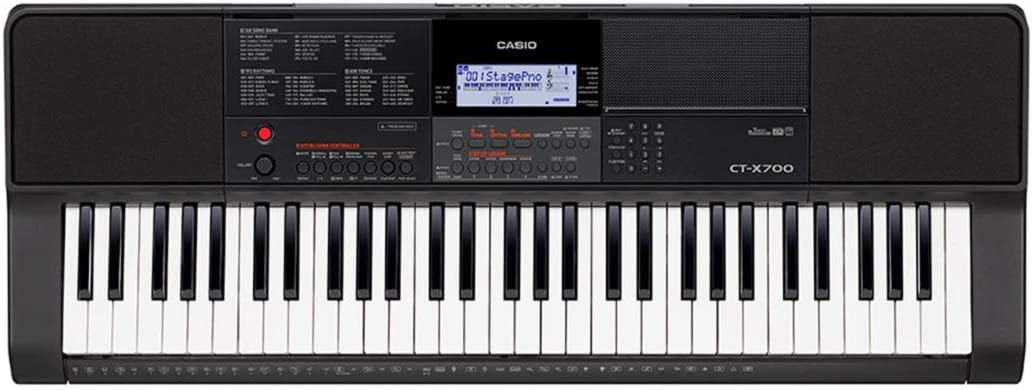
    Casio CT-X700 Portable Keyboard
    Key Specifications

    • Dimensions: 37.32 x 13.78 x 4.29 inches
    • Number of Keys: 61
    • Touch Sensitivity: Yes
    • Polyphony (Max.): 48
    • Sounds: 600
    • Rhythms: 195
    • Effects: Yes
    • Speakers: Yes
    • Weight: 4.3 kg
    • Price: $199

    My top pick for the Best Casio Keyboard for beginners is the Casio CT-X700 portable keyboard. It’s designed for beginner students, but it produces impressive sounds.

    Also, it has a compact and lightweight design that makes it easy to carry around wherever you go, perfect for practicing on the go.

    The keyboard features 61 piano-style keys with a touch response on/off button, giving it a realistic feel.

    The sound quality of the CT-X700 is truly impressive. This keyboard produces 600 high tones and 195 rhythms with high computing power. You’ll find old favorite tunes and chart-topping hits played with incredibly realistic instruments that sound better than ever.

    In addition, its large, clear LCD and intuitive user interface make it incredibly easy to use. You can also record your musical performance with the six-track recorder.

    One of the standout features of the CT-X700 is the Step-Up Lesson System. This system can help beginners learn to play the keyboard or be used alongside regular piano lessons.

    Also, this keyboard includes an AC power supply and optional battery power, making it a perfect go-anywhere musical partner.

    Overall, the Casio CT-X700 is one of the best entry-level arranger keyboards. It is ideal for people looking for an affordable, versatile keyboard with realistic piano sounds, high-quality voices, and accompaniment styles.

    Check On Amazon

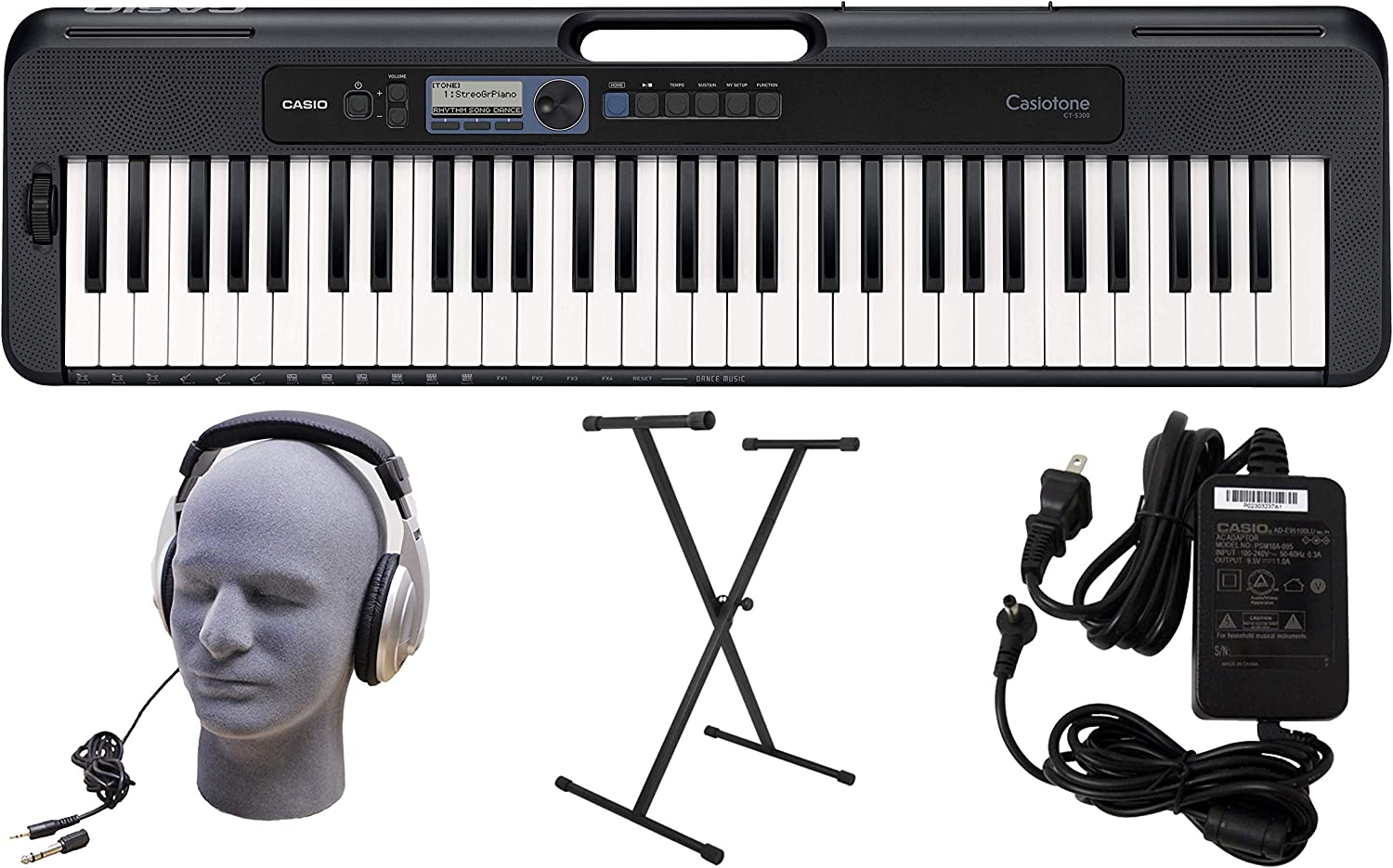
    Casio CT-S300

    Key Specifications

    • Dimensions: 36.61 x 10.07 x 2.87 inches
    • Number of Keys: 61
    • Touch Sensitivity: Yes
    • Polyphony (Max.): 48
    • Sounds: 400
    • Rhythms: 77
    • Effects: Yes
    • Speakers: Yes
    • Weight: 3.3 kg
    • Price: $189.95

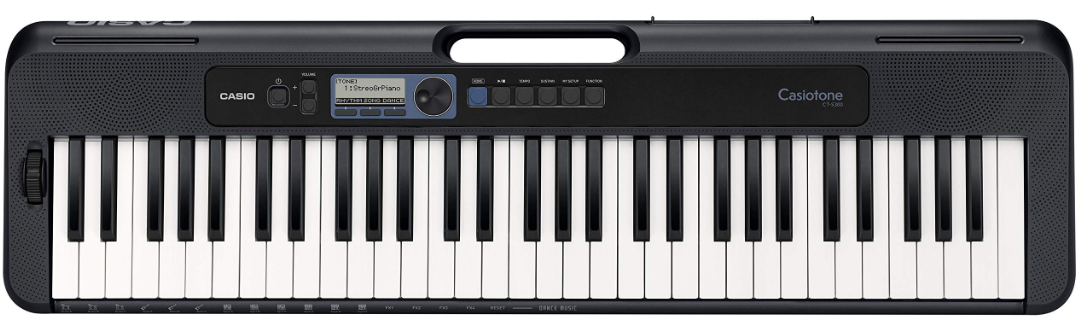
    The CT-S300 model is one of the best portable Casio piano keyboards for under $200.

    It features 61 touch-sensitive keys. That means how hard you press a key affects the volume of the pressed key sound. The keyboard is a step towards a real piano keyboard, but still far from it.

    Despite only weighing 3.4 kg, it features a sustain pedal that keeps notes in time even after keys are released.

    In terms of sound quality, it’s pretty decent for the price.

    The keyboard has 48 notes of polyphony, which is quite good for its price and one of the most important aspects of piano sound. It includes 400 impressive quality sounds, 77 fun rhythms, and some piano sound effects.

    It also features a pitch bend wheel. You can easily create and remix EDM tracks using its Dance Music Mode.

    Furthermore, this Casio keyboard includes a micro USB port, so you can connect it to any digital device if you want to access a music media program or app.

    As a side note, the CT-S300 can be powered by six AA batteries and lasts up to 20 hours. You can also use the provided AC adapter.

    In summary, if you’re looking for a good, cheap piano keyboard that plays well and sounds alright, the CT-S300 is a good option.

    Check On Amazon

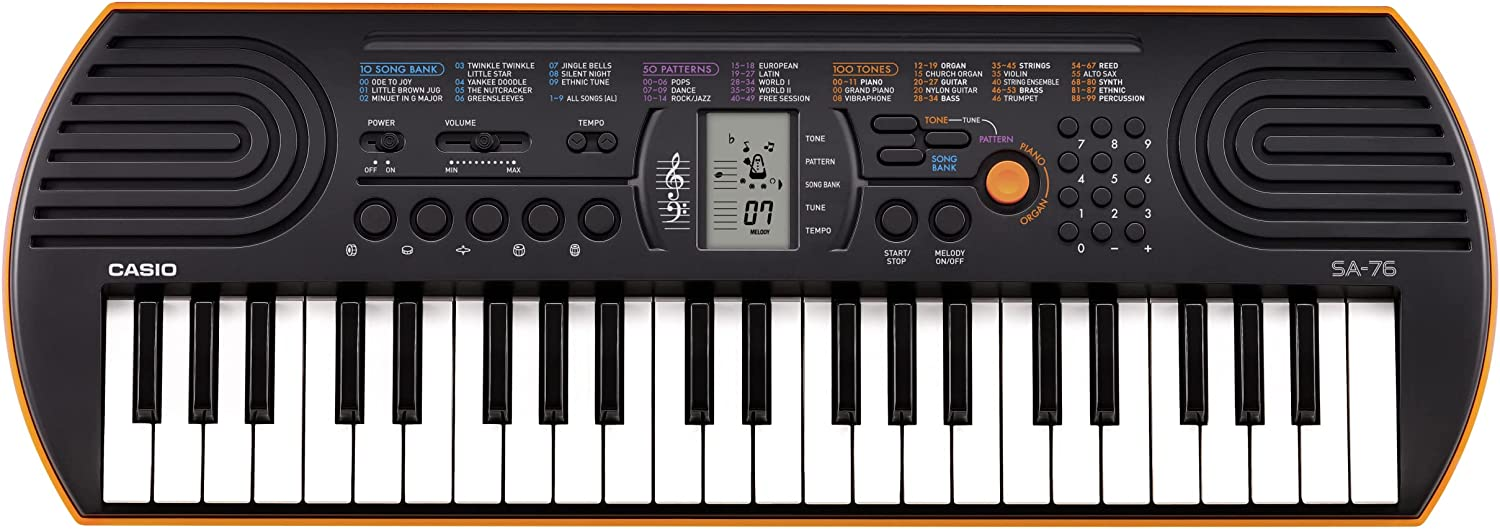
    Casio SA-76 44-Key Mini Personal Keyboard
    Key Specifications

    • Dimensions: 23.78 x 2.25 x 8.3 inches
    • Number of Keys: 44
    • Touch Sensitivity: N/A
    • Polyphony (Max.): 8
    • Sounds: 100
    • Rhythms: 50
    • Effects: Yes
    • Speakers: Yes
    • Weight: 1.4 kg
    • Price: $59

    The SA-76 is the cheapest Casio Keyboard for beginners available in the Casio SA series mini keyboards. It costs around $60.

    It weighs only 1.4kg, making it the most lightweight and compact keyboard on this list.

    It has a touch-sensitive keyboard with 44 mini-sized keys, ideal for young musicians. Remember that the keys are not weighted, so it does not feel like a real piano.

    However, that’s not a deal-breaker at this level – it’s a fun way for kids to learn how to play simple melodies over fun backing tracks.

    The SA-76 features built-in speakers, 100 built-in sounds, and 50 exciting rhythms. It also has ten basic songs, five drum pads, and, perhaps most importantly, a headphone jack.

    Designed for beginners, this keyboard is easy to use and fun to play. You can operate all the buttons quickly, and they’re clearly labeled. You can pick the Grand Piano or Reed Organ sound with the big orange button.

    Additionally, it has an LCD screen that lets you see the notes you play on screen, which helps you learn music notation.

    In summary, the Casio SA-76 is an excellent practice keyboard and perfect for kids or newbies trying to play piano to see if it is for them. Since the keys aren’t velocity-sensitive, it is not suitable for serious beginners.

    Check On Amazon

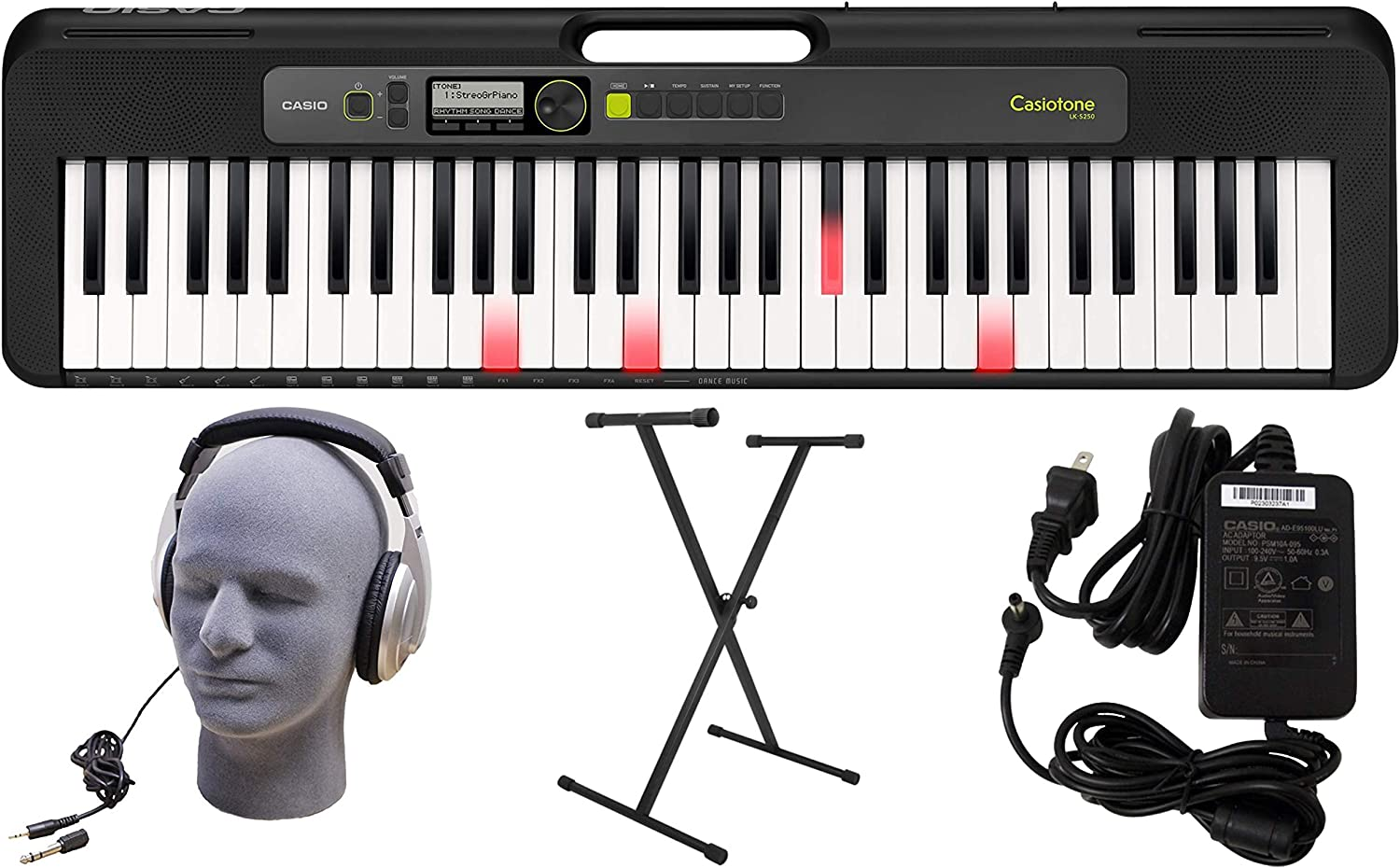
    Casio LK-S250 61-Key Premium Lighted Keyboard
    Key Specifications

    • Dimensions: 36.6 x 10.07 x 2.87 inches
    • Number of Keys: 61
    • Touch Sensitivity: Yes
    • Polyphony (Max.): 48
    • Sounds: 400
    • Rhythms: 77
    • Effects: Yes
    • Speakers: Yes
    • Weight: 3.4 kg
    • Price: $209.95

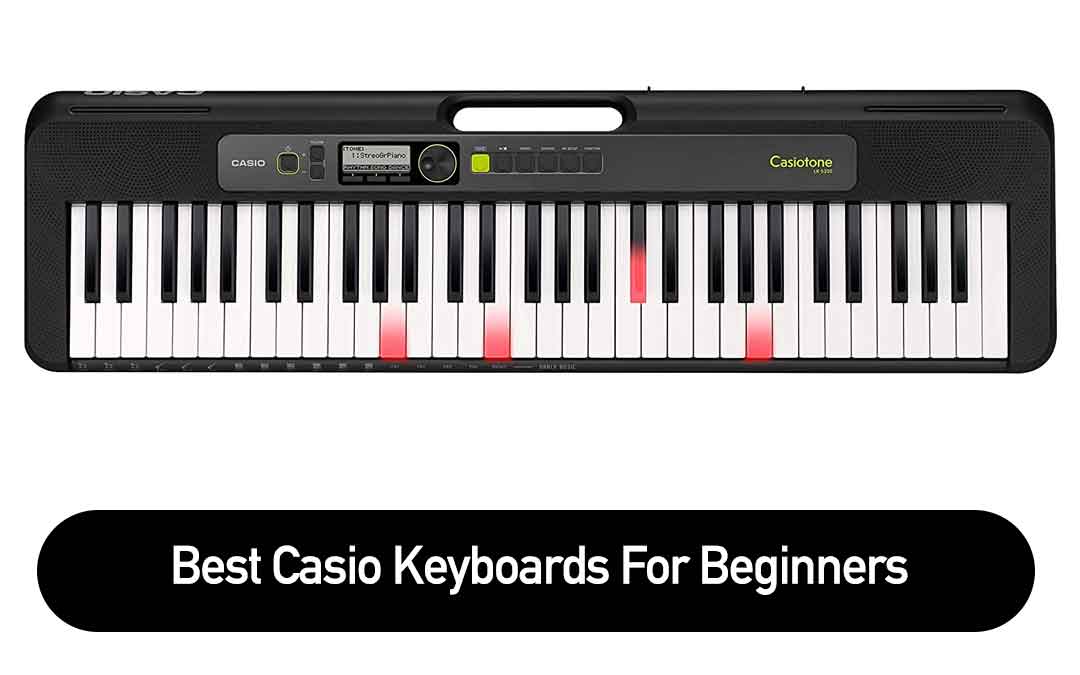
    Next up, we have the Casio LK-S250 keyboard that features 61 full-size velocity-sensitive, light-up keys.

    That means the correct keys will light up to tell you which notes to play as you play along to an onboard Step Up lesson or one of the 60 built-in songs.

    You can connect the keyboard to a smart device via the micro-USB port and use the Chordana Play app, which uses light-up keys to expand the keyboard’s educational possibilities.

    The keyboard’s minijack audio input lets you play MP3s along with external music sources.

    With its lightweight and slim design, the LK-S250 is incredibly portable. The device can be powered by batteries, making it easy to carry to practice sessions or performances.

    This learning keyboard has 400 tones and a Dance Music mode with 50 different rhythms, which makes it an excellent all-rounder. It also offers a maximum polyphony of 48, which is enough for beginners.

    In summary, the Casio LK-S250 keyboard is an excellent tool for beginners to learn to play the piano keyboard and improve their playing skills. Its 61 light-up keys provide helpful visual cues to learners.

    Check On Amazon

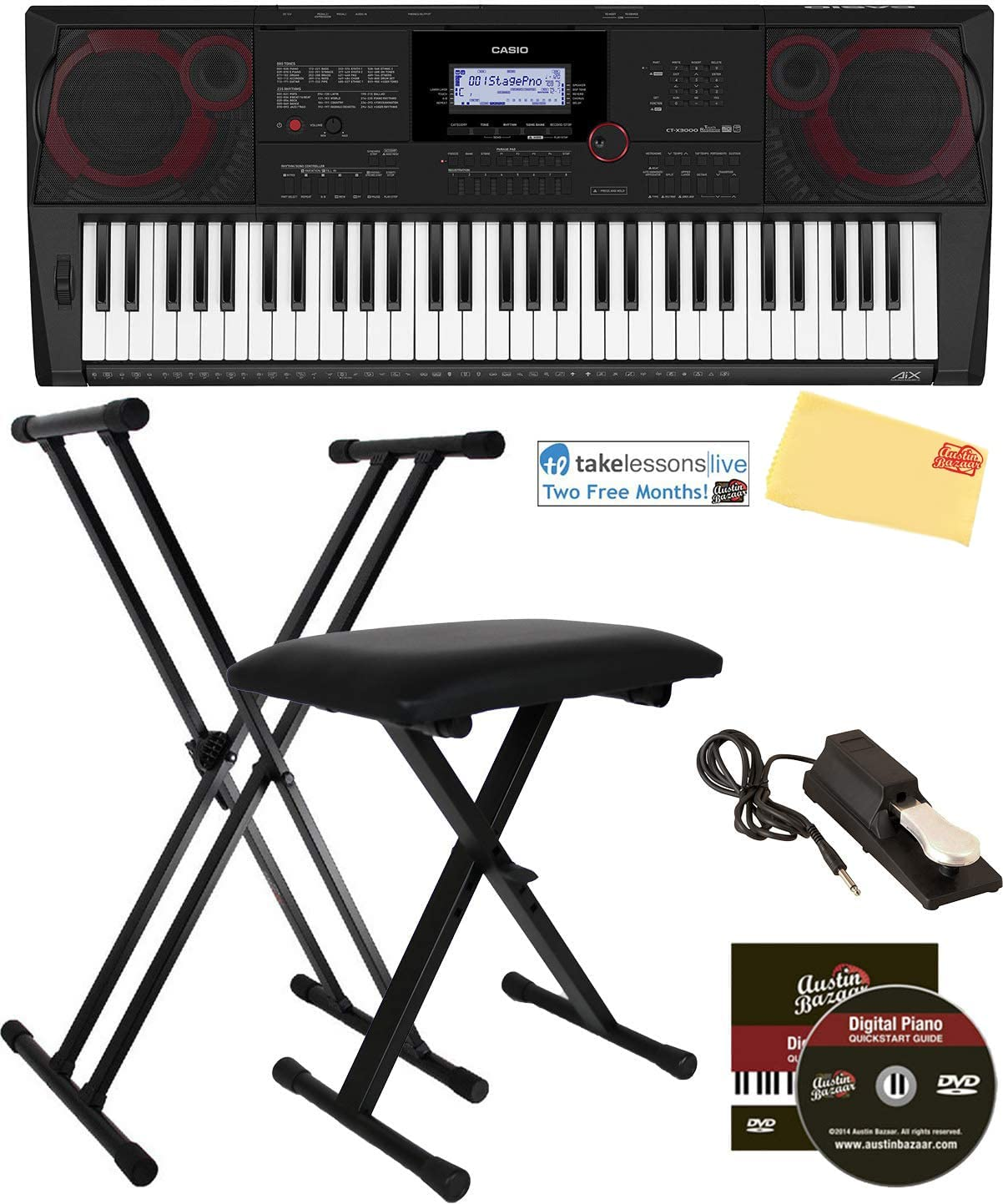
    Casio CT-X3000

    Key Specifications

    • Dimensions: 37.3 x 15 x 4.5 inches
    • Number of Keys: 61
    • Touch Sensitivity: Yes
    • Polyphony (Max.): 64
    • Sounds: 800
    • Rhythms: 235
    • Effects: Yes
    • Speakers: Yes
    • Weight: 6.9 kg
    • Price: $449

    The Casio CT-X3000 is an excellent choice for beginners looking for a high-quality keyboard. It has 61 full-size touch-responsive keys that provide an authentic playing experience.

    While the keys aren’t fully weighted, the touch response is adjustable, making it easy to play.

    The sound quality of this keyboard is superb. It has all the professional sounds you can expect from such a quality keyboard.

    It comes with 800 tones, giving users many options to keep them busy. The 235 editable rhythms and wide range of powerful DSP effects make this keyboard versatile and fun to play.

    The CT-X3000 also comes with a powerful 12-watt stereo speaker system that ensures users won’t be disappointed with the volume level.

    In addition to that, the 17-track sequencer, phrase pads, and arpeggiator provide plenty of options for creating music.

    One of the most impressive features of this keyboard is it comes with two months of live online keyboard lessons, making it an ideal choice for beginners who are just starting.

    The keyboard includes an adjustable stand, sustain pedal, and bench in a bundle pack, which saves you money while providing quality gear.

    Overall, the CT-X3000 is one of the best digital piano keyboards for beginners, intermediate players, and experienced pianists. It is an excellent value for the price.

    Check On Amazon

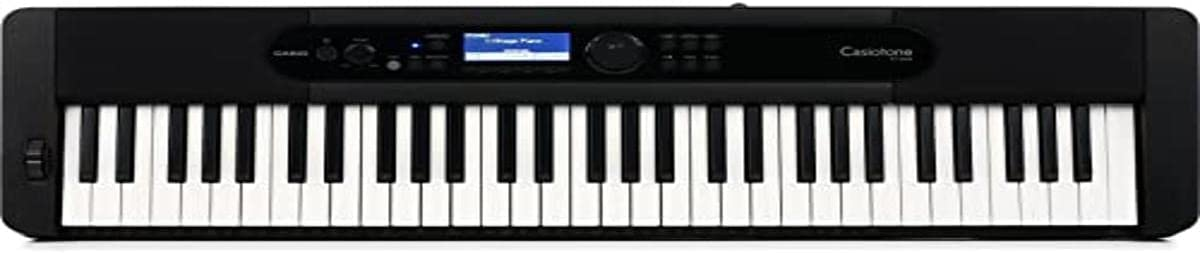
    Casio CT-S400

    Key Specifications

    • Dimensions: 36.61 x 10.15 x 3.30 inches
    • Number of Keys: 61
    • Touch Sensitivity: Yes
    • Polyphony (Max.): 48
    • Sounds: 600
    • Rhythms: 200
    • Effects: Yes
    • Speakers: Yes
    • Weight: 4.5kg
    • Price: $249

    The Casio CT-S400 portable keyboard is an excellent addition to the Casio Casiotone line.

    Casio launched the Casiotone brand in the 1980s, and in 2019, the company released three new portable keyboards: the CT-S100, the CT-S200, and the CT-S300. In 2021, they added the CT-S400 to the lineup, which is the range-topper of the line.

    The CT-S400 has a 61-key velocity-sensitive keyboard with a pitch-bend wheel and the AIX sound engine. The keys are full-sized and feel high-end, giving the player the experience of playing an acoustic piano.

    This musical instrument boasts 600 tones, 200 accompaniment styles, and a new backlit screen with five user-configurable soft buttons. The sounds are authentic.

    Casio’s philosophy of helping people make music anytime and anywhere is embodied in the CT range, and the CT-S400 is a worthy addition to that range.

    For those who prefer illuminated keys, there’s an equivalent light-up model called the LK-S450.

    Overall, the CT-S400 is a fantastic choice for beginners and experienced musicians looking for a versatile, reliable portable keyboard. Its sleek design, impressive sound, and user-friendly interface make it a favorite among players

    Check On Amazon

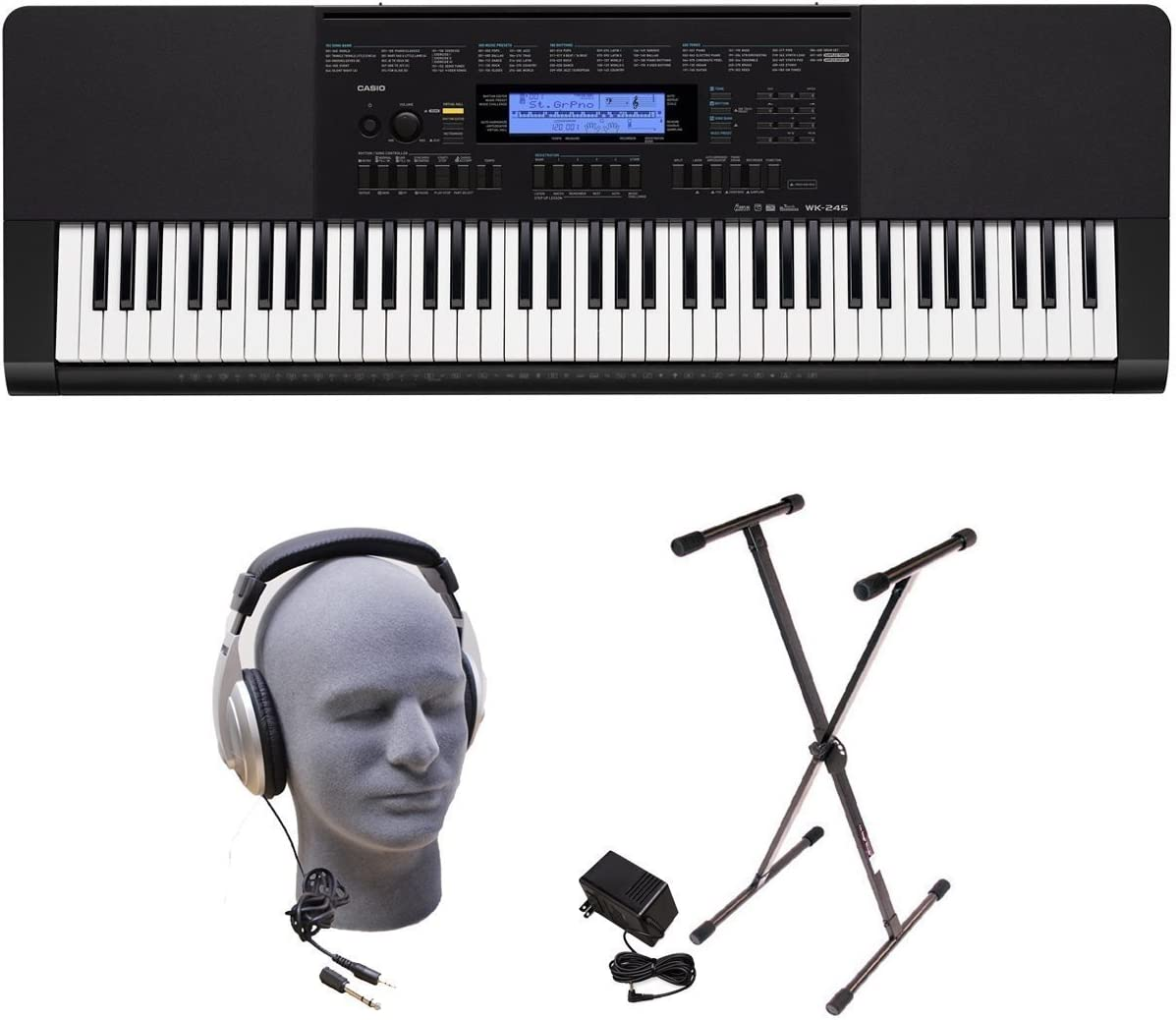
    Casio Inc. WK245 PPK Premium Portable Keyboard
    Key Specifications

    • Dimensions: 54 x 12 x 20 inches
    • Number of Keys: 76
    • Touch Sensitivity: 
    • Polyphony (Max.): 48
    • Sounds: 600
    • Rhythms: 260
    • Effects: Yes
    • Speakers: Yes
    • Weight: 7.2kg
    • Price: $250

    The Casio WK-245 PPK 76-Key Premium Portable Keyboard is an excellent choice for beginner students.

    The keyboard comes bundled with a bench, headphones, and a stand on top of the keyboard, making it a complete package for aspiring musicians.

    This beginner keyboard features a large backlit LCD panel that shows everything, including music notation. It also has performance controls, which allow you to combine tones into layers and split the keyboard.

    Furthermore, the Casio WK-245 PPK includes an AUX input that lets you connect your MP3 player or other devices, allowing you to enjoy the stereo speaker system in multiple ways.

    It also has a USB MIDI port, meaning you can connect it to computers and iOS devices without needing drivers.

    With 600 built-in tones and an impressive library of 152 built-in songs, you have plenty of options to choose from.

    Additionally, the 180 preset rhythms help to expand your music composition, creativity, and fun, and 48 notes of polyphony ensure no dropped notes.

    The keyboard also features an onboard 5-song/6-track recorder that lets you capture your ideas before they disappear. The headphones that come with this keyboard bundle pack are on the cheaper end, but they’re decent.

    Overall, the Casio WK-245 PPK is one of the best beginner keyboards that any age of musician will like. It feels pretty nice and is reasonably priced for the features it offers.

    Check On Amazon

    Casio CDP-S150 88-Key Digital Pianos-Home

    Key Specifications

    • Dimensions: 52 x 9 x 3.9 inches
    • Number of Keys: 88
    • Touch Sensitivity: Yes (3 sensitivity levels, off)
    • Polyphony (Max.): 64
    • Sounds: 10
    • Rhythms: N/A
    • Effects: Yes
    • Speakers: Yes
    • Connectivity: USB Type-A port, stereo mini audio jack, sustain pedal jack, Phones/Output: stereo mini jack, Connector for SP-34 three-pedal unit
    • Weight: 10.5 kg
    • Price: $399

    If you have your heart set on getting an 88-key digital piano keyboard, the Casio Privia PX-160 is the best choice.

    With its affordable price tag of $399, this keyboard features 88 full keys with weighted hammer action.

    Because the weighted keys are made of simulated ebony and ivory, this keyboard feels like a more expensive piano keyboard. You can adjust the touch sensitivity to three levels or turn it off entirely, depending on your needs.

    The CDP-S150 offers ten different sounds and effects, including grand piano, electric piano, and harpsichord. Its grand piano sounds and 64 maximum polyphony are sufficient for a professional pianist and more than enough for a beginner.

    The built-in speaker system and dual headphone jacks allow for private practice. Also, it has a USB Type-A port and stereo mini audio jack for connecting to other music gear, such as amplifiers.

    Additionally, this instrument comes with a keyboard stand and bench, making it an all-in-one package.

    Overall, if you are serious about learning piano and want to become a professional musician, the Casio CDP-S150 is the right digital piano.

    Check On Amazon

    How To Choose A Casio Keyboard For Beginners?

    Before you begin your search for the best keyboards for beginners and kids, you need to know how to choose the best ones.

    Choosing the best Casio musical keyboard for beginners comprises specific factors. The following are these factors:

    No. of Keys

    The first thing to consider is the number of keys on the keyboard. It largely depends on the genre a player plays or intends to play.

    As a beginner, you might want to opt for a keyboard with 61 keys, which is good enough for initial learning.

    If you are serious about learning the piano and want to mimic the feel of an acoustic piano, a keyboard with 88 keys would be a better choice.

    Sound

    Another crucial factor to consider is the keyboard’s sound quality. You should look for a keyboard with high-quality sound, which includes a wide range of instrument sounds and tones.

    You should look for a keyboard with high-quality sound, which includes a wide range of instrument sounds and tones.

    Casio keyboards come with a vast library of sounds and tones, which can be helpful for learning different types of music.

    Portability

    Portability is an essential factor, especially if you plan on carrying your keyboard around. If you need a keyboard that is easy to carry, look for a lightweight and compact design that is easy to transport.

    Speaker Quality

    It is also essential to consider the quality of the speakers. As a beginner, you may not want to invest in additional speakers or amplifiers.

    Therefore, a keyboard with high-quality built-in speakers is essential. Some Casio keyboards come with excellent built-in speaker systems, which provide a rich and full sound.

    Price

    Finally, you need to consider the price of the keyboard. As a beginner, you don’t want to spend too much money on a keyboard that you may outgrow soon.

    Casio offers a range of keyboards that are affordable and suitable for beginners. Look for keyboards that provide good value for money without sacrificing quality.

    Ultimately, choosing the best Casio musical keyboard for kids and beginners is all about finding the right balance between functionality, sound quality, portability, speaker quality, and price.

    By considering these factors, you can select a keyboard that suits your needs and helps you learn music effectively.

    Conclusion

    These are my top eight best Casio musical keyboards for beginners and kids.

    No matter which model you opt for, these electronic musical instruments are among the best and will help you learn to play the piano and improve your musical skills.

    I hope my Casio keyboard reviews and buying guide will help you make an informed purchase.
    Related Topics

  • Best Digital Piano Under 300 In 2023

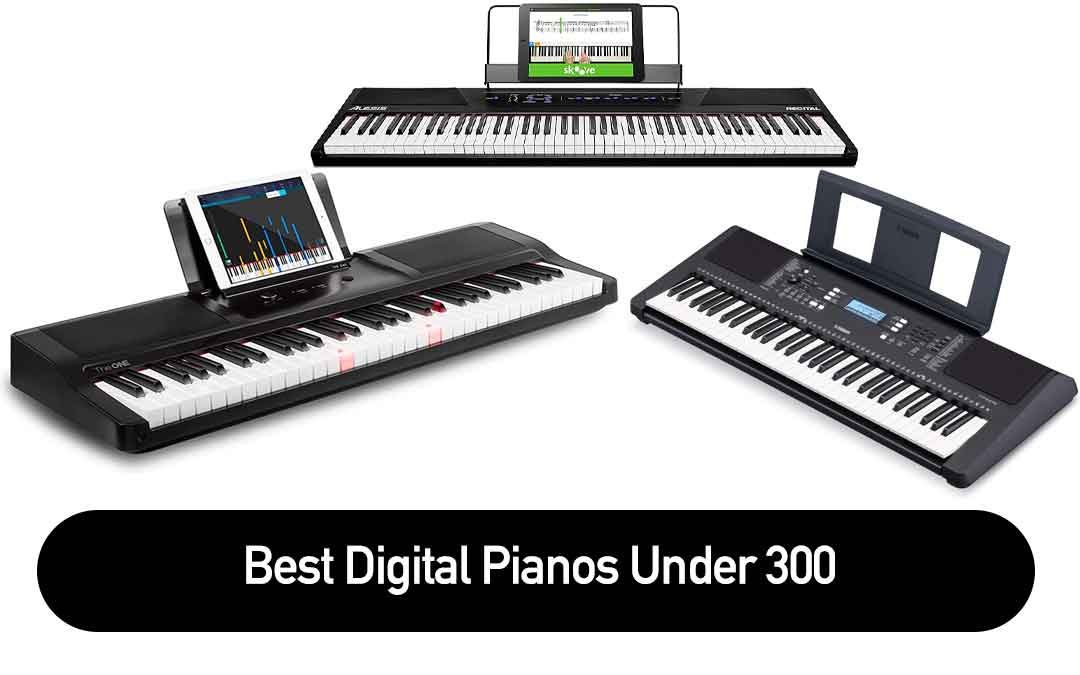
    Best Digital Piano Under 300 In 2023

    If you are looking for the best digital piano under 300, then you’ve reached the right place.

    Choosing a budget-friendly keyboard piano doesn’t mean sacrificing quality.

    In today’s market, many options are available, so finding the best digital piano keyboard is not difficult, even with a $300 budget.

    The problem is that manufacturers make many promises; some are true while others are not, which leaves us confused when choosing one.

    That’s why we scoured the market and narrowed down the top 8 best digital pianos under $300 based on their features, sound quality, connectivity, and overall value for the price.

    With this guide, you can be confident in your decision and find a piano that suits your needs and budget.

    So, read on to find out which models made our list!

    8 Best Digital Pianos Under 300 Dollars (2023)

    If you (or your kid) are an absolute beginner taking your first steps into the world of piano playing, you don’t need to break the bank on your first instrument. I suggest spending no more than $500 on your first keyboard or digital piano.

    While the best digital piano models listed below don’t have weighted hammer action keys like more expensive digital pianos, they have touch sensitivity. As a result, they are piano keyboards, not digital pianos.

    However, these inexpensive musical instruments are ideal for beginners to test out their interest or enthusiasm in music.

    Plus, they offer a range of digital features to help you to learn to play piano and exciting instruments to have fun with, especially with the accompaniment feature.

    Although they aren’t meant for professional use, you can still learn a lot of music with them and show off your or your children’s musical skills to friends and family.

    Here are the eight best digital pianos under 300 dollars for kids and adult beginners:

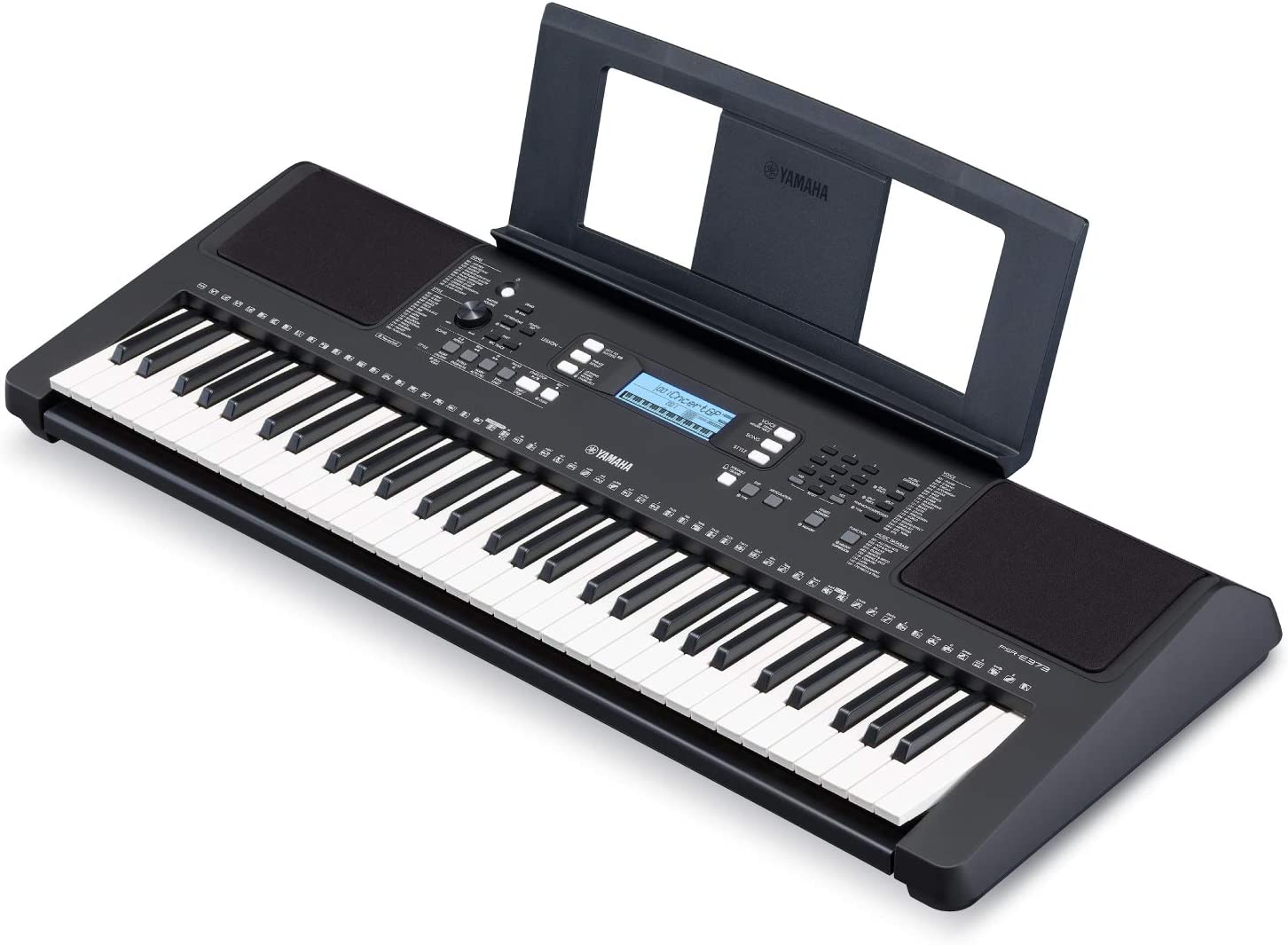
    Yamaha PSRE373 Portable Piano

    Specification

    • Dimensions: 37.1 x 14.5 x 4.6 inches
    • Number of Keys: 61
    • Touch Sensitivity: Yes (Soft, Medium, Hard, Fixed)
    • Polyphony (Max.): 48
    • Voices: 622
    • Effects: Yes
    • Speakers: Yes
    • Pedals: N/A
    • Metronome: Yes
    • Connectivity: USB TO HOST, DC IN, AUX IN, sustain pedal input, stereo headphone jack.
    • Weight: 4.6 kg
    • Price: $189

    The Yamaha PSR-E373 is our top pick for best digital pianos under 300 because of its high-quality sound and versatile features. You can use it as a beginner’s piano keyboard or a full-featured arranger.

    The keyboard weighs only 4.6 kg, making it easy to carry around.

    It features 61 touch-sensitive keys to play with different dynamics and styles. It also has a maximum of 48-note polyphony, which allows you to play complex musical passages without any notes dropping out.

    The 373 produces a beautiful sound of a grand piano. You can conveniently access the default grand piano voice by pressing the Portable Grand button. The sound sample is from Yamaha’s quarter million dollar CFX concert grand piano.

    In addition, the E373 offers over 620 voices ranging from acoustic pianos to electronic instruments such as electric pianos, flutes, guitars, strings, percussions, saxophones, drum kits, and various sound effects. You can also apply reverb, chorus, and Digital Signal Processing (DSP) effects to the voices.

    Additional features of the PSR-E373 include dual, split, and duo modes, transposition, Smart Chord, custom master tuning, a built-in metronome, and a 2-track MIDI recorder. Also, it features a backlit LCD panel for ease of reading in any lighting condition.

    Regarding connectivity, this beginner keyboard piano includes a USB MIDI port to connect your devices and a built-in audio interface to transmit audio data between your keyboard and computer or mobile devices. Under $300, you won’t find this feature in any other digital piano.

    The Yamaha PSR-E373 doesn’t come with a power adapter. You can run it on six AA batteries, of course. However, the battery only lasts a few hours, and it’s best for on the road when you don’t have access to an electric outlet.

    Overall, the Yamaha PSR-EW310 keyboard piano undoubtedly offers exceptional value for money. I highly recommend this keyboard piano for beginners and those who are just starting and want to see if they will stick with it long-term.

    Check On Amazon

    Casio Casiotone CT-S300

    Specification

    • Dimensions: 36.6 x 10 x 2.8 inches
    • Number of Keys: 61
    • Touch Sensitivity: Yes (2 sensitivity levels, off)
    • Polyphony (Max.): 48
    • Voices: 400
    • Effects: Yes
    • Speakers: Yes
    • Pedals: N/A
    • Metronome: Yes
    • Connectivity: USB port (micro B), sustain pedal jack, stereo mini audio jack, Phones/Output: stereo mini jack.
    • Weight: 3.3 kg
    • Price: $179

    Our runner-up is the Casio CT-S300, which is actually the best digital piano under 200 USD.

    Made with solid materials, the design of the CT-S300 model is nice. Its thoughtful carry handle makes the device easy to carry anywhere.

    The keyboard has 61 touch-sensitive boxed keys with texture and matte finish that enhance the piano playing experience. It also offers a maximum polyphony of 48 notes, 400 tones, 77 accompaniment rhythms, and 60 demo songs.

    With the LCD screen, you can easily see at a glance what tones, rhythms, and parameters you have set, which makes the layout very logical and convenient.

    Additionally, the instrument comes with a dance music mode that lets you easily create and remix EDM tracks.

    The CT-S300 is a fun piano keyboard if you want to be a DJ (Disc Jockey) since it has 50 dance music patterns. You can even spice up your DJ patterns with 12 human voices.

    Furthermore, this affordable piano features built-in speakers for sharing with friends, and the headphone jack allows you to practice quietly without disturbing others. It has a stereo mini audio jack, a sustain pedal jack, and a USB port for connectivity.

    At $179, the Casio CT-S300 comes with a music rest and power supply.

    Overall, this keyboard is an excellent choice for those looking for an affordable and fun digital keyboard with decent sound quality and various features.

    Check On Amazon

    Alesis Recital – 88 Key Digital Piano

    Specification

    • Dimensions: 50.5 x 11.5 x 3.6 inches
    • Number of Keys: 88
    • Touch Sensitivity: Yes
    • Polyphony (Max.): 128
    • Voices: 5
    • Effects: Yes
    • Speakers: Yes
    • Pedals: N/A
    • Connectivity: USB-MIDI output, sustain pedal input, stereo headphone jack
    • Weight: 7 kg
    • Price: $229

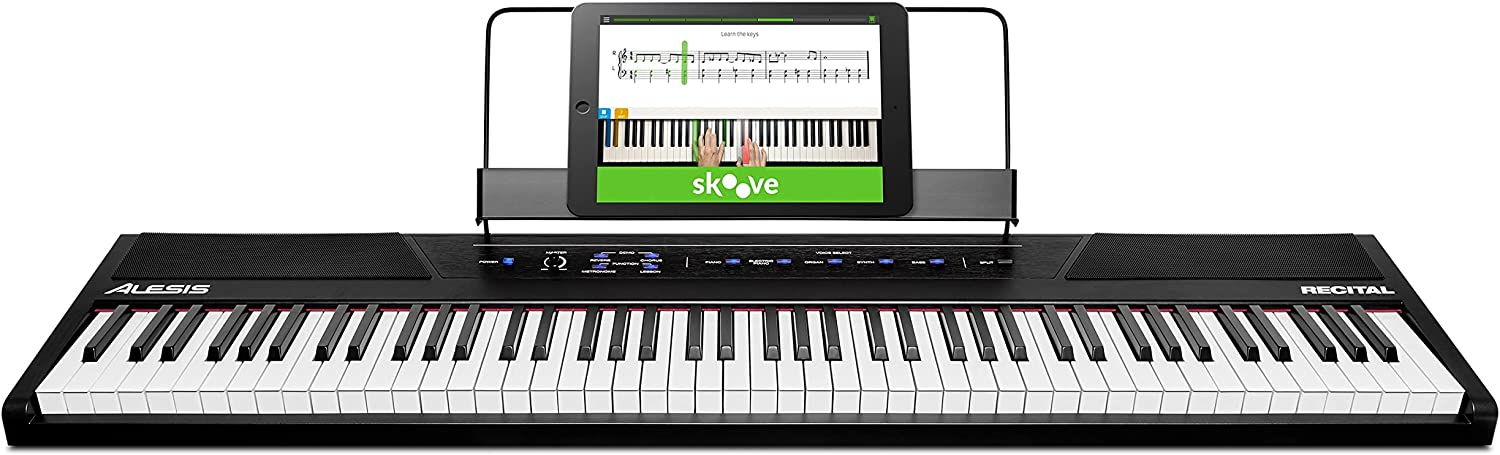
    On this list of digital piano reviews, the Alesis Recital is the only model with 88 keys. This keyboard features 88 semi-weighted keys, which are not as good as fully weighted, responsive keys but good enough for beginners.

    Additionally, it provides ultra-realistic sound and a great playing experience with 128 maximum polyphony and powerful 20-watt speakers.

    Because of these qualities, the Recital earns the third spot on our list of the eight best digital pianos under 300.

    If you’re a beginner or intermediate pianist with a tight budget and wish to progress your piano journey quickly, the Alesis Recital is a fantastic choice.

    While the Recital doesn’t have hundreds of sounds, its five voices (piano, electric piano, organ, synth, and bass) are decent enough for beginners or seasoned players.

    Some people may use this as a controller in their home studios or live settings. They don’t care about the weighted keys; they want the right size and feel.

    Luckily, the Recital has a USB MIDI output that allows musicians to hook up with MIDI programs or apps.

    But what sets the Recital apart is its educational features. This keyboard offers powerful educational features like standard, split, layer, and lesson modes, as well as a three-month premium subscription to Skoove for expert interactive online piano lessons.

    And if you want to improve your piano skills for any genre or technique, you can take advantage of the 60 free virtual lessons from Melodics that come with the Recital.

    In summary, if you are looking for the best digital piano under 300 dollars with a realistic piano feel, then the Alesis Recital 88-Key Beginner Digital Piano is worth considering.

    Check On Amazon

    Yamaha NP32 76-Key

    Specification

    • Dimensions: 49 x 10.18 x 4.12 inches
    • Number of Keys: 76
    • Touch Sensitivity: Yes
    • Polyphony (Max.): 64
    • Voices: 10
    • Effects: Yes
    • Speakers: Yes
    • Pedals: N/A
    • Metronome: Yes
    • Connectivity: USB to Host port, DC IN, sustain pedal input, headphones jack
    • Weight: 5.7 kg
    • Price: $329.99

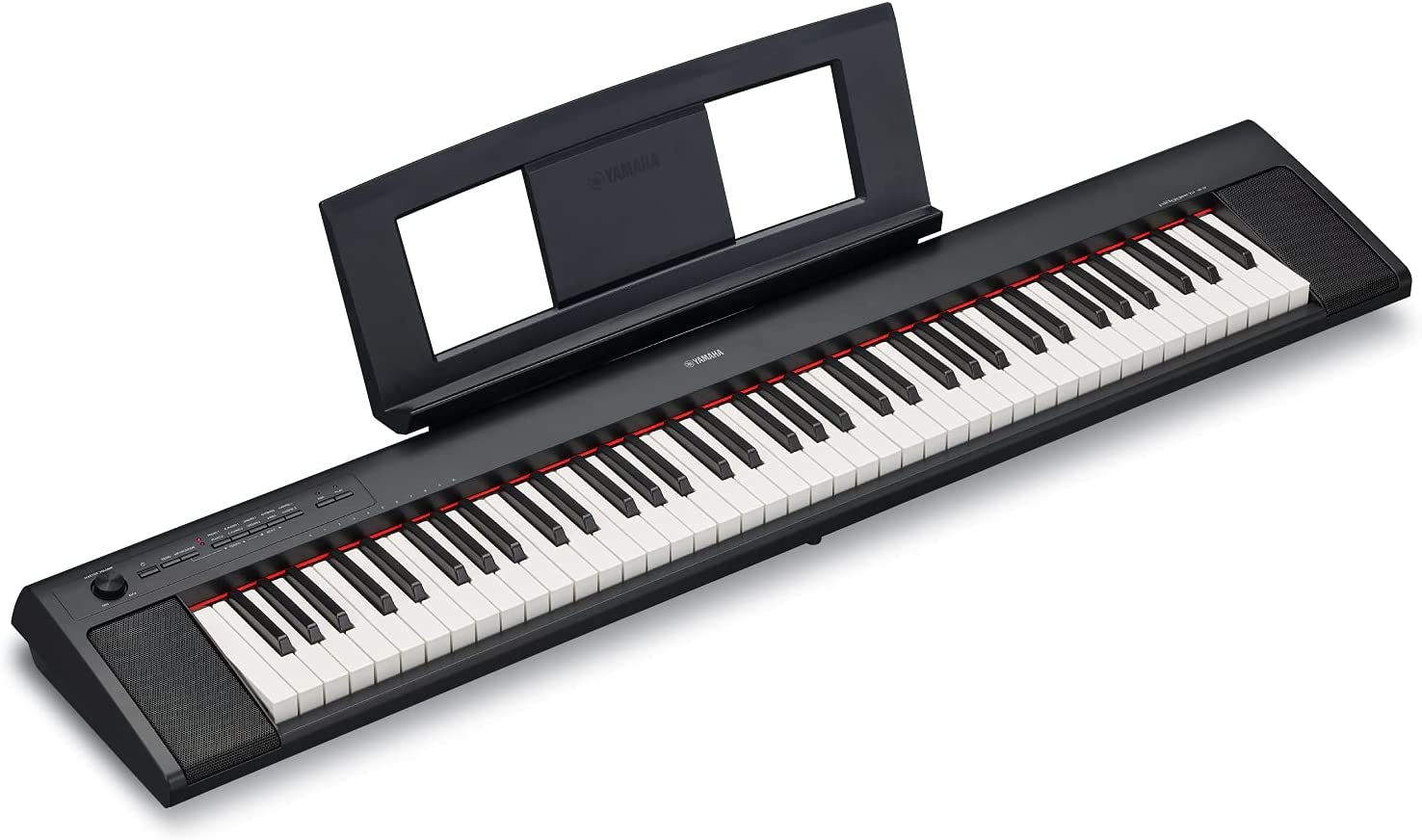
    Another popular Yamaha digital piano for $300 in this list is the Yamaha NP32 76-Key lightweight, portable keyboard. It is an excellent choice for those who want to learn how to play piano.

    The NP32 has a 76-key Graded Soft Touch (GST) keyboard that simulates the feel of an acoustic piano. This allows an authentic playing experience despite its lightweight construction.

    The piano’s Advanced Wave Memory Stereo Sampling technology provides top-notch sound quality, replicating the natural sound of instruments. Additionally, it includes ten other sounds that are equally impressive.

    The NP32 offers 64-note polyphony, a song recorder, and extended battery life. Since the device is battery-powered with 6 AA batteries, you’re not tied to a wall outlet power supply. However, you can buy one separately if you so choose.

    A notable feature of this musical instrument is the controller app for iOS, which adds a rich and user-friendly interface for easy navigation and configuration. The USB port lets you connect and interact with various educational apps on your computer or mobile devices.

    Overall, the Yamaha NP32 is a good choice for beginners who want to learn the basics of piano playing.

    Check On Amazon

    Alesis Melody 61 MKII

    Specification

    • Dimensions: 37.4 x 12.4 x 4.1 inches
    • Number of Keys: 61
    • Touch Sensitivity: Yes
    • Polyphony (Max.): N/A
    • Voices: 300
    • Effects: Yes
    • Speakers: Yes
    • Pedals: N/A
    • Connectivity: a 1/8″headphone output
    • Weight: 4 kg
    • Price: $117

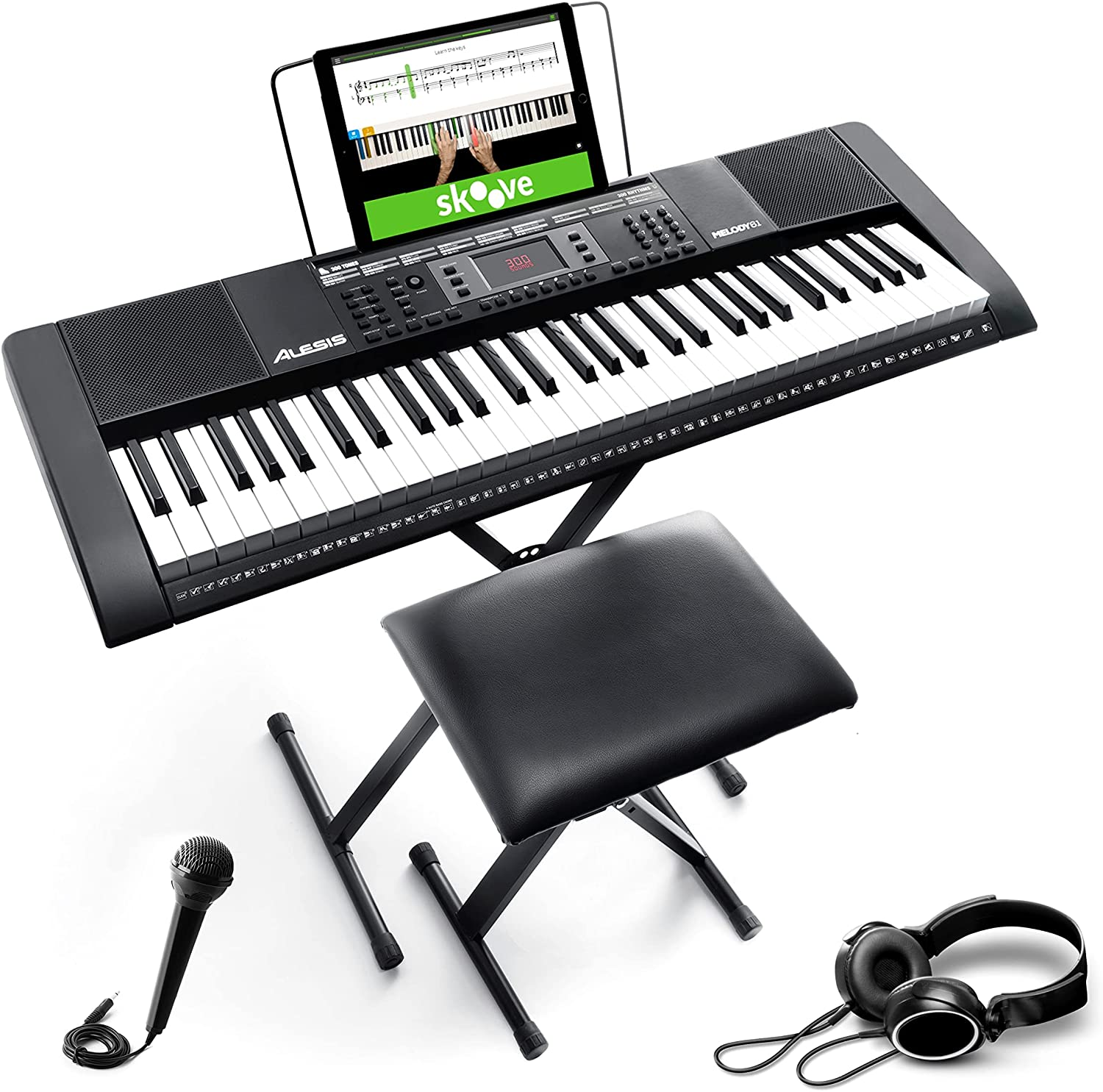
    The Alesis Melody 61 MKII is the most portable and cheapest digital piano on this list. It has 61 full-size piano-style keys and built-in speakers that allow you to practice and perform in front of friends and family.

    Also, this piano has 300 sounds to choose from, including acoustic piano, electric piano, strings, organ, synths, and drums. With Dual and Split modes, you can mix two different sounds to create a unique sound.

    You can even record your performances with the “Record” feature. This piano also comes with 40 demo songs, 300 rhythms, and a wide range of piano sound effects.

    Furthermore, this portable piano offers powerful educational features, including a 3-month premium subscription from Skoove for interactive online piano lessons and two months of live video lessons from TakeLessons.

    The Alesis Melody package includes everything you need: a keyboard stand, bench, headphones, sheet music stand, microphone, and power adapter. The sheet music stand can hold sheet music or tablet devices, so you can read music or attend lessons while playing.

    Although the microphone and headphones aren’t great, they’re decent for the price.

    Overall, Alesis Melody 61 MKII is one of the best portable digital pianos for children and adult beginners who want a fun and engaging way to learn and practice piano.

    Check On Amazon

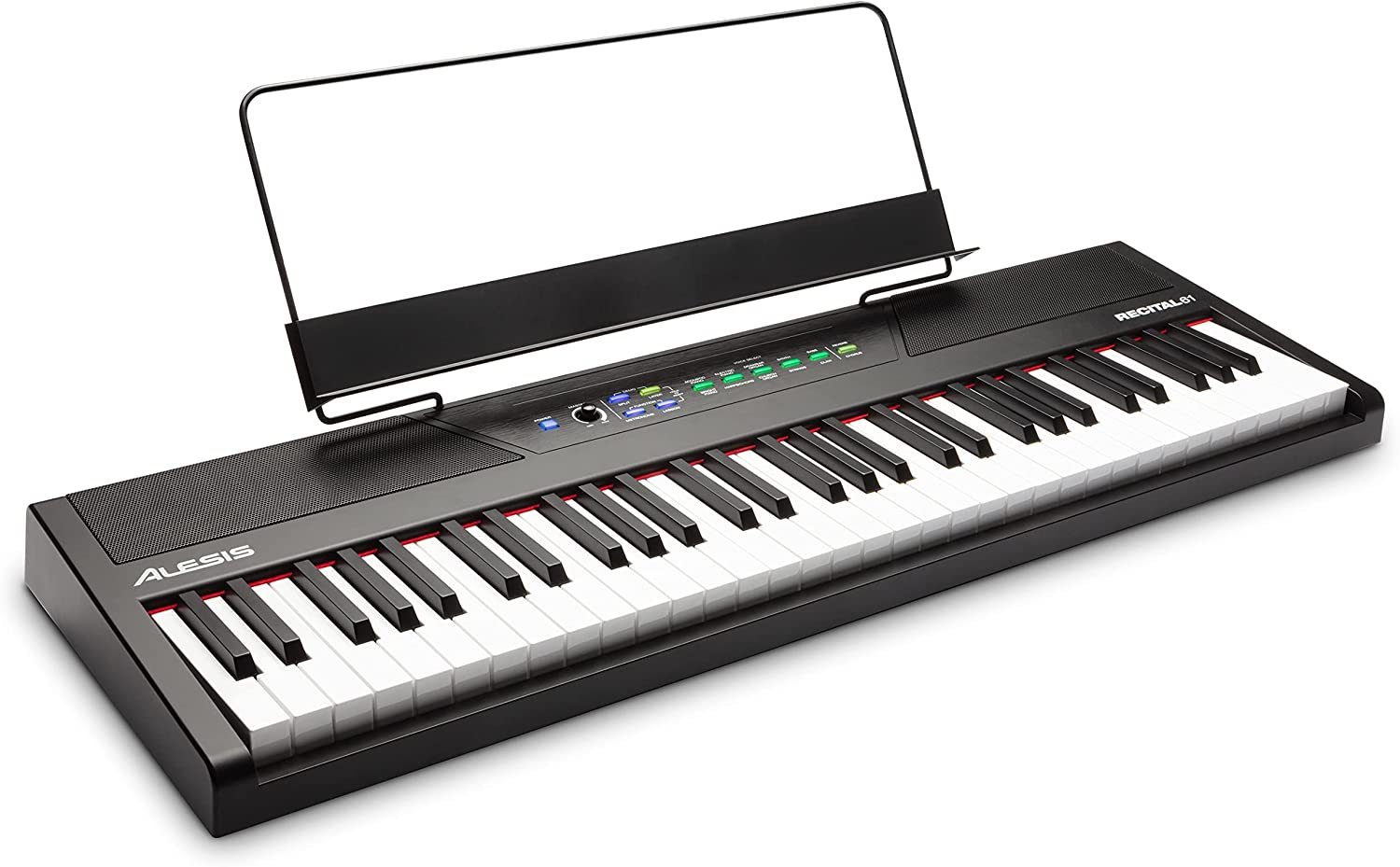
    Alesis Recital 61 Digital Piano

    Specification

    • Dimensions: 35.64 x 11.5 x 3.4 inches
    • Number of Keys: 61
    • Touch Sensitivity: Yes
    • Polyphony (Max.): 128
    • Voices: 10
    • Effects: Yes
    • Speakers: Yes
    • Pedals: N/A
    • Connectivity: USB-MIDI output, sustain pedal input, stereo headphone jack
    • Weight: 5.6 kg
    • Price: $199

    The Alesis Recital is a fantastic entry-level keyboard piano with a sleek and compact design. It has 61 semi-weighted keys with adjustable touch response, which allows you to customize your playing style.

    The sound quality is impressive for a keyboard at this price. It also features ten premium sounds, a wide range of sound effects, 128-note max polyphony, and powerful 20-watt built-in speakers.

    The speakers produce high-quality sound, making this keyboard piano suitable for small performances.

    Additionally, the keyboard has educational features that help students learn and practice piano.

    When it comes to connectivity, this instrument features a dedicated headphone output, RCA connectors for hookup flexibility, and a damper pedal input.

    On the negative side, it doesn’t include a sustain pedal and lacks a recording feature.

    You can’t go wrong with the Alesis Recital 61 if you want a budget digital piano keyboard that offers excellent value for money without overloading it with bells and whistles.

    Check On Amazon

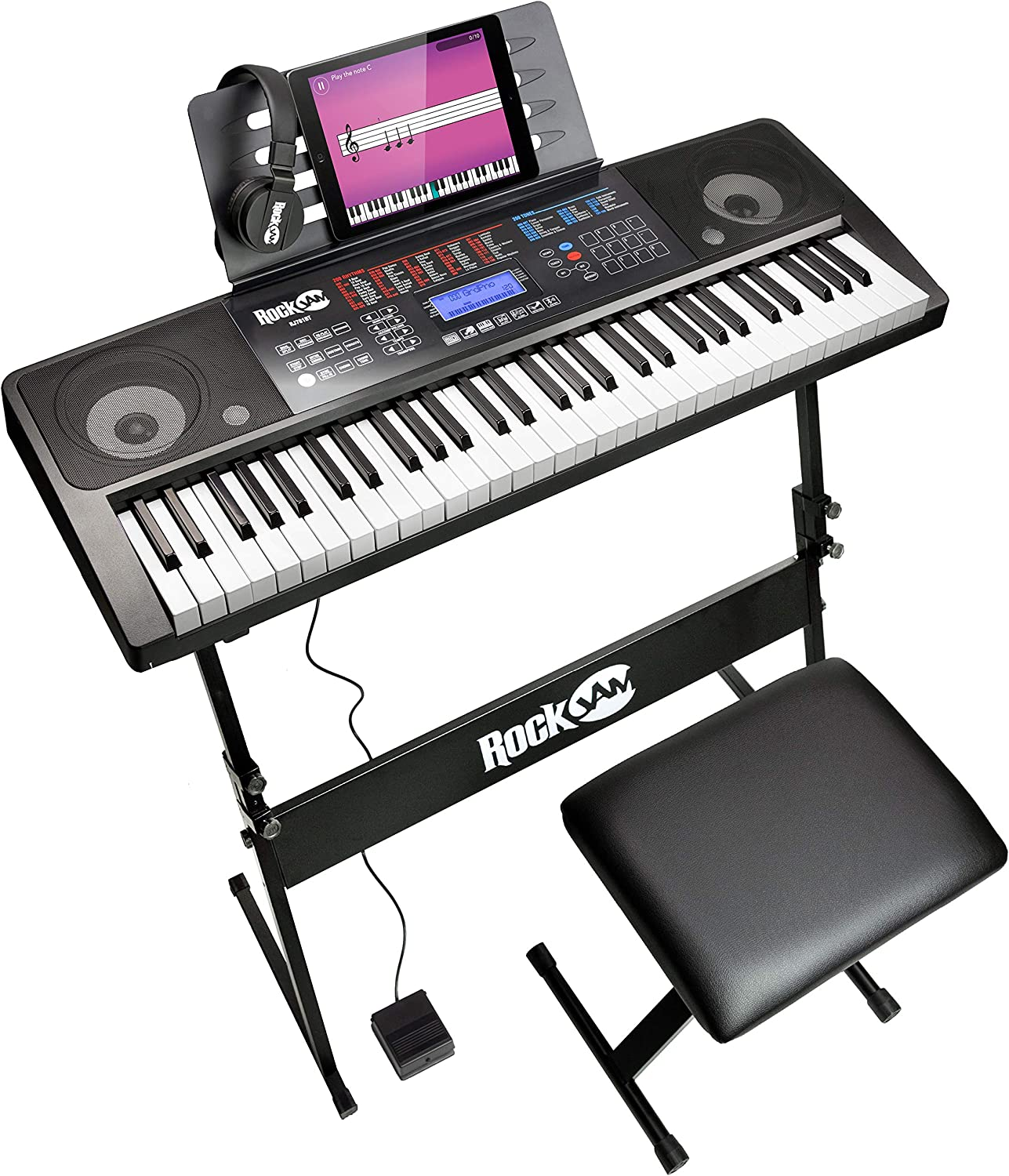
    RockJam 61 Key Keyboard Piano

    Specification

    • Dimensions: 35.6 x 12.6 x 4.3 inches
    • Number of Keys: 61
    • Touch Sensitivity: Yes
    • Polyphony (Max.): N/A
    • Voices: 200
    • Effects: Yes
    • Speakers: Yes
    • Pedals: 1 (sustain pedal)
    • Connectivity: USB-MIDI port, AUX IN, sustain pedal input, headphones jack
    • Weight: 5.4 kg
    • Price: $165.78

    The RockJam 61 Key Keyboard Piano SuperKit isn’t the best when it comes to sound quality or audio fidelity. But if you’re looking for a package that includes everything you need at a reasonable price, then it might be the best option.

    Featuring 61 full-sized keys, this piano gives the feel of a traditional piano while still being portable and compact. This keyboard can be powered by either mains or batteries, allowing you to play wherever you want.

    One of the best things about the keyboard is that it comes with piano note stickers and the Simply Piano app, which makes learning piano quick and enjoyable for beginners.

    Furthermore, it has a touch display panel that provides feedback and access to 200 rhythms, 200 tones, a teaching function, and 30 demo songs.

    You can also easily record and play back your music and integrate the keyboard with your digital audio workstation via a single cable.

    In addition to the keyboard itself, this super kit also comes with headphones, a sturdy keyboard stand that can be adjusted to suit players of all ages, and a padded seat that provides hours of comfortable play.

    In contrast to all the other models on this list, this one includes a damper pedal that enhances your piano-playing experience.

    Overall, the RockJam 61 Key Touch Display Keyboard Piano is a good option for beginners and intermediate piano players looking for a versatile and reliable keyboard at an affordable price.

    Check On Amazon

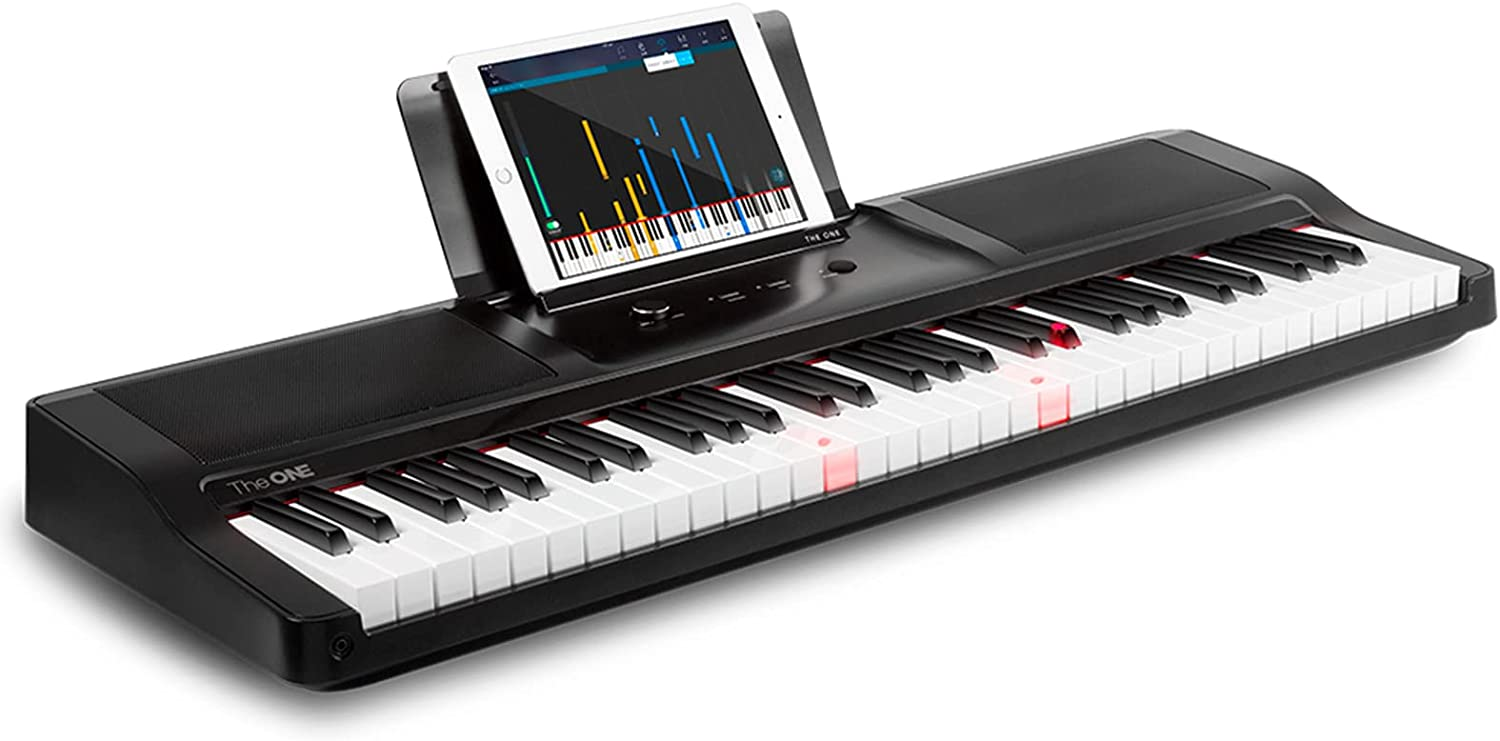
    The ONE Smart Piano Keyboard

    Specification

    • Dimensions: 36.22 x 12.99 x 3.94 inches
    • Number of Keys: 61
    • Touch Sensitivity: Yes
    • Polyphony (Max.): 128
    • Voices: 417
    • Effects: Yes
    • Speakers: Yes
    • Pedals: N/A
    • Connectivity: USB port, sustain pedal input, triple-pedal port, headphones jack
    • Weight: 5 kg
    • Price: $243

    Last but not least, the ONE Smart Piano Keyboard is an excellent beginner-friendly digital piano with built-in red LED lights. The light-up keys tell the player what piano key he (or she) needs to play.

    The keyboard features 61 standard keys with touch response and two speakers. It also comes with 128 notes of polyphony which means you won’t have any note drops even when you are playing fast or complex pieces.

    The piano contains over 4000 sheet music, 100 instructional videos, and games in the free apps, making it a comprehensive learning tool.

    The ONE Smart Piano app offers video lessons, quick courses, and 417 tones. The video lessons are graded and start from the very first lesson to more advanced playing.

    You can pause and rewind if you want to return to a particular topic. As a result, you can learn according to your own schedule.

    This teaching piano keyboard is compatible with iOS and Android devices and supports external pedals and headphones. With only four buttons on the surface, it is easy to operate.

    The ONE Smart Piano also comes with a recording and MIDI function, a headphones jack, and Power Adapter. It can be powered by an AC adapter or 6 AA batteries, making it convenient to carry.

    Overall, the ONE Smart is an excellent lighted keys digital piano that suits adult and junior students. It’s not only a piano but also a teacher.

    Check On Amazon

    Conclusion

    So, this was our list of the eight best digital pianos under 300. These models are not only inexpensive but also portable and versatile.

    These digital pianos let you play silently with headphones, experiment with different instrument sounds, and even record your performances.

    While you won’t find any new pianos with fully weighted keys for under $300, plenty of great options are still available. Most keyboards in this price range come with semi-weighted keys, which still offer a decent playing experience.

    If you’re looking for an 88-key keyboard, the Alesis Recital is a fantastic option.

    Other digital piano keyboards that sell for under $300 usually have 76 keys or less, which is fewer than the keys on a real piano. That’s fine if you’re a beginner or just playing for fun.

    Ultimately, choose the one that is most suitable for your needs and budget.

    Related Topics

  • How to Play the Piano Faster: Tips and Techniques

    How to Play the Piano Faster: Tips and Techniques

    Practical Ways to Play the Piano Faster

    Learning to play the piano is an exciting journey that requires time, patience, and dedication. Many people dream of playing their favorite songs or pieces with ease and confidence, but struggle to improve their playing speed. Fortunately, with the right techniques and practice methods, it is possible to play the piano faster and more accurately. In this article, we will explore some tips and techniques for improving your piano playing speed, from mastering finger exercises to using advanced practice strategies.

    Mastering Finger Exercises

    One of the most important aspects of playing the piano faster is developing dexterity and control in your fingers. Finger exercises are a great way to achieve this, as they help to build muscle memory and improve coordination. There are many different types of finger exercises you can practice, such as scales, arpeggios, and chromatic exercises. By practicing these exercises regularly and gradually increasing your speed, you can train your fingers to move more quickly and accurately across the keys.

    Scales are a fundamental part of piano playing and are essential for developing finger strength, speed, and accuracy. Practicing scales regularly can also help you improve your finger positioning, hand posture, and coordination. To practice scales, start with simple major and minor scales, playing each note evenly and consistently. As you become more comfortable, gradually increase the tempo and aim for smooth, flowing transitions between notes.

    Arpeggios are another important finger exercise that can help improve your piano playing speed. An arpeggio is a sequence of notes played in succession, usually consisting of the notes of a chord. Practicing arpeggios can help you develop finger strength and coordination, as well as improve your ability to play chord progressions quickly and accurately. Start with simple major and minor arpeggios, and gradually increase the tempo as you become more comfortable.

    Chromatic exercises are another great way to improve your finger dexterity and accuracy. Chromatic scales consist of all twelve notes in the Western music system, played in ascending or descending order. Practicing chromatic scales can help you develop finger independence and improve your ability to play complex passages quickly and accurately. Start with simple chromatic exercises, playing each note evenly and consistently. Gradually increase the speed and challenge yourself to play more complex patterns and sequences.

    Improving Muscle Memory

    According to a study published in the Journal of Neuroscience, practicing a complex motor skill such as playing the piano can lead to structural changes in the brain. These changes include increased gray matter density in areas of the brain responsible for motor control and auditory processing

    Another key factor in playing the piano faster is developing strong muscle memory. This involves training your fingers to remember the movements and patterns required to play a particular piece or passage. To improve your muscle memory, you can try breaking down difficult passages into smaller sections and practicing them slowly and repetitively. As you become more familiar with the movements and patterns, you can gradually increase your speed until you can play the passage smoothly and accurately.

    One effective technique for improving muscle memory is called “chunking.” This involves breaking down a piece into smaller sections or “chunks” and practicing each section separately until it becomes automatic. Once you have mastered each section, you can begin to combine them into larger chunks and eventually play the entire piece with ease.

    Practicing Piano Theory

    Understanding piano theory can also help you play faster and more efficiently. By learning about scales, chords, and other theoretical concepts, you can develop a deeper understanding of the music you are playing and how it is structured. This can help you identify patterns and repetitions in a piece, making it easier to play quickly and accurately. You can also practice sight-reading, which involves playing a piece of music for the first time without any prior preparation. This can help improve your ability to read and interpret music quickly, which is essential for playing at a faster tempo.

    Using Advanced Practice Strategies

    In an article for Piano Magazine, pianist and teacher Graham Fitch suggests using a technique called “thumb tucks” to improve piano playing speed. This involves tucking the thumb under the fingers and using it to play the black keys, which can help improve finger independence and control.

    In addition to finger exercises, muscle memory, and piano theory, there are many advanced practice strategies that can help you play the piano faster. For example, you can practice with a metronome, which helps you keep a consistent tempo and develop a strong sense of rhythm. Start by setting the metronome to a slower tempo and gradually increasing the speed as you become more comfortable. You can also try practicing with different rhythms, such as syncopation or off-beat patterns, to challenge yourself and improve your ability to play complex rhythms accurately.

    Another advanced practice strategy is to practice a piece in reverse order. This can help improve your memory and technique, as well as help you identify patterns and repetitions in the music. Start by playing the last measure of the piece first, then add the second-to-last measure, and so on until you reach the beginning of the piece. Practicing in reverse order can also help you identify and correct mistakes in your playing.

    Additionally, you can try practicing a piece at a slower tempo, gradually increasing the speed until you reach your desired tempo. This is known as “gradual tempo acceleration” and can help you build endurance and control, as well as improve your accuracy and technique. Start by playing the piece at a comfortable tempo, then gradually increase the speed by a few beats per minute each day until you reach your desired tempo.

    Conclusion

    Playing the piano faster is a challenging but rewarding goal that requires patience, dedication, and practice. By mastering finger exercises, improving muscle memory, practicing piano theory, and using advanced practice strategies, you can improve your playing speed and accuracy. Remember to practice regularly, be patient with yourself, and enjoy the journey of learning to play the piano. With time and effort, you can achieve your goals and play your favorite songs or pieces with confidence and ease.

    According to a study published in the Journal of Music Therapy, practicing the piano can have positive effects on mood and emotional well-being. The study found that piano playing was associated with decreased symptoms of depression and anxiety, as well as increased feelings of relaxation and satisfaction

    One novel suggestion for improving your piano playing speed is to incorporate interval training into your practice routine. This involves alternating between playing at a fast tempo and a slower tempo, with short breaks in between. Interval training can help you build endurance and stamina, allowing you to play for longer periods of time without fatigue. It can also help you improve your accuracy and control at faster tempos, making it easier to play challenging pieces with speed and confidence. Try incorporating interval training into your practice routine and see how it can improve your piano playing speed and endurance.


  • How to Learn the Major Scale on the Piano

    How to Learn the Major Scale on the Piano

    The major scale is one of the most widely used musical scales. It is comprised of seven unique notes (and one repeating note) that span the range of an octave. The distance between notes in a major scale always follows this formula: Whole-Half-Whole-Whole-Whole.

    It is also the foundation of many other scales that are frequently used in music. The modes are also built from this formula, as is the relative minor.

    Having a clear understanding of the major scale will make it much easier to play other types of chords and melody lines. It will also help you to become a more fluent player.

    You will need to practice the major scale on a piano regularly in order to learn it properly, but there are some exercises that can help you do that faster. These are all based on memorization and picking hand technique and will make your playing speed increase significantly as you improve your finger strength and muscle memory.

    Exercise #1: The Scalar Speed Drill

    First of all, you want to make sure that you are using the correct fingerings for your scale. This is done by identifying the first, third, fifth, and seventh degrees (or notes). While the first three keys of a major scale look identical on a keyboard with black keys added to them, the sixth and seventh degrees look different.

    Then, you want to practice using your thumb under and your third finger over to play each of the corresponding notes on the scale in this order: A-B-C-D-E-F#.If you have trouble finding the correct fingerings, look at a music book or ask someone who can show you how to do it correctly.

    After you are confident with the proper fingerings, try to build a scale on the piano by playing each note one at a time. Do this by starting with the white key that comes before the two black keys on a C major scale and building it from there.

    Once you have done this for all of the C major scale degrees, then it’s time to move on to the D major scale and so on. This will help you to understand the scale in a more detailed way and give you a better understanding of how the scale formula works, as well as allowing you to begin building the other scales on the piano.

    Exercise #2: The Steps Pattern

    Once we’ve built the major scale on a piano, it’s time to start learning how to read it in the music notation. This can be a little difficult at first as you will be seeing the notes in a different order than what you’re used to, but it’s not too hard once you get used to it. You’ll notice that scales are written with key signatures instead of with each accidental placed before the note. This can take some getting used to but once you’ve mastered it, you’ll find it very easy to read and play any scale on the piano!

    Now that you’ve learned how to read and build the major scale on a piano, it’s now time to work on memorizing the notes within the scale. This will make it so much easier to learn other scales on the piano and you’ll be able to play them more quickly too!

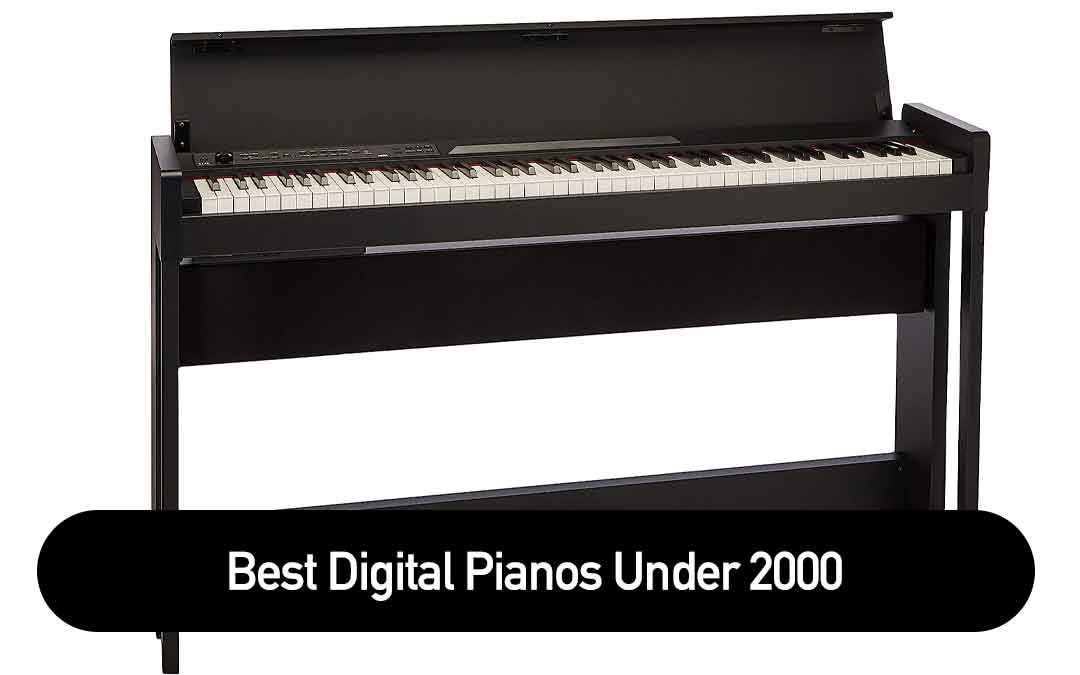
  • Best Digital Pianos Under 2000

    Best Digital Pianos Under 2000

    Are you looking for the Best Digital Pianos Under 2000 dollars in 2023? If so, your search ends here!

    In the current marketplace, numerous options are available for those seeking a high-quality digital piano for under $2000.

    But finding the right one can be challenging.

    To help you make the best choice, we carefully reviewed several digital pianos available today and compiled a list of the best digital pianos under $2000.

    We looked at several features to determine the best models, including weighted keys, speakers, sound quality, polyphony, connectivity, and user reviews.

    So, let’s dive into our top recommendations for the best digital pianos under 2000!

    Top 10 Best Digital Pianos Under $2000 Available In 2023

    Before we get into our list of top ten digital pianos, I want to disclose that all the models included in this list have the following characteristics:

    • A keyboard with 88 fully weighted keys that respond realistically.
    • High-quality piano sound featuring simulated acoustics (resonances, noises, etc.)
    • A variety of sound effects.
    • Built-in speaker system.
    • Built-in MIDI and Audio recorder.
    • Various connectivity options for comfortable use on stage and in the studio.

    Here are the top ten best digital pianos under 2000 dollars that you can buy right now:

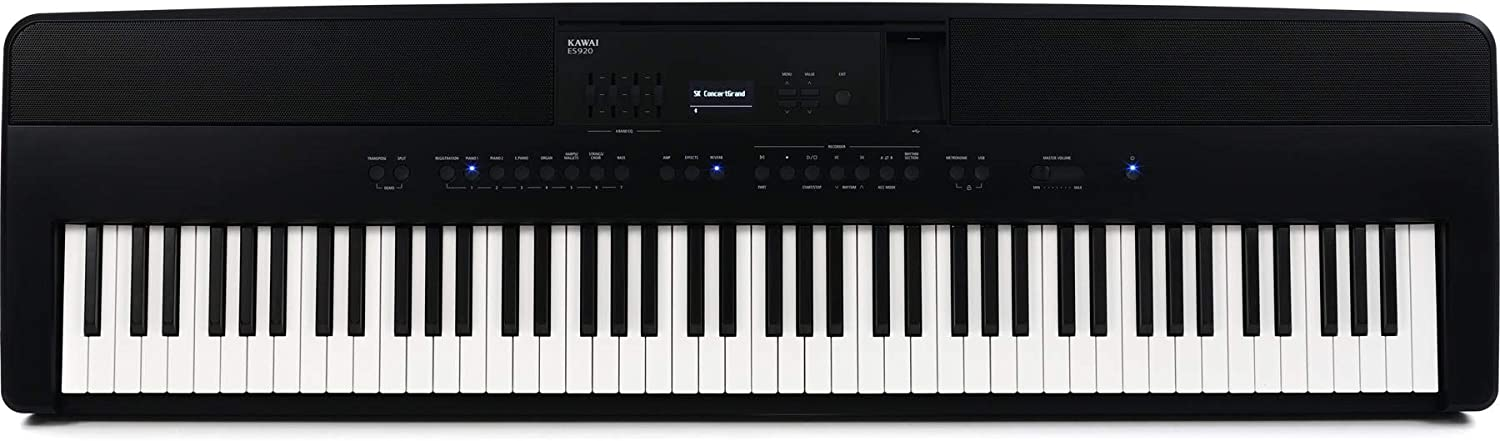
    Kawai ES920 88-key Digital Piano

    Specification

    • Size: 56 x 17.5 x 10.75 inches
    • No. of Keys: 88
    • Touch Sensitivity: Yes
    • Polyphony (Max.): 256
    • Sounds: 38
    • Effects: Yes (Reverb, Delay, Chorus)
    • Speakers: Yes
    • Pedals: 1 (Sustain Pedal)
    • Bluetooth Connectivity: Yes
    • Weight: 55 pounds (25 kg)
    • Price: $1,799

    Our top pick for the best digital piano under 2000 dollars is the Kawai ES920. Many intermediate and professional pianists have praised the ES920 for its rich, uncolored tone and natural key action.

    The Kawai ES920 has a sleek, modern design with a matte black finish that looks stylish and sophisticated. Also, it is lightweight and compact, making it easy to move and store. It weighs just 55 pounds.

    It comes with the Responsive Hammer III keyboard action, which provides the same playing experience as an authentic acoustic piano. The keyboard features 88 progressively weighted keys with simulated ivory keytops, offering effortless control, even in high-moisture environments.

    In terms of sound quality, the Kawai ES920 delivers rich and dynamic sound through its built-in speakers. It replicates the sound of a grand piano well.

    With 256 notes of polyphony, you can easily create rich and complex compositions without losing a note.

    Furthermore, the ES920 offers 38 different instrument voices and sound effects, including reverb, delay, and chorus, making it an excellent choice for anyone who wants to enhance their recordings with additional effects.

    The wireless Bluetooth compatibility lets you stream music directly from your smartphone or laptop. Other connectivity options such as two headphone jacks, line Out jacks, USB to Host, USB to Device, MIDI In/Out ports, and a damper jack make the ES920 a versatile and convenient instrument.

    Aside from that, the ES920 features a 2-track MIDI recorder, audio recorder, and metronome with 100 preset rhythms, allowing for a range of creative options.

    The layer and split modes offer adjustments like lower octave shift, layer octave shift, volume balance, and layer dynamics, making it easier to blend sounds together.

    Overall, the Kawai ES920 is a high-quality digital piano that offers a realistic piano-playing experience. Its portable design and Bluetooth connectivity make it an ideal choice for serious musicians and pianists. At a price tag of $1,799, the Kawai ES920 offers excellent value for your money.

    Check On Amazon

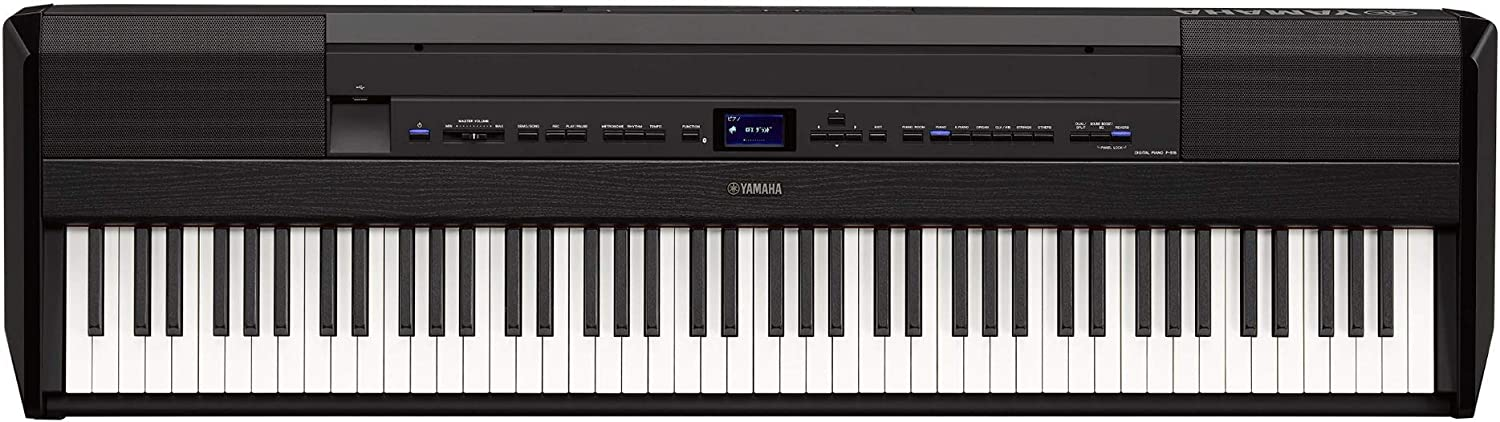
    Yamaha P515 88-Key Weighted Action Digital Piano

    Specification

    • Size: 52.6 x 14.8 x 5.7 inches
    • No. of Keys: 88
    • Touch Sensitivity: Yes (Hard2/Hard1/Medium/Soft1/Soft2/Fixed)
    • Polyphony (Max.): 256
    • Sounds: 500+
    • Effects: Yes
    • Speakers: Yes
    • Pedals: 1 (Sustain Pedal)
    • Bluetooth: Yes
    • Connectivity: USB TO DEVICE, USB TO HOST, DC IN, Pedal Unit, MIDI IN/OUT, Dual Headphones Jacks, AUX IN/OUT
    • Weight: 48 pounds (22 kg)
    • Price: $1,599.99

    Another best digital piano under $2000 on the market is Yamaha P-515. It is a relatively new digital piano introduced mid-2018 to replace its highly popular predecessor, the Yamaha P-255. As a result, it became the new flagship model of the P series.

    The Yamaha P-515 features one of Yamaha’s top-level key actions, called NWX (Natural Wood X), which provides an exceptional playing experience. Its white keys are made of solid wood, while its black keys are made of plastic with a simulated ebony feel.

    Featuring a sleek design, the P-515 is an easy-to-use and portable digital piano.

    The Yamaha P515 stands out for its superior sound quality. It features Yamaha’s best piano samples recorded from the Yamaha CFX and the Bösendorfer Imperial Grand, two of the world’s most famous concert grand.

    In addition, the piano incorporates Virtual Resonance Modeling (VRM), which reflects the many factors responsible for creating the concert grand piano’s sound. It delivers impressive sound quality through four powerful speakers.

    The Yamaha P515 also has a 16-track MIDI recorder, which is rarely found on a digital piano. You can use the recorder to create multi-instrument arrangements and convert them into audio files for live performances.

    The USB Audio Interface feature allows you to exchange MIDI and audio data simultaneously, eliminating the need to connect to a separate audio interface.

    The piano also features several connectivity options, including a pedal unit, MIDI IN/OUT, dual headphones jacks, and AUX IN/OUT. However, the headphone jack is not as durable as it should be, so use it carefully.

    One of the advantages of the P515 is that it comes with a 3-year warranty.

    The Yamaha P515 is an excellent digital piano with high-quality sound, superb key action, and easy transportability. You can’t go wrong with it if you’re looking for a portable digital piano with professional-level sound and performance.

    Check On Amazon

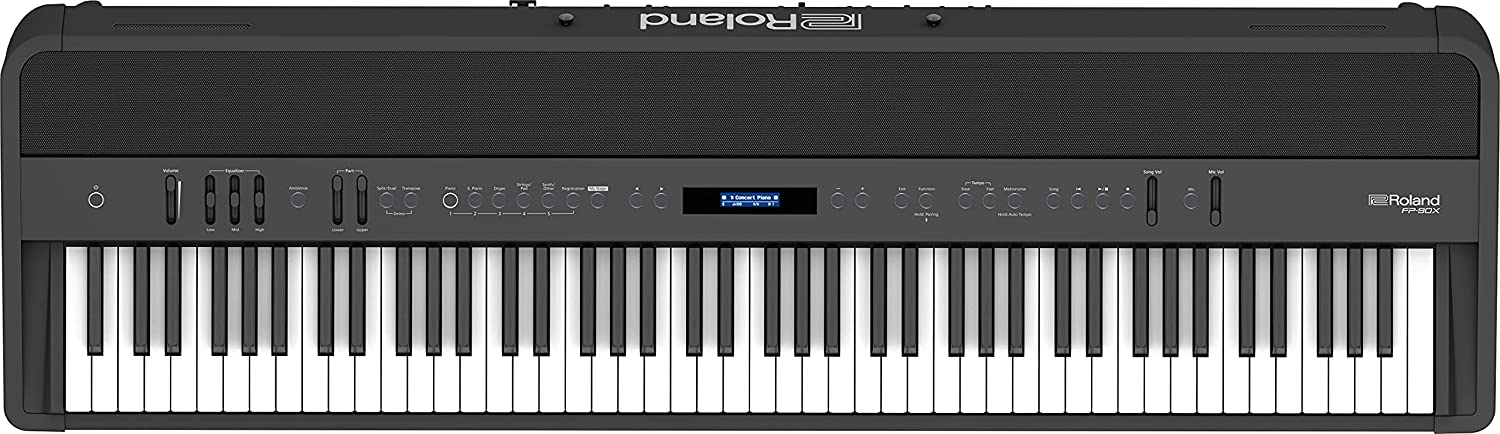
    ROLAND FP-90X Portable Digital Piano

    Specification

    • Size: 52.82 x 15.4 x 5.4 inches
    • No. of Keys: 88
    • Touch Sensitivity: Yes (100 types, Off)
    • Polyphony (Max.): 256
    • Sounds: 350+
    • Effects: Yes
    • Speakers: Yes
    • Pedals: 1 (Sustain Pedal)
    • Bluetooth: Yes
    • Connectivity: DC In jack, USB ports (Type A & B), MIDI IN/OUT, Input Stereo jack, Pedal Input, Dual Phones jack
    • Weight: 52 pounds (23.6 kg)
    • Price: $2,199.99

    The Roland FP-90X is one of the best portable digital pianos under 2000 dollars in this list.

    It features some of Roland’s best technology, found in their top-level home digital pianos (such as the HP and LX series).

    This digital piano comes with the PHA-50 hybrid keyboard that combines acoustic-style wood keys. This allows for a natural and expressive playing experience, with an accurate response to even the lightest touch.

    Also, this piano keyboard features 100 types of touch sensitivity so that you can adjust it or turn it off according to your preferences. You can add an extra level of expressiveness to your playing with the included sustain pedal.

    The sound quality of the FP-90X is outstanding. Its powerful amplifier and stereo speakers provide a clear, rich sound that can fill a room.

    There are over 350 sounds, including grand piano, electric piano, strings, and more. You can also add sound effects to enhance the sound even more.

    The FP-90X model supports Bluetooth connectivity, allowing you to use apps like Roland’s Zenbeats and Apple’s GarageBand to compose music.

    There are also USB ports for connecting to a computer, a stereo input for connecting an external sound source, and a dual headphone jack for private practice.

    Overall, the Roland FP-90X is an excellent digital piano for piano players who want to play more advanced songs and need as much polyphony as possible.

    Excellent playability, unique sound quality, various connectivity options, and many other features make it a versatile and premium digital piano.

    Check On Amazon

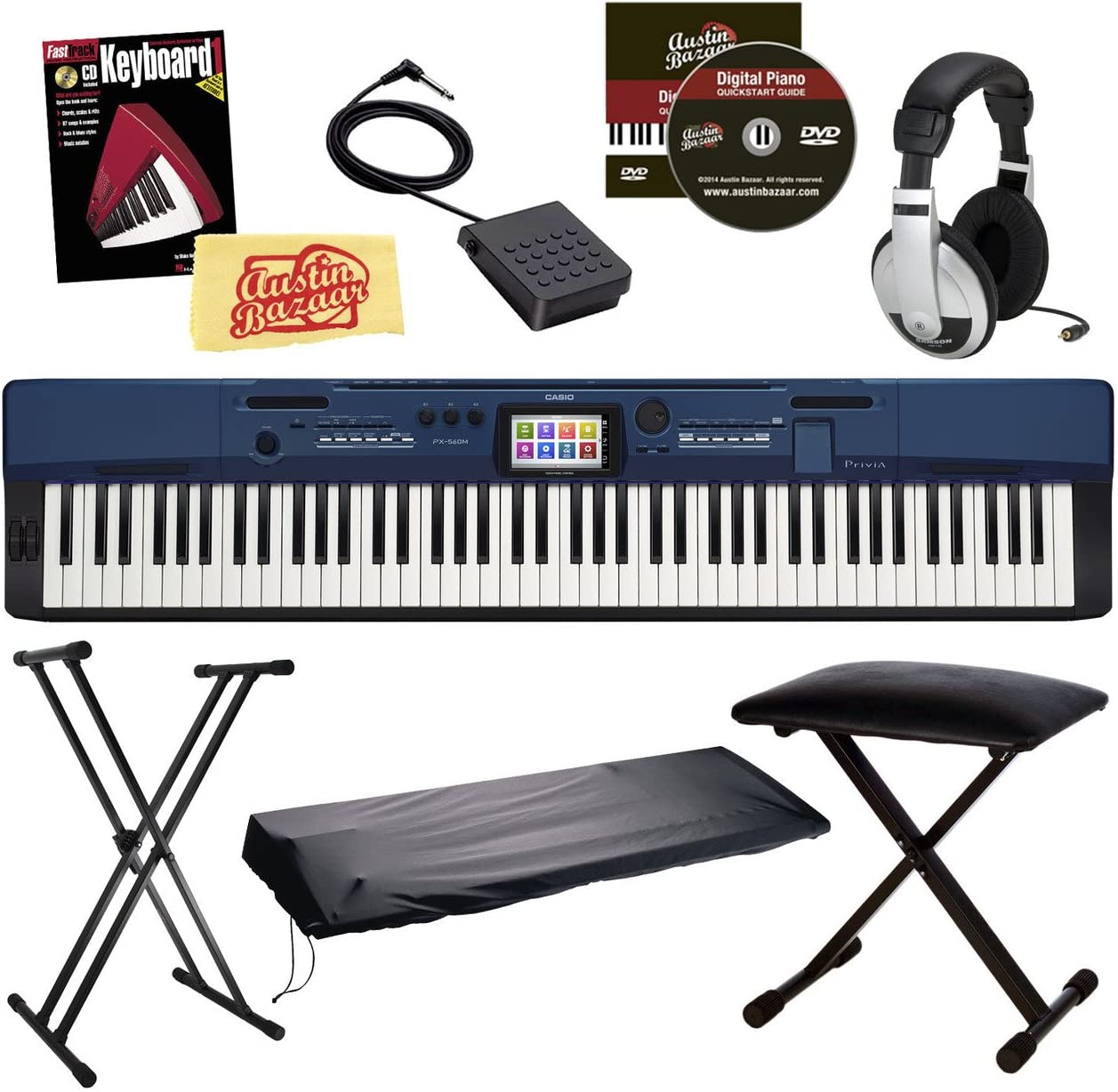
    Casio Privia PX-560 Digital Piano

    Specification

    • Size: 58 x 16 x 19 inches
    • No. of Keys: 88
    • Touch Sensitivity: Yes
    • Polyphony (Max.): 256
    • Sounds: 650
    • Effects: Yes
    • Speakers: Yes
    • Pedals: 1 (Sustain Pedal)
    • Bluetooth: Yes
    • Connectivity: USB ports (Type A & B), MIDI IN/OUT, Input Stereo jack, Sustain pedal Input, Triple pedal Input, Line IN/OUT, PHONES/OUTPUT: 2 (Stereo mini jack)
    • Weight: 50 pounds (22.7kg)
    • Price: $2,199.99

    Casio PX-560 is one of the most compact digital pianos available. It is a very light and portable instrument, making it perfect for musicians always on the go. It has a contemporary look and a modern design.

    Featuring a Tri-Sensor Scaled Hammer Action Keyboard II with a realistic feeling keyboard, the PX-560 provides musicians with an excellent playing experience. The keyboard offers three different sensitivity levels and ebony and ivory keytops for optimal playing.

    With 650 in-built sounds, the Casio PX-560 offers endless creative possibilities. Its sound customization lets you customize your sound precisely as you like. Also, you can easily edit the inbuilt sounds if you don’t like them.

    Besides that, the PX-560 digital piano has a 5.3-inch color touchscreen for easy menu navigation, which is one of its impressive features. It also includes a 17-track recorder, USB audio recording, and 200 different rhythms for easy recording and storing.

    Furthermore, with the Casio PX-560 digital piano, you’ll get an adjustable stand, bench, dust cover, headphones, sustain pedal, instructional book, Austin Bazaar Instructional DVD, and polishing cloth.

    Even though it is the most expensive digital piano on this list, its features and accessories make it well worth the price.

    Overall, the Casio PX-560 digital piano is a powerful and versatile instrument that offers much more than a realistic piano experience. Whether you are a professional pianist or a beginner, the Casio PX-560 is an excellent choice.

    Check On Amazon

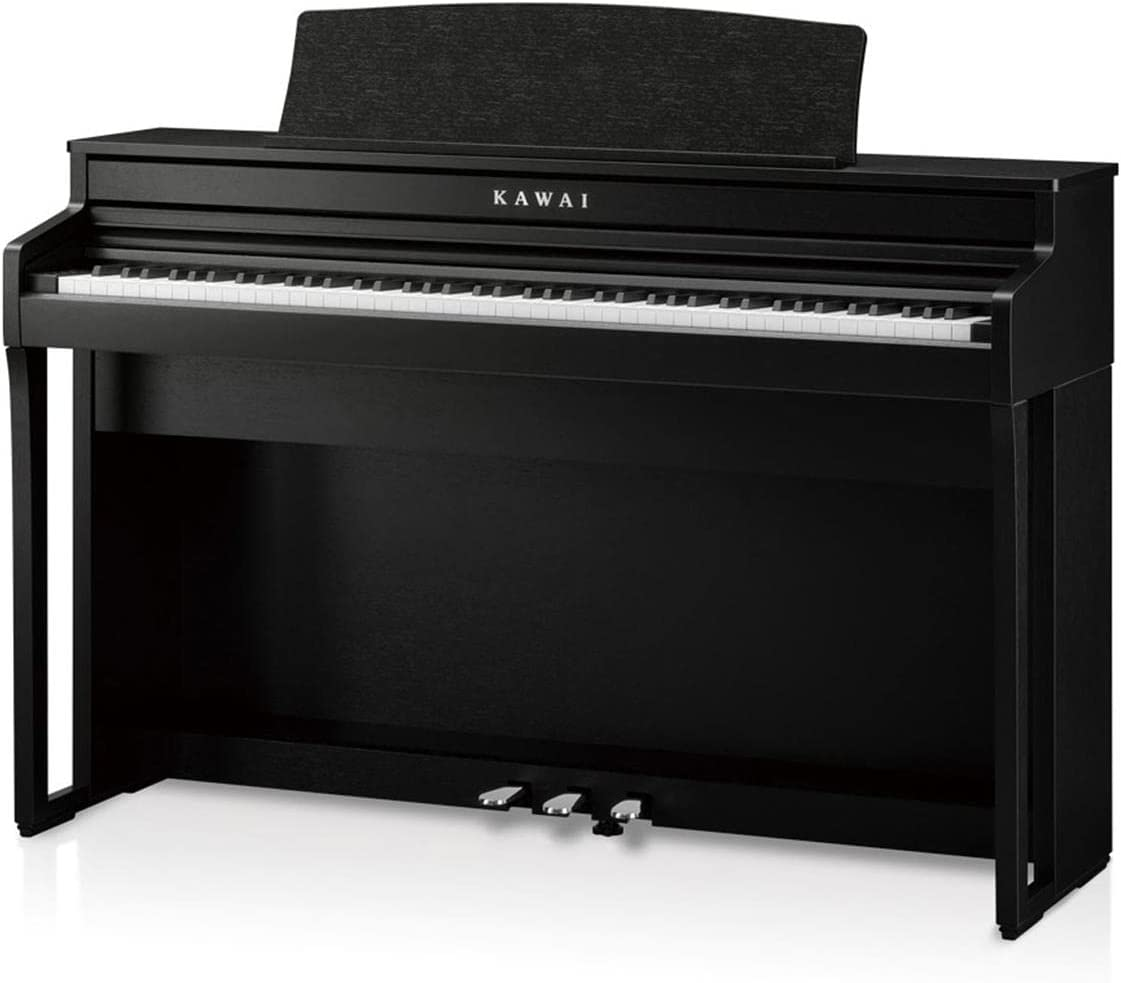
    Kawai CA49 88-Key Grand Feel Compact Digital Piano

    Specification

    • Size: 58 x 28.25 x 21 inches
    • No. of Keys: 88
    • Touch Sensitivity: Yes
    • Polyphony (Max.): 192
    • Sounds: 19
    • Effects: Yes
    • Speakers: Yes
    • Pedals: 3 (Soft, Sostenuto, and Sustain Pedal)
    • Bluetooth: Yes
    • Connectivity: USB to Host, MIDI IN/OUT, Dual headphones jacks
    • Weight: 150 pounds (68 kg)
    • Price: $1,999

    The Kawai CA49 Digital Piano is the successor to the popular CA48 piano. It combines premium features and authentic sound to deliver players the best playing experience possible.

    This digital piano is part of the Kawai Concert Artist Series, a highly acclaimed line of digital pianos. Its updated cabinet design adds a premium feel by adopting the taller body and rounded edges of larger Concert Artist models. However, it is a bit heavier than other models on this list.

    The CA49 features an 88-key wooden keyboard action with a real acoustic piano sound. The sound quality is fantastic. The maximum polyphony is 192 notes, sufficient for playing complex pieces.

    Aside from that, this piano offers 19 internal sounds, numerous sound effects, a metronome, and internal recording features.

    Unlike previous digital pianos, this one comes with three pedals – Soft, Sostenuto, and Sustain – so you can play like an actual piano.

    The Low Volume Balance function helps improve consistency when practicing at reduced volume levels. For easy operation, this digital piano features an easy-to-use OLED graphic display.

    Like other digital pianos, the CA49 features Bluetooth wireless connectivity and several ports for connecting external devices.

    The package includes an AC Power Adapter and a matching Bench. Also, the company provides a 5-year limited warranty, ensuring durability and reliability.

    Overall, the Kawai CA49 Digital Piano is a top-notch model that delivers beautiful sound and performs like a real piano.

    Check On Amazon

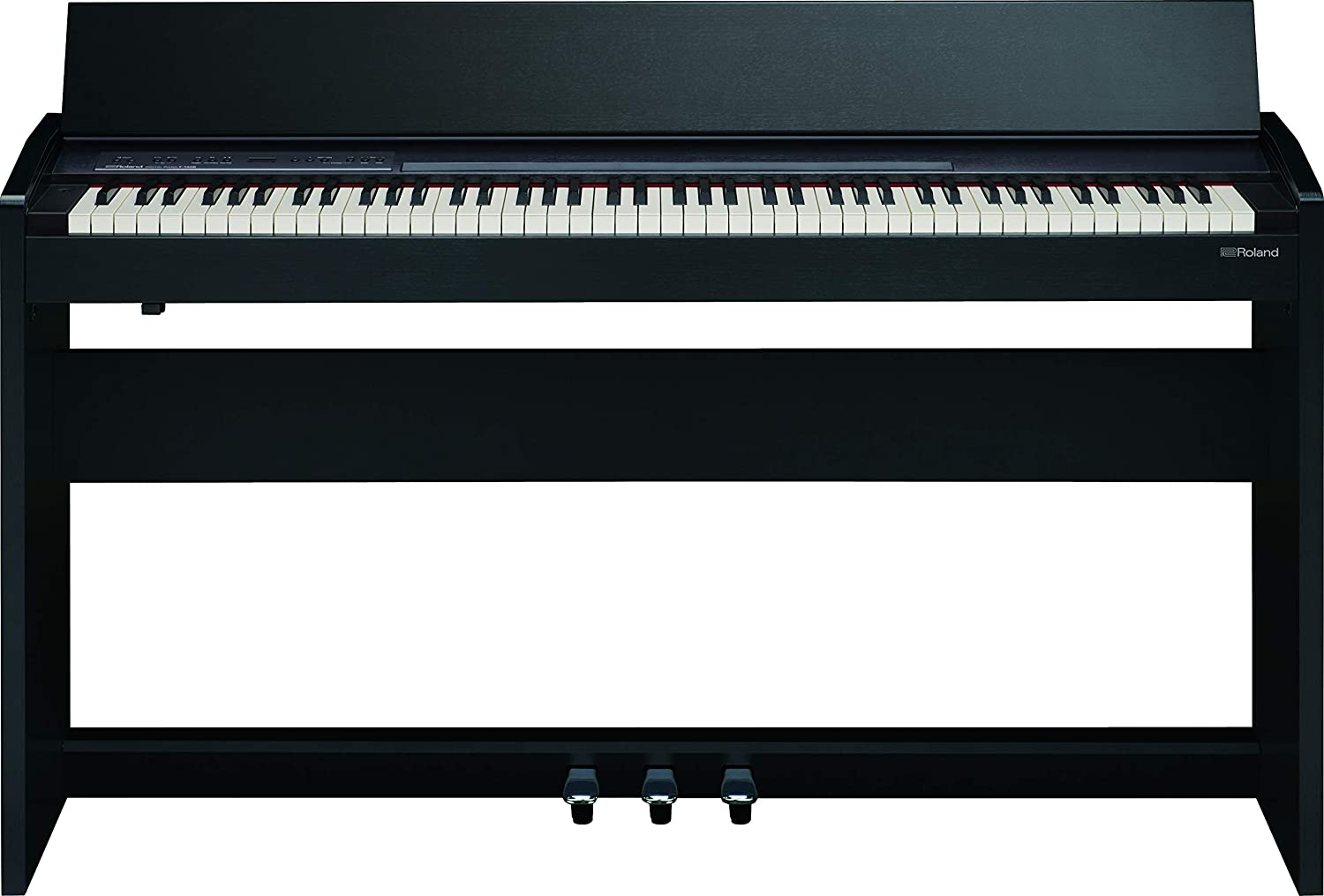
    Roland F-140R Compact 88 Console Digital Piano

    Specification

    • Size: 53.65 x 13.65 x 35.85 inches
    • No. of Keys: 88
    • Touch Sensitivity: Yes (5 types, fixed touch)
    • Polyphony (Max.): 128
    • Sounds: 316
    • Effects: Yes
    • Speakers: Yes
    • Pedals: 3 (Soft, Sostenuto, and Sustain Pedal)
    • Bluetooth: Yes
    • Connectivity: DC In jack, USB ports (Type A & B), Input & output stereo jack, Two phones jacks
    • Weight: 76.1 pounds (34.5 kg)
    • Price: $1,853

    The Roland F-140R Compact 88 Console Digital Piano is a fantastic choice for those who want an affordable and stylish piano with all the latest technology. Due to its compact size, the F-140 is ideal for smaller living spaces.

    It has a PHA-4 standard keyboard containing 88 keys with escapements and an ivory feel.

    The SuperNATURAL Piano sound engine produces an incredibly realistic grand piano sound, making it an excellent option for musicians who want a natural piano sound in their home or studio.

    Besides the acoustic piano, there are also 305 other instrument sounds you can experiment with, such as electric pianos, strings, organs, guitars, brass, synthesizers, and more.

    Additionally, the Roland F-140R comes with 72 rhythms and a 3D Ambience effect for headphones, so you can enjoy a multi-dimensional sound experience while practicing privately.

    A unique feature of this digital piano is that it has Twin Piano mode, which splits the keyboard to allow two players to play together.

    You can also connect your smartphone or tablet via Bluetooth and use the Roland Piano Partner 2 app for wireless control, learning games, and digital sheet music. With three months of free piano lessons from Pianote, you can learn at your own pace and from the comfort of your home.

    To sum it up, the Roland F-140R is a stylish and versatile instrument with a realistic piano sound, Bluetooth connectivity, and educational features.

    Whether practicing at home or performing on stage, this piano will impress you.

    Check On Amazon

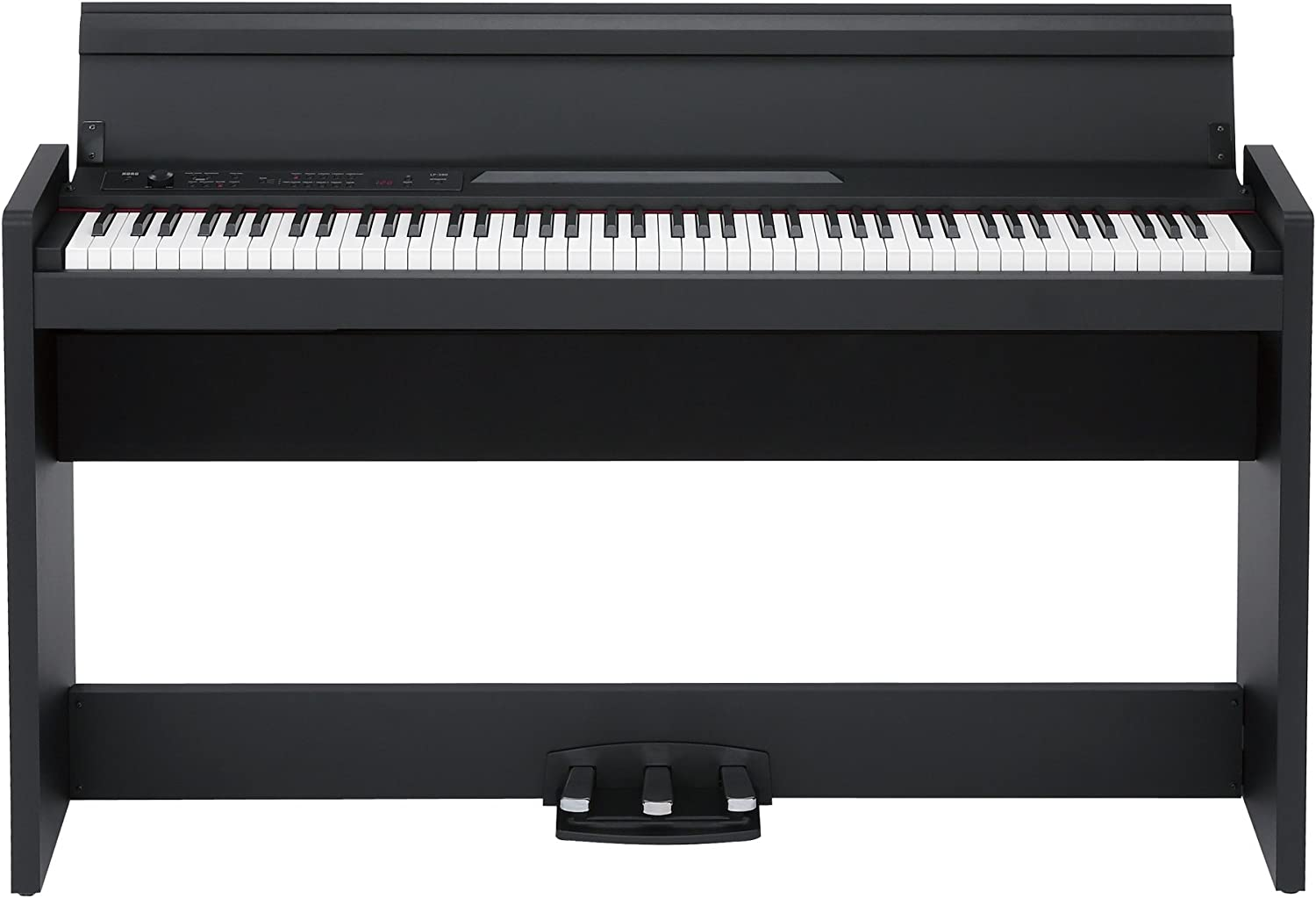
    Korg LP380 Digital Piano

    Specification

    • Size: 53.35 x 13.82 x 30.39 inches
    • No. of Keys: 88
    • Touch Sensitivity: Yes (Light, Normal, Heavy)
    • Polyphony (Max.): 120
    • Sounds: 30
    • Effects: Yes
    • Speakers: Yes
    • Pedals: 3 (Soft, Sostenuto, and Sustain Pedal)
    • Bluetooth: N/A
    • Connectivity: DC19V, Line Out, MIDI In/Out, Two headphones jacks, Pedal jack, Audio Jack
    • Weight: 81.57 lbs (37 kg)
    • Price: $1,249.99

    On this list, the Korg LP380 is the most affordable digital piano. It has a slim and stylish design available in five color variations to suit any interior.

    The Korg LP380 features a Real Weighted Hammer Action 3 (RH3) keyboard with 88 keys and various touch sensitivity settings.

    This keyboard provides an authentic feel with a heavier response in the lower register that becomes lighter as you play upward.

    The sound of this digital piano is excellent. Additionally, it offers 30 expressive sounds, various effects, and three pedals to create an immersive piano experience.

    In this piano, you will find two cool modes: layer mode and partner mode. The Layer mode lets the user play two sounds simultaneously, while the partner mode divides the keyboard into two sections for duets.

    The LP-380 digital piano also has large-diameter speakers, MIDI connectivity, and two headphone jacks for private practice.

    Overall, if you are looking for a high-quality digital piano experience at an affordable price, the Korg LP380-88 is a fantastic choice.

    Check On Amazon

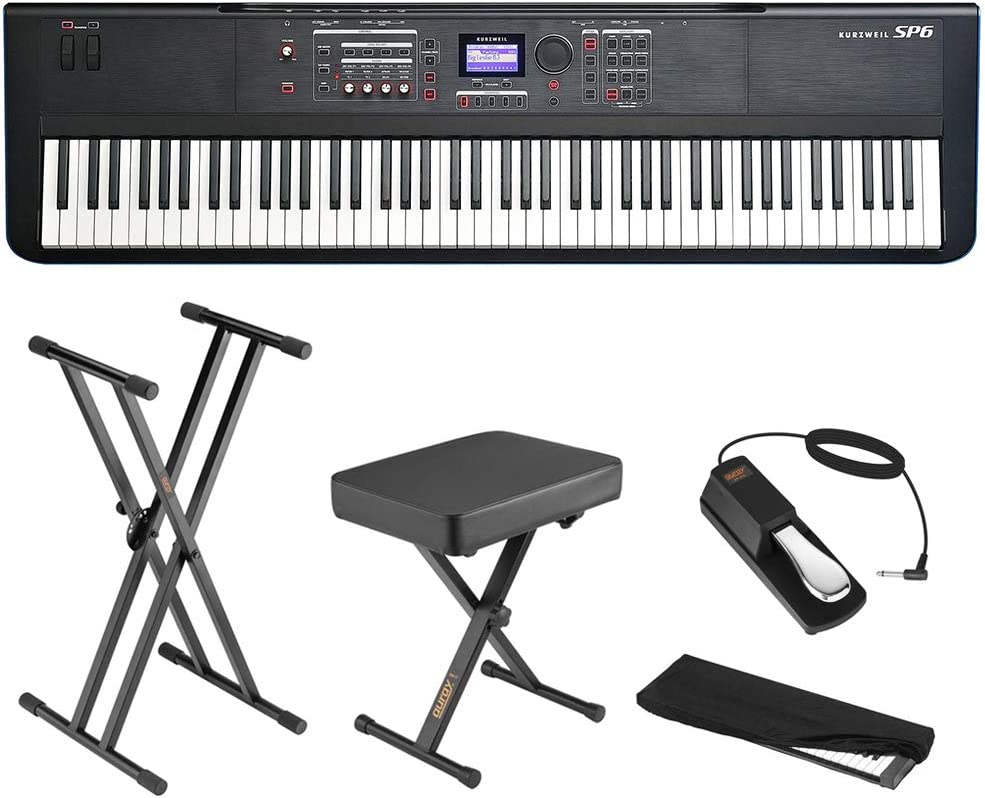
    Kurzweil SP6-8 88-Key Stage Piano

    Specification

    • Size: 52 x 15 x 6 inches
    • No. of Keys: 88
    • Touch Sensitivity: Yes
    • Polyphony (Max.): 128
    • Sounds: N/A
    • Effects: Yes
    • Speakers: Yes
    • Pedals: 1 (Sustain Pedal)
    • Bluetooth: N/A
    • Connectivity: USB ports (Type A & B), MIDI IN/OUT, audio outputs, one headphone jack, two dual-switch pedal inputs, one continuous control pedal input
    • Weight: 27 pounds (12 kg)
    • Price: $1,549.99

    The Kurzweil SP6-8 88-Key Stage Piano is one of the best digital pianos under 2000 for beginners or intermediate piano players.

    Measuring 52.5 inches x 5.75 inches x 15 inches and weighing only 12 kg, it’s the lightest and most portable digital piano on this list.

    This piano’s small size and lightweight design make it ideal for performances on stage and in the studio. The keyboard has 88 keys, all fully weighted, have hammer action capabilities, and are velocity-sensitive.

    With these qualities, the SP6-8 is one of the best digital piano options that mimic a larger acoustic piano’s playing experience and sound quality.

    Its 128-voice polyphony ensures a rich and full sound even in complex compositions. The piano has various effects, and the built-in speakers provide excellent sound.

    With this digital piano, you’ll get a keyboard stand, a piano bench, a single pedal, and a dust cover.

    The only drawback is the lack of Bluetooth connectivity, but overall, the Kurzweil SP6-8 88-Key Stage Piano is a fantastic choice for anyone in the market for a high-quality stage piano.

    Check On Amazon

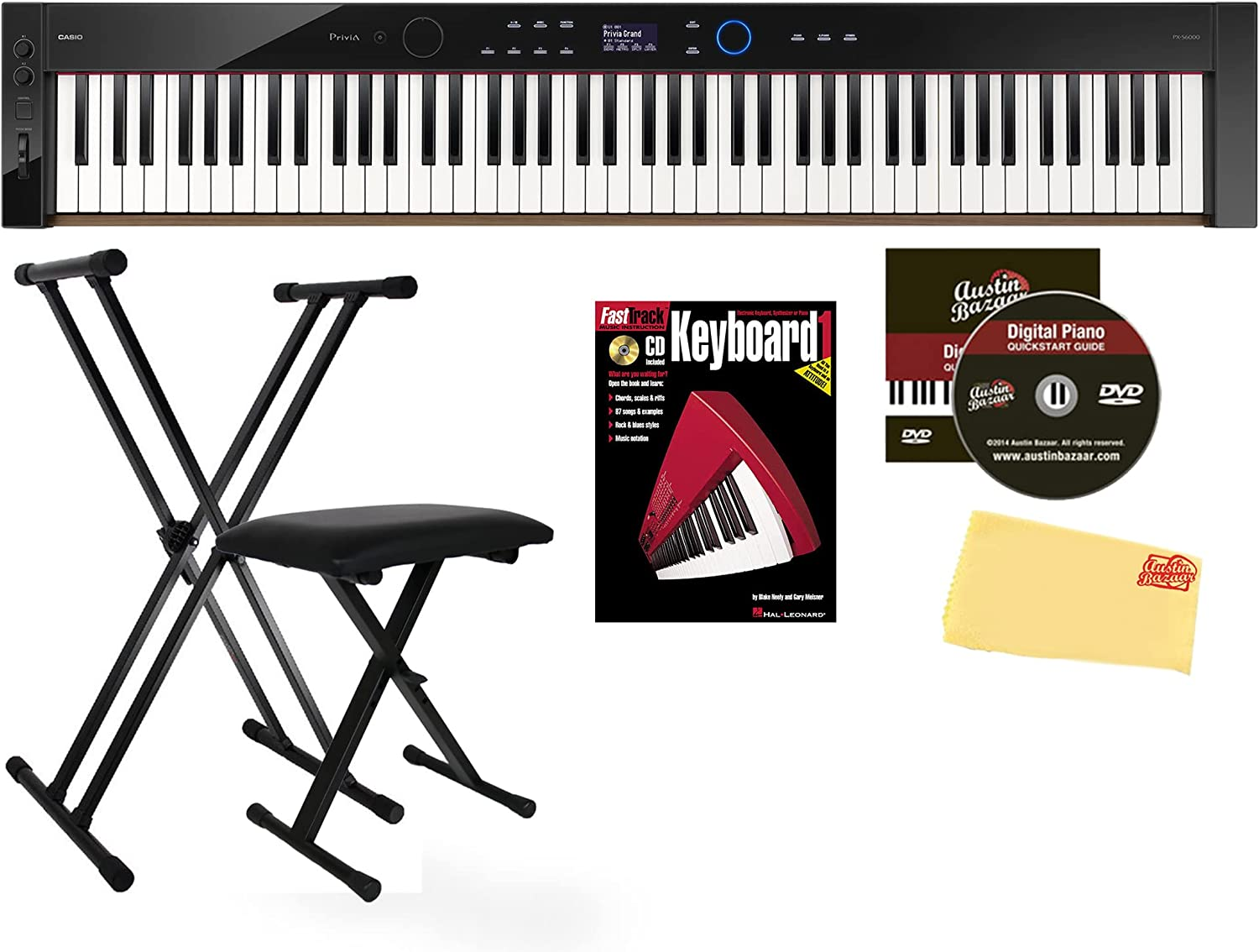
    Casio Privia PX-S6000 Digital Piano

    Specification

    • Size: 52.7 x 9.5 x 4 inches
    • No. of Keys: 88
    • Touch Sensitivity: Yes (5 sensitivity levels, off)
    • Polyphony (Max.): 256
    • Sounds: 350
    • Effects: Yes
    • Speakers: Yes
    • Pedals: N/A
    • Bluetooth: Yes
    • Connectivity: USB ports (Type A & B), MIDI IN/OUT, Microphone jack, Triple pedal Input, Line IN/OUT, PHONES/OUTPUT: 2 (stereo phone jack)
    • Weight: 14.8 kg
    • Price: $1,799.99

    This popular digital piano from Casio has a wealth of impressive features.

    The Casio Privia PX-S6000 comes with an 88-key Smart Hybrid Hammer Action Keyboard that offers highly expressive playing with five sensitivity levels. The fully weighted keys make it play like a real piano.

    The Privia PX-S6000 piano sounds incredible. The Multi-Dimensional Morphing AiR Sound Source gives you a realistic piano experience with string, damper, and mechanical sounds.

    Featuring 256 notes and 350 sounds, this Casio piano offers countless possibilities for composing, practicing, and performing.

    The WU-BT10 Bluetooth adapter allows easy connectivity to MIDI software, and the built-in speakers make streaming music a breeze.

    The top panel is elegant and easy to use. This device also has an easy-to-read backlit display, illuminated touch sensor controls, and a pitch bend wheel that changes colors.

    And with four context-sensitive multi-function buttons, you can quickly access your favorite sounds and settings.

    Besides the piano, the package includes an adjustable stand, an X-style piano bench, an instructional book, a DVD, lessons, and a polishing cloth.

    The Casio Privia PX-S6000 is a fantastic digital piano that promises to elevate your musical journey.

    At $1,799.99, it’s a bit pricey, but the top-notch sound quality and premium features make it worth every penny.

    Check On Amazon

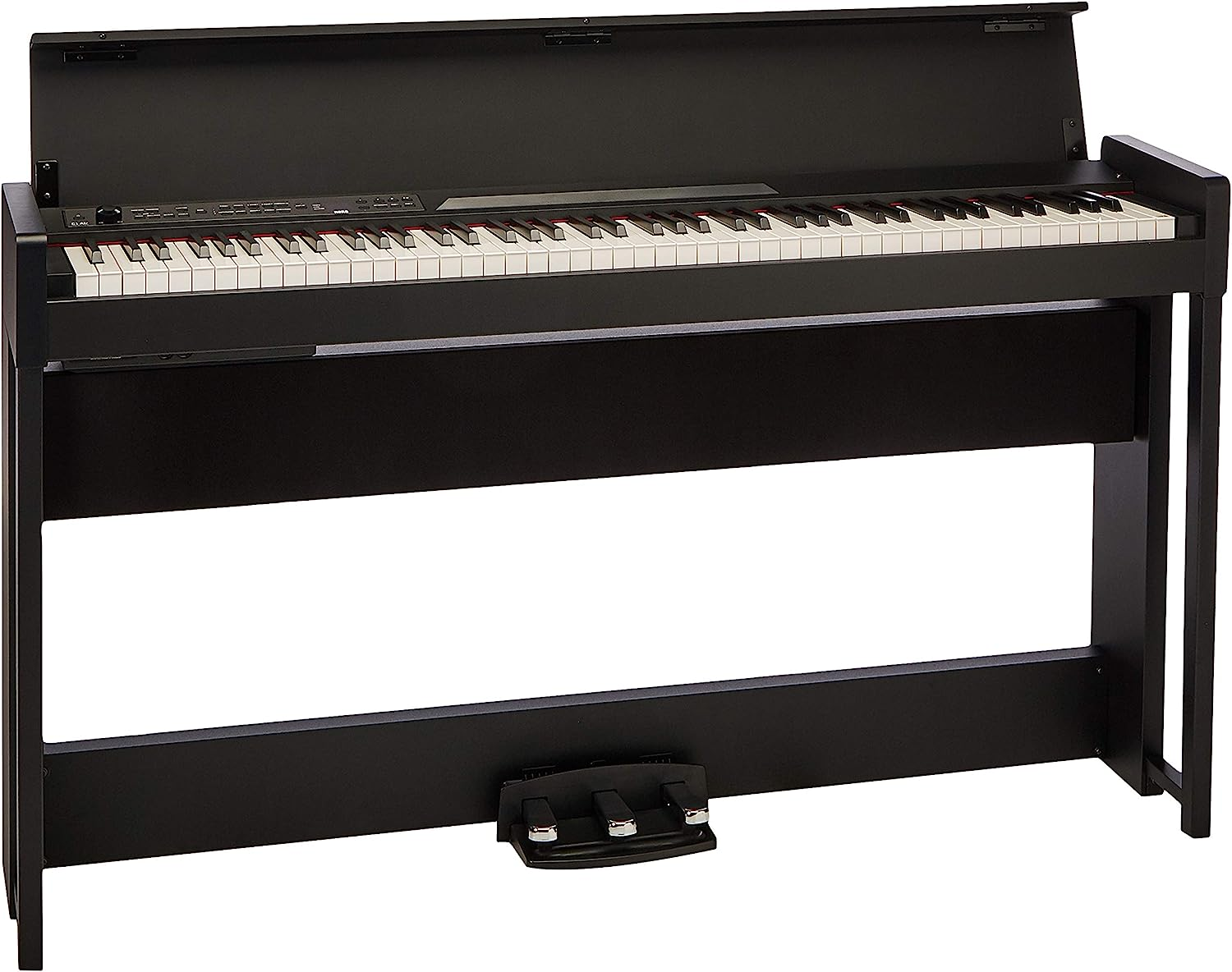
    Korg C1 Air Digital Piano

    Specification

    • Size: 57.25 x 17.6 x 17.15 inches
    • No. of Keys: 88
    • Touch Sensitivity: Yes
    • Polyphony (Max.): 120
    • Sounds: 30
    • Effects: Yes
    • Speakers: Yes
    • Pedals: 3 (Soft, Sostenuto, and Sustain Pedal)
    • Bluetooth: Yes
    • Connectivity: DC 24V, LINE OUT, MIDI (IN, OUT), two headphones jacks, Pedal jack, Audio jack,
    • Weight: 50 pounds (22.6 kg)
    • Price: $1,599.99

    Last but certainly not least, we have the Korg C1 Air Digital Piano. It is a sleek and stylish instrument that offers a high-quality playing experience for musicians of all levels.

    At 22.6 kg, the Korg C1 Air is compact and lightweight, making it easy to move around and set up in different locations.

    With its 88-key RH3 keyboard, you can enjoy a full range of notes and a responsive touch sensitivity.

    The sound balance is perfect, neither too bright nor too muffled. The maximum polyphony of 120 ensures that all notes are played with precision and clarity.

    The Korg C1 Air is equipped with three pedals, including a soft, sostenuto, and sustain pedal, which provide added control over the sound.

    Besides Bluetooth, it also features a variety of other connectivity options and built-in speakers. With these options, you can connect this keyboard piano to other devices and enjoy a powerful sound.

    Overall, the Korg C1 Air Digital Piano is a well-designed instrument that provides a satisfying and enjoyable playing experience. The Korg C1 is a good digital piano for those looking for a versatile, high-quality piano at a reasonable price.

    Check On Amazon

    Conclusion

    These are the ten best digital pianos under 2000 dollars available in 2023. These digital pianos come from reputable brands that offer excellent sound and realistic touch.

    If you’re still unsure which digital piano to choose, consider Kawai ES 920, Yamaha P515, and Roland FP-90X. They are lightweight and portable. These piano models provide superior sound quality and playability, similar to traditional acoustic pianos.

    Additionally, they come with various connectivity options, making it easy to connect to any computer and other external devices.

    If you’re looking for an affordable digital piano packed with great features, then the Korg LP380 may be right for you.

    Ultimately, the best choice comes down to your budget and needs, so pick the one that suits you best.

    Which digital piano are you going to choose? And why? Let us know in the comments!

    Related Topics

  • Are Casio Keyboards Good? Explained in Detail

    Are Casio Keyboards Good? Explained in Detail

    If you’re considering buying a keyboard, you may have come across the brand Casio.

    Casio is known for its reliable and affordable electronic musical instruments, and its keyboards are no exception.

    But are Casio keyboards good? That’s a question many people have asked, and the answer is not so straightforward. It depends on the individual’s needs and preferences.

    In this blog post, we will dive into the world of Casio keyboards and answer the question, “Are Casio keyboards good?

    We’ll cover everything from their affordability and versatility to their sound quality and additional features to help you determine if a Casio keyboard is the right choice.

    So, whether you’re a beginner or a professional musician, read on to find out if a Casio keyboard is right for you!

    About the Casio Brand

    Casio has been one of the world’s leading brands in the world of electronic musical instruments for decades. It was founded a year after World War 2 in 1946 by the Kashio family, which gave the company its namesake.

    It was founded a year after World War 2 in Japan in 1946 by the Kashio family, which gave the company its namesake. Since then, the company has become a household name in electronic keyboards, synthesizers, and digital pianos.

    Casio is known for producing high-quality instruments that are both affordable and accessible for musicians of all skill levels.

    As you might know, the Casio brand is also known for its innovative technology, such as its use of touch screens and mobile app integration, which allows users to control their instruments from their smartphones or tablets. They manufacture watches, calculators, and cameras, as well as projectors.

    The first keyboard Casio released was the miniature Casiotone 201 in 1980, which was the first portable keyboard ever released. At that time, the brand was already well-established.

    Today, Casio is a trusted and reliable brand. It has an electronic keyboard or digital piano that suits your needs and budget, whether you’re a piano student, a home player, or a professional musician.

    Casio Keyboards: A Honest Review

    In this section, we’ll take a closer look at the reputation of the brand in the music industry and various aspects of its piano keyboards.

    This information will give you a better picture of what the brand offers so that you can make an informed decision.

    So, let’s begin!

    The Reputation of the Brand

    If you are buying a musical instrument, you should pay attention to the reputation of the brand. Reputation is extremely important and plays an essential role in what they do.

    In fact, a brand’s reputation is the key to its long-term success. A well-known brand means they provide high-quality, durable, and reliable products.

    Casio has a solid reputation in the music industry and is well-known for manufacturing high-quality, affordable keyboards.

    In the music industry, Casio has a good reputation for producing affordable and accessible keyboards with high-quality sound and durable construction. Casio keyboards have earned positive reviews for their cutting-edge technology and new features.

    Overall, the brand is well-respected by musicians and beginners alike, making it a good choice for those who want a quality keyboard at an affordable price.

    Variety of Models

    A diverse product line allows different types of customers to find what they need.

    If a company sticks to only one or two types of products, it won’t be able to meet the needs of different kinds of customers. As a result, it will soon find itself in a rut.

    Casio offers a wide range of electronic keyboards, digital pianos, and stage pianos, making it an excellent choice for musicians at all levels, from beginners to professionals.

    In their Privia product line, Casio decided to focus on having a variety of keyboards in one product line. Here, you can find all kinds of keyboards, from simple and affordable keyboards to portable digital pianos for professional musicians.

    With the Privia series, you can have a digital piano that resembles an acoustic piano.

    Here are various Casio models you can choose from:

    Portable Keyboards

    • SA Series: Casio SA-46, Casio SA-76, Casio SA-77, Casio SA-78
    • CASIOTONE Series: Casio Casiotone CT-S100, Casiotone CT-S200, Casiotone CT-S300
    • LK Series: Casio LK-190, Casio LK-265, Casio LK-280, Casio LK-S250 (Casiotone)
    • CTK Series: Casio CTK-2500, Casio CTK-2550, Casio CTK-3500, Casio CTK-6250
    • CT-X & WK Series: Casio CT-X800, Casio CT-X3000, Casio CT-X5000, WK-245, WK-6600, WK-7600

    You can easily find these keyboards for less than $300. They are perfect if you’re new and don’t want to invest in something that might not be a long-term hobby.

    The CT-X series keyboards have 61 keys, while the WK series keyboards have 76 keys.

    Portable Digital Pianos

    • CDP-S Series: Casio CDP-S100, Casio CDP-S150, Casio CDP-S350
    • PX Series (Privia Line): Casio PX-360, Casio PX-560, Casio PX-5S, Casio PX-770, Casio PX-870
    • PX-S Series (Privia Line): Casio PX-S1000, Casio PX-S3000

    These privia digital pianos are suitable for all pianists, from beginners to professionals.

    Console Digital Pianos

    • AP Series: Casio AP-470, Casio AP- 650, Casio AP- 710
    • GP Series: Casio GP-310, Casio GP-510

    These digital pianos are ideal for Intermediate to Advanced level piano players.

    Arranger/Music Workstations

    • MZ-X Series: Casio MZ-X300, Casio MZ-X500

    Sound Quality

    Sound quality is one of the most important factors when choosing a keyboard. It is what makes a keyboard appealing to musicians and what separates a good keyboard from a bad one.

    The sound quality of Casio digital pianos and keyboards is decent. You can find a good piano keyboard from Casio if you’re looking for an affordable keyboard with good sound quality.

    For example, Casio’s Tri-Sensor keyboards in their Privia line produce excellent sound quality.

    However, the company does not have many models in the $1000 or more range for professional musicians. Therefore, if you’re looking for a high-end, expensive keyboard with the best sound quality, you should choose another reliable and trusted brand, such as Yamaha.

    Key Action and Touch Response

    Key action and touch response are two crucial factors in keyboard performance. Key action refers to how the keys move and respond to touch, while touch response refers to the sensitivity of the keys to different levels of touch.

    Casio keyboards generally have superb key action and touch response, particularly in their Privia line.

    Their Privia line offers Tri-Sensor Scaled Hammer Action keyboards, which provide a realistic playing experience and a good touch response.

    The keys are extremely responsive. These keyboards are ideal for beginners and intermediate players.

    Construction

    No matter how good the sound of a keyboard piano is, it is worthless if it breaks down the first time you transport it. This is especially important for portable keyboards that are frequently transported from gig to gig.

    The construction of a product determines its durability and longevity, which is why it is one of the most important factors to consider when buying a piano keyboard.

    A well-constructed keyboard can last for many years and withstand regular use.

    Casio keyboards are known for their sturdy construction, which is made to withstand regular use. The company uses high-quality materials in its keyboards, which results in a durable and long-lasting product.

    Casio devotes a great deal of time and effort to constructing their keyboards. So, if you’re buying a keyboard from Casio, we can safely say that you are purchasing a well-made instrument that will not break under normal circumstances.

    Even though some keyboards are bulkier than others, that is not really related to this category – that is a design issue (more on that in the next section).

    Design and Visual Appearance

    Design and visual appearance are not the most important factors when choosing a keyboard, but they are still important.

    The design and appearance of a keyboard can affect its overall appeal and impact how comfortable it is to play. Visually appealing keyboards enhance the aesthetics of any setup.

    Many musicians are concerned about the design and appearance of their keyboards. You will want your upright digital piano to look attractive if you plan to place it in the middle of your home.

    When performing on stage in front of an audience, you’ll want a keyboard that looks flashy and nice rather than one that looks like a plastic toy.

    Casio is unmatched in terms of design and visual appeal. In the last few years, the company seems to have been putting more effort into creating unique and beautiful design solutions.

    Their keyboards come in various designs, from sleek and modern to classic and traditional. They offer a range of colors and styles to suit the taste of any musician.

    In particular, the models in the Casio Privia series have a fantastic design that is ideal for small spaces and portability.

    Some of the best examples are the PX-160, PX-5S, and PX-130. They are sleek, elegant, and filled with just the right colors. The best thing about them is that these models are free of unnecessary accessories.

    In short, Casio keyboards are stylish and visually appealing.

    Additional Features

    One of the main reasons why many people prefer digital pianos and keyboards over acoustic pianos is because they have so many useful digital features. These features help musicians improve their performance.

    However, adding different kinds of features to keyboard types isn’t always easy, which is precisely what separates great companies from average ones.

    Casio modern digital pianos and keyboards come with several additional features that make them a good choice for beginner and intermediate musicians. Some of these features include:

    • A wide range of voices and sound effects
    • MIDI connectivity
    • Accompaniment styles and rhythm patterns
    • Preset songs
    • Built-in speakers
    • Recording and playback functions
    • Piano lessons and educational features

    Connectivity options like USB and Bluetooth make Casio keyboards easy to connect to other devices, such as smartphones, laptops, and computers.

    Price and affordability

    Affordability is one of the biggest selling points for Casio keyboards. Casio offers a wide range of keyboards at different price points, from beginner keyboards to more advanced models.

    Most Casio keyboards are affordable, so you don’t need to spend a fortune to get a good instrument. Their affordable price range makes it easy for beginner musicians to get started with a decent instrument without breaking the bank.

    Even though they are affordable, they do not compromise on quality. Some Casio digital pianos and keyboards have features that are similar to many Yamaha models, but they are typically much less expensive than Yamaha models.

    Even with a minimal budget, you can still find a quality product from Casio.

    Yamaha digital pianos and keyboards tend to cost more just because they are Yamaha. Remember that more expensive doesn’t always necessarily mean a better product.

    So, if we are talking about price and affordability, Casio is definitely a good choice.

    Home or Stage Use

    Do you plan on using your digital piano at home, in a studio, or on stage? When choosing a digital piano, whether it is from Casio or another brand, you should ask yourself this question.

    Casio keyboard pianos are suitable for both home and stage use. They have a wide range of models, from beginner to advanced, with different features and capabilities.

    Their digital pianos and keyboards come with built-in speakers, making them ideal for home use and practice sessions. They also have portability options, making them easy to carry and use on stage.

    Casio’s Privia line is popular for stage use, as it provides excellent sound quality, touch response, and key action. Additionally, the connectivity options, such as MIDI and USB, allow you to easily connect to other devices on stage.

    If you are planning to use it exclusively at home, you might be interested in Casio’s console digital piano. With this type of digital piano, you won’t need to use an amplifier because it comes with built-in speakers.

    Many console pianos have a cabinet that blends in with your furnishings and decor. And there are many different styles available at various price points.

    A Casio model you may find interesting is the Previa PX360, which uses Casio’s AiR (Acoustic and intelligent Resonator) sound engine, which creates a realistic acoustic grand piano sound.

    This piano keyboard also features 88 full-size keys with hammer actions, making it feel like playing a regular piano.

    Now that we have looked at the different aspects of Casio keyboards and digital pianos, it’s time to answer your question: Are Casio Keyboards Good?

    Yes, Casio keyboards are good, especially for beginners and intermediate players. They are an excellent choice because of their affordability, sturdy construction, decent sound quality, and superb playability.

    Additionally, they come in various designs and styles to appeal to different tastes. However, they may not have as many high-end models as other brands so professional musicians may prefer a higher-end brand like Yamaha for their exceptional sound quality.

    Even though the sound quality of Casio is not as good as other brands, the finish and reliability are better at a fraction of the cost.

    Overall, Casio keyboards are ideal for both beginners and intermediate players. To be honest, Casio is an excellent and affordable brand.

    Who should buy a Casio keyboard?

    If you’re a beginner or on a budget, you should consider buying a Casio keyboard. Casio musical products are reliable, sturdy, and fun to play. You can’t go wrong with a Casio instrument if you want a keyboard for your children or want to start playing.

    Advanced players may also like them because they feature touch-sensitive keys, built-in sound effects, and other advanced features such as Dance Music Mode.

    In short, Casio keyboards are ideal for beginners, children, hobbyists, and anyone looking for an affordable and portable option.

    Are Casio Keyboards As Good As Yamaha?

    Comparing Casio keyboards to Yamaha is a matter of personal preference and individual needs. Both brands offer a range of keyboards with different features and price points, and each brand has its strengths and weaknesses.

    As I mentioned before, Casio keyboards are known for their affordability, portability, and versatility. This makes them a popular choice for beginners, hobbyists, and travelers. They also offer a range of features such as built-in speakers, multiple tone and rhythm options, and connectivity options like USB and MIDI.

    On the other hand, Yamaha keyboards are widely recognized for their outstanding sound quality, advanced features, and durability, making them popular among professionals, piano teachers, and serious hobbyists. In addition to keyboards, Yamaha also offers stage pianos, synthesizers, and workstations.

    Ultimately, the choice between Casio and Yamaha will depend on your specific needs and budget.

    Casio may be a better choice if you’re a beginner or need something portable and affordable. But if you’re a professional musician or require a keyboard with advanced features and sound quality, Yamaha may be the way to go.

    Here’s a quick comparison of Casio keyboards and digital pianos with other popular brands:

    Casio vs. Yamaha

    Beginner keyboards: Tie

    Keyboard pianos: Yamaha

    Digital pianos: Yamaha

    Synths: Yamaha

    Casio vs. Korg

    Digital pianos:

    Beginner keyboards: Casio

    Keyboard pianos: Korg

    Synths: Korg

    Casio vs. Roland

    Beginner keyboards: Casio

    Digital pianos: Roland

    Synths: Roland

    Casio vs. Kawai

    Beginner keyboards: Casio

    Digital pianos: Kawai

    Synths: Kawai

    FAQs

    Are Casio Keyboards Good For Beginners?

    Yes, Casio keyboards are undoubtedly suitable for beginners because they are less expensive and easy to use. They offer a variety of sounds, touch response keys, and other helpful features to make learning to play the keyboard fun and easy.

    Is Yamaha Piano Better Than Casio?

    Both Yamaha and Casio are reputable brands in the musical instrument industry.

    They offer a variety of instruments at different price points and quality levels. Each of their products caters to a different need or preference.

    So, it’s not accurate to say that Yamaha pianos are generally better than Casio pianos or vice versa.

    Yamaha pianos are known for their high-quality sound and feel, making them popular among professional musicians and serious students.

    On the other hand, Casio is known for its wide range of digital pianos that offer a more affordable option with advanced features and versatility.

    Ultimately, whether a Yamaha or Casio keyboard is “better” depends on the individual’s needs, preferences, and budget.

    Conclusion

    So, Are Casio Keyboards and Digital pianos Good? Yes, Casio keyboards are a good choice for individuals looking for a budget-friendly, versatile, and durable instrument.

    Here’s a quick breakdown of why Casio keyboards are good:

    • Affordable – They are more affordable than their competitors.
    • Available in various series – Casio’s keyboards and digital pianos come in a range of series, so you can choose a model that best suits your needs.
    • Exceptional functionality and key action – Provides reliable playing and assists players in developing their skills.
    • Wide range of features – Casio piano instruments offer a variety of features, including hundreds of sounds, rhythm patterns, and built-in lessons, making them suitable for both beginner and advanced players.
    • The best design and visual appeal – Their design and aesthetics are fantastic.
    • Lightweight and portable – Most Casio keyboards are lightweight and compact, making them easy to transport for performances or lessons.

    Although Casio keyboards have some limitations, such as limited piano sound options in entry-level models, they are an excellent choice for those who want to start playing the keyboard without breaking the bank.

    So, if you’re looking for a new keyboard, consider a Casio keyboard and experience its superior performance.

    Related Topics

  • Roland FRP-1 Digital Piano Review

    Roland FRP-1 Digital Piano Review

    Are you looking for a digital piano from Roland that offers the excellent sound quality, playability, features, and a complete set of accessories? If so, you probably came across the Roland FRP-1 digital piano.

    Keep reading to learn if this Roland FRP-1 portable piano is the right choice for you!

    In this article, I will thoroughly review Roland FRP-1 digital piano currently available at Costco. This comprehensive review will cover the following aspects in depth:

    • Design
    • Key Action
    • Sound
    • Features
    • Connectivity
    • Accessories
    • Price & Availability

    By the end of this review article, you’ll better know whether the Roland FRP-1 Digital Piano fits your needs.

    So, let’s dive in!

    Roland FRP-1 Digital Piano: Initial Thoughts

    First, before I get into the Roland FRP-1, I want to point out that it is basically a rebranded FP-10 piano with a few added accessories.

    The FP-10, priced at $600 on average, includes a music rack, sustain pedal, and power supply but no stand, bench, or headphones.

    The FRP-1, on the other hand, comes with a padded bench, piano stand, and headphones, bringing the total cost to around $700 on average. It provides a more convenient option for those who want a digital piano complete with accessories.

    Overall, I think FRP-1 is just the name of the bundle, and the actual piano you get is an FP-10. There is no difference between the FP-10 and the FRP-1 other than the FRP-1 includes a padded bench, piano stand, and headphones.

    Roland FRP-1 Digital Piano: A Detailed Review

    Quick Overview

    Roland FRP-1 Digital Piano

    Check The Product Here

    The Roland FRP-1 Digital Piano is a compact and affordable digital piano that offers an authentic piano-playing experience with its advanced technology and features.

    It comes with an 88-note hammer-action keyboard with Ivory-Feel keys that provides a responsive and expressive touch. The built-in SuperNATURAL Piano sound engine offers rich and dynamic tones that you can through the onboard speakers or headphones.

    The FRP-1 also supports Bluetooth connectivity, making it easy to connect to various devices and apps. The free Piano Partner 2 app provides an intuitive interface for selecting sounds, adjusting settings, and viewing sheet music.

    This Roland digital piano also has a twin piano mode, which lets two people play side-by-side in the same octave range. This makes it a perfect choice for piano lessons.

    Additionally, it comes with a sustain pedal and music stand, so you can start playing immediately.

    Overall, Roland FRP-1 is one of the best digital pianos for those looking for a musical instrument that offers the superior sound quality, playability, and features. It is an excellent choice for both beginner and experienced pianists.

    Key Specifications

    First, let’s look at the main specifications of the Roland FRP-1 digital piano.

    • Dimensions: 50.7 x 29.3 x 13.5 inches
    • Keyboard Type: PHA-4 Standard Keyboard: with Escapement and Ivory Feel
    • No. of Keys: 88
    • Touch Sensitivity: 5 types, fixed touch
    • Piano Sound: SuperNATURAL Piano Sound
    • Tones: 15
    • Polyphony (Max.): 96
    • Demo Songs: 15 songs (Listening: 17 songs)
    • Speakers: Yes (12 cm x 2)
    • Effects: Yes
    • Metronome: Yes
    • Pedals: 1 (Sustain Pedal)
    • Split Mode: N/A
    • Connectivity: DC In jack, USB Ports (Type A & B), Phones jacks (usable as output jack) x 1: Stereo miniature phone type, Bluetooth MIDI interface
    • Power Supply: AC adaptor
    • Color: Black
    • Weight: 12.3 kg (27 lbs)

    Now that we have a brief knowledge of the Roland FRP-1, it’s time to dive deeper into it!

    Design

    The FRP-1 digital piano has a sleek, compact design, making it an excellent choice for home use and professional performances.

    Since this product is built with high-quality materials and sturdy construction, it will last for years.

    It looks clean and modern. It can easily fit into any decor style. However, unlike other digital models, the Roland FRP-1 is only available in black.

    Size & Weight

    Being a portable digital piano, the FRP-1 is compact and lightweight. It weighs about 12.3 kg (27 lbs) and measures 50.7(W) x 29.3(H) x 13.5(D).

    This digital piano is considerably smaller and lighter than the Roland FP-30.

    Compared to its competitors in the market, the FRP-10 is one of the most portable digital piano keyboards.

    Control

    The Roland FRP-1 Digital Piano’s control panel is user-friendly. It is simple to use, and this model has four toggle buttons to access all of its functions.

    These buttons allow you to change the key transposition, select touch sensitivity, select instrument sounds, ambience/reverb, brilliance control, and metronome and access a song library with 17 song demos and 15 full songs.

    You can also control the master volume using two toggle buttons on the control panel, which go from loud to soft. And you can see the volume level (minimum to maximum) through the lighted LEDs.

    In addition, there is a power button for the entire piano and a default piano button that’s useful for those who only want to play piano.

    Overall, in terms of simplicity, the FRP-1 piano is easy to use even though it does not have a display. Because this piano doesn’t have many “bells & whistles,” a display screen is not as necessary as it would be if it did.

    Key Action

    The Roland FRP-1 piano has a full keyboard with 88 weighted keys. It uses Roland’s PHA-4 key action, which is the company’s basic but great entry-level weighted key action.

    Each key on the keyboard is individually weighed. This gives the piano the same feel as a real piano. On the left side, the keys are heavier, and as you move toward the right side, the keys gradually become lighter.

    The piano keys are also velocity-sensitive. That means you can adjust the volume depending on how hard or soft you play them. This feature is essential for creating a realistic keyboard experience.

    Since the PHA-4 has synthetic ivory key tops, it helps absorb moisture during extended playing sessions. It also helps to improve grip as you move your fingers across the keyboard.

    Overall, the hammer action keyboard provides plenty of control over your playing dynamics.

    Even though the Roland FRP-1 offers a slightly heavier playing experience than other models in the same price range, it is more expressive and dynamic.

    Sound

    The Roland FRP-1 digital piano delivers excellent sound quality. You’ll feel like you are playing a real grand piano when you play this piano. That’s because it has an authentic acoustic piano sound with plenty of depth and character.

    Tones

    The Roland FRP-1 has 15 different instrument tones. They include four pianos and two electric pianos, and the other instrument sounds include strings, organs, harpsichords, vibraphone, pad, and jazz scat which is a fantastic sound.

    To access these sounds, press the “function button” on the control panel and simultaneously play an appropriate black or white key. Once you have completed that step, the FRP-1 is ready to play the sound.

    You can even layer up to two sounds together or divide the keyboard into two sections with different sounds. Musicians will appreciate this feature on the FRP-1.

    Effects

    The Roland digital piano also has plenty of sound effects, such as ambience, brilliance, and more, to enhance your playing experience. You can use these effects to create your own sound, depending on your preferences.

    Speakers

    The FRP-1 digital piano has two 6-watt speakers facing the floor under the piano. Unfortunately, the sound is muffled when you play it because it points away from you (the player).

    Unlike this Roland piano, the speakers on Yamaha, Korg, and Casio digital pianos in the same price range face the player, which produces a clearer and more immediate sound.

    A digital piano cabinet and speaker system would sound better if the speakers were pointed upward. That way, you can hear the frequency range much better than speakers facing away from you and down to the floor, like with the FRP-1.

    Also, each speaker of the FRP-1 produces 6-watt power. As a result, the total power output for this model is just 12 watts. They don’t sound very loud and aren’t very powerful.

    With this limitation, the FRP-1 is only suitable for home use. If you’re going to do any serious performance, you’ll need an external monitor or speaker.

    When the master control is turned up, the piano has sufficient volume. But the sound quality and speaker positioning could be improved. Considering its $600 price tag, it performs well.

    Polyphony

    Polyphony refers to the number of piano notes that can be played and heard at once on a digital piano. It describes the maximum number of piano notes played and heard simultaneously when playing and sustaining multiple piano notes at once.

    The polyphony number depends on the complexity of the instrument sounds and affects the processing power needed. This model has 96 notes of polyphony, which is considered a bit low. And it reflects its lower price. It uses Roland’s entry-level sound engine.

    The 96 notes of polyphony should be sufficient for you if you don’t layer or mix sounds and don’t play at a high level.

    Features

    The FRP-1 piano model offers several features that make it a perfect choice for beginners and professional pianists. Some of its best features include:

    Bluetooth Wireless MIDI

    The Roland FRP-1 features built-in Bluetooth wireless MIDI connectivity.

    That means you can connect the keyboard piano wirelessly to external Bluetooth devices like Garageband, Piano Partner 2, computers, DAW software, and more. This eliminates the need for a USB cable.

    The Bluetooth connection does not affect what the apps and software do.

    Roland Piano Partner 2 App

    One of the best features of the FRP-1 digital piano is that it is compatible with Roland’s free Piano Partner 2 app.

    It provides interactive features such as lessons, sheet music, and games, along with the ability to control various settings and sounds on the piano directly from your tablet or smartphone.

    You can select sounds, set metronomes, view Digiscore sheet music, and record directly from your smartphone. This app works on iOS and Android devices.

    Modes

    The keyboard piano has two modes, including;

    • Dual mode: This mode splits the keyboard piano into two parts, allowing two players to play the same instrument simultaneously.
    • Twin mode: Twin Piano mode is ideal for lessons. It allows students and teachers to play in the same octave ranges at the same time. Piano teachers acclaim this unique feature.

    Pedal

    The pedals on a piano are essential, especially the main sustain pedal. The Roland FRP-1 digital piano comes with a basic square plastic sustain pedal switch called the DP2.

    The DP2 is an on/off pedal switch that activates the sustain and holds the piano sound when you press down the pedal.

    As soon as you release the pedals, the piano sound stops sustaining. This pedal is pretty simple and does a good job.

    In contrast to most other digital pianos, the FRP-1 does not have a triple pedal option. It may be a bit disappointing for professional piano players. But since it’s an inexpensive piano, you can’t expect some things.

    Connectivity

    In terms of connectivity, the Roland FRP-1 digital piano won’t disappoint you. It features several connectivity options, including;

    • DC In jack
    • USB ports (Type A & B)
    • Phones jacks (usable as output jack) x 1: Stereo miniature phone type
    • Headphone jacks

    The USB Type-A port lets you connect the FRP-1 to USB memory devices such as flash drives for easy storage and data transfer. You can use it to load new firmware updates or to transfer piano performance data.

    At the same time, the USB Type B port allows you to connect the piano to your computer to access the best music apps.

    In addition, it has a stereo mini phone jack for connecting any external device, such as amplification systems. You can plug in your headphones if you want to practice quietly without disturbing your family members and neighbors.

    There is also a DC In jack where you can connect the power adapter, which provides the necessary power to run the piano.

    Overall, the Roland FRP-1 digital piano offers a wide range of connectivity options, making it an excellent choice for musicians and music teachers. All these connectivity options give you more flexibility and control over how your piano is connected to other devices.

    Accessories

    As I mentioned above, the Roland FRP-1 digital piano comes with most of the accessories that some piano players may want. They include:

    • Music Rest
    • Headphones
    • Dedicated Stand: KSCFP10
    • AC Adaptor, Power Cord (for connecting AC Adaptor)
    • Sustain Pedal switch (DP-2)
    • Bench with Storage
    • Owner’s Manual

    All these things provide a more convenient way to play piano. A padded piano bench helps you sit comfortably for long hours without causing discomfort or pain while the music rest securely holds sheet music.

    You can plug in your headphones if you need to practice piano and don’t want to disturb your roommates or neighbors. The headphones provide a private and quiet playing experience.

    The sustain pedal allows you to create longer, sustained notes while playing. The dedicated stand provides a sturdy and stable platform for the piano, and the bench with storage offers a convenient place to store sheet music and other accessories.

    Price & Availability

    As we all know, price is one of the most crucial aspects when choosing a product. The same goes for digital pianos.

    Fortunately, Roland FRP-1 digital piano is available at an affordable. It costs around $699.99 at Costco, which makes it an excellent value for money considering all its features.

    You can buy the Roland FRP-1 digital piano from Costco. For the last few years, Roland has had the FP-10 model available at Roland piano dealers. It has now been repackaged for Costco and comes with a few extra accessories under the new name, FRP-1.

    Previously, it was also available through a couple of other places besides Costco, but for now, the FRP-1 is only available at Costco and only while supplies last.

    Let’s take a quick look at Costco!

    Costco is a popular store for in-store and online sales. As a membership-based warehouse club, Costco provides its members with quality brand-name merchandise at the best possible prices.

    The company offers groceries, electronics, furniture, home goods, and more. Founded in 1983, it operates in various countries worldwide, including the United States, Canada, Mexico, and others.

    The store always has a few digital piano brands on sale during the year. And occasionally, you can see a few digital piano models in person in some of their stores during the holiday season.

    The Roland FRP-1 is one of the best portable digital pianos currently available at Costco.

    Pros and Cons of The Roland FRP-1 Digital Piano

    We have reviewed the Roland FRP-1 portable digital piano in-depth. Now let’s summarize its pros and cons!

    Pros

    • Compact size and lightweight design.
    • Excellent PHA4 with Ivory feel keys and Escapement.
    • The keys are touch-sensitive, giving you a realistic feel.
    • Easy to use interface.
    • The digital piano offers a variety of sounds and effects.
    • Piano Partner 2 app for extended functionality.
    • It features Bluetooth connectivity and other connectivity options.
    • The package includes sustain pedal, piano bench, and music stand.
    • Affordable.

    Cons

    • The speakers are not very powerful.
    • Some players don’t like plastic keys.
    • There is no internal recording capability on the device.
    • No optional 3-pedal unit.

    Who Should buy Roland FRP-1 Piano?

    In my opinion, the Roland FRP-1 is a perfect entry-level digital piano for beginners and even lower-intermediate piano players. If you’re on a tight budget, you can go with this one, as it’s affordable and portable.

    However, it is not a suitable option for professional pianists. That’s because the most crucial factor for a digital piano is the authentic playing experience, including key action, sound, pedaling, and speaker system.

    Other features, such as Bluetooth connection and accessories, are not as important. They will not excite pro-level players musically.

    Therefore, if you’re serious about playing piano, you should invest in the best piano-playing experience you can afford.

    Conclusion

    In conclusion, the Roland FRP-1 digital piano is an excellent option for those looking for a portable instrument that offers good sound quality and playability without breaking the bank.

    It has many features, such as velocity-sensitive keys and a variety of sounds, so it is a good choice for beginners and even experienced players.

    This digital keyboard piano provides an authentic playing experience at an affordable price, thanks to its easy-to-use interface and modern design.

    Although professional pianists may not find it the best fit, the FRP-1 still offers excellent value for its price.

    Ultimately, the Roland FRP-1 is a good choice for anyone looking for an entry-level digital piano.

    What do you think of this Roland FRP-1 Digital Piano review? Let me know in the comments!

    And do you have any experience with the Roland FRP-1? I’d love to hear about it in the comments section.

    Related Topics

  • Yamaha U1 Piano Review

    Yamaha U1 Piano Review

    The Yamaha U series is one of the most popular and successful model lines in the piano world. It has been the upright piano of choice for decades and has won the hearts of many musicians, music teachers, and piano enthusiasts.

    Amongst the various models in the Yamaha U series, the Yamaha U1 upright piano is the most popular.

    But just because something is popular doesn’t necessarily mean it’s perfect for you.

    That’s why I’m bringing you an honest review of one of the most well-known upright pianos on the market: the Yamaha U1.

    This review will cover the following aspects of this musical instrument:

    • Main Specifications
    • Design & Build Quality
    • Key Action
    • Sound quality
    • Features
    • Price
    • Pros and Cons

    By the end of this upright piano review, you will better understand what the Yamaha U1 has to offer and whether it will suit your needs.

    So, let’s dive in!

    Yamaha U1 Upright Piano: A Detailed Review

    About Yamaha U1 Upright Piano

    Yamaha U1 Piano

    Yamaha has been making upright and grand pianos for decades. And it is widely favored by musicians, teachers, students, and more. Since 1967, Yamaha has sold more than four million upright pianos.

    The Yamaha U1 piano was first introduced in the 1960s. The company crafted the U1 upright piano with care and high-quality raw materials. Because of that, you can hand it down from one generation to the next.

    Made in Japan, the U1 was designed for professional musicians. It produces a rich, deep bass tone and is easy for quick repetition. Its consistent action and deep tones distinguish it from other pianos.

    Furthermore, the Yamaha U1 upright piano has a good resale value and consistency, which makes it so appealing.

    In short, the Yamaha U1 is a reliable and versatile instrument that inspires musicians of all levels to reach new heights in their piano playing.

    Key Specifications

    Now let’s look at the main specifications of the Yamaha U1 upright piano.

    • Brand: Yamaha
    • Type: Upright Piano
    • Dimensions (W x H x L): 60″ x 48″ x 24″
    • Speaking length of #1 bass string: 46.8″
    • Hammer Weight: 10 kg (22 lbs)
    • No. of Keys: 88
    • No. of Pedals: 3 (Soft Pedal, Mute Pedal, Damper Pedal)
    • Soundboard material: Spruce
    • Back post material: Spruce
    • V-pro Plate: Yes
    • Soft-Close Fallboard: Yes
    • Caster: Single-wheeled
    • Finishes: Polished Ebony, Polished American Walnut, Polished White, Polished Mahogany, Satin Ebony, and Satin American Walnut
    • Google Condition: Used
    • Weight: 228 kg (503 lbs)

    Design & Build Quality

    The Yamaha U1 piano has a classic and elegant design and is made with premium materials. Its sturdy construction ensures that this acoustic piano will last for many years.

    The U1 Upright uses solid spruce wood for its soundboard and back post, which contributes to its rich and deep tone. The company uses this material in its top-of-the-line acoustic pianos because of its outstanding acoustic properties.

    For this reason, the Yamaha U1 Upright has become a popular choice for professional musicians and music schools. They use it for classes and performances.

    In terms of size and weight, the Yamaha U1 Upright piano is pretty standard for an upright piano. Its dimensions are 60″ x 48″ x 24″, and it weighs 503 lbs. It may be a little heavy to move around. The U1 features a single-wheeled caster, making it easier to move around.

    Besides its robust construction, this wonderful piano comes in several finishes, including polished ebony, satin ebony, polished American walnut, satin American walnut, polished white, and polished mahogany.

    These finishes enhance the instrument’s appearance and add durability and protection to the wood. Choose one that perfectly fits the style and decor of your room.

    Overall, the Yamaha U1 Upright Piano boasts excellent design and build quality that looks great and performs well. It is probably the most reliable, well-made upright piano you’ll ever own.

    Key Action

    The Yamaha U1 comes with an 88-key keyboard. The key action on the Yamaha U1 is super precise and suitable for any genre of music. It is neither too heavy nor too light. While it is on the lighter side, the U1 provides excellent quality control over your music.

    For example, Yamaha U1 responds admirably when playing demanding, virtuosic music with constant dynamic changes. You can play the late Beethoven sonatas, Chopin Ballades, and Scherzi, even a piano duet version of Stravinsky’s Rite of Spring. I can assure you that the U1 won’t let you down.

    The Yamaha U1 also features Yamaha’s “V-Pro Plate,” which helps distribute the hammers’ force evenly and reduces stress on the strings and soundboard. This results in a consistent and smooth touch, even after years of use.

    Furthermore, the Yamaha U1 Upright doesn’t require tuning often since it keeps a tune well, so you’ll always have a satisfying time when you play.

    Ultimately, the Yamaha U1 has a smooth, responsive, and consistent action that makes it easy for players of all levels to play effectively and expressively.

    Sound

    The sound and tone quality is the most critical aspect we look for in a musical instrument. And the Yamaha U1 Upright Piano does not disappoint in this aspect.

    The Yamaha U1 produces a rich and deep bass tone. It is ideal for classical music, but it can also accommodate jazz, pop, rock, and other genres of music.

    Yamaha did well in building such a robust piano with a versatile tone. The U1 has a powerful and full sound that fills the room and will suit any playing style.

    However, remember that the U1 is sized for studio-type spaces like average-sized living rooms, smaller classrooms, practice rooms, etc. So if you plan to place your piano in a larger area, you may find that the U1 might not fill the space with sound.

    The Yamaha pianos are known for their bright tone, which may not be for everyone. The crisp, live sound you get from a Yamaha upright is delightful to listen to the ear.

    In terms of tuning, Yamaha U1 can hold the tuning better than other pianos.

    If you want an acoustic piano with a crisp, lively sound, you won’t go wrong with a Yamaha U1. It is very versatile and can hold a tune quite well. It produces a high-quality sound that can satisfy musicians of all levels.

    Features

    In addition to its outstanding design and sound quality, the Yamaha U1 piano has some additional features that make it a great choice for pianists of all levels. Here are a few of them:

    Soft-Close Fallboard

    The Yamaha U1 comes with a soft close fallboard to prevent the board from abruptly closing on the keyboard, which can cause accidental injury or damage. It uses a damping mechanism to control the descent of the fallboard and ensure a smooth and safe closure.

    The cover over the keys reduces the risk of potential damage to the keys and internal parts. It protects the keyboard from dust and other foreign objects when not in use.

    This piano feature adds to the overall durability of the piano.

    Pedals

    The Yamaha U1 Upright Piano offers three pedals, the Soft Pedal, the Mute Pedal, and the Damper Pedal.

    Soft Pedal: It is also known as una corda pedal, which means “one string.” This pedal is often used to soften the sound of the piano.

    When the player presses the pedal, it shifts the hammers slightly so that only one string is struck for each note. This makes the sound less powerful and creates a softer, more delicate tone.

    Mute Pedal: It is also known as a practice pedal or middle pedal. The purpose of this pedal is to reduce the volume of the piano. Pressing the mute pedal lowers a piece of felt or cloth between the hammers and the strings to muffle the sound.

    Piano students often use this pedal to practice the piano without disturbing other people. You can also use it to achieve a specific sound effect in performance.

    Damper Pedal: The damper pedal, also known as the sustain pedal, is the most commonly used pedal on the piano. The purpose of this pedal is to make your notes sound longer.

    When you press the damper pedal, the dampers are lifted from the strings, allowing the sound to continue even after you have released the keys. This creates a smooth and sustained sound, making it easier to play legato or connect notes.

    Price

    The price of the Yamaha U1 varies based on the condition and location, but on average, it ranges from $8,000 to $11,999 for a new piano.

    If $8,000 is too much, you can try the used market. You can usually find a refurbished model for around $4,000. Make sure it has been refurbished by someone competent and professional – a piano refurbished by a cowboy will cause you problems in the future.

    Although the price may seem high, the value you get is way more than the price. In fact, it’s hard to find a better product than this one with other brands at that price.

    Overall, the Yamaha U1 is a piano that will give you the most bang for your buck if you want the best piano for your money.

    Pros and Cons of the Yamaha U1 Upright Piano

    With all that information about the Yamaha U1, let’s summarize its pros and cons!

    Pros

    Elegant design & solid construction: The Yamaha U1 has a classic and sleek design. It is made with premium materials, ensuring its durability and longevity.

    Reliable and versatile: This Upright piano is very reliable. With regular maintenance, it will last an extremely long time without degradation. It is also suitable for various musical genres, making it ideal for amateur and professional musicians.

    Precise, light action: The Yamaha U1’s key action is superbly precise and suitable for any genre. When you shift dynamics, it responds amazingly well.

    Nice, rich tone: The U1 produces a rich, deep bass tone and has a consistent and smooth touch. It is ideal for classical music, jazz, rock, and more.

    Multiple finishes available: This popular upright piano also comes in several finishes, including polished ebony, satin ebony, satin American walnut, polished American walnut, polished white, and polished mahogany.

    Good resale value: The Yamaha U1 piano has a great resale value.

    Cons

    Higher price point: New Yamaha U1 Upright pianos are more expensive than other upright and digital pianos on the market, making them less accessible for budget-conscious piano players.

    Bright tone: Yamaha pianos are bright. Even though it isn’t necessarily bad, some people find it too bright.

    Who should buy the Yamaha U1 Upright Piano?

    In all respects, the Yamaha U1 is an excellent instrument. It is a high-quality instrument that is suitable for a variety of purposes.

    It is an excellent choice for professional musicians, music teachers, piano students, families, and individuals looking for reliable instruments for their homes, music schools, and performance venues.

    If you are looking for a reliable upright piano that offers excellent sound quality and good playability, the Yamaha U1 is your best bet.

    This fantastic piano is worth every penny, but if your budget is limited, you may not be able to afford it. In that case, you should consider getting a used piano. If you’re buying a used one, make sure it’s been well-maintained or refurbished.

    Is It Okay to Buy a Used Yamaha U1 Piano?

    Getting a used Yamaha piano raises a lot of concerns. Some of these Yamaha u series pianos come from Japan, where they were used in schools for 20-30 years, then sold to a dealer or distributor and shipped overseas for sale.

    It is called a “gray market” piano. This is because it was initially built for the Japanese market but is now being used elsewhere.

    So, the question is, is it okay to buy a Second-hand Yamaha U1 Upright Piano?

    As I mentioned earlier, the U1 Upright could command a good resale value if well maintained.

    So, it is okay to buy a used Yamaha U1 Upright piano. However, it is important to thoroughly inspect the piano before purchasing it to ensure that it is in good condition and free from any damage or problems that could affect its performance.

    It’s always a good idea to hire a trained technician to inspect the piano before buying.

    If you want your piano to last the longest, you should always buy a new one (whether upright or grand piano). But if you can only afford a used Yamaha piano, you can find one that’s in good condition and won’t have any problems.

    The most commonly used Yamaha U1 pianos in Europe and the United States are grey-market pianos.

    Conclusion

    The Yamaha U1 Upright piano is an excellent investment for professional musicians and institutions. Its Japanese craftsmanship and attention to detail are evident in its superior tone and touch.

    This instrument’s impressive performance and durability make it popular among musicians. It offers great value for the money.

    You will surely enjoy many years of musical enjoyment if you own the U1, no matter how experienced you are.

    Hopefully, this information helped you decide whether Yamaha U1 Upright piano is worth your money.

    Related Topics

  • Roland digital piano vs Yamaha Digital Piano

    Roland digital piano vs Yamaha Digital Piano

    Roland digital piano vs Yamaha digital piano: Which one fits your budget? Our comparison will help you choose the best instrument for your needs. As you know the piano is a timeless instrument that almost all musical artists love. We are currently living in the golden era of pianos. A traditional piano is quite expensive and bulky. And if anyone is looking for a compact and affordable piano, a Digital piano should be your choice.

    Digital pianos are lighter compared to grand pianos and with better technology which is improving every day to a new level. Digital pianos are not only suited for professional pianists but are also an excellent choice for beginners and learners of any age. Key features to look out for in a digital piano are:

    • Portable digital pianos
    • Versatile
    • Cost-effective
    • Technically updated Sound system
    • Recording
    • Sound Amplifier

    Best digital pianos: Product guide

    Good music can change the world and good music needs good instruments.

    With various big brands offering a variety of pianos like digital pianos, upright pianos, portable pianos, etc., it is becoming difficult to choose a piano that will fulfill our requirements.

    With innovation and technology taking a front seat, there are numerous good choices available for the pianist to choose from and at an affordable price. Digital pianos are lighter in weight and design and sound better than acoustic ones. A digital piano is more delicate and equipped with better technology and sound.

    Many famous brands manufacture top-quality digital pianos that are not only suited for professional pianists but also beginners and learners, be they, kids or adults. Usually, people look out for different features and the price range of the pianos before buying them. A few features to be kept in mind while selecting a piano are:

    • Keyboard Quality: This is the central feature to look out for. Digital pianos have come a long way in terms of the keys. Choose a keyboard with weighted keys. Weighted keys are the most durable and produce a sound of top-class quality. A full-fledged piano will have 88 keys and 7 octaves, while a few have 76 keys. Make sure the digital piano comes with an adjustable stand.
    • Voice/ Sound: A good digital piano comes with an in-built synthesizer that controls the piano’s voice. Digital piano empowers you to play many sounds, from sample strings sections to rhythms.
    • Polyphony: Polyphony is simultaneously combining two or more tones or melodic lines. This feature is essential in a high-quality digital piano. The best digital keyboard brands have 64 notes or 128-note polyphony. Polyphony allows them to sustain layered voices and introduce more notes without chopping off sustains.
    • Material: This is also an important feature. Some traditional pianos, for example, acoustic or grand pianos, are made like ordinary furniture in the house. Other digital pianos are made of rigid plastic with metal components. Digital pianos must balance mobility and structural integrity in their design.

    Yamaha vs. Roland pianos:

    Choosing suitable digital piano models is one of the most demanding tasks. Various digital piano models are available at different prices with world-class features. It is a tough market for pianos, and buyers often need clarification about which brand to buy. When it comes to the top two brands of the piano industry, we need to find the most realistic digital pianos amongst Yamaha digital pianos and Roland digital pianos.

    Both these brands are amongst the top in the market and offer different models to cater to additional requirements and budgets. Both these brands make high-quality instruments with the best features catering for beginner instruments to professional pianos.

    Compared with Roland, Yamaha is the most prominent instrument manufacturer in the world. It is the best brand to buy a high-end piano. The high-end models of Yamaha sound more like acoustic pianos.

    Yamaha digital pianos cost relatively less the Roland pianos and cater to all ages, including beginners, intermediates, and professional pianists.

    Yamaha specializes in classical piano sounds and is less into innovation and modern technology. On the other hand, Roland is the leading brand of modern technology of digital pianos which provide tons of different sounds.

    Roland is known for using the best synthesizers used by many musicians and provides substantial sonic innovation to provide creativity and innovation in producing music.

    Roland digital pianos are good with classical piano sounds, but Yamaha is much better than Roland. Roland is a performance master in piano sounds with a lot of innovations.

    As per dimensions, both Yamaha and Roland are compact and easy to transport.

    Both the piano brand use weighted keys; Yamaha uses graded hammer standards, which is quite good, especially in the price range. At the same time, Roland uses PHA-4 hammer action on its Keyboard. It is higher in terms of price and technique as compared to the previous models.

    Both the piano brands have two headphone jacks which is a very essential feature, the only difference is the location of the jack on the piano.

    Portable vs. Upright vs. Grand piano

    Portable pianos are also known as the Flat piano.

    • Portable pianos are a great option if there is a space constraint or the pianist wishes to store the piano after playing.
    • The only drawback of the portable piano is that the piano stand can wobble when playing vigorously.
    • A foot pedal is also attached to the piano, which could slide around and be frustrating while playing.

    Upright Piano: The upright piano is relatively compact compared to a portable piano, wobbles less, and has a stationary pedal.

    • The strings are vertical in an upright piano, making it relatively compact and can be played in limited floor space.
    • Upright pianos come in various sizes; the shortest are snippets or consoles.
    • The main advantage of an upright piano is that it is moderately priced, used for playing at home, schools, and learning studios, and cannot be used for concerts.

    Grand piano: A grand piano is a giant piano with strings set horizontally to the ground.

    • Grand pianos are large pianos used for concerts and recording purposes.
    • The piano offers a wide dynamic range, rich resonance, diverse tonality, and responsive touch. When all these features are combined, a pianist can perform better and with precision.
    • Grand pianos have considerably large soundboxes and longer strings, often resulting in much louder and fuller-sounding pianos.

    Yamaha PSR-E363 vs. Roland GO: PIANO 88

    • Yamaha PSR-E363: Yamaha is a massive name for digital pianos. Yamaha PSR is one of their leading choices in the budget category of Yamaha pianos.
    • Yamaha PSR- E363 has the budget arranger keyboard formula. The Arranger keyboard allows musicians to perform with a virtual backing band and a built-in auto accompaniment.
    • Yamaha PSR -E363 is the best digital piano with an arranger keyboard. This is an ideal keyboard for beginners. It has touch sensitivity keys feel, onboard lessons, and computer and mobile device connectivity. It has 61 keys.
    • Roland Go: Piano 88: For beginners starting their journey to become a pianist, Roland go is the best digital piano in this category with 88 keys. This is one of the super affordable digital pianos.
    • It has 88 keyboard keys, that are not fully weighted but are more like a traditional piano allowing you to develop a correct technique from the beginning itself and become a dynamic player.
    • Its unique features like built-in speakers, Bluetooth MIDI support, wireless connectivity, sustain pedal, and music rest make it the best digital piano in a premium, affordable and compact category.
    • As discussed, both Yamaha and Roland digital pianos are entry-level digital pianos for beginners, but both excel in their respective features. Yamaha PSR 363 has more sonic sounds and around 574 presets compared to Roland, which has four presets. Yamaha has 48-note polyphony, whereas Roland has 128-note polyphony.

    Yamaha P45 vs. Roland FP-30X

    • Yamaha P45 is a high-quality digital piano with great sound and keys, and Roland FP-30X is a versatile piano with a fantastic sound feature. Both these models are well suited for middle-level pianos.
    • Both these models can be used by beginners as well as professional pianists and have 88 keys. Yamaha P45 keys are fully weighted graded hammer action keys, while Roland digital piano keys are fully weighted touch-sensitive keys.
    • Yamaha has ten instrument sounds equivalent to two pianos, and Roland FP -30 X has 56 sounds. Yamaha P45 has a more authentic piano sound and feel with 64-note polyphony and a dual 6W speaker system. Roland FP-30 X is an all-around digital piano model with sonic versatility, touch-sensitive keys, and a MIDI controller.

    Roland HP-201

    Roland HP201 is one of the new digital piano models, with a unique piano sound and a beautifully designed cabinet feel. It has 88 essential piano sounds along with a PHA II keyboard with a dynamic range. It has a damper pedal which gives an acoustic feel and makes it a grand digital piano. It has a twin piano mode for better application and sound.

    Casio vs. Yamaha

    Yamaha digital pianos are considered better digital instruments than Casio due to their sound quality and key-off resonance, as they can sample their concert grand pianos.

    Some musicians feel that Yamaha keys are better than any other brand like Casio or vice versa. Choosing a better digital piano depends on the requirement like Casio digital pianos are more appropriate for recording purposes, while Yamaha is used for concerts and performances.

    Casio pianos are less expensive, with a good level of sound and sturdy built compared to Yamaha digital pianos. If you are performing or are a traveler musician, Yamaha should be your choice, and if you are still learning or a beginner, go for Casio digital pianos.

    What Keyboard or digital piano brand is most used by today’s famous artists?

    • Professional and popular artists usually have personal preferences for the best digital piano brands. There are many criteria based on which they decide, like authentic piano sound and affordable digital piano; some prefer high-end digital piano r may be portable models.
    • Some professionals choose the sound and tone of the digital piano while some advanced players prefer electric keyboards and other new technology.
    • Many professional artists choose Nord as they produce the best electronic keyboards.
    • Pianists by far choose Yamaha for stage pianos and performances.
    • Kawai for a fabulous look and sound at a competitive price range.
    • Roland digital pianos are preferred for flexible settings and external hardware.

    What brand of keyboards is most trusted by professional musicians?

    Professional musicians starting their musical journey prefer Casio, while someone already experienced in the music world would blindly choose the Yamaha Keyboard brand.

    Brands to avoid

    The digital brands are Keyboards that should be avoided are:

    • Williams: These pianos are meager prices compared to the other brands, but they need the mechanics to back up their aesthetics. The range and quality are not up to the mark, and the speakers are powerful, but the sound quality is disappointing. It feels like playing on an old tabletop.
    • Artesia: This is a brand similar to Williams. They are dealing in the beginning range pianos. These are priced relatively higher than Williams but much less than Yamaha or Casio and definitely not worth the savings. The building quality of Artesia could be better. The technology used in these pianos fell ages old. So definitely, this brand is to be avoided for sure.
    • Other brands that should be avoided are Suzuki, Omega, and Galileo. These brands have come up with their names in the far east but are not worth buying as they need more technology and basic piano sounds.

    Are cheap pianos from lesser-known brands worth trying?

    As beginners, we can try some lesser-known brand that offers pianos at a lower price. But this could prove to be a very wrong decision in the long run. Most digital pianos from brands like Yamaha, Casio, and Roland are made in such a way that they are durable, worth the money, and performance-based and would be helpful for a longer time. At the same time, cheaper pianos need new technology and mechanics and soon become outdated. So even if you are s beginner, buying a digital piano from a well-known brand is always a wise idea, even if the cost is a bit high, as learning piano requires a strong foundation early on.

    Semi-Recommended Brands

    Two brands can be considered for a digital piano but are not as competitive as the earlier ones:

    • Kurzweil: This brand started by making machines that helped people with disabilities and eventually ventured into acoustic pianos. These were basically for intermediate piano players. Though they are pretty affordable, their keyboards need to be lighter, lighter, and with outdated technology.
    • Their top-end stage piano is quite popular and expensive, with 23 program controllers. Still, a better digital piano is available in the same price range as a better digital piano brand, which is why Kurzweil is less recommended.
    • Alesis: This well-known brand has been manufacturing musical instruments and audio equipment for 30 years. But if you require a realistic digital piano, it is better to consider other famous brands, as Alesis has limited experience in digital pianos.

    What are the benefits of choosing a digital piano?

    Usually, a beginner starts their piano journey with an acoustic piano at home. After learning piano, they switch to a grand piano, a digital piano, or an upright piano. Technology has come a long way, and everyone wants to be well-equipped with the changing and new scenarios of the piano industry.

    Brands like Yamaha or Roland digital pianos are effortlessly trying to build new and innovative digital pianos considering the following benefits

    • Better Priced and Affordable than Acoustic pianos
    • High-Quality Sound
    • Nearly very similar to the acoustic piano but better in technology.
    • Digital pianos do not require tuning.
    • Easy Bluetooth and MIDI connectivity (can be easily played with two headphone jacks).
    • Digital pianos are more versatile; many sounds and tones can be played simultaneously.
    • Better Accompaniments due to new and advanced technology.
    • Ability to record various audio and sounds

    Which brand has the best piano sound?

    This is a very personal preference and challenging also. Per the piano market and research, Yamaha and Kawai are considered the best piano sound brands in a digital piano. At the same time, Nord and Roland’s digital pianos are the best among stage pianos.

    Final Thoughts

    It is a large market for pianos out there. Innovation, advanced technology, and the availability of almost all types of pianos at a competitive price are big blessings for the music industry.

    Deciding which piano to buy depends on your preference, ability, affordability, required features, and the brand’s dependability.

    It is essential to make sure that amongst the many models that you are choosing, the piano should be as per the new technology with good connectivity options and is suited for beginners, intermediate professionals, and advanced players as well.

    Related Topics

  • Roland GO PIANO Review

    Roland GO PIANO Review

    Are you a beginner pianist looking for a portable piano from Roland that’s easy to use and packed with features? If so, you’re probably wondering if the Roland Go Piano is the right choice.

    Roland is a well-known brand in the piano industry, known for high-quality digital pianos. It has been one of the leading players in this market for decades and continues to be an innovative brand.

    The Roland Go Piano is one of Roland’s best portable digital piano keyboards for beginners and musicians on the go.

    In this article, I will thoroughly review Roland GO:PIANO 61 so you can decide if it’s right for you. In this review, I will take a close look at the following factors:

    • Design
    • Keyboard & playability
    • Sound quality
    • Features
    • Connectivity
    • Accessories
    • Price

    By the end of this post, you’ll better understand whether the Roland GO:PIANO is the right choice for your needs.

    So, without further ado, let’s get started!

    Roland GO:PIANO: A Detailed Review

    Quick Overview

    Roland GO PIANO Review

    The Roland GO:PIANO 61-key Digital Piano is a compact instrument that offers superior piano performance at a reasonable price. Its 61-note keyboard and standard full-size keys provide an authentic touch response for an immersive playing experience.

    The Roland GO PIANO has Bluetooth audio/MIDI support, which lets you connect your smartphones or tablets for even more versatility.

    It also features high-quality Bluetooth speakers for wireless smartphone connection, making it easy to play and share your music with others.

    Since this digital piano has a compact and lightweight design, you can easily store and transport it. Therefore, it is ideal for musicians on the go.

    And with the fully wireless operation, including battery power and Bluetooth connectivity, you can play your piano anywhere without needing cords or cables.

    Additionally, this digital piano includes Roland’s acclaimed piano sounds with 128-voice polyphony and electric pianos, organs, and other sounds.

    It also includes three months of free piano lessons with Pianote, the ultimate online piano lesson service. If you own a Roland keyboard piano, you’ll get unlimited access to everything inside Pianote, including step-by-step tutorials, live lessons, and teacher support.

    You can learn to play your Roland piano from the comfort of your home, anytime you like, and access your lessons from any internet-ready computer, tablet, or phone.

    Overall, the Roland GO:PIANO 61-key Digital Piano is an excellent choice for both beginner and experienced piano players looking for a compact and versatile instrument. You can turn your piano goals into a reality with its premium piano performance, Bluetooth connectivity, and free piano lessons.

    Note: I’m reviewing the Roland GO:Piano 61 portable keyboard in this blog post. This Roland piano is also available in an 88-key version, though they have quite a few differences. So please keep in mind that this review is only about the 61-key version.

    Key Specifications

    Let’s first look at the main specifications of the Roland GO:PIANO 61-key digital piano.

    • Dimensions: 34.5 x 10.7 x 3.2 inches
    • No. of Keys: 61 (Ivory Feel and Box-shape Keys with velocity)
    • Touch Sensitivity: 3 types, fixed touch
    • Voices: 40
    • Polyphony (Max.): 128
    • Demo Songs: N/A
    • Display: Custom LCD (with Backlit)
    • Speakers: 2.5 W x 2
    • Effects: Chorus, Reverb
    • Metronome: Yes
    • Pedal: N/A
    • Recorder: Yes
    • Split Mode: N/A
    • Connectivity: Phones/Output jack (1/8″), USB Micro-B type (MIDI), DC In jack, a 1/4″ sustain pedal input jack, and a 1/8″ Aux In jack
    • Battery Life: 4-6 hours
    • Power Supply: AC adaptor or Alkaline battery
    • Color: Black
    • Weight: 8.6 lbs (3.9 kg)

    Check On Amazon

    Now that we have a brief knowledge of the Roland Go:Piano 61-key, it’s time to dig deeper into it!

    Design

    The Roland GO:PIANO 61-key Digital Piano has a compact and lightweight design, making it an ideal choice for players on the go. The device weighs only 3.9 kg and measures 34.5 x 10.7 x 3.2 inches.

    Its simple yet effective design would look great in any apartment or home. The piano’s white and black color scheme is eye-catching and gives it a clean, elegant look.

    However, the build quality may not meet everyone’s expectations, as the body construction feels cheap. The keyboard is made from glossy/satin plastic, and its lightweight design leaves a bad first impression.

    Although some people like the look, your mileage may vary.

    Thankfully, the front panel control area has a matte finish, which helps reduce fingerprints and enhances its overall appearance.

    This digital piano also has a red felt cloth behind the keys that adds a premium feel, even though it doesn’t serve much of a purpose.

    The underside of the keyboard does not seem to be sturdy.

    Unlike most keyboards, the GO:PIANO shows how little plastic is used at its bottom. The lightweight construction of the piano gives an apprehension about its sturdiness.

    But the piano didn’t bend during play, even with forceful playing fortissimo.

    User Interface

    The user interface of the Roland GO:PIANO is easy to use. It uses smooth touch buttons and has a basic menu screen. Once you get the hang of it, the interface is pretty simple.

    Although some players don’t like smooth buttons, they prefer a more tactile interface. However, when you make selections, you get audible beeps (if you want), so you get confirmation that you’ve pressed the button. You’ll become accustomed to them pretty quickly.

    On the left, there is volume control, then a button to access the settings menu, built-in songs, as well as recording and playback of your own play. The octave shift up and down buttons are a standout feature, making it easy to adjust the octave without navigating through menus.

    The right side of the menu has +/- keys for menu navigation, a “home” button to return to the main menu, and voice category navigation buttons.

    Overall, the user interface is simple once you get used to it, and the audible beeps provide feedback when making selections.

    Keyboard

    This Roland Go Piano features a 61-note keyboard with standard full-sized keys designed to offer a realistic playing experience.

    Since the piano keys have full-size, they feel very similar to a traditional piano. This is a plus for beginners as they can transfer their playing habits from the Go Piano to other pianos.

    Also, the keys have a matte finish which helps reduce slipping during play.

    Like real piano keys, the keys are box-shaped. These box-shaped keys respond beautifully to your touch, making playing effortless and enjoyable.

    While there are no weighted keys, they are touch-sensitive. The keyboard offers three types of sensitivity levels, allowing you to choose the most appropriate settings for your playing style.

    Overall, the keys feel nice and easy to play on the Roland Go:Piano 61, offering a great playing experience for beginners and intermediate piano players.

    Sound

    The sound quality of the Roland GO:PIANO is excellent. The piano samples are clear, rich, and full of depth.

    With its clean and clear sound, the Roland Go Piano has a similar sound to an acoustic or grand piano, which is better than most portable keyboards at the same price point.

    The sounds on this digital piano are derived from Roland’s acclaimed premium pianos.

    Voices

    The original 61-key GO:PIANO features 40 voices. Here is a list of the included sounds:

    • 10 Acoustic piano sounds
    • 7 electric piano sounds
    • 7 organ sounds
    • 16 “other” sounds (a drum kit, a sound effects set, and others)

    The sounds are generally good, and some are admittedly hilarious inclusions, such as the Jazz Scats.

    Sadly, you cannot layer or split the voices; the keyboard still offers a decent piano and strings voice and an awe-inspiring piano and pad voice found in the piano section.

    Effects

    This Roland model also offers some piano sound effects, so you can customize the sound of your music to suit your taste. It includes chorus and reverb sound effects.

    Certain Roland GO:Piano 61 voices have a chorus effect, but you cannot modify it. In addition, some piano voices feature damper resonance (which you cannot control).

    This piano also features a reverb effect with adjustable levels. There are ten levels from 0-10. You can tweak the intensity between 0-10. The algorithm emulates a hall reverb to help give the sound a sense of space. Some sounds come with reverb by default.

    Polyphony

    The Roland digital piano has 128-note polyphony, allowing you to play complex compositions easily.

    Polyphony is the number of notes you can play simultaneously without cutting off samples. The 128-note polyphony means you’re likely to have enough notes while performing.

    Speaker System

    The Roland Go Piano 61 also features 12cm x 2 + 6cm x 2 built-in speakers, offering a high-quality sound. Each speaker produces 2.5W. This results in a total output power of 6W.

    Although they are not the most powerful speakers, they are good enough for home practice. The sound quality is slightly better than average for a piano keyboard like this.

    Features

    The Roland GO:PIANO is packed with features that make it an excellent choice for both beginners and professional pianists. Some of its best features include:

    Roland Piano Partner 2

    One of the impressive features of the Roland GO:Piano 61 is its compatibility with Roland’s free app Piano Partner 2. It is a free piano app designed to help you learn piano and develop your music skills.

    This app provides interactive features for Roland digital pianos, including sheet music displays, lessons, and piano accompaniments.

    Roland knows that accompaniment features are a necessity for many beginners. So they’ve included this functionality through the Piano Partner 2 app, which also serves as a recording and educational tool.

    With the app, you get the standard accompaniment options, and it tracks your chords with Bluetooth, playing off the corresponding backing.

    Please Note: In keyboard courses, the accompaniment features of the app are not a replacement for arrangement keyboards.

    With Piano Partner 2, you can quickly expand your musical capabilities and enjoy the full potential of the Roland piano.

    Metronome

    The Roland digital piano also features a built-in metronome. It helps you keep a consistent tempo, so you don’t inadvertently speed up or slow down.

    You can use a metronome to practice playing at different tempos and to improve timing and rhythm. The piano keyboard lets you set variable time signatures and a tempo from 5-300.

    With this feature, you can stay on time and play in sync with other musicians.

    Transposer

    The Roland Go Piano digital piano also features a transposer function. Piano players can use this feature to change the key of the notes according to their preferences. You can move up or down within a 12-semitone range if unfamiliar with the key signature.

    Single Song Recorder

    The Roland GO: Piano 61 features a built-in MIDI song recorder (single-track song recorder) that is relatively easy to access and can store more than one song.

    You can’t overdub or edit in any way, so it’s just a handy way to get an idea for that new hit song you’re writing.

    To record a song, you will need to use a device with recording software like GarageBand on an iPad, either by using the micro-USB port to send MIDI data or the headphone port with a splitter cable to transmit audio data to your recording device.

    Connectivity

    When it comes to connectivity, the Roland GO: PIANO will not let you down. It offers a range of connectivity options that make it easy to connect with other devices, such as your computer or mobile device.

    You can connect it to a computer or mobile device via USB or Bluetooth, so you can use your favorite music software.

    It also includes a 1/4″ headphone jack for practicing quietly without using speakers. If you want to use external speakers, you’ll need to use this jack, but keep in mind that you’ll need to work with converters.

    Additionally, this piano keyboard features the 1/8″ Auxiliary In jack that allows you to connect your smartphone or media player to use the built-in speakers. It is the best option if you don’t like using Bluetooth due to reliability issues.

    Lastly, the 1/4″ Pedal jack lets you connect a sustain pedal. On the 61-key version, the front panel has a light that indicates when a pedal is connected.

    You can easily use this digital keyboard piano with its range of connectivity options. These connectivity options make the Roland GO: PIANO a versatile, user-friendly choice for musicians.

    Accessories

    The Roland piano offers a few accessories to make it easy to set up and start playing right away. The accessories include:

    • Music stand
    • AC adaptor
    • Owner’s manual
    • Leaflet “USING THE UNIT SAFELY”

    I like these keyboard accessories because they are all good quality and make the keyboard much easier to use.

    Additionally, you can purchase some other accessories separately. For example, you should purchase a separate damper pedal (sustain pedal) if you are serious about learning how to play piano.

    Price

    Price is one of the most crucial factors when choosing a digital piano. You want to get the best value for your money, especially if you’re on a limited budget.

    The Roland Go:Piano 61- key retails for around $314.99 on Amazon. The price is a little higher than some other options.

    If you’re on a tight budget, you might consider the Yamaha NP-32. Although the Roland Go:Piano has better sounds, the Yamaha NP-32 is still one of the best keyboard pianos for beginners who don’t need arrangement features.

    It falls in the $300 price range, which makes it a more affordable option than the Roland Go Piano.

    However, if you’re looking for a digital keyboard that can go with you on road trips, the GO:PIANO is an option worth considering. You can use it to practice anytime, anywhere, and even jot down ideas when inspiration strikes.

    Pros and Cons of the Roland Go Piano

    We’ve reviewed all the features of the Roland Go:Piano (61-key) in detail. Now let’s summarize its pros and cons!

    Pros

    • Simple yet effective design.
    • The device is very light and portable, so you can take it wherever you go.
    • It has full-sized touch-sensitive keys that respond well to the user’s touch.
    • Easy-to-use controls.
    • Offers a wide range of good quality and impressive sounds.
    • Compatible with Bluetooth MIDI technology.
    • It can connect to various devices to enhance your playing and recording experience.
    • Ideal for both beginners and younger players.

    Cons

    • The price is a bit high.
    • The build quality isn’t great.
    • The keyboard has non weighted keys.
    • It lacks split and layer modes.

    Who should buy Roland Go:Piano (61-key)?

    In my opinion, the Roland Go:Piano is an excellent choice for traveling musicians and beginners. It is suitable for younger players who want to develop music-making, songwriting, and production skills.

    The only downside is its price and abundance of features, which might not be ideal for all younger users.

    Overall, this keyboard piano is the best option for young aspiring piano players and traveling musicians.

    Conclusion

    After thoroughly reviewing the Roland Go Piano, it’s clear that this is one of the best portable keyboards for traveling pianists.

    With its excellent sound quality and connectivity, the Go Piano is perfect for novice and expert pianists looking for portability.

    While it has only 61 keys without counterweight, it has good key response thanks to its pressure sensitivity and keyboard speed system.

    Remember that the Go Piano is only ideal for people who want to travel and learn to play the piano, but if you want a keyboard for music production or more functions, you should look at something else.

    Now I’d like to hear from you!

    Have you ever used this Roland Go Piano before? What is your opinion on this model? Please share your experience or thoughts in the comments.

    Related Topics